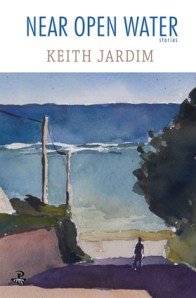
33. Near Open Water by Keith Jardim

Published in 2011 by Peepal Tree Press.

Longlisted for the 2012 OCM Bocas Prize for Caribbean Literature.

You should never underestimate good short fiction, I thought, dragging the back of my hand across my stinging eyes. I had just read the first story, called “In The Atlantic Field” of Keith Jardim’s collection, and already, just like that, the serenity of my day had been stolen. I put the book down, took decisive steps away from it. I walked around the house, and when I returned to the book, it was with mild resentment (the good kind), mixed with greater parts curiosity and the salted wound of unscripted emotional response. I read on.

The twelve stories in Near Open Water invite our considerations (and yes, our tears, too) on loss and excess, each one set or linked closely to a vast body of water. In “In The Atlantic Field”, a young boy and his mother go for a longer-than-usual drive along the north coast road. Nicolas meets a beautiful young woman and learns both less, and more, than he wants to know in “The Marches of Blue.” “The Visitors” who come to Trevor’s father’s house are intent on finding something to satisfy their motivations. In “The White People Maid”, Cynthia meets a legendary figure after witnessing a gruesome pharmacy robbery. A man and a woman play with dangerous intimacies before a wild beast’s enclosure, in “In the Cage.” Complacent Gene and frustrated Anna travel to Georgetown by Essequibian boat in “A Landscape Far From Home.” “Caribbean Honeymoon” tells the story of quite a different couple on quite a different, crueller journey. Nello, the narrator of “Fire in the City”, muses on the directions his own life has taken. A man takes a drive whose destination seems both grim and unclear, in “Kanaima, Late Afternoon”. Roy and Fiona visit the zoo’s most regal occupant, learning more about its origins from an eccentric source in “The Jaguar”. “Night Rain” tells a seemingly-bare story of a man who visits a woman in bed. The collection concludes with its titular piece, “Near Open Water”, in which a journal is kept, a dream is had, and more than one frightful thing is embedded into a consciousness, for good (or not so good).

Perhaps some of these descriptions strike one as would blurry, indistinct landscape art, the sort that adorns dental waiting rooms. If there is vagueness in the detailing here, it is because detail can linger where you least expect it in Jardim’s work. Neither the reader nor the narrator can be guaranteed of any answers that will illuminate. In “The Marches of Blue”, after a string of seemingly-unconnected encounters with other islanders, Nicolas turns to his severe grandmother for the mapping-lines that will make sense of their stories, receiving further uncertainty for his pains. What she does share is coloured in with a kind of resigned, tranquil bitterness.

“His grandmother said: “The sweetness of the very young, to think that. But age dries up things in you, even poetry, like this damned island. Damned because everything that has ever happened here over the last five hundred years was never meant to happen, was a mistake, wrong. […] I’m an old woman now, and I don’t want to drag up the past. It’s too tiresome. I want to tend my garden and die in peace.”

With uncertain provenance, guided by ambitious and destructive historical sculptors, how can any path we reasonably take in Caribbean waters seem straightforward? In this way, the stories interrogate a time that perhaps has always been marred by fracture, split on more fault lines than lends comfort.

There is a certain savagery to unchecked human appetite, to the places it can lead. In these stories, personal pleasures are pursued recklessly, consequence a distant island blurring out of focus. “Total madness” is the way Nello describes a club scene in “Fire in the City”, adding “like people only want to dance their life away. Not just the night, eh. Their whole fockin’ life. And to hell with the damn island.” Some characters are barely bemused by the curious, inelegant politics that govern survival. Roy explains to Fiona, when she presses him for a detail he is either unwilling or unable to provide, that “The rumours are there. This place is loaded with them. It’s a way of life here. How can people not make assumptions? It’s how the island amuses itself…”. For others, like the young writer in “Near Open Water”, the pursuit of a contemplative interior life, set against a vivid natural backdrop, can mask the fear of things committed towards violent ends, things guessed at and unknown. He tries to keep a journal against such thoughts, but a voice  both cautionary and seductive encroaches on his pages, with dire warnings that hint at his fate.

“This matter of fate, and the uneasy part of yourself – you leave it abruptly. No reflection whatever; you told me that’s dangerous, that’s what’s wrong with the world – the neglect of history, and of selves, even. And here you are, guilty of it, refusing to take your own advice. Or is it the melancholy the sea brings to most of us? […] It seems an act of destruction has begun…”

In spite of this questionable interpersonal canvas, the land and water offer, if not outright solutions, then a measure of solace, of feeling oneself linked to something other than a daily gamble with rigged odds. Jardim’s prose reveals the places we inhabit in stunning, achingly grateful ways. The young boy who frolicks on the north coast littoral in “In The Atlantic Field” experiences a suspended moment of raw glory.

“He’s in the haze, happy in the light. The wet rocks are dark and glinting. He throws the spear at them; it breaks in two and falls into the bright surf. Among the rocks there is one with a smooth, triangular slate surface angling at him. He finds a quartz-crystal stone and begins writing the words: I am the first person here.”

Unfettered love for the land and its non-bipedal citizens grants us access to people who cherish existence differently, operating off the grid in quirkily reassuring ways. The itinerant, multi-wristwatched Dr. Edric Traboulay, who favours Roy and Fiona with smatterings of his wit, vast knowledge and naturist’s sympathies, reminds us that the truest names for jaguars, even caged ones, aren’t the cutesy handles affixed to official signposts. The verdant thickets indigenous to islands; the mangrove’s mystery; the sea’s brutal, tender refrain: all are suggestions on how we might live, or alter our living. The dearth of characters like Traboulay suggests that we are immune, or too far removed, to hear or respond authentically.

This is the thing about painful literature: it hurts. Revelations in print rest uneasily, many of them because they are less revelations and more revolving doors smacking us in the face with more truth than we like. It makes reading Jardim essential, rewardingly thorny: here are vistas framed by separate seas, converging. For those willing to explore, there are reminders of beauty, even levity, in the muck: rambling zoologists; feisty domestic workers resisting kleptomanic labels; bliss, at finding the perfect north coast road to unmoor what remains of a distant, faintly shimmering life.

32. Archipelago by Monique Roffey

Published in 2012 by Simon & Schuster.

One day, Gavin Weald uproots himself from the staid, reassuringly placid existence he’s meted out for himself and his six year old daughter, Océan, and quite literally takes to the sea. Companioned by their loyal hound, Suzy, and enough furtively-acquired supplies to see them well out of Port of Spain waters, they set sail on Gavin’s old Danish boat, Romany, to visit the Venezuelan Los Roques archipelago. Gavin once frolicked there in his heyday, before the advent of his family, before the coming of the great brown flood waters that devastated his home and its now distressed, fragile occupants. Other Weald family members will not be making the trip with them. Each precarious marker of the voyage out is signalled by Gavin’s fear, his nauseous uncertainty over where the right path might lie. As he shepherds this most unlikely of crews across the startlingly blue seas for which his daughter is named, he is reminded that there is a shape to his oldest of dreams that he scarcely registers, one that the sea will send surging to the fore.

Overweight, beset by painful psoriasis and more than his fair share of daily nightmares, Gavin Weald resembles no archetypal moulds for an adventurer-hero. Before he sneaks Romany out of the TTSA harbour, the burden of his aging body weighs heavily on him, so disparate from the younger, fitter, carousing image of his youth. Soon after he and Océan slip the bonds of Trinidadian waters, though, Gavin feels that settled knowing of the sea stir in his bones.

“The sea makes him feel lonely and yet so very much himself; she makes him gather himself up, a self which has vanished some time ago into the element of air. Overnight, the fluid in his veins is catching up with the fluid and the rhythms of the sea; he feels like the sea appears, placid, powerful.”

For all of our protagonist’s uncertainty, his prevarications on both dry land and shifting water, the quiet splendour of Roffey’s characterization means that we want no other guide for our travels. Gavin is less overtly reassuring than he is persistently earnest, a sentiment that earns him further unwarranted harshness from life, yes, but also visits upon him moments of sublime grace, such as the raw pleasure of seeing Océan snorkel for the first time. Everyone, the author subtly reminds us with each sea-swell and map-charting, can face bold and complicated terrain. Peregrinations of discovery are not merely for the flat-chested or unflinching.

Islands are everywhere in this stunningly rendered novel, reminding or teaching us anew about our individual selves against their history-mired backdrops. The long arm of human injustice, greed and excess runs on no shorter a leash here, as Gavin, Océan and Suzy dock in multiple ports to discover. Beach-combing through the sea’s washed up treasures on one of the Los Roques islands, Gavin muses on the disturbing assortment of plastic debris and shattered coral, thinking, too, of how oil swallows up life around them, oil destroying nature. Father, daughter and dog confront the garish spectacle of cruise liners; the beguilingly pink slave huts at Bonaire; the uneasy history that built the Panama Canal, with equal parts wonderment, dread and curiosity. Nothing seems clear about human progress: it all glimmers, like the Sea Empress tourist ship, “grotesque and a spectacle in its own right.”

We’re taught in some of our earliest creative writing classes that one of the great bankable conflicts worth exploring in both fiction and non- is Man’s relationship, and struggle, with the environment. The novel mines this persistently (and not necessarily in the ways you’d expect, either), but it also reveals in both frustrating and gleeful detail what we learn about ourselves in the process. The sea cradles the real possibility of a different life for Gavin and his daughter, bound up in which is the re-scripting of their damaged intimacy. Water of one sort has the potential to heal, if not completely, then life-sustainingly, the rupture caused by water of another chaotic provenance.

“It feels like he and Océan have blended. They have softened in themselves and with each other; the sea has dissolved them, and they are suppler in their skin. They have been disappeared for weeks now, and they are sun-henna brown […] He didn’t expect to feel so lost in his own escape; a new space has opened up, an ocean.”

This wilful act of disappearance reminds or encourages the reader of what solace and redemption there might be in unmooring. If no-one is sympathetic to your plight, the sea will have you, but one cannot bargain with her for support or guidance. Gavin marks every leg of his journey with unlooked-for allegiances of varying intensity, with keen observations of the shifting natural landscapes around him. Reflecting on South America’s bloody history of invasion, torture and revolt, he muses that “Recovery takes time; it is the story of the still emerging Caribbean.” The land aches for the erasure of trauma, much as the individual does: Roffey stresses here that neither on regional nor personal fronts can rooted suffering be brushed away, not without investigation and the watchful calendar’s cycle.

Archipelago’s trajectory reminds the reader in both subtle and unapologetic flourishes that through our best-laid plans for Nature, Nature herself persists. The novel is replete with achingly beautiful descriptions of the world that frames these seafarers. Even in the midst of tantalizing doubt, of crippling loneliness, Gavin cannot but soak it in, the “skies… reflecting sea reflecting sky reflecting sea; this world is so electric in its shades of blue…”. Storm weather holds its own relentless magic, at once spellbinding and cautionary:

“That evening the sky pinks over. Grey and indigo clouds stay still in the sky like towering puffs of cream, like staircases made of foam. Forks of lightning appear miles away, silent delicate veins of gold, fizzing down from the clouds.”

The further Gavin, Océan and Suzy plot their course, the more they allow themselves to drift into the arbitrary shelter that Nature provides, learning in increments that the best harbours can turn hollow, learning, also, that there is refuge in unexpected places. This hard-won reassurance beats at the maritime heart of Archipelago: that the perilous journey, no matter how hurricane-beset, finds its own natural way of leading you back to yourself.

A marginally shorter version of this review first appeared in the Trinidad Guardian’s inaugural Sunday Arts Section on August 5th, 2012. You can view it here.

To read my impressions of Roffey’s novel prior to its launch, you can check out my Bocas 2012 coverage of her discussion with Rivka Galchen and Anita Sethi, here.

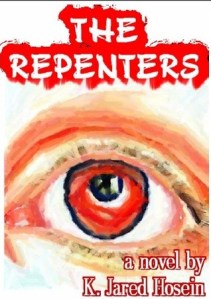
31. The Repenters by K. Jared Hosein

Published in 2011 by K. Jared Hosein.

“And then he walk up to me with a fake smile. I know the smile was fake. I am the man to know bout fake smiles. And I am the last to be offended by them.”

Joshua Sant is busy doing God’s work. This is what he’s been led to believe by the eerily charismatic Judah Weir, a foreigner to Trinidad with seemingly fathomless resources and a singular purpose: salvation. Weir is in the business of making sinners repent, no matter how bloodstained or brutal the path that leads towards a plea for forgiveness. He seeks out those with no necessary talents other than the eager capacity for violence, and the dogged mettle requisite for enforcing it. This is where Joshua comes in, finding the pattern of his previously nihilistic yet unremarkable life changed forever by Judah’s imperative. If this new, financially viable lifestyle is a conduit through which Joshua can keep close to Mouse – a woman who proved to be the saving grace of the former’s upbringing – then it is a path he will take without a flicker of hesitation. Even a semblance of intimacy with his cherished Mouse, Joshua decides, is worth far greater crimes than the ones he commits in Judah’s quarantined hilltop facility.

This novel is not for the faint of heart. Hosein acquaints us early on to what happens when we dredge closeted sins from the basement and make them play in the bright daylight. Is there nowhere we won’t go, I wondered, mid-reading, in this vivisection of the human psyche? You will think you have encountered some of the bleakest mappings-out of individual behaviour, (keep an unblinking eye out for the story of Emil Syrový) and then a previously-unseen corridor will shift into focus, holding enough contemplations to shake you out of your complacency. What keeps this from registering as hyperbolic or overwrought is that the lens through which we observe most of this depravity is Joshua himself. A creature of merciless, arbitrary circumstances, Joshua is so inured to violence that he’s able to calmly mull sentiments like, “Fire is really just another kinda knife” without missing a beat.

Joshua Sant is drawn with a meticulous hand, as are all of the writer’s characters. We understand that they have lived before we meet them in print here, that some will continue to live after the story has been concluded, while others will brush up against far more dubious fates. Whether we’re spending time with Joshua and his Blue Bayou CD, Mouse and her suitcase of books, Sister Kitty and her insatiable penchant for people-pleasing, Hosein turns them all to the light of our scrutiny. Major and minor players alike are primed for our illumination, horror and bleak humour. We believe their best intentions as much as we doubt their worst.

Perhaps you get a headache when your straight highway through fiction takes an unexpected detour. If so, you should probably skip The Repenters, which is a stream of consciousness ramble/rant/pleasure-pain-cruise through one man’s patchwork interpretation of his past, present and days yet to come. Joshua’s coherency is often in dispute, and it is in fact his jagged internalizations that share the most of himself. Witness, for instance, how he unfurls, after visiting some stake-related remodelling on an snarling predator:

“… a bowl of grapes appear before me i take one and eat it. i eat the grapes then the grapes eat me. the grapes feed away on my insides and what a lovely symbiosis it is turning out to be

i think bout waking up

i think bout people waking up and praying to god and kneel before their ten dollar calendars with dead jesus on it or putting the milk or flowers or whatever on the lingums outside. scrubbing up leftovers of ash and feelin so grateful for the day

always secretly wished i could wake up and know what it like to be grateful to wake up

and know how grateful i should be feelin for even bein able to feel grateful for wakin up

i have to be drunk yes”

If you think this is spectacularly weird, then truly you’ve seen nothing. I began the novel with a confident blueprint for continuity and procedure, yet I found myself repinning time-space markers, backtracking to check events and the minutiae that defined them. Eventually, I let go, and let the experience happen to me, which I found to be eminently more satisfying, because of the non-linearity. Hosein neither breaks nor bends any rules of storytelling lightly. Indeed, his attitudes towards storytelling define something I vastly enjoyed in the narrative’s premise.

Books have the power to change your life. It hardly seems like a lesson I’d need to stress, but stories don’t always lend themselves to examining this in voluble and plot-related ways, so it’s a treasure to find it reinforced here. The way that Mouse describes the active art of reading to Joshua, during their first meeting, stands out as rather tender testimony in a work where so much is characterized by moral bankruptcy, greed and savagery. She assures him that, yes, books can take you everywhere, and against the proof of a cloistered, grey existence, the boy believes her. The result is a protagonist who contemplates Exupéry’s The Little Prince as a metaphor for ultimate escape, who regards Judah Weir as a live-action Man-Man from Naipaul’s Miguel Street. There may not be immediate solace to be derived in a life informed by literature, not if Joshua’s daily rigours are to be trusted. Still, reading offers the only consolation we can cling to, sometimes — the assurance that other beings in other places have suffered as much, or worse, than we; that all pain and all joy is relative on a vast, written sliding scale.

Can we ever stop paying for what, and whom, we’ve done wrong? Who gets to mitigate our sins, and who decides how our ethical compasses are calibrated? Is there redemption in repentance? The Repenters asks some of the hardest questions that fiction can put to us, and returns a bloodied basket of answers for us to pick from — and yes, the answers make sense in one light, but they cut at your palms in another. This is the work of the grittiest and most uncompromising storytelling, it seems: not merely to hold the mirror up to what we are, but to peer down the rabbit hole of all we might become, given provocation, misery, and a limitless credit card. By turns both chilling and comedic, Hosein’s novel presses us to take heed of whom we ask for forgiveness. They may or may not be listening.

You can download The Repenters for free, with the author’s permission, here. You can access a frequently updated list of Hosein’s other projects, and contact information, here.

K. Jared Hosein (1986 -…) has been working on his prose and poetry since his early teenage years. In 2009, he penned a poem entitled “The Wait is So, So Long” that would go on to be adapted as a short film that would be featured and win a Gold Key Award at the NY-based Scholastic Art & Writing Awards. He frequently writes to the local newspapers but those pieces are only of political and sociological nature. Although he is currently employed as a Biology and Physics secondary school teacher, he writes fiction frequently to have a significant body of work, to build discipline and to create his own voice and style in the world of West Indian literature.

A free electronic copy of this novel was provided by K. Jared Hosein for review. The opinions expressed in this review are entirely my own, and are not influenced by his generous gift of gratuitous literature.

Author portrait by Portia Subran.