36. Redemption in Indigo by Karen Lord

Published in 2010 by Small Beer Press.

Winner of the 2010 Carl Brandon Parallax Award.

Winner of the 2008 Frank Collymore Literary Award.

Longlisted for the 2011 OCM Bocas Prize for Caribbean Literature.

“It is not the known danger that we most fear, the shark that patrols the bay, the lion that rules the savannah. It is the betrayal of what we trust and hold close to our hearts that is our undoing: the captain who staves in the boat, the king who sells his subjects into slavery, the child who murders the parent.”

Paama has fled the gluttonous suffocations of wedded life with her husband, the incessant eater, Ansige. Retreating to her family village of Makhenda, where “a stranger was anyone who could not claim relation to four generations’ worth of bones in the local churchyard,” Paama takes refuge in the comforts of this homestead, turning towards the preparation of sumptuous meals, for which skill she has become deservedly renowned. Her newly-earned equanimity is shattered, however, when Ansige waddles into Makhenda, eager to win back his wife, wreaking havoc on village mascots, corn crops and mortar grinders in the process. In her resolution to sever ties with Ansige, Paama receives an unsolicited gift from the djombi, immortals who observe and often intermingle their stories in the lives of men. Wielder of this present, the Chaos Stick, Paama struggles with the full implications of its power: that of exerting balance amidst the world’s discordancies. She cannot see the indigo-hued djombi who lurks, cloaked in shadow and resentment, intent on reclaiming the sceptre of Chaos, complete with all the power he believes stolen from him.

This remarkable first novel comes with a guide: a wryly humorous, tender-tongued omniscient narrator whose presence in the story is unshakeable. It is through this voice that the reader is ushered in and out of scenes, as if being whispered to gently between the set-changes of a play. Frequently, we are invited to set our minds to the task of furnishing details for the settings invoked by the writer. For instance, in the chapter that introduces us to the indigo lord, the narrator has us conjure the image of a many-pillared hall, studded by striking details yet still surprisingly open to the finishing touches of readerly interpretation.

“Beyond the pillars are more pillars, presumably supporting more roof structures, a whole fleet of upturned boats to the right and to the left of this main enclosure. If there are walls, I cannot see them to give you any report of them. It is supposed to be majestic, the hall of a high lord. Instead, it is empty, sterile and cold, speaking not of present pomp, but of ultimate futility. It proclaims that all is vanity.

There is a throne. The throne is unoccupied.”

If the forays into sideline commentary of this sage speaker ever veer into too-muchness, they prompt less eye-rolling than one might expect. Instead, the method of framing Paama’s revelations is cannily done, leveraged with the wit and perspicacity of the bard-minstrel to whom we listen. This renders the experience of Redemption in Indigo as akin to a courtyard’s fireside rambling, not a structured bookshop discourse.

The characters of Lord’s novel, protagonists and background figures alike, are coloured in with unfaltering precision, with a craftswoman’s devotion and constancy. No hero is devoid of at least one persistent foible; no villain languishes in the abyss of utter depravity. This fullness of fleshing-out applies not merely to the book’s mortals, either: djombi resemble in intention the capricious, world-weary Greek and Roman gods, though they do not seek out their mannerisms, nor the particularities of their origin stories. One of the narrative’s most endearing passages sees the Sisters of a certain arcane House describing Paama’s attributes to a young man assigned the perilous task of tracing her whereabouts. They speak of her courage, compassion, discretion and integrity, adding, too, that “she has the most beautiful dreams”, but are frankly nonplussed when taxed for Paama’s physical appearance. The hint is subtle, yet well-taken: in some sects, at least, impressions of personality weigh most favourably…perhaps they will continue to do so.

A slender fictive work, Redemption in Indigo is told in an even, neatly-trimmed pace, with no chapter likely to be accused of unnecessary padding. Though a minor marvel of economic exuberance, one rather longs for those extra chapters, especially in those scenes where Paama’s journeys scatter her footsteps across the globe, as she tries to parse the complexities of meaning that the Chaos Stick affords. Concepts of chaos and calm are not, however, subject to short shrift; it is to Lord’s credit that she navigates considerations of anarchy and splendour in a shorter novel. Longer creative works often suffer because of their refried bombastic exposition; it is a rare feat to prompt the desire for a story to be cushioned instead of clipped.

Such is the writer’s moulding and mapping of this other-world (that hints at other worlds within and around its terrain, too) that what dissatisfies us for its brevity may be imagined-in, with generous amplitude. It is this vastness of scope and significance, housed in so unassuming a structure, that gives the most pleasurable pause to the pages of Redemption in Indigo. When converging folklores find their waypoint, stories like these are the result: sensitive, personage-driven tellings of arachnid tricksters, divining rods, of the sanctity of sisterhood and the astonishing gifts that may be given to a woman who confronts the unpredictable force that is Chaos itself.

This review is proud to be part of Aarti’s A More Diverse Universe Reading Tour, a truly exciting event that seeks to showcase the broad spectrum of talent in speculative fiction written by authors of colour. A thrilling assortment of novels, short fiction collections and anthologies have been read and reviewed; for the full list of participants, visit the schedule post on Aarti’s book review site, BookLust. 

35. Is Just a Movie by Earl Lovelace

Published in 2011 by Faber & Faber.

Winner of the 2012 OCM Bocas Prize for Caribbean Literature.

On the islands named Trinidad and Tobago, it is the 1970s, and the Black Power uprising has come and gone. The men who led it with courage and determination have seen their dreams of social change shattered, their purpose suddenly uncertain. Among these former revolutionaries is KingKala, a poet-kaisonian returning from detention to find that his former comrades-in-arms have either fled or adapted strange new personas. KingKala is joined in bemusement by Sonnyboy Apparicio, a fellow songster and man of action who no longer knows in which direction his fortune, to say nothing of his responsibility, might lie. When the chance to perform roles in a promising foreign film emerges, KingKala and Sonnyboy leap at the opportunity, only to learn that the parts in which they have been cast, that of exotic tribesmen, are to be short-lived. Faced with this dilemma – of whether to die the complacent on-stage deaths they have been assigned, or to challenge this assumption – the two men begin to grow closer. Their camaraderie sets one of the multiple backdrops for the events in Earl Lovelace’s Is Just a Movie, a novel of myriad contemplations on life, love, and the issue of identities on a personal and national scale.

Winner of the 2012 OCM Bocas Prize for Caribbean Literature, Is Just a Movie is Lovelace’s first published novel in over a decade. A work marked by much anticipation, it is told in that signature style of an ease in storytelling, of a writer’s tongue primed in the rich awareness of local landscape and local concerns. The characters who populate this novel strike the reader as people known throughout a lifetime, their stories, dreams and grievances akin to those overheard at the market, the mosque, in Woodford Square or on the streets during Carnival Tuesday mas. KingKala, self-avowed “maker of confusion, recorder of gossip, destroyer of reputations, revealer of secrets”, does not so much preside over the happenings in the fictional village of Cascadu as he observes them, sometimes in silence, sometimes chiming in, but always vigilant.

It is Sonnyboy who more often claims the focal role; in his frequent forays into different jobs and titles, he is a portrait of a nation’s expectancy; he channels the frustration of his unrealized dreams, along with his ever-persisting desire to be seen in his community not as a badjohn, but as someone more: as a man capable of rising above the weight of old, unwise decisions.

Perched on the shoulder of the narrator, KingKala, the reader can expect to shift seamlessly through decades, major occurrences, seasons of both nature and politics. The Prime Minister who rules both uneasily and assuredly over the nation is seen at one instance in the heyday of his governance; in a later scene, he appears to still be in power, far past his expected due. The everyday grit of ordinary circumstance is pitted against the suggestion of otherworldly happenings. This subtle marriage of the literal and the fantastical is woven together with an unblinking skill; it convinces utterly, making no digression seem unnecessary, no tall tale excessive. It feels perfectly natural for villagers to be playing cards in one chapter, then lining up to officially sell their Dreams for money in another. Ancient historical figures are invited to celebrate the nation’s successes; prime ministers declare their intentions to live forever; miracles remain within the realm of hope. A multitude of voices accompany single encounters, acting as a reminder that there are a whole host of ways in which reality can be perceived. Not every story needs to be told within rigid lines; Is Just a Movie benefits from the intricate tapestry of its structure, presenting a reading adventure as ornate as it is serenely guided.

The narrative never focuses doggedly on Sonnyboy alone, allowing the stories of the other inhabitants of Cascadu to be told in vivid, enduring detail, with equal measures of humour and sobriety. Through Sonnyboy’s experiences are filtered the hopes and dreams of unforgettable figures: of Franklyn, whose unmatched prowess at batting causes an entire village to creak to a standstill; of the beautiful Dorlene, whose near-mishap with a falling coconut prompts her to literally turn her life around. Daily events shape the fabric of everyday communal life, ranging from the commonplace to the fantastic: the swift decline of corner shops, the disaster of a flambeau-lit political party’s campaign, the unexpected miracle accompanying a funeral.

Told in language that soothes and thrills, Is Just a Movie is a novel replete with symbols by which Trinbagonians can map their multiple places in history. When Sonnyboy hears the sound of steelpan for the first time, “the notes flying out like flocks of birds…like a sprinkling of shillings thrown in the air, like a choir of infants reciting a prayer,” he is attuned to a timeless magic. Not every revelation is meant to be comforting, however – as a Laventille shopkeeper grimly comments, “What was performance in Carnival is now the reality of life. The devil is no longer in the make-believe of Carnival; he is right here on our streets. The Midnight Robber is not a character in our fiction, he is in possession of real guns.”

In this most recent offering from a master literary craftsman, the abiding messages of resistance, and of the pride one earns from self-recognition, illuminate every page. It is writing that unhurriedly allows us to see ourselves as we are, blemishes and beauty marks alike, and to grow in the power of that incredible knowledge.

This review first appeared, in its entirety, in the Trinidad Guardian‘s Sunday Arts Section on September 2nd, 2012. You can view it here.

This book, and 11 more, are part of my official reading list (which can be found in my sign-up post here) for the 2011 Caribbean Writers Challenge.

The three books of my 26th birthday.

I turned twenty-six on August 18th. Part of these celebrations involved the merry claiming of Novel Niche’s very own, spiffy domain! That’s right… instead of holding to that handy ‘dot wordpress dot com’ suffix, I took the plunge, and now Novel Niche lives at ‘dot net dot com’. Apart from the ability to fit the blog’s name more handily and elegantly upon business cards, and the thrill of its triple alliteration, nothing else has changed. I haven’t gone corporate, I’ve just… embraced the delights of a new address.

I cannot recall a single birthday where my mother hasn’t gifted me a book, or several. This year it was one, and I am glad it came unaccompanied. There’s something to be said for the single title in your hands, the way it demands your attention, especially if it’s worthy. My mother never gifts me books that won’t, sooner or later, inhabit precious space in my interior weather.

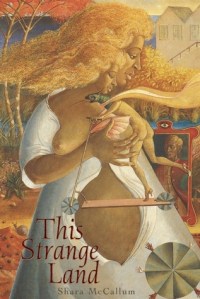
Library Journal describes This Strange Land, (Alice James Books, 2011) the third full-length poetry collection of Jamaican poet Shara McCallum, as “poems of ruin and rebirth, … a marvellous collection filled with a lovely and evocative music.” Even more entrancing than this is fellow Jamaican writer Lorna Goodison’s assessment:
“Jean Rhys could be the presiding spirit of this moving collection, which mines deep veins of loss and displacement. The personal and the political converge in new ways in these finely crafted poems, and readers should be prepared for unexpected turns and genuine surprises.”

A collection governed by that particular Jean Rhys-ian sentiment and spirit will win me over, I know, in ways I may find difficult to articulate, in the aftermath of my experiences with the work. I wasn’t exaggerating when I called Wide Sargasso Sea my Everything Book, back when I recommended six Caribbean novels for summer/long vacation/life reading. I am just as eager to discover just how Rhys “presides”, as Goodison suggests, in these poems, as I am to find out how McCallum speaks, hearing the shape and weight of her poetic concerns as articulated in her own voice. (The collection is beautifully accompanied by a CD of the poet reading several of her pieces.)

I’ve been lucky enough to hear Shara McCallum read her work before, at a 2012 Bocas reading with Guyanese poet, Fred D’AguiarThis Strange Land was longlisted for the 2012 OCM Bocas Prize for Caribbean Literature. When I heard McCallum read, I knew I would need to acquire her work, vitally and through urgent means, so it made the best kind of sense to be surprised with it on my birthday, by my mother. That language of essential, literary knowingness, can be so tenuous, so impossible to script convincingly between two souls. I am infinitely lucky to have that with my mum.

My uncle and I have this tradition: no matter how busy our lives get, he takes me book-shopping on my birthdays. Last year, he bought me The Amazing Absorbing Boy by Rabindranath Maharaj (at whose 2012 Bocas reading I was present, and on which I shared my thoughts), and Turkish writer Elif Shafak’s The Forty Rules of Love. This year, I chose two titles firmly rooted in Caribbean terra firma.

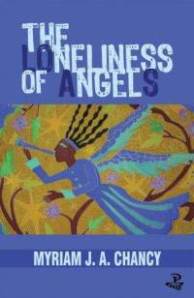
Haitian writer Myriam J. A. Chancy’s The Loneliness of Angels (Peepal Tree Press, 2010) was longlisted for the 2011 OCM Bocas Prize for Caribbean Literature, and is hailed on the Bocas blog as “steeped in Haitian history, charting human connections across gulfs of time and space.” Told from multiple narrative voices, spanning generations, borders, languages and communities, the novel hints, even from its blurb, at a transformation (or else a confirmation) of how Haiti is perceived. It feels that it will be a necessary read, if not an easy one. Spiritual matters are said to bind the novel’s numerous threads, and I am, I confess, almost singularly concerned in seeing how this is borne out.

Chancy read from The Loneliness of Angels at this year’s Bocas festival, too, but with the program as delightfully stuffed as it was, I couldn’t make it. When next she reads here, I will endeavour to be in attendance, my well-read copy in hand.

Another writer whose Bocas reading I missed was that of Indian author Rahul Bhattacharya. His novel, The Sly Company of People Who Care, (Farrar, Strauss and Giroux, 2011) was the winner of this year’s Royal Society of Literature Ondaatje Prize, and generated quite a bit of buzz at Bocas, too. It is annoying to consider that Kirkus Reviews touts the book as “occasionally rippling with pidgin English and yet always sparkling with literary insights”, as though the presence of the former could automatically be thought of as a detractor to the latter. Kirkus goes on to say that the narrative is set “within the landscape of a forgotten corner of South America…an exotic locale”, compounding my issues with its nonetheless glowing write-up. I’m much happier quoting the dust jacket’s other critic, Sam Lipsyte:

“What a voice, what a startling, funny, charming, provocative voice! Rahul Bhattacharya’s narrator is a true wanderer and a gifted poet of description. The journey he takes us on, through Guyana, through histories and selves, is a wonder.”

Perhaps the reality of having grown up/continuing to grow up in a former colony, of inhabiting a place that others feel comfortable breezily grouping as “oh, the islands“, perhaps that has led me to think of “exotic” as pejorative rather than laudatory. No islands are created equal; there is nothing in Trinidadian history that ought compel one to think it is synonymous with Guyanese history, a reality that writers like Bhattacharya doubtless know. I love reading novels about Guyana, not because it is an exotic place, but because the novels are about Guyana. That an Indian native has written what’s been called the quintessential Guyanese novel is not a deterrent. It hints to the possibility of more access to seeing, and to the abundant richness of discovery — both of which can lead to the finest writing.

I’d meant to close this post with thoughts on the book I ordered for myself, in recognition of twenty-six bibliophilic years. I’ve wanted it for so long, and been quietly enthralled with its writer for even longer. I will speak of it, and her, another time, when my order is delivered, and I’m holding that much-anticipated volume in my grateful, hungry hands.

34. The Twelve-Foot Neon Woman by Loretta Collins Klobah

Published in 2011 by Peepal Tree Press.

Winner of the Poetry Category Prize, OCM Bocas 2012.

Shortlisted for the overall OCM Bocas Prize for Caribbean Literature 2012.

Shortlisted for the Felix Dennis Prize for Best First Collection, 2012.

We lead complex, beautiful, many-dimensioned relationships with the Caribbean islands we inhabit. They require different masks, evolving responses to unpredictable seasons: whether we luxuriate in the heated thrust of Carnival, or mourn our murderous headlines, we, people of these particular islands, contain multitudes. This is one of the many gracefully-articulated messages woven into the fabric of Loretta Collins Klobah’s poems. At their forefront gleams the titular persona, the twelve foot neon woman, a resistance heroine, a glorious Madonna for the 21st century. She resonates with passion as much as she snarls in discontent, this unabashed Puertorriqueña, and in so doing she provides both anchor and platform for Klobah’s wondrously sung pieces.

Indeed, it is singing that comes first to mind as one allows this collection to simmer in the blood, registering the finely-wrought heat of its movements, the attention paid to dance and the rhythms many claim as indigenous to our shared shorelines. In “The BBC Does Bomba”, barrio children set themselves free to the persistent, encouraging tattoos pounded out on Modesto Cepeda’s barrel-drum, becoming receptacles of kinetic splendour.

“Girls raise the ruffled circle-skirt
to salute the drum, flick wrists
con fuerza until the butterfly skirts snap
por la derecha, por la izquierda,
the flower-print cotton
faldas swinging like machetes
over the harvest.”

Wrapped up in the flowing undulations of dances like these, the poet reminds us, are examinations that pierce, conducted by both foreign and local eyes. The question of perceptions, of how Puerto Rico and the wider Caribbean sees itself, how we are seen by others, runs through several of the poems, keenly felt in pieces such as “Googling the Caribbean Suburbs”. Here, the narrator conducts a search that zooms in on satellite images of her home from space, the rows of houses making up, in impersonal relief, the neighbourhood whose inhabitants she knows intimately, having shared her life in close communion with their own. “Google Earth makes us out as small, blurred spaces,” the penultimate line of the poem reports, closing with, “That’s how we look, from out there.”

Embedded in this discussion of how we see ourselves are uncompromising, angry refrains against the criminal violence exploding through Puerto Rican and all Caribbean streets. Klobah’s voice rings out against the censorship of police brutality, gang warfare, injustices against children. These poems do the opposite of presenting a unified touristic front: they impel in language that abjures the severity of academia for the warmth of the pueblo, for the anxious concerns of living, working, struggling Caribbean people. “We have created a new world where the indiscriminate gun is always at our backs,” laments the narrator, in “El Velorio, The Wake (1893)”, a poem that paints in vivid and excruciating detail the preparations for the funeral of a child killed by a stray bullet.  Unforgettable images of sorrow in the wake of destruction accompany many of these examinings, in the shape of a halo of flies around a child’s head; of corpses that “lie in little beds of straw in the war zones”; of five young bodies tumbling off a fortress wall, “their surprised appendages flailing like starfish legs, turning like pinwheels.”

At the epicentre of all this, the soul’s purely decadent delight with its own rhythms is allowed to unfurl. Poems like “The First Day of Hurricane Season” possess this self-ownership without apology or shame, as its narrator, a woman in the full glow of her maturity, savours the taste of her life as it is now.

“I brew fresh ginger tea with coarse brown cane sugar,
cut a papaya, and watch the sun bead its juices.
No one ever taught me to expect that a phase of life
spent without a lover could be as happy, simple, and rich
as this.”

There is a way, too, that Nature reaches out to graze its fingertips against the wetness of human experience in the poet’s verse. The veil between what we fabricate for convenience, and what the land offers us for survival: this seems thinnest and most porous in pieces such as “Night Wash”, wherein a woman, post-washtub-rinsing, hears night beckoning her. “When one frog sings alone,” she listens, “it sounds like someone weeping, or hiccuping after the kind of hot-eyed, bottomless weeping that I have not had for a very long time.” Even amidst the uncertainty of violence, about which nothing is definite other than its eventuality, these poems are sheathed in sylvan hope. They can show you the way back to your own open heart,  gently, with the grace of forests, bamboo cathedrals, singing frogs.

If we run the risk of becoming inured to daily senselessness, then Klobah’s poems pull us back from the brink of ennui, reminding us what fiery solace can live in raised arms of protest. There is a balance here of old worlds meeting new, of the slavery barracks colliding with street art, of our ancestors melding into the patterns of fierce pop and rap songs.

The twelve-foot woman herself, she who can claim many names in daylight or in darkness, holds this cultural syncretism proudly in the cradle of her belly. In the lushly-titled “The Twelve-Foot Neon Woman on Top of María’s Exotik Pleasure Palace Speaks of Papayas, Hurricanes, and Wakes”, she sways in her hard-won confidence. She has wrestled her autonomy from the clutches of slave owners and abusive lovers, from history’s cruelties and a nation’s difficult congress with itself. She channels “Oya, orisha of whirlwinds and cemeteries”, making no apologies for her pain, no reparations for her sweet, Boricua music, intent on “writing my son and daughter all my love songs,” a woman warrioress we both need and recognize triumphantly.

A marginally shorter version of this review first appeared in the Trinidad Guardian‘s Sunday Arts Section on August 19th, 2012. You can view it here.

Andre Bagoo interviews Loretta Collins Klobah in the September/October issue of Caribbean Beat, here.