

Justin is a good boy. He minds his little sister, Lichelle, when their mother teeters off the edge of responsibility, when her presence at either the dinner table or the ironing board is conspicuously absent after a night of unspecified work. It is Justin who fastidiously readies Lichelle for school, Justin who hands over twenty of his own dollars for a textbook she needs, a textbook she will be physically punished for not having. Brother and sister pass by the enterprising young Pedro on their way to school, Pedro’s faithful, mange-riddled pothound Mackie trailing in their wake. Pedro, with his dapper threads and ready supply of crisp notes, is well disposed to treat Justin kindly: it is thanks to Pedro that Justin wears a pair of spotless Clarks to school. After classes, Justin goes to check Pedro at the latter’s request. While liming beneath a mango tree, Justin accidentally dislodges Pedro’s gun from its concealment cubby. The gun in Justin’s hands is dense, a previously unknowable entity coming to life in his hands, a thing of great promise and dread.
Allen-Agostini’s biting use of urban Trinidadian vernacular reads like a welcome two-fingered salute against the edicts of writing dialogue by conventional, powdery-wigged standards. The narrative is arguably at its strongest when it issues directly from the mouths of Pedro, Lichelle and Justin, as well as the story’s more peripheral characters: the overbearing schoolteacher haranguing Justin over his tardiness; the elaborately coiffured receptionist who somehow manages to conjecture that Justin has been late six days in a five-day schoolweek. What the characters say becomes entrenched in the manner in which they say it, and the writer is good at fuelling the exchanges of direct speech with just enough spatial context to sell us the scene convincingly, while steering away from an expository paint-by-numbers approach. Witness, for instance, Pedro’s gentle admonition towards his less fiscally endowed friend, when the latter refuses the chance of an evening toke.
“If is money you ain’t have, you know that is not a problem, faddah.” Pedro slipped the bag backing into his pocket and flicked away a seed from the handful of weed he had been cleaning as he leaned against the mango tree. “You know you’s my boy. Ent we play pitch together? Ent I give you them Clarks you does wear to school? A ten dollars ain’t nothing, faddah.”
Pedro’s mannerisms reveal his practiced swagger, his fingers dismissing the seed a tiny testament to previously-acquired proficiency with handling the marijuana. One gets the impression that ten dollars may be ‘nothing’, perhaps, but that all manner of transactions between the two, those which attest to Pedro’s magnanimity — whether over a ten dollar spliff or a pair of shoes worth hundreds — will be catalogued, mentally recorded and set down in an invisible ledger of accounts. As the story’s suggestive antagonist, Pedro is a formidable piece of characterization: affable, kitted out in the respectable accoutrements of his profession, young, far from unintelligent, and deadly.
Yet the treatment of villainy in Allen-Agostini’s story is far less simplistic than holding up one streetwise little boy for vilification. A single juvenile weed-peddler may do well for a less involved treatment of the roots of urban domestic decay, but not here: here, the finger-pointing can justifiably waggle in multiple directions. For all that she is conspicuously absent in the story, Justin and Lichelle’s mother’s weighty shadow dominates the children’s familial disarray. Nothing is even remotely intimated of the pair’s father. What we absorb of the mother is revealed through her off-stage actions: the sounds of her slapping her daughter, the sight of a sequined bra sticking out of an overflowing clothes barrel, the silence that Justin uses in response to “Eh heh? And where your mother was?”
As with the best writing that knows how to cleverly conceal its bruise-making declarations, “The Gun” is good at knocking you where you least expect it. Consider the markers of measurement used by Justin to gauge the gun’s weight.
“Hefting it in his hand, he thought it was about the weight of his sister’s bottle, which he still had to make her every night even though she was going on six. No, it was heavier than that. Maybe the weight of the pot he made her porridge in, a battered old iron pot with fat, round handles on either side. The gun’s barrel was smooth. He had never felt anything like it.”
Virtually every experience endured by the protagonist is filtered through his solicitude for his sister. He categorizes his interest in the death-delivering weapon through the objects he uses to help keep Lichelle alive. We want nothing more than to root for this solemn boy-adult, flung unceremoniously into the daily duties of a grown man. He is less of a cape-collared, stolidly-hewn hero against Trini lower class wars, and more someone who does what he must because no one else does, or can, or will, in a series of meticulous, stoic gestures that make him all the more heroic.
“The Gun” reminds the reader of the often-vacant desperateness of hope: we hope that Justin will continue going to school, even though his needs seem insufficiently and obliquely-met within those walls. We hope that he will not abandon his painstakingly pressed uniform to sidle alongside Pedro’s dubious, pistol-toting ranks of sequined shirts and solid blocks of ganja. We hope that even the most starved and runtish of common-breed puppies will survive to endure another uncertain day, and we wonder at the quality, consistency and base worth of hope as a precious, limited virtue.

You can read “The Gun” by Lisa Allen-Agostini here. (sx salon) Author photograph by Richard Acosta.
Story Sundays was created by Fat Books and Thin Women as a way to share appreciation and engage in discussion on the short fiction form, which often receives less attention than full-length works. All stories discussed are available to read free, online. Here’s Fat Books and Thin Women’s Story Sunday archive, and here’s mine.

 It’s December 1st, 1955. After a day of work at her seamstress’ job in Montgomery, Alabama, Rosa Parks boards a city bus from its hateful Coloureds entrance, and takes a seat in the vehicle’s neutral section, where both blacks and whites can sit. Looking forward to returning home and cooking her husband something special, Parks’ positive daydreaming is interrupted by the bus driver’s belligerent demands that she surrender her seat to a white passenger. As anyone with a smidgeon of knowledge on the African-American Civil Rights Movement will tell you, Rosa Parks refused – not with equal hostility, but with a calm, undaunted resolve that has etched her name into history books, monuments and national holidays. Giovanni’s faithful, poetic retelling of Parks’ story takes the reader onto that very bus, and beyond it, to the Montgomery Bus Boycott that her actions springboarded into life. It includes the nomination of Martin Luther King, Jr. as the official spokesperson for anti-segregation laws, sparking a nonviolent movement towards equality in the Constitution of the United States.
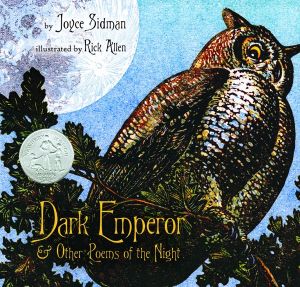 This collection begins with a nocturnally winsome invocation, “Welcome to the Night”, in which these dark hours are described with as much liveliness and imaginative engagement as any merry daylight revel:
 Novel Niche