My 2012 Bocas Lit Fest Diary: Bocas’ Eve

Last year, in April, at least an entire library of my bookish dreams became page-turning realities, when I attended, and blogged for, the 2011 Bocas Lit Fest. One of the best things about this year’s festival is that I have the chance to do it all over again.

Don’t misunderstand; even if I weren’t part of the merrily busy Bocas staff, I would be no less in love with this festival. I’d still be present at as many of the events as I could reasonably stuff into my day. I’d still leave home early in the morning, to return long past the sunset, weary, my mind still turning a thousand gears of creative hyperstimulation. I’d still be sitting on the amphitheatre steps of the Trinidad and Tobago National Library on the festival’s last day, thinking that the next Bocas can’t come too soon.

The fact that we’re celebrating a second Bocas should, I hope, put paid to the notion that an entire festival seeking to highlight the importance of books, reading and publishing is flighty, fanciful, or worse, non-sustainable. So much of what makes us of these islands has its genesis in a singular, inimitable style of storytelling. How can it be claimed that the honouring of Caribbean and Caribbean diaspora stories is unworthy of every effort we can make to keep sharing those tales?

I confess that one of the best curated memories I possess of last year’s Bocas was sitting outside the Old Fire Station, after a New Talent Showcase that featured the readings of an exciting voice in prose fiction, and a Cropper Foundation co-alumni, Alake Pilgrim. While speaking with her about her work, two schoolgirls strolled by, the trail end of their conversation within earshot.

Girl I: What it have going on here? Something was advertising in the papers, ent?

Girl II: I eh know, nah. I think might be some book thing, but I eh know. 

Perhaps it’s reactionary of me to be sad. I know that not everyone likes reading. Not every one thrills to the sight of writers they’ve only up until that point encountered in the pages of their favourite novels, their best-beloved poetry collections, their most fiercely defended non-fiction paperbacks. I’m not saying that the country should grind to a halt to take the Bocas Festival in… but it worries me that a basic awareness is lacking. It worries me that festivals like these, which seek, at their core, to be all-embracing, all-encompassing, generously ecumenical in outreach, instead often appear to be elitist, exclusive and esoteric fora wherein only red wine is sipped, where only Standard English is allowed. People… please, perish the thought.

I believe that, on Bocas’ Eve, if I want to transmit one message over all other messages about this celebration, it is this:

All are invited; all are welcome.

Let’s not be literary exclusivists at the 2012 NGC Bocas Lit Fest. Let’s be lovers of books. A full day of events kicks off bright and early at 9 am tomorrow. I hope to see you there, with your notepads/ novels for signing/ fresh enthusiasm in tow!

To learn more about the Bocas Lit Fest, visit the website, here.
For Thursday 26th April, 2012’s full schedule of events, visit here.

For Friday 27th April, 2012’s full schedule of events, visit here.
For Saturday, 28th April, 2012’s full schedule of events, visit here.
For Sunday, 29th April, 2012’s full schedule of events, visit here. 

Reading Ruminations: January to March 2012

Dear Novel Nichers,

Welcome to this, the first post of its kind, my introductory entry to a reading journal! I’ve been feeling for some time the desire to incorporate other aspects of book-loving to Novel Niche, to round out the palette of reading fare you can expect to encounter here. (This means that I’ll also be resuming the Charting Children’s Literature and Story Sunday features, soon, and with great enthusiasm.) I love the process of crafting a full-length review, but I reminded myself that there’s more to the bookish connection, and its sustenance, than an uninterrupted stream of those. I plan on sharing these reading retrospective rambles monthly, so since I’ve not done any for January and February, this month you get all three, sandwiched together! Without further ado…

January
Books Read: 5 

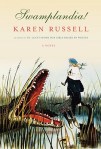
Ah, Swamplandia!… Karen Russell’s first novel and Novel Niche’s first full-length review of 2012. What an intriguing title with which to begin my reading year! From it, I was reminded of how much I adore ambitious moxy in storytelling, even when the results aren’t as pristine or polished as the clamouring critical crowd demands. I moved on from the Floridian bayou to the Middle Eastern markets and mosques of Distant View of a Minaret, by Alifa Rifaat, which I borrowed from the Tunapuna branch of my local library. Rifaat’s stories explored the ways in which traditionally devout Muslim women chafed against the yoke of what I recently described as “male hegemonic bastardry.” (Yes, I was a little emotively worked up, at the time.) These are important stories to have read, and I am glad I discovered them when I did. My reaction to them was complex and fragmented, which convinced me that this slim collection warrants a second reading before I review it.

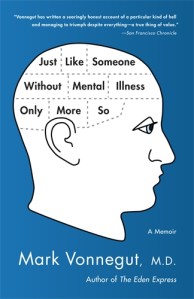
Readers, I have long had the suspicion, ever since reading (and rereading, and rereading some more) “What You Pawn I Will Redeem”, that Sherman Alexie is one of my special literary boyfriends. (Shh, he doesn’t know about it just yet.) His young adult title, The Absolutely True Diary of a Part-Time Indian, is one of the most essential reads of this year for me. It was harrowing and hilarious, jarring and jocund. I’m going to review this one, without a doubt. I also bought it, so in keeping with my 2012 bookish giveaway resolution, I’ll also be making a gift of it to someone. This time, it’ll be someone in particular, so stay tuned to find out who! Right on the heels of this read, I got intimately acquainted with the bloody, bruised slew of Fight Club references that have been sailing over my head for several years. This was my first Palahniuk (actually, it was Palahniuk’s first Palahniuk too, heh heh), and it’s only spurred me on to devour more of his work. The book was gritty, gorgeous and entirely too short, but more on that in a future review. I rounded January out with one of my Netgalley reads, the Mark Vonnegut memoir, Just Like Someone Without Mental Illness Only More Sobringing the full-length review tally for 2012 up to two, where it has stayed since. I never suspected I’d read a Mark Vonnegut before a Kurt, but that reaffirms my delight in the power of literary trajectories to surprise you.

February
Books Read: 2

This was a brief month for books; only two titles were read. I probably spent a lot more time planning which books I was going to read, and ended up reading… well, significantly less than I’d projected. I began the month with one of the titles my mother gave me for Christmas 2011, I Was Told There’d Be Cake, a collection of essays by smart, caustic-witted Sloane Crosley. A difficult read to place in my affections for a few reasons (which I’ll get into when I review it in full), but I found the book to be a chuckle-inducing stroll through humorous non-fiction, compared to the work of David Sedaris, but not quite at his altitude. The other book of February was the pictorial delight, Brian Selznick’s The Invention of Hugo Cabret. It’s one I have returned to several times since reading, to pore over, to marvel at the contagious poetry of Selznick’s story, a story distilled through words and images with equal ebullience. I think of it as indispensable reading for all dreamers, designers, engineers and film enthusiasts, as well as for all those who enjoy the sensation of adventuring through a book, delighting in the journey and all it uncovers.

March
Books Read: 5

March’s figures match January’s, with a total of five books being read. The first of these was the feisty, nigh unputdownable Zoo City by Lauren Beukes, which I also consider to be my first speculative fiction read of 2012. Swamplandia! possesses hints and glimmers of the supernatural here and there, but Zoo City is all-out, unapologetic spec. fic. at its finest—and wow, does it ever work. The second title of March is classified beneath a sub-genre of spec. fic. called “weird fiction”, which, I admit, I’d not encountered before. You know when people describe the book they’re reading with the cautious preface, “Well, um, it isn’t for everyone…”—that description is tailored to books like this, Shirley Jackson’s We Have Always Lived in the Castle. It’s rare for me to encounter a reading experience wherein most of the conclusions appear foregone, where you feel reasonably certain you won’t be surprised, to then brush up against goosebump-prickling passages, every other page. Weird fiction fans, and general admirers of non-orthodox tales, will, I think, agree that Jackson’s book is (literally) frightfully good.

My third read of March 2012 was a Netgalley-provided copy of Ready Player One by Ernest Cline, which in all likelihood will be the next book I review, given its prominence at the forefront of my thoughts. There is so much to say about this book. In my notes taken while reading, I remarked,

Tron meets The Karate Kid meets a World of Warcraft raid, meets… a LAN Party!”

It will, I promise, make sense in my review, but if you’re even remotely intrigued, and if you were born in and identify with the 80s, and if you are even fractionally a self-avowed nerd… you should really read this book. Now. Yes, right now. The book I read right after Ready Player One was Leonard Cohen’s Beautiful Losers, a melancholic, oft-scatological, searing, bewildering examination of human frailty and decay. What else would one expect from Leonard Cohen, after all? This is a difficult book to love, and it’s hard not to feel singed at the ways it wounds the sensibilities (by setting them on fire)—and wow, is this ever a Not for Everyone sort of book—but if it is for you, you won’t be able to deny it.

The last book of March, Jean Rhys’ Voyage in the Dark, made me think of Beautiful Losers often. I think it’s because of how mercilessly both works interrogate the most vulnerable, achingly secret selves we try to keep veiled, how they investigate the depths of individual excess and the terrible curse of unwished-for loneliness. This is the third book I’ve read by Jean Rhys, the woman who wrote my Everything Novel†. I think the reason that I’ve only read three of her books thus far is because I am saving them, hoarding them against the knowledge that the list of Rhys titles is distressingly finite. There won’t ever be any more. I am making what exists count, as counterintuitive as that seems. Perhaps where your Everything books are concerned, you’re allowed to be at least mildly irrational.

† For my thoughts on the concept of an Everything Book, read my post recommending six Caribbean novels.

Observations

♣ I have a horrifying substantial number of full reviews to draft, edit and post. The more I think about this, the more I realize that, for me, a review is as painstaking and delicate a process as crafting anything else I write. In many ways, it takes less out of me to write certain poems. Sometimes the verses just happen to me, if you take my meaning. Book reviews rarely ever just happen. They require mulling, deliberation, copious tea consumption, and care. I am always sensitive to the truth that when I review, I am handling someone else’s work, too. My review is the space where their work (the text) meets mine (the review). If we, the book blogging community, are ever going to escape the pernicious labelling cast on us  by other, ‘loftier’ literary critics, we need to work well. We need to be able to proudly and, at times, aggressively, defend our body of work against attack—and for that to happen with any conviction, quality (and an assurance in the quality of what we write) has to be present. I’d rather work well and slowly, than hyper-prolifically, with mediocrity.

♣ I’ve purposed to read more literary work from the Caribbean in April, largely in the spirit of celebrating the upcoming Bocas Literary Festival. At present, I’m reading two books side by side: Earl Lovelace’s Is Just A Movie and Michael Anthony’s The Year in San Fernando. Is Just a Movie has already won the fiction category for this year’s OCM Bocas Prize, and… even without having read the other contenders, even without having reached more than a quarter of the way through the book… I cannot be surprised. Lovelace’s prose is phenomenal. It makes the act of reading as immersive and natural as breathing. You forget that you’re holding a book in your hands. You are there, in the village of Cascadu in 1970s Trinidad, in the aftermath of the Black Power rebellion. You are there, listening to men hammer and coax the magic out of a steel pan; you are there, learning how to die excellently in the WhitePeople movies despite the urgings of directors who’ve come to film in foreign, exotic locales. Arundhati Roy (author of another Everything Book, The God of Small Things) said this about the book:

Is Just a Movie is not just a movie, it’s a poem, too.”

I cannot think but that she is entirely right, even if my estimation is premature. Maybe there are books you get the measure of, from the opening chapters, and if you are wrong about your first, blushing impressions, then the results can, and do, break your heart.

♣ Some questions for my dear Novel Nichers!

  •  Do you have a favourite read for the first quarter of 2012?
  • Perhaps some of you curate online reading journals—I would love to see them, of any and all descriptions.
  • How goes your April for reading, thus far? Are you loving/loathing what’s currently on your bookish bedside table?
  • Maybe you’ve read one/some/all of the books on my quarterly list… what are your thoughts on these titles? Do you eagerly agree or vociferously shun my own opinions? I’m hoping for a rousing literary debate in my near future!

Novel Niche Recommends: Six Caribbean Novels

Dominican writer, Jean Rhys.

As January drew to a close, I found myself in a delightful conversation with two dear intimates (be careful you didn’t read that as inmates), on “best of” book lists. The topic fire-starter was Project Gutenberg’s compilation of the Best Books Ever Listings. I scanned some of the listings, and while they all featured many prominent titles from around the globe, I grew disheartened, as often I do, by the lack of Caribbean literature presented there. Here’s exactly what I said in the conversation thread:

More lists to love! Ah, I wonder how many books from the Caribbean are on these? I am like a broken record, harping on that, but it’s been much on my mind of late. I shall just have to bolster the tradition of making lists of books from the islands, then! 😉

One of my friends had an exceptional suggestion… that I curate a list of six books from these islands for her summer reading. My other friend, who also lives in a climate where “summer” is less a cultural affectation and more of a sweltering reality, eagerly agreed that she’d be up for a Caribbean Book Challenge in the warm, sultry months.

Since I’ve been whinging to myself about reading more regional work, I decided to try a different tack with this list. I’m recommending three books I’ve already read, and adored, as well as three works I’ve not yet approached. (How does one recommend books one hasn’t yet read, you might ask? I’m recommending them on the strength of expectation I attach to them, based on the promise they show, not necessarily (or at all) on the accolades they’ve won.) My friends are both superlative, sensitive, wise readers, and I’m hoping they will come to this list with even a glimmer of the excitement I feel, in composing it.

Three Titles I’ve Not Yet Read

Is Just a Movie by Earl Lovelace (Trinidad)

One of the illustrious three titles on the OCM Bocas Prize shortlist, and the winner of the prize’s fiction category, Is Just a Movie is Earl Lovelace’s sixth novel. Any Caribbean literature devotee worth her… heh, well, worth her Salt (Lovelace’s fifth novel) will have encountered this prolific prose master’s publications. (Yes, compulsory secondary school readings of The Schoolmaster count, but they don’t make you an enthusiast!) I’ve only read two of Lovelace’s novels so far, and I heartily want to make this my third. In fact, this book was one of twelve Caribbean titles I challenged myself to read last year—thus far, I’ve read only three, proving that I’m addicted to making reading challenge lists, but that I need to work on that pesky follow-through. I’ve had the pleasure of hearing the author read from this book before its publication, and I was mesmerized… as was everyone present in the audience that day, if appearances were anything to go by. I look forward to encountering that scene again as I read, and smiling at the memories it evokes. The OCM Bocas judges described Is Just a Movie as “a tapestry of island history . . . steeped in place and full of beautifully realised characters.” I’m eager to explore it!

♦♦♦

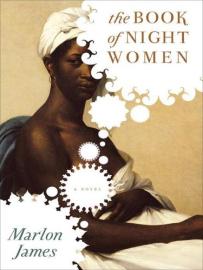
The Book of Night Women by Marlon James (Jamaica)

Superficially, a cover and title like these cannot help but catch the eye. James’ second novel caught mine when I first saw it, about two years ago, browsing through the shelves at Paper Based bookstore, one of the best repositories for regional lit. on this island. Kaiama L. Glover, in her review of the novel at The New York Times Sunday Book Review, likened the author’s writing to the work of Toni Morrison and Alice Walker—hefty endorsements, both. As Baker summarizes it, the plot of The Book of Night Women “takes us back to the cruel world of a Jamaican sugar plantation at the turn of the 19th century.” I’m extremely excited to see what James brings to the table of this old, sad discussion, which holds the potential for emotional liberation through harrowing catharsis in its very telling. This particular book has also been much on my mind since my book blogging colleague Amy reviewed it last year, as part of The Real Help reading initiative she co-founded.

♦♦♦

The Ghost of Memory by Wilson Harris (Guyana)

There are writers from these islands whose names I feel I’ve known all my life, whose books have lined the shelves of libraries close to my heart. The writers I’m thinking of specifically are those with whose works I feel I should be more familiar, because I want to be more familiar with them. Their names are, among others: Edgar Mittelholzer; Anthony Winkler; Jamaica Kincaid; Erna Brodber; Michael Anthony; George Lamming… and Wilson Harris is on that list, too. I am personally involved in an ongoing relationship with his mesmerizing, ensorcelling first novel The Palace of the Peacock. The thought of being unmoved by that particular literary journey is terrifying to me—you know, of being someone who “just didn’t get it.” This isn’t to say I hold a grudge against strictly linear readers (though I wonder how much fun they’re having), but suffice it to say that The Ghost of Memory would probably irritate, rather than enchant them. Stephen Howe’s review in The Independent informs me that this, Harris’ twenty-fifth novel, will also be his last. I read his first many years ago; I’ll read his last this year, and spend the rest of my life filling in the spaces of the other twenty-three.

Three Titles I’ve Read

Cereus Blooms at Night by Shani Mootoo (Trinidad)

This is Shani Mootoo’s first novel, and it remains my favourite work of hers. Nothing I’ve read by her hand in the past several years has come close to matching my emotional response to this seductive, sorrowing tale, set on the fictitious island of Lantanacamara, narrated by a gay male nurse, Tyler, as he grows close to his taciturn patient of many secrets, Mala Ramchandin. I don’t want to suggest that Mootoo’s subsequent novels and short fiction pieces (I’ve not yet had the pleasure of reading her poetry collection, The Predicament of Or) have taken a nosedive in quality—far from it. In fact, the unfairness is stacked on my end, since I’ve approached every Mootoo publication hunting down a similar sense of lush magic, of the beautiful urgency wherein lyrical language dances with an unforgettable story. As I remarked to one of the readers for whom I’m making this list, one of the primary reasons I need to reread Cereus Blooms at Night is to gauge how much of my adoration is based in nostalgia. Even if it turns out to be the lion’s share, I cannot think I would love it any less.

♦♦♦

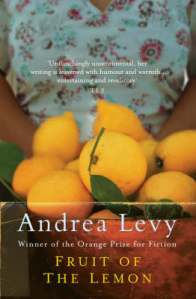
Fruit of the Lemon by Andrea Levy (Jamaica)

To put it simply, this is one of the better Caribbean reads I’ve encountered about finding yourself—about the realization that that process is rarely ever simple, that it comes studded with difficulties and detours one can’t possibly foresee. We might think we’ve got a decent benchmark on how far back the long arm of our history goes, but Levy’s protagonist in Fruit of the Lemon, Faith, learns that you can’t ever truly know until you take the journey. This was one of the three Caribbean titles from last year’s challenge that I did read, and I reviewed it here. Summoning this title to this list reminds me, too, of how much I want to read Small Island, the author’s penultimate novel to date, and one of the books I received in last year’s Yuletide Book Gifting.

♦♦♦

Wide Sargasso Sea by Jean Rhys (Dominica)

There are some books in life about which you will find it impossible to be impartial. When someone asks you how you feel about them, you will hear the word “Everything” fall out of your mouth, and you will, perhaps, be a little bit irritated when people ask you to elucidate. Everyone’s got an Everything book… and Wide Sargasso Sea is mine. In fact, it’s one of only two titles I am extremely reluctant to review on Novel Niche, because I think my thoughts would less resemble coherent reviews than they would desperate love letters scented with my fangirlish glee. I could never make a “reading the Caribbean” list without including this book. It is one of the first titles I read that sought to interrogate and respond to colonial perceptions of island identity. It’s immeasurably poetic while being rapier-sharp in its economy. It’s brutal, bold, visionary, shockingly sad and… well, you know. It’s everything.

Some post-listmaking musings:

♣ Picking six novels wasn’t intentional at first, but I decided to stick with it, so I’ll be making separate lists for my Caribbean picks in short fiction, poetry and non-fiction, too.

♣ It wasn’t intentional, either, that the three unread books are by male authors, and the three read ones are by women. Getting into my thoughts on gender roles in writing would take several posts, but in short, I try not to be reductive on either/in any spectrum of the equation.

♣ Most, if not all, of the writers I’ve referenced here have their points of identification and origin in lands additional to the ones I’ve listed. I have offered in brackets alongside their names, the islands with which they are chiefly aligned, with which they chiefly align themselves by birth, residence, inclination, and any and all such markers of prominence. (Now I want to do a completely separate blog post on the (inter)national naming of writers, of how they carve out their geographical footholds… *files away that thought dutifully*)

♣ If anyone else has got an Everything book they’d like to share, please do! I love knowing about which books fellow readers love (and hate) best.

♣ Do you plan on adding any or all of these six novels to your reading queue? It would be fantastic to hear how you get along with them!

 “The island had given me the world as a writer, had given me the themes that in the second half of the twentieth century had become important.”
— V.S. Naipaul

27. Just Like Someone Without Mental Illness Only More So by Mark Vonnegut

Published in 2010 by Delacorte Press.

“I’m getting better again, taking medication, doing my very best to be a good patient, but then out of the blue, the chain-link fence that surrounds the hospital pulls me toward it, wraps around me, and is going to crush me. […] At some point in there I try to tell my father that I’m feeling better, and he says that he wouldn’t nominate me as Mr. Mental Health quite yet. I want to ask him if he is in the running or just one of the judges.”

I’m fully prepared to be wrong here, but I suspect that high on the lists of why people gravitate towards reading memoir is because they anticipate a certain unflinchingness in articulation. They expect, oft-erroneously, that if a person’s got the testicular/cervical fortitude to put themselves out in the limelight, then, by gad, they’re going to write with moxy, with aplomb, with some brass! I’m pleased to report that Mark Vonnegut’s got all three. Even though I’ve not yet read anything by his famous father, I was hesitant, approaching this title. You know full well how the children of illustrious creatives often balk from the wide circles of fame their parents cast. If they do venture into productive waters of their own, they typically embody one of the following traits:

1. They offer work that is painfully, ludicrously derivative—but this is forgiveable, and less egregious than—
2. the fact that they just as easily feign ignorance of their parents’ existence, shunning the specific styles of their mothers and fathers.

Shunning is all well and good, but shunning for reasons that are petulantly emotive rather than deliberately stylistic—well, that smacks of danger, to me… the danger of potentially good art being obscured by the long, long arm of familial resentment. It’s important to note that Vonnegut doesn’t write with cloying sycophancy or feigned apathy about Kurt, when he writes of him. In this way, I suppose people who turn to Just Like Someone Without Mental Illness Only More So to glean more of Vonnegut Senior’s inner workings would be most put out. I respectfully posit that they’re looking in entirely the wrong place. This is Mark’s story, after all. Readers like myself, who’ve not had the benefit of reading his previous book, The Eden Express, will likely be relieved to know that this second offering stands heartily on its own—though, doubtless, if you enjoyed this one, as I did, you’ll want to seek out the first.

A wideness and generosity of range drives the scope of the memoir; it feels like we’re touching base with Vonnegut at various points on his life, that he’s chosen this approach in attempt to round and flesh out the narrative: to show the polyvalency of the paths he’s trod. In addition to sharing the trajectory (if not the specifics, but more on that anon) of his four psychotic breakdowns, the writer presents his childhood days, his memories of Kurt the non-writer (his pre-fame father was, to quote Mark, “the world’s worst car salesman who couldn’t get a job teaching English at Cape Cod Community College.”) We’re also treated to reflections on Mark’s seemingly circuitous path to entering medical school at the age of twenty-eight, glimpses into his family’s mental health (or lack thereof) history, his decision to specialize in paediatrics, humorous anecdotes gleaned from his stint of relief work in Honduras. The overall impression created is less linear than good-humouredly scattered, with the chapters anchored by the author’s own paintings.

What’s particularly illuminating about Vonnegut’s situation is that, as both mental patient and physician, he’s able to speak candidly and forthrightly about either side of the institutional coin. His perspectives on the profession, patient-doctor relationships and medical insurance are wise, modulated by experience rather than any desire of his to sell you something. The insights he proffers on what one might term “behind the scenes” goings-on in the world of health care might not be novel, but it’s refreshing to have them uttered by someone in his specific white coat. Here, he speaks about the nature and classification history of his ailment:

“I was diagnosed as suffering from schizophrenia. […] What I had and have is more consistent with what is now called bipolar disorder, which used to be called manic depression. The name change was an effort to get away from the stigma around the diagnosis of manic depression. Good luck. Until we come up with an unequivocal blood test or the equivalent, we’re all blowing smoke and don’t know if what we call schizophrenia and bipolar disorder are one disorder or a dozen.”

It’s especially gratifying to read Vonnegut’s less than flattering opinion of the corporate concerns that undercut the quality and consistency of aid given. In remarking on the shifting behaviours that govern patient-doctor discussion, he reminisces with gratitude on the open, wide-ranged talks he was able to have with his own psychiatrist when his Thorazine dosage was being reduced. In speculating on what that procedure would entail in a present-day setting, his tone is resolutely bald.

“Today, if I was lucky, I’d see a case supervisor monthly and maybe a psychopharmacology nurse every three months. Clinical guidelines would mandate that I be on antipsychotics for at least five years. The medication I was on would be determined by who paid for lunch and what deal was cut between my health insurer and the pharmaceutical industry.”

I didn’t get the impression that the author was trying to earn a battery of enemies in the medical insurance field. He’s not calling out the insurers, the pharmaceutical manufacturers, the impersonal practitioners, because he’s trying to curry favour with readers for his audacity. One senses that Mark Vonnegut’s just speaking his mind, that having lived through his psychotic episodes (which he refers to as “breaks”) made him less susceptible to tolerating perceived injustices: in short, that those very breaks helped build him into a more genuine, candour-driven self.

An anticlimactic area centres on the issue that there is little visceral untangling of the four psychotic breaks themselves. The writer doesn’t shy away from bringing them up, but we’re never allowed a full and inexorable assessment of those specifics. The autobiography opens with the general delineation of Mark’s symptoms: his inability to eat or sleep; the voices that plagued him; his tendency toward self-harm; his heavy sedation. I kept waiting, with bated breath, to be led further down the rabbit hole of an insider’s vivid description of bipolar disorder… but it felt like Mark kept me solidly, perhaps even safely, at the fringes. Maybe this is as much enlightenment as can be reasonably expected, and maybe this is just the way Mark experienced those breaks, too. Still, it’s difficult not to feel stranded on the shore of apprehension, hoping an illuminating wave of prose will sweep us into the churning emotional seas of a world populated by voices in your head. It never happens. Perhaps I ought to be grateful for that, rather than critical.

What will win readers to this artful autobiographical meandering is, ultimately, its ease of voice. The narrative is laden with quotable illuminations on the role of art in assuaging despair, on the combined weight-inspiration of laying claim to a famous father, on the ways in which interludes of madness can wreak havoc on your life and simultaneously transform it to your best advantage. All of these are shared in the writer’s personable, gently self-deprecating style. Just Like Someone Without Mental Illness Only More is a interior journey you can take with the signposts of a life that’s been, by turns, extraordinary and reassuringly simple. If you think of your autobiographical narrator as a companion and cohort in the reading experience, you’d be hard-pressed to find one more earnest and admirably principled than Mark Vonnegut.

A free electronic copy of this novel was provided by the Random House Publishing Group (Delacorte Press imprint) for review, through NetGalley. The opinions expressed in this review are entirely my own, and are not influenced by their generous gift of gratuitous literature.

26. Swamplandia! by Karen Russell

Published in 2011 by Vintage Books.

Longlisted for the Orange Prize for Fiction, 2011.

Ava Bigtree can’t help but feel like she’s floundering, rather than flourishing, in her deceased mother Hilola’s footsteps. Hilola was the feature attraction show-stopper at the Bigtree’s family-owned and operated alligator wrestling theme park, “Swamplandia!”, nestled on an island little more than an adventurer’s spit of a hundred acres, off the Floridian mainland. “Mainland” is a geographical state that the Bigtree children—Ava; her awkwardly academic brother Kiwi; her eerily disengaged sister Osceola—have come to both desire and decry. The swamp, the theatre of routine and spectacle, of sold-out crowds clamouring in the stands, the moods and movements of their alligator brood (each animal named Seth, to avoid ambiguity): this is the life to which they’ve been born. However, when Hilola Bigtree succumbs, mundanely and sadly, to cancer, “Swamplandia!” falls on hard times. First Kiwi, then the Chief (the children’s gruffly well-intentioned father) head to the mainland for reasons both disparate and bonded, leaving the girls, the alligators, and the island to each other.

Much has been made of Swamplandia! since it was published, and it’s easy to see why—the novel is a quirk-factory. The ingredients for a tall-taled yarn are stacked sky-high, lined up for our perusal without even a shred of self-effacement in the prose. Nothing seems tongue in cheek or inversely satirical about the host of Seths, the fantastic Bigtree establishment ensconced within the swamp, the undead visitations of Osceola’s supernatural gentleman callers. To swallow this narrative arc, you won’t need suspension of disbelief so much as an utter willingness to park your reliance of concrete allegories outside. This novel isn’t for the reader who dismisses weirdness; quite the contrary… if you’re not inclined to wade through the inlets that lead to the sound of surreality, then this isn’t the best way to kick off your year in reading. Adherents to the sweet, cerebral cult of oddities, however, will find the book gratifying, akin to a curious girl’s fictional compendium of island-within-island navigation, of gritty, unsentimental survivalism.

I have read few books within recent memory wherein the author so skilfully constructed her setting as integral to the work’s beating heart. In Swamplandia!, the swamp is far more than a mere cardboard backdrop against which a plastic alligator or two is positioned. The landscape is capable of eliciting fear, awe or grudging respect (or all three), depending on which season you confront it. Early on in the story, Ava’s description of persistent bad weather coincides with the theme park’s declining fortunes.

“Our swamp got blown to green bits and reassembled, daily, hourly. The wet season was a series of land-versus-water skirmishes: marl turned to chowder and shunted the baby-green cocoplums into the sea; tides maniacally revised the coastlines. Whole islands caught fire from lightning strikes, and you could sometimes watch deer and marsh rabbits leaping into the sea of saw grass on gasps of smoke.”

When the plot becomes dense with dreadful adventure, much later on, as Ava, in the company of the enigmatic, leather-jacketed Bird Man, embarks on a quest to rescue her sister from the dark maw of the underworld, the descriptions of the islands teeming around our tenacious narrator threaten to steal the show. The nearer Ava draws towards the Stygian wilderness in which she believes Osceola to be trapped with her paranormal beau, Louis Thanksgiving, the more dreadfully fascinating her surroundings become.

“I was seeing new geometries of petals and trees, white saplings that pushed through the peat like fantailing spires of coral, big oaky trunks that went wide-arming into the woods … A large egretlike bird with true fuschia eyes and cirrusy plumage went screeching through the canopy.”

If landscape in Swamplandia! can be considered a pliable, inventive entity, then the tridented, oft-unspoken concord among the Bigtree progeny often feels and reads like a ghost character who haunts the pages, howling with love and angst. Ava’s frankly inquisitive absorption of the secrets and foibles in both her brother and sister’s nature make her a talented voyeuse. The perils into which she dashes, seemingly uncaring of her personal welfare, are prompted by the fiercest of sibling devotions, and yet, very little that is voluminous or fulsome distinguishes the talks that Ava trades with Osceola and Kiwi. Their adoration is made to stretch thinly over mysterious swamp islands, into the cheerless concrete of mainland life. In depicting it, Russell reminds the reader of the craggy heartlands of human communication, of how, even (or especially) among those who love each other best, familial adoration is unerringly represented by a snarling, non-communicative beast, one who skulks in a cave, one whose feelings run too deep to fathom.

It is, however, in the narrative split between Ava and Kiwi that the structure of the novel falters, diminishing a sustained sense of reading pleasure by forcing unsolicited somersaults from one compelling character, to one decidedly less so. This shift is taken up when Kiwi heads to the mainland, his act of teenagerly defiance to his father’s pipe dreamed notions of salvaging the future of “Swamplandia!”. For what he’s worth, Kiwi is not an unsatisfying character. His self-imposed blend of awkwardness and haughtiness, his massive disconnect from mainland life meeting his puppyish desire to ingratiate himself into the best ideas of his full potential: these make for good reading, and hold the bulwark of levity for much of the novel’s narration. Anyone’s who’s felt the weight of being a smart outsider hang heavy on their shoulders will relate to what Kiwi goes through as he endures the undignified employ at the subterranean-themed rival amusement centre, The World of Darkness. Witness, for instance, as poor Kiwi’s inner sufferer-scholar flares up, following the unwarranted opprobrium of a superior.

“Kiwi could feel his intelligence leap like an anchored flame inside him. His whole body ached at the terrible gulf between what he knew himself to be capable of (neuroscience, complicated opthalmological surgeries, air-traffic control) and what he was actually doing.”

Indeed, reading the ‘World’ segments are grimly, wit-stingingly winning: the setting is described as so mock-garish, so ostentatiously macabre, so unaware of its own enormous kitsch, that it prompts comparisons with similar, comically absurd urban designs. A short story featuring Kiwi’s exploits and misadventures at the ‘World’ would go over spectacularly, but even for all his tragicomic fumblings towards manhood, Kiwi’s narration is eclipsed utterly by Ava’s.

Perhaps what I like best about Swamplandia! is its audacious ambition. There is always some distance, in varying increments, of how outstanding a thing wants to be, of how ardent its desire to overwhelm you, compared to the impact, the force of actual resonance it generates. Respectfully, there is more distance between ambition and impact in this kaleidoscopic swamp-romp than, say, the illumination of other, greater first novels. That said, (bearing in mind that even a poor work of art, which this is not, usually requires patience, effort and devotion), Russell’s work here is both charming and challenging, beautiful in a graphic, grounded light. It introduces us to a pragmatic heroine fighting for a happy story, or at least, a safe one, while a wilderness of reconditely-curved fates clutch at her ankles like vine creepers. If there were no other fine hallmark of writing prowess in Swamplandia!, Ava Bigtree on her own would be worth the price of the paperback/hardcover/Kindle copy. She’s the sort of little girl whom grown women ought aspire to de-age themselves towards.

Yuletide Books of 2011, and a 2012 Resolution

I didn’t get my mother any books last Christmas. I know… what was I thinking? In my defense, my favourite second-hand bookshop underwent a severe truncation of its store space this year, which was rather disheartening, considering that the bulk of reading material I gift to others, including (and especially) to her has been whittled down in selection. I made, all tomes considered, a much better bookish showing in the Yuletide book exchange of the year before. Still, I promise, I got her nice things… pretty, thoughtful, carefully selected things. (Yes, I’m hanging my head in shame over the lack of books. I’ve already got her three for this Yuletide, in advance against my guilt.)

She, however, being my mother, continues to give me the best books, and last year beneath the Christmas tree, there were nine, each one corresponding to an aspect of my reading tastes with the exquisite, comfortable ease of synchronized swimmers finishing each others’ chlorine flourishes.

1. Staying Alive: Real Poems for Unreal Times, edited by Neil Astley. Bloodaxe Books. 2002.

Hailed on the front cover as “a magnificent anthology” by Philip Pullman, the author of one of my favourite books in the History of Ever, I got the immediate impression that Staying Alive would be nothing less than that: magnificent. Astley brings together, from all the despairing, life-affirming cloisters and corridors of the world, a five hundred poem collection of how to get through the pain of living by embracing it, how to write deep into sorrow, how to sing with exultation even by the wayside of grief—the things the best poems are made of, frankly.

My first thoughts: A-ha! I saw this book lying around the house, unguarded, in the weeks leading up to Christmas. I should have known it would be for me. My mother knows me so well. I trust so few people to give me poetry that speaks to my sensibilities, but she nails that feat every time.
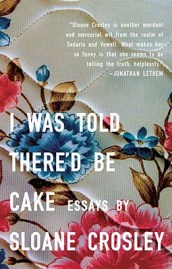
2. I Was Told There’d Be Cake: Essays by Sloane Crosley. Riverhead Books. 2008.

There will always be room on my shelves for acerbically-conducted, intelligently rowdy, self-and-societally-investigative non-fiction, and Crosley’s collection appears sculpted on the riverbed of such tenets. Colson Whitehead endorses the work as “hilarious and affecting and only occasionally scatological … sardonic without being cruel, tender without being sentimental …”. Can I get into something thus-described? Very absolutely, yes. I think I’ll keep I Was Told There’d Be Cake handy in my purse for those moments in the upcoming year when I’d like the comfort/swift kick combination in literature that few writers, even those calling themselves satirists, seem to achieve.

My first thoughts: Hmm… this writing seems like it’d be comparable to the work of David Sedaris—ah, there it is, on the front jacket, being compared to David Sedaris. I feel a little self-satisfied, I don’t mind saying.

3. Bright Shiny Morning by James Frey. Harper Perennial. 2008.

This is James Frey’s first novel, though, somehow, that sounds like an odd statement—the blurb assures me it’s entirely true. Indeed, the first page of the work proper advises the reader (somewhat ominously?), “Nothing in this book should be considered accurate or reliable”: as clear a clarion call for fiction as ever I’ve heard. The narrative is described as being peopled with vibrantly unforgettable characters, whose poignant, fiery stories all combine to etch a portrait of the vast, insurmountable protagonist: the city of Los Angeles. I enjoy reading fictive pieces that are presented as homage/hatchet job to specific cities, so I’m hoping that Bright Shiny Morning will live up to its dazzlingly-depicted premise.

My first thoughts: Look, it’s a James Frey novel! I’m beginning to round out my Frey collection. Hmm… why haven’t I read A Million Little Pieces yet, anyway?
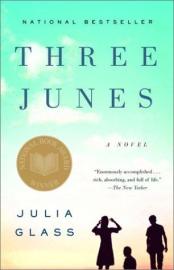
4. Three Junes by Julia Glass. Anchor Books. 2002.

Michael Cunningham (The Hours) says that this book “almost threatens to burst with all the life it contains”. I adore Michael Cunningham, but I’ve been suckered before by the beaming endorsements of even my favourite writers, on books over which I ended up feeling very lukewarmly. Glass’s first novel, this is an intergenerational familial examination spread across several continents, the kind of fare, that, depending on how well it’s told, makes for either a tearjerker of a Hallmark movie or a rousing low-budget, indie-produced theatrical success. I’m keeping my fingers crossed that it embodies attributes of the latter.

My first thoughts: This sounds like the epitome of adult contemporary book club fare. Oh, look… it’s a selection of “Good Morning America’s “Read This!” Book Club”. It’s a good thing my mother got me this one. Mass media endorsements (in the vein of Oprah’s cheery, validatory stickers which I adore pulling off my personal copies) tend to send me running. I’m such a snob.
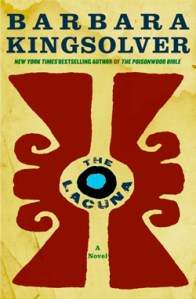
5. The Lacuna by Barbara Kingsolver. HarperCollins. 2009.

The only hardcover of the gift pile, and rightly so—everything about this book seems to imply a subtle, sexy swagger. The novel’s plot is concerned with charting the story of Harrison Shepherd, an American adventurer who forms friendships with the artists Diego Rivera and Frida Kahlo while working in Mexico. He traces his life between the north of his provenance and ambition, and the south of his imaginative and personal development. The result is described by the Chicago Tribune as “rich…impassioned…engrossing…Politics and art dominate the novel, and their overt, unapologetic connection is refreshing”. I’m hooked before the fact, which is one of the most perilous and exciting places to begin with a freshly-acquired work.

My first thoughts: Why haven’t I finished reading The Poisonwood Bible yet? Is it because I began it, became darkly compelled, then put it down because I felt the need to produce writing of my own that would speak as strongly to my own concerns? Is it because I was jealous? Quite possibly.
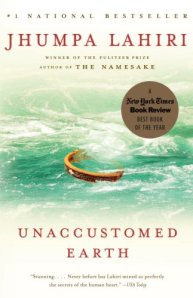
6. Unaccustomed Earth by Jhumpa Lahiri. Vintage Books. 2008.

Okay, show of hands: who remembers Anis Shivani’s vitriolic, rapier-sharp article on The 15 Most Overrated Contemporary American Writers? Have a look at it, if you’ve not come across it before—though you might shake a stick at many of his conclusions, you’ll probably concede his writing style to be immensely enjoyable, in a piquant, vigorous fashion. I bring it up because Shivani… um, praised Jhumpa Lahiri as being the only readable writer on his cautionary list. The short story collection’s blurb describes Unaccustomed Earth as having rendered, in exquisite craft, “the most intricate workings of the heart and mind”. I am particularly interested in seeing how much of Shivani’s admonition is true, of how well Lahiri’s otherwise colossally-famed talent suits the short fiction format.

My first thoughts: Didn’t I see a film adaptation of The Namesake, protagonizing the Indian half of the Harold and Kumar franchise? He displayed surprising depth.

7. Wandering Star by J. M. G. Le Clézio. Curbstone Press. 1992.

Telling the twinned tale of two women trying to navigate their lives as successfully as possible against the backdrop of Middle Eastern war, Wandering Star proclaims itself as no lightweight: “2008 Nobel Prize Winner” is emblazoned across its front cover in a self-assured swath of red. I feel somewhat chagrined to not have known this before—to not, indeed, have even heard of Le Clézio before this point. Acclaimed by Le Figaro as “…a luminous lesson in humanity amid the ruins of civilization and intelligence”, I have little doubt that this will be an impacting read, and will endeavour to also read it in its original French, either afterwards or concurrently.

My first thoughts: The Peruvian song that prefaces the body of the work is beautiful:
Wandering star
Transitory love
Follows your path
Through seas and lands
It breaks your chains
(It’s even lovelier in Spanish.)
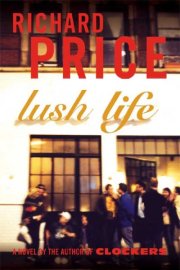
8. Lush Life by Richard Price. Picador. 2008.

HBO is still proud of The Wire. Why shouldn’t they be? From what I hear (because I’ve yet to see), it’s one of those television series that helped define what outstanding TV means today. No doubt once I’ve seen it in its entirety, my life will be neatly dissected into “before and after I saw The Wire” references. I mention this because Richard Price is one of the cowriters of that small screen bastion, and the premise of Lush Life sounds no less terrestrially gritty: two Lower East Sides collide in a catastrophic turf war that redefines everything in insidious, startling ways. Described by Michael Chabon (The Amazing Adventures of Kavalier and Clay) as “…our best, one of the best writers of dialogue in the history of American literature”, Price is a writer whose work has eluded me until now. Does your mother gift you blood-spattered, street-fresh fiction over the Christmas breakfast table? She should!

My first thoughts: Oh my goodness, that is a lot of endorsements on the back cover. It’s a wall of admiration. Almost every one of these people praises the author’s dialogue. The dialogue must be…. boom, outstanding! I really need to start looking at The Wire.

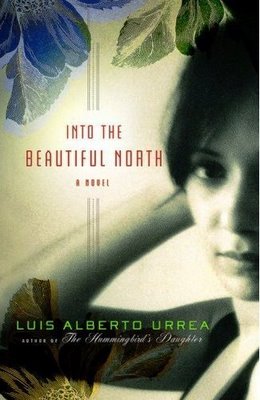
9. Into the Beautiful North by Luis Alberto Urrea. Back Bay Books. 2009.

Luis Alberto Urrea’s book covers always seem to herald some sort of imminent magic—magic waiting to leap into your lap and command your bookish attention. “Magical” is just the word that Vanity Fair uses to describe the book (and just that word, too, no others), while the Seattle Times calls it “a wondrous yarn in the hands of a terrific storyteller”. Spurred on by visions of The Magnificent Seven, nineteen year old Nayeli embarks on a rousing U.S. adventure with her compatriots, hunting down recruits for her own team of seven stalwarts, so that she can bolster her village against the threat of bandidos. Are you rolling your eyes at this premise? Shame on you! Magic is most malleable when charted on a secure system of disbelief, didn’t you know? What’s Christmas day without the offering of at least one book that trails along the glittery, bandido-infested highway?

My first thoughts: Why did I not finish The Hummingbird’s Daughter? Why have I not finished, or begun, quite a few of the other books written by these authors? Too many books, not enough world and time. Read more—everything else, less.

People other than my mother also gift me books, with varying degrees of success, though I’m pleased to say that 2011’s non-maternal literary offerings all met with approval and gratitude. I’m a nice girl, so I’m always grateful for the books I get! My inner snob might just sneer at the Oprah stickers, but there were none of those to be had on the following titles.

From my brothers:

1. Small Island by Andrea Levy. Headline Review. 2004.

Having read both Never Far from Nowhere and Fruit of the Lemon, (the latter which I read and reviewed for my ambitious, ultimately unsuccessful Caribbean Writers Challenge 2011) it’s difficult for me not to get excited about Andrea Levy’s work. I’ve had my eye on Small Island for a while now, so it was a pleasure to unwrap it over Christmas morning tea. Levy writes evocatively of the quandaries inherent in straddling identities, of the persistent struggle of finding one’s place, when one belongs to places. Set in 1940s England at a time of shifting perceptions regarding race, class and colour politics, the novel focuses on the concerns of a handful of people who find themselves entrenched in the mire of a world that’s changing whether they embrace it or not. I particularly enjoyed seeing the specificity of praise offered by the Evening Standard: “Never less than finely written, delicately and often comically observed, and impressively rich in detail and little nuggets of stories”. This novel won the “Orange of Oranges” in 2005, acclaimed as the best book of the Orange Prize for the past decade. I’m eager to read why.

My first thoughts: I really need to read more Caribbean writing.
(Yes, I did have that thought in italics. It was/is urgent.)

2. Songs of Love and Death, edited by George R. R. Martin and Gardner Dozois. Pocket Books. 2010.

Anyone familiar with my reading habits will already know that I have a mild… well, more than mild fascination with Martin’s A Song of Ice and Fire series. I reviewed A Game of Thrones last year (plans to review the other four are on my Best Intentions blogging to-do list), and having finished A Dance With Dragons in less sittings than you’d imagine, I’m already avid for something bearing G. R. R. M.’s seal of approval. This collection of stories documenting star-crossed lovers seems to have arrived at a fortuitous time, therefore. It boasts contributions from Neil Gaiman (The Graveyard Book), Diana Gabaldon (the Outlander series) and Tanith Lee (the Tales from the Flat Earth series), as well as several other authors, all beloved in their specific genres. Melding speculative fiction with romance  and fantasy, this gathering of darkly and sweetly twisted tales will probably provide a platter of uneven delights (as most short fiction anthologies tend to do), but I expect to be delighted, nonetheless.

My first thoughts: So this is what you’re doing when you should be working on chapters for The Winds of Winter, G. R. R. M., you grizzly old goat.

From my cousins:

1. Juliet by Anne Fortier. Ballantine Books. 2010.

I will confess upfront to not being the biggest fan of Romeo and Juliet. Give me the tragic splendour of Antony and Cleopatra, if you’re giving me tales of Shakespeare’s tempest-tossed lovers. Still, Juliet comes with a lofty recommendation from the Washington Post, wherein the writing is thusly described: “Fun … engaging … The Shakespearean scholarship on display is both impressive and well-handled”. As a huge proponent of deftly-decorated Shakespearean scholarship put to poetic/prosaic good use, I’m incredibly intrigued, though I doubt, somehow, that the calibre of writing will be on par with the lush fantastic-historical embellishments of A. S. Byatt’s Possession (though, to be fair, few books, if any, dwell in that rarefied company, for me). When endorsements like the Washington Post‘s are proudly flanked by ones from Elle and Marie Claire magazine, too… well, I suppose I just wonder, is all. I know. I’m a snob.

My first thoughts: So Anne Fortier holds a Ph.D in the history of ideas from Aarhus University… what exactly would a doctorate in idea-history entail?

2. Frog on the Log, written by Leyland Perree, illustrated by Joelle Dreidemy. Alligator Books. 2011.

I’m pleased to say that I have read Frog on the Log from cover to cover, and plan to feature it in my next Charting Children’s Literature post. This is  the tale of Frog, who is much taken with his log-residence, and is loath to leave it under any circumstances. Even when a storm washes away the permanency of his former abode, he drifts downstream, clinging to said log, soliciting the aid of other woodland creatures. When they insist that he can only be aided if he gives up his log, Frog staunchly refuses… but to what end will his stubborn, house-proud insistence lead him, as the river’s end rushes ever closer?

My first thoughts: FROGS!!!

As for my 2012 resolution when it comes to books, here it is:

I will give away every single book I buy for myself in 2012.

I’ve had this intention for some time now, but was, frankly, nervous about implementing it. Books are my ultimate sanctuary of revelling in the joys of material ownership. To gift them, even ones I’ve waited for ages to buy, has previously seemed like too much of an imposition. I’ll willingly part with pretty much anything else, I’ve told myself, so why should this giving extend to my favourite things?

Without wanting to carry on too much about it, I think it’s precisely because books are my favourite things that I must give them away. Someone reminded me, recently, that a book lives anew every time it’s read and held, cherished by someone new. That on its own would be reason enough for me to embark on this project.

Some of the books will be given to specific people whom I believe would love certain titles. Some will be offered up as randomly selected (or thematically-selected, such as the less impartial ‘best response wins book’ system), giveaways here on Novel Niche. I’ll likely also make some of the giveaways exclusive to my e-mail, WordPress, Facebook and Twitter followers, as a continued mark of gratitude. All book gifting will be logged on Novel Niche in one format or other.

It’s 2012… as pertinent and as timely a year as any to give the things that matter most. For everyone who’s read and found resonance with even a fragment of a post on Novel Niche, thank you. I have so very much more to share.

Story Sundays: “How to Become a Mars Overlord” by Catherynne M. Valente

Catherynne M. Valente

“We have all wanted Mars, in our time. She is familiar, she is strange. She is redolent of tales and spices and stones we have never known. She is demure, and gives nothing freely, but from our hearths we have watched her glitter, all of our lives. Of course we want her. Mars is the girl next door. Her desirability is encoded in your cells. It is archetypal. We absolve you in advance.”

Catherynne M. Valente’s fictive worlds have been much on my mind for most of December. My first reading of her novel, Palimpsest, is one I’ve drawn lingeringly across weeks, when a part of me would have liked to devour it in one feverish night, but I resisted, because I was more interested in savouring each embellishment and prose filigree as though imbibing from a wineskin. Valente handles language with an adroit reverence that is both gratifying and illuminatory. She furnishes each page with landscapes that linger, with streets and signposts you swore existed only in your most chimeric of dreams. I became curious—would this mistressing of the written word translate just as resoundingly in her short fiction pieces? So I investigated, and “How to Become a Mars Overlord” landed in my lap, or, rather, I alighted upon its curious, ensorcelling geography.

The piece is, in its entirety, a proclamation, a seminar given at an unnamed (and, one supposes, intergalactic) advisory forum for a group of attendants interested in, to quote the introductory greeting, “the potential growth opportunities inherent in whole-planet domination”. This narration fills the story’s frame, told as it is in a metallically cheerful, almost-avuncular first person plural. One gets the feeling that this collective of Martian-conquest entrepreneurs has one’s best interests at heart, a sentiment that surely runs counter to the self-aggrandizement that fuels the core of each overlord’s personal interests. Still, despite the seemingly-simple, two-tiered approach to planetary despotism offered by the board, no records are permitted at the congregation, the uncertain significance of which seems to be understood implicitly by everyone present. The things revealed in this “how to” primer run deeper, possibly, than even the stealthiest trade secrets, but more for the revelations they hold about oneself rather than that elusive, lustworthy red orb.

Any writer with a basic command of her language could tell you, tongue-in-cheek, that the interstellar highway to Mars is equally informed by the journey as by the destination, and betrays just as much about the sanguine conquistadora’s aspiration-flooded heart, as the crimson-floored terrain of the planet itself. Catherynne M. Valente is an exceptional writer, and the transmission of this truth is jewel-studded, dripping with rich, effulgent lyricism. Not an adjective of adornment feels out of place, which is a rousing success when one considers how description-heavy is the writing, how much it shies away from a staid, thrifty commerce in storytelling. Despite this gilt-edged application in style, at no point is wandering through her fictive depictions of the history of Martian ambition cloying. This is a reading experience that is immersive in the best way; it tugs you down the labyrinth without the suggestion of a migraine, afterwards, when you’re trying to retrace your steps. Valente crafts copious, lush paragraphs of character exposition (more on those characters soon), and flanks them with precise declarative sentences, such as “Mastery of Mars is not without its little lessons”, and another in particular, which I won’t quote because it’s at the gleaming core of what makes this story so spectacular for me.

In a short fiction work spanning no more than a few thousand words, the author populates her chronicle with a legion of unforgettable characters, more than many full-length novels can boast. It will be impossible for you not to pick your favourite, as I have mine. Valente describes the unique, incandescent trials of those who have triumphed in the dominion of their own specific red planets: the titan of civil engineering industry and first All-Emperor of Mars, Felix Ho; the winged Muror poetess of celestial unrhyming, Oorm Nineteen Point Aught-One; the volatile,  impetuous and unsuccessful monarch, Harlow Y. She lovingly catalogues the exploits and endeavours of those who have reached for that distinctive brass ring that is Mars, and furnishes no less attention to detail on those who, crestfallen, have failed, dooming themselves to admire the planetary object of their affections from distant, less fiercely-burning surfaces.

As you come to the end of this parable that reads, simultaneously, as assiduously drafted science fiction and lyrical high fantasy, you might be most moved by the notion of discovery that ignites each paragraph of the piece. You’ll learn that Catherynne M. Valente has unveiled more than you thought apparent about space exploration and self-actualization—of how both to strive for Mars, and to strive to own it without losing ownership of yourself—and, if, like me, you’re new to her work, you will wonder where she’s been your entire series of lifetimes until now.

You can read (and listen!) to “How to Become a Mars Overlord” by Catherynne M. Valente here. (Lightspeed Magazine)

This Sunday, Ellen, the creator of the Story Sundays feature, proprietress of Fat Books and Thin Women, shares her thoughts on Touré’s “A Hot Time at the Church of Kentucky Fried Souls and the Spectacular Final Sunday Sermon of the Right Revren Daddy Love”, here.

Story Sundays was created by Fat Books and Thin Women as a way to share appreciation for this undervalued fiction form. All stories discussed are available to read free, online. Here’s Fat Books and Thin Women’s Story Sunday archive, and here’s mine. Want to start up Story Sundays on your blog? Yay! Email story.sundaysATgmail.com for details.

Story Sundays: “Something More” by Erica Lorraine

Erica Lorraine

“When Avery was nineteen, he saw a woman on the city bus. Imagine him, uncherished—alone. It’s not just a word, lonely. Lonely adds to solitary a suggestion of longing for companionship, while lonesome heightens the suggestion of sadness; forlorn and desolate are even more isolated. Avery hated the woman on the bus. She carried friendship, that fragile animal, but she withheld it from him.”

It’s not a premise that would alarm you, normally. A woman, quiet and thoughtful within herself, notices a man diligently at work, handling his craft with skill and consideration, and she wants him. Seizing her fate firmly between her palms, she pursues and secures him, moves her life into his dwelling, and thus begins the catalogue of their romance. This synopsis, so far, reads like the pitch for a straightforward romantic comedy, maybe a little on the staid side—and there’s no denying that if “Something More” were transcribed to screen, moments of it would be dutifully sweet. Thankfully, the story recommends itself for a studied perusal because its fabric is darted through with insinuations of guilt, buttoned up by bone fixtures done in implied and understood chaos. It’s as sinister as any “girl seeks boy” story can get without latching you into the surprise woodshed by force, and that makes it riveting.

One of the reasons that this unexpectedly fierce story works as well as it does is because of the calculated startle that opens it. We learn within the first few words that Avery is a rapist, but it’s not this that draws our principal narrator, Jackie, to him. There is much more to Avery, the bespectacled, talented florist at the shop from which Jackie makes her frugal purchases, than the intimation that he may, or may not, have violated a woman’s personal, sacred space. Why the element of doubt, then, that threads itself through much of the brief, sparsely depicted narrative? If we’ve been told within the story’s initial breath that he is, in no uncertain terms, a perpetrator of sexual assault, then why is our ultimate perception of him so studded with uncertainty? Delicate, astutely moulded ambivalence of this tenor makes reading “Something More” a Sunday afternoon’s disturbing pleasure.

What I liked best was the way that the entire experience of reading puts one in mind of being primed for violence, and yet, that violence is transmitted to us with self-conscious, earnest, almost awkward gentility. Jackie’s domestic pugilism, her premeditative conquest and capture of Avery, is so whisperingly well done that a coarse reader might easily miss it—but every devoted entry in her catalogue of ownership is neatly scribbled. From the moment she decides on making Avery her own, stalking him with delicate fixation outside the florist’s as he compiles a stunning bouquet for her, to the way she solicitously nurses him back to good health when she’s moved her life into his old-fashioned apartment, Jackie traces affectionate, unmistakable brands onto the artistic young man she’s made her partner and prey. The way she claims his body as her own is simultaneously chilling/thrilling to envision:

“She stayed home from work, stayed home from school, and when his fever broke, she made him hard in her hands and fit herself on top of him. She held his wrists above his head and buried her face against his neck.”

By having her consecrate all of her hours to Avery’s care (and in so doing sublimating her importance), and then asserting her importance by possessing him, Lorraine sculpts Jackie’s duality magnificently: the duality that simmers in each of us, to abnegate and to rule over another, over and within ourselves.

If you’re receptive to its imbedded frissons of alarm, and sensitive to its open-handed sense of storytelling justice, “Something More” will own your Sunday’s attention, utterly. I am almost always impressed by a fictive voice that documents with as little intrusive, perception-distorting authorial judgement as possible, and Lorraine is proficient at telling the intertwined stories of Avery and Jackie on a slate so bereft of omniscient frowns or applause as to be pristine. The authoress isn’t debating, here, whether or not people are compelled to do terrible things. Knowing that we already know the answer to that, she peels back the covers we make for our facilely lying faces, to examine our secret compulsions, and to probe discomfitingly at the tacit deceits we feed ourselves, even when we’re certainly fooling no-one.

You can read “Something More” by Erica Lorraine here. (Joyland)

This week, the lovely Jennifer of Books, Personally,  shares her thoughts on “Lucky Bamboo” by Agnieszka Stachura, here. Ellen, the creator of the Story Sundays feature, proprietress of Fat Books and Thin Women, is currently on blogging hiatus.

Story Sundays was created by Fat Books and Thin Women as a way to share appreciation for this undervalued fiction form. All stories discussed are available to read free, online. Here’s Fat Books and Thin Women’s Story Sunday archive, and here’s mine. Want to start up Story Sundays on your blog? Yay! Email story.sundaysATgmail.com for details.

25. American Psycho by Bret Easton Ellis

This review is affectionately and irreverently dedicated to Joshua X. Thank you for introducing me to Patrick Bateman, and thank you even more for not doing so in person.

Published in 1991 by Vintage Books, New York.

You’ve met Patrick Bateman. He’s the guy you had Waldorf salad/ apéritifs/ a candid sauna conversation/ a three course dinner/ a tray of Bellinis with, last Friday/ weekend/ fortnight/ financial quarter, at Indochine/ Dorsia/ 21/ Tunnel/ Pastels/ the Hamptons, with… oh who remembers, really? He’s a member of your yacht club/ exclusive gym/ Harvard graduating class, and you get your ties/ pocket squares/ tans/ dry cleaning from the same places. If you’re an attractive, elegantly dressed woman of a certain social set, you’ve probably shared his bed. If you’re an unsure yet comely prostitute, or an ecstasy-addled socialite, you’ll probably die in it.

But do you know Patrick Bateman?

He is handsome; there can be no denying this. He is superbly educated, outstandingly networked, exquisitely attired. His apartment, housed in the same building in which Tom Cruise owns the penthouse suite, is an interior designer’s wet dream. He has friends. He has money. He is… he is… a damned unreliable narrator, and why? Patrick Bateman is insane. You have, in all likelihood, never encountered a principal narrator whose word you could trust less, and this is, at once, outstandingly written and utterly bemusing—a twinned pleasure/migraine to parse. The novel’s plot, which in terms of thickness could be described as bareboned at best, is delivered to us entirely through Bateman, a Manhattanite yuppie businessman, as he navigates the breakneck-paced, agenda-laden, hyperactive worlds of commerce and pleasure that dictate the speed and settings at which he consumes, makes love, arbitrates, teases vagrants, and contemplates murder. As the novel progresses, Bateman’s brutal inner monologues morph into equally misanthropic slayings, several of which are highlighted and lovingly recounted to the reader in high-definition detail. Ultimately, our urbane protagonist becomes less and less capable of neatly compartmentalizing his serial killer and business savant personas, and as the body count grimly rises, so too does his paranoia, despair, desolation and impeccable cruelty.

One of the most striking facets of Bateman’s world is that it is inundated with a never-ceasing stream of conversation, a steady, witty, charming flow of dazzling one-liners and emphatic recommendations. It is a world in which no one listens to anyone else. Indeed, Bateman might be one of the few people who does any real listening. He might be the only person he knows who listens. It isn’t that he never shares the worrying compulsions within him, either. He quite frequently bares his… er, soul… on the subject of his insatiable blood-lust, but on the incredibly rare occasions that his words penetrate his audience’s mire of self-indulgence, his confessions are met with distracted humour and prompt dismissal. In one interchange, when his romantic partner for much of the novel, Evelyn, gushes enthusiastically about her visions of wedding splendour for them, Patrick effusively responds with a description of the ideal firearms he’d bring to their nuptials, with which to slaughter Evelyn’s immediate family. He receives no response to this other than his girlfriend’s continued pre-bridal salivations. In another, particularly mirthful scenario, when asked by a vapid model he is vaguely interested in bedding about his occupation, he shares that he is “into, oh, murders and executions, mostly”, after which, predictably, his companion asks him if he enjoys the work. The establishment of this savage, smirking landscape, in which no one practices human interaction without artifice, provides the perfect canvas against which Bateman lets the blood of so many flow. Perhaps our protagonist might be less deranged than he is, if he existed in a convivial, earnest setting, perhaps not… but there is no denying that it is infinitely easier to committ atrocities against someone if they have never, despite their honeyed insistence, truly given a damn about who you are.

Easton Ellis is arguably at his finest when he allows us to peer into the ragged veil of Bateman’s flinching, badly bruised humanity. Any passable horror story will be strewn with as many depictions of smouldering carnage as can be forced between its dripping pages; few are capable of drawing out our sympathy and begrudging acceptance of the similarities between ourselves and the monster that crawls across the chapters with smoking entrails for his necklace. Bateman works as well as he does because he is crafted with multilayered complexity, with unerring attention to detail, with as much brittle amusement as raw terror. In one of his final executions of the novel, in the midst of a failing attempt to wrangle a culinary delight from a section of corpse, our murderer slips into plummeting despair.

“And later my macabre joy sours and I’m weeping for myself, unable to find solace in any of this, crying out, sobbing “I just want to be loved,” cursing the earth and everything I have been taught: principles, distinctions, choices, morals, compromises, knowledge, unity, prayer — all of it was wrong, without any final purpose. All of it came down to was: die or adapt. I imagine my own vacant face, the disembodied voice coming from its mouth: These are terrible times.

This is a remarkable work of fiction. It might be most remarkable for how much your conflicted, uneasily mottled reactions to the depiction of its protagonist will render your introspective ruminations, your late-night diary scribblings, your smoothly hip but really self-conscious Facebook posts, not just of the book, not just of this genre of literature, but of and on yourself. Patrick might well become your antihero nonpareil, your reverse answer to the question, “What Would Jesus Do?”. You will not only be disgusted and sickened by him, startlingly enough. You will be touched by his overtures of gentility, by his saccharine daydreamings of ambling through the park with his secretary Jean, buying and releasing balloons into the air. You will laugh uproariously at his expense. (I challenge you to go into a Chinese drycleaners’ and not dissolve into hysterics after softly whispering “Bleach-ee”, with just a hint of threat in your voice). You’ll laugh at Bateman because of every one of his thousand nervous tics, his ridiculously overblown reactions to perfectly common occurences, his manic stops and starts, his revolting yet astoundingly funny pranks (coating a much-pissed-upon urinal cake in cheap chocolate, then proffering it to Evelyn over dinner). Then, when it dawns on you that you’re laughing at a man whose mind is the wasteland of serious dementia, a man desperately in need of a cornucopia of corrective drugs, you’ll ask yourself about your own sickness.

While reading American Psycho, it was easy enough for me to commiserate, in the abstract, with popular opinion surrounding its release at the end of the 1980s. Reviled, condemned, near-categorically panned, it was described as being too vulgar, too misogynistically self-serving to be worthy of the worst pornography. It would be unfair to wipe some of the mud from these allegations by theorizing that the novel was written before its time. When, one wonders, would be ‘the right time’ for a work of fiction concerned with the graphic satirical exploration of a young  lunatic, simultaneously trapped and liberated by the consumerist, capitalistic framework of fiscal success and personal nihilism that is his life? Perhaps there is no time in which such a book could have been written which would have ensured it a stellar reception—perhaps, when you’ve read the book, you will think this is more of a coup de grâce than a criticism. You might not be happy living in a society where the only thing a publication such as this merits is rousing applause. It would mean, one supposes, that either no one got the point, or, worse, everyone did, and endorsed it unflaggingly for the wrong reasons.

Almost every awful thing you have heard about American Psycho is true. It is nauseatingly graphic about murder, rape, torture, cannibalism, necrophilia, animal assault, and the perverse, detached delight that the perpetrator of these crimes takes in committing them. It will not comfort you. It is not a comforting book, but, as Patrick himself is always reminding us, these are not times for the innocent—and if they weren’t, on the cusp of the 1990s, they are indubitably not so, now.

I maintain, however, that Patrick Bateman should not terrify you.

Somewhere, even as you read this, even as you gingerly contemplate adding this book to your “must-read” (or “never-read”) list, there is an improbably beautiful man in an Ermenegildo Zegna suit, wearing A. Testoni loafers, crossing the street to go to work, where he will be greeted by a receptionist he believes, despite an overwhelming lack of evidence, to be madly in love with him. His body is a wonderland. He grows weak in the knees at the sight of expensively manufactured business cards, and the thought of not being able to secure a dinner reservation at the town’s most exclusive restaurant could, quite likely, bring tears to his eyes. He is frequently, ruthlessly cruel to homeless people, and demands abortions of the girls he’s gotten pregnant without so much as batting a well-rested eyelid. Last Hallowe’en, he wore one of his suits, covered in a plastic overcoat, and carried a chainsaw, to go to an upscale party as Patrick Bateman, because Patrick Bateman is his non-ironic hero. He has no natural sympathy, proclivity for kindness, no moral compass, no scruples, and no criminal record.

That should terrify you.

Story Sundays: “Still Life, With Wreckage” by Paulo Campos

Paulo Campos

“Then everything was everywhere. Lowell walked through broken bags, airline seats, curls of fuselage, electronic devices, baseball caps, broken Duty Free bottles of whiskey, peanut packets, an inordinate number of tampons. Columns of steam moved away into the night from scattered hot bits of plane. The co-pilot stood on a rock and shouted through a rolled up magazine. Lowell stepped through the hole and looked up the luggage hull. Small fires burned some suitcases and chests inside. “I’m ruined,” Lowell said.”

This is one of those stories that pretentious literary criticism groups, or workshop writers, would subject to a series of elaborately obfuscating vivisections, all the while sipping french press, fair trade coffee, and lamenting the demise of whatever formerly hipster trend had gone sourly into the mainstream. Let’s not, here at Novel Niche, be pretentious about what we like, and about what discomfits us—and “Still Life, With Wreckage” prompts both reactions, though not necessarily in equal measure.

The narrative is divided into three sections, each of which features Lowell as its principal character. In the first section, he is trapped on board an airplane whose housing has been perforated, resulting in devastating consequences for its human cargo. He takes stock of the loss of human life as well as material properties, and notes the varying reactions of other passengers. As his box of official inquest documents flies further and further out of his reach, he remembers the circumstances surrounding the disappearance of his son, Carlos. In the second, Lowell returns to his home in the aftermath of the aircraft fiasco. He recounts the loss to his apparently glib, socially preoccupied wife, Fern, then heads to bed, where he falls sideways into a labyrinthine reminiscence (or is it a foreshadowing?), before being jarred out of it by Fern’s insistence that he remove his shoes. In the final section, Lowell is being carted off to an unnamed penitentiary (where the heavily implied promise of torture awaits him and his fellow prisoners), when he believes he recognizes his son Carlos, the last prisoner to be brought out for shipping to the new facility. Whether or not this sighting becomes a true reunion of father and child remains obscured by the forceful intervention of a nearby guard.

So many things are happening in this story that, once it doesn’t turn you off with its considerable (and, for me, much-appreciated) weirdness, you’ll want to reread it at least twice, slowly, so that its full effect can sink in. I’ve read it five times now, and I’m not sure that I can claim to a comprehensive understanding of every arc and sub-arc, every veiled plot suggestion or hidden character conflict. Once the prospect of rereading excites, rather than elicits groans of frustration, then you’re usually on to a piece of good writing. What makes the story worth each reexamination is the way it isn’t afraid to grow non-normatively. I think it’s safe to conjecture that if you liked watching Synecdoche, New York, you’ll enjoy reading this. It’s plausible, too, that even if you didn’t like Synecdoche, but you respected what its internal circuitry attempted to say, then you’ll appreciate what turns and ticks within the software of “Still Life, With Wreckage”.

There are several tiny treatments in the detailing of the narrative that demand our focus, and our consideration. There’s the way in which Lowell’s second son’s sunglasses are light blue, the same colour used to describe Carlos’ eyes. There’s the deliberate loss of Carlos in proximity to the People Eater installment at the amusement park, a  detail that renders as injected with painful irony, until it’s repeated by the security guard who tends to their case, so that it becomes both literarily ironic and bitterly humorous. There’s the muted horror of never knowing the fate of the woman who, hysteria-stricken, rips her breathing mask from its panel, to stare at it uselessly in her hands. There are stories within the minutiae begging to be told. Not telling them, but hinting at them with just enough detail to be maddening, suits the short fiction form eminently, and Campos employs it in full force here.

What moves the most, ultimately, is Lowell’s muddled, conflictingly articulated self-perception. Everything around him, every event he absorbs by being a part of it, from losing Carlos by the happenstance of his arachnophobia, to confronting his financial ruin through a candid confessional with the portrait of a plantation owner in his bedroom, holds the uncomfortable quality of being easily applicable to events we’ve each of us faced or fled from. What is most upsetting, and rewarding, to consider, is that Lowell’s life, its most colossally tragic, ludicrously uncertain structure, is our combined existence. His life has no backspace button, just like ours, and just like him, we march on irredeemably, resolutely, with as much grace as we can muster when our own fuselage tears loose.

You can read “Still Life, With Wreckage” by Paulo Campos here. (The Incongruous Quarterly)

This week, the lovely Jennifer of Books, Personally,  shares her thoughts on “Sinners” by Edna O’Brien, here. Ellen, the creator of the Story Sundays feature, proprietress of Fat Books and Thin Women, is currently on blogging hiatus.

Story Sundays was created by Fat Books and Thin Women as a way to share appreciation for this undervalued fiction form. All stories discussed are available to read free, online. Here’s Fat Books and Thin Women’s Story Sunday archive, and here’s mine. Want to start up Story Sundays on your blog? Yay! Email story.sundaysATgmail.com for details.