“The Madwoman as Rasta Medusa” – Shara McCallum

8068434185_516264d807_k
Image: Haight Medusa, San Francisco, posted at Flickr by Derek Σωκράτης Finch under a Creative Commons License.

How better to stun Babylon than with serpents?

Vengeance is one thing, and justice another. Which of these two snakes would bite harder, poison faster? Shara McCallum‘s “The Madwoman as Rasta Medusa” does not leave us guessing. Announcing the arrival of a serpentine-coiled agent of Armagiddeon, the poem hisses, “Yu think, all these years gone, / and I-woman a come here fi revenge? / But yu wrong. Again is so yu wrong.”

In the space where all blood debts must be paid in sanguinary tithes, this mad rasta medusa comes with a ready salver, promising no Perseus will take her head. In this mythos, one gleefully suspects Perseus is a trifling youthman who can’t even cock his own gun, far less trouble the scaled tail of the I-woman.

With all the unaplogetic, swaggering braggadocio you might find in a Midnight Robber speech, Rasta Medusa enters, her own body a terrible, calcifying witness. Not terrible as in, “I caught a terrible cold and have to miss work.” Terrible as in, “The face of the creature shone, sovereign and terrible, and all men quaked.”

Witness the Rasta Medusa’s biological weaponry: “This face, etch with wretchedness, / these dreads, writhing and hissing / misery”. How triumphantly precise is this mapping of the female-identified body as its inbuilt defense, its native artillery, its original vessel, vanguard and future tomb?

We all know the I-woman. We have all beheld her in our dreams, our fantasies, our Sunday morning marketplaces and Saturday night sweatdown sessions. Maybe she can flex on her head. Maybe she can cure the sick with cerassee and senna. Maybe she is the leveller of men, the liberator of women, the herald of the right and ready now. Instead of the bat signal, how can we call her when we have terrible need?

Read “The Madwoman as Rasta Medusa” here.
Shara McCallum’s Madwoman is the winner of the 2018 OCM Bocas Poetry Prize.

Puncheon and VetiverThis is the fifteenth installment of Puncheon and Vetiver, a Caribbean Poetry Codex created to address vacancies of attention, focus and close reading for/of work written by living Caribbean poets, resident in the region and diaspora. During April, which is recognized as ‘National’ Poetry Month, each installment will dialogue with a single Caribbean poem, available to read online. NaPoWriMo encourages the writing of a poem for each day of April. In answering, parallel discourse, Puncheon and Vetiver seeks to honour the verse we Caribbean people make, to herald its visibility, to read our poems, and read them, and say ‘more’.

“Matie Shall Not Conquer” – Tanya Shirley

2997392912_dd63523b05_o
Image: Apples are Red…, posted at Flickr by David Robert Bliwas under a Creative Commons License.

Let’s not pretend we’re not animals.

This isn’t a debasement, Tanya Shirley reminds us in “Matie Shall Not Conquer”. Beasts are capable of ingenuity, manipulation, sleight of hand and rapier wit, to get what they want, and to defend what they have. The wronged woman in this poem is orchestrating both. Her man has a matie, a mistress, a side piece, an Eve who might, given enough rope, entwine herself around the fella with the gift of multiple climaxes, stake him out and oust the current queen.

Enter magic.

Call it obeah, or call it a parlour trick, but you can’t call it passive. The energy of the poem crackles, whiplashes, curlicues tendrils of want, of mine, of beware. Three blue candles are brought out, three papers with the names of all involved parties, “three positive wishes / for your rival, all the time wishing the bitch well.”

To quote one of the most resonant poetic odes of this or any age, “Yuh tink me done? Yuh think me done?”

Tanya Shirley isn’t invoking the violent incredulity of Lady Shabba’s “Ram Ram”, so much as she is summoning what presages it. This, before I lose my cool over you. This, before you make me make a jail on your head. We believe her utterly, the wounded, but undaunted, woman being addressed in second-person, the “you” who gathers her items of conjure, protection and blessed badmind. The “you” could be any of us, rediscovering that we are wild, repurposing our steps to suit our better, bitter, jealous nature.

Watch your ass. Guard your cunt. This poem’s a primer in how to do both, and prevail. A blueprint of warrior rite, a dancehall galvanizing of ovarian fortitude, the poem cautions all maties, warning that if you enter the gayelle, expect spirit lash.

Read “Matie Shall Not Conquer” here.
Tanya Shirley’s most recent collection of poems, The Merchant of Feathers, was longlisted for the 2015 OCM Bocas Prize for Caribbean Literature.

Puncheon and VetiverThis is the fourteenth installment of Puncheon and Vetiver, a Caribbean Poetry Codex created to address vacancies of attention, focus and close reading for/of work written by living Caribbean poets, resident in the region and diaspora. During April, which is recognized as ‘National’ Poetry Month, each installment will dialogue with a single Caribbean poem, available to read online. NaPoWriMo encourages the writing of a poem for each day of April. In answering, parallel discourse, Puncheon and Vetiver seeks to honour the verse we Caribbean people make, to herald its visibility, to read our poems, and read them, and say ‘more’.

“Come, Shadow” – Loretta Collins Klobah

1359287762_6274c9dbea_b
Image: To Sleep Forevermore., posted at Flickr by Dean under a Creative Commons License.

In the end, it’s a combination of everything that puts you to bed.

For the mother, remembered by the unwilling but deep-memoried daughter in Loretta Collins Klobah‘s “Come, Shadow”, it’s the electroconvulsive therapy that surrenders her. To what? She isn’t succumbing to herself, this darkly and intricately scrutinized figure, remembered as both a mother rocking her baby to sleep, and a woman strapped down, juddering and rendered, eventually, inanimate. The poem is an execution of women’s desires, decided for them by medicine and men, then enacted upon them. After eighteen rounds of ECT, the poem warns us, you can expect there will be a nineteenth not recorded here. The poet leaves you to imagine it, in the sanitized hospital hallways of your worst envisioning.

“Come, Shadow” is a marrow-curdling reminder that simply because a past is hygienic doesn’t mean it’s clean. It is the thoughtful, orderly journey to the sanatorium that leaves us shaking, without even a volt rippling through us. I come to find this again, and again, in Klobah’s poems: an internal spillage, the reservoir inside me deftly unbricked with a touch here, a dislocation there, everything deliberate and steady-handed.

The poem begins with a summoning. Come, shadow, it asks. The poem ends by asking the shadow to go. “I’m not your horse”, the speaker declaims. The odyssey that we undertake, between the invocation and the refutation, is a hallway of pain and remembering. It’s a table with straps that dangle like inhuman, uncivil ribbons. It’s a waiting room of the damned, where a woman tells her physician “if she has another / shock treatment, she will die. / It will be months before she is home, though, / and she will be hospitalized uncountable times / after that.” Look around. What shadow taps you on the back?

Read “Come, Shadow” here.
Loretta Collins Klobah’s new book of poems, Ricantations, will be launched at the 2018 NGC Bocas Lit Fest.

Puncheon and VetiverThis is the thirteenth installment of Puncheon and Vetiver, a Caribbean Poetry Codex created to address vacancies of attention, focus and close reading for/of work written by living Caribbean poets, resident in the region and diaspora. During April, which is recognized as ‘National’ Poetry Month, each installment will dialogue with a single Caribbean poem, available to read online. NaPoWriMo encourages the writing of a poem for each day of April. In answering, parallel discourse, Puncheon and Vetiver seeks to honour the verse we Caribbean people make, to herald its visibility, to read our poems, and read them, and say ‘more’.

“Papa Bois and the Boy” – Brandon O’Brien

16267892635_72292e2100_k
Image: Edelhert (Red Deer) 001206, posted at Flickr by Zweer de Bruin under a Creative Commons License.

Gaze into the forest long enough, and it will reach for you by the root.

Brandon O’Brien‘s “Papa Bois and the Boy” is the parable you’ve been waiting for, if you’re tired of complacent, hearthside romances, and doily-dotted domestic bliss. Nothing’s wrong with the hearth, or the human home, but the poet opens the kitchen door and tumbles us into the fields. “What?” he asks. “You didn’t notice there was a wilderness, on the edge of your trimmed acre? Take one step, only one, past your boundary. Don’t be afraid of the ensuing growl.”

Oh, and growl this poem does. O’Brien parts bamboo-cathedral canopy to show us a love, and a pair of lovers: Papa Bois, and the boy who startles him, changing both their lives. The poem builds in leaf-brush strokes of intimacy, til soon, we find it teeming in us; it rifles in our pockets, plucks our smartphones from our grasps, says, stay awhile. Breathe in the verdancy. You can always selfie your pleasure, after.

This paradise of queer eros, at once boldly declarative and speculatively antlered, is not immune to the chainsaw-rap of the outside world on its mora door. The world outside of the lovers’ realm announces itself with quarrying machineries, “splitting rocks with their toes / in search of something more golden-black / than freshwater clear.”

The poem is its own sanctuary, but does not forget to be its own warning, too. In a world fringed by risks, encroached upon by the spattering gravel of curtailing freedoms, our best recourse, and truest, is to turn inward. Not turn the other cheek, necessarily: turn to the woods. Reach into the heartsapling of yourself, hold your deciduous husband’s hand, and give them hell, by first giving yourself heaven. Only come out, arboreally-haloed, when you damn well please.

Read “Papa Bois and the Boy” here.
Brandon O’Brien is the poetry editor of FIYAH: Literary Magazine of Black Speculative Fiction.

Puncheon and VetiverThis is the twelfth installment of Puncheon and Vetiver, a Caribbean Poetry Codex created to address vacancies of attention, focus and close reading for/of work written by living Caribbean poets, resident in the region and diaspora. During April, which is recognized as ‘National’ Poetry Month, each installment will dialogue with a single Caribbean poem, available to read online. NaPoWriMo encourages the writing of a poem for each day of April. In answering, parallel discourse, Puncheon and Vetiver seeks to honour the verse we Caribbean people make, to herald its visibility, to read our poems, and read them, and say ‘more’.

“Sea Blast” – Gilberte O’Sullivan

15395991452_182800d5aa_b
Image: Siren – Songkhla, posted at Flickr by Axel Drainville under a Creative Commons License.

Every child who had to be dragged from the sea, screaming wild, howling for entry, wonders what it would be like if they’d broken free from their parents’ grasp, run back to the surf, and traded their limbs for fins.

“Sea Blast” is a baroque, embroidered sea-poem. Sargasso has stitched it. There are no embankments against tide and time here: not human passion, not iron, no industry of man’s desire or man’s jealousy or man’s architecture. Nothing keeps the sea, embodied as a mad island woman, from surveying and claiming what she wants. Including what she’s wed.

Gilberte O’Sullivan gathers starfish-splayed images, unites them into a coral reef of beauty and foreboding: “little fish scholars”; “scrolls of perishable ideas”; “the sign of the mast”. In the domestic disharmony of pirate husband and maritime wife, in the slow and insidious untethering of the former’s defenses against the latter, the poet both builds her caverns under the ocean, then chips at them, worrying language to prise out pulsing miniature snakes of malaise. What a fine, sanguineous festering O’Sullivan invokes.

The poet needles gentleness out of the poem with sharp, underwater spears, leaving us with the long, vicious effects of saltwater-erosion. The sea takes everything when you aren’t looking: time, love, decency, family ties, even a bowl to cast your cares into, weeping. Yet it is the very cruelty of the poem that sings us the most sublime of narratives: an anti-conquest fable, like something out of a waterlogged tome, promising a vengeful end of any man who wants to marry a woman into submission without her tacit seal of approval.

What a chorus of oceanic comeuppances is “Sea Blast”. What an augur of inevitability. What a promise, waiting to rise up and eat everything you own, with salt. Dive in; forget drowning.

Read “Sea Blast” here.
Gilberte O’Sullivan was a featured writer in “Who’s Next” at the 2014 NGC Bocas Lit Fest, and was again featured at the festival in 2017’s “Stand and Deliver”.

Puncheon and VetiverThis is the eleventh installment of Puncheon and Vetiver, a Caribbean Poetry Codex created to address vacancies of attention, focus and close reading for/of work written by living Caribbean poets, resident in the region and diaspora. During April, which is recognized as ‘National’ Poetry Month, each installment will dialogue with a single Caribbean poem, available to read online. NaPoWriMo encourages the writing of a poem for each day of April. In answering, parallel discourse, Puncheon and Vetiver seeks to honour the verse we Caribbean people make, to herald its visibility, to read our poems, and read them, and say ‘more’.

“Investigation of Past Shoes” – Vahni Capildeo

16553094216_bb3ceddbad_k
Image: Little red shoes, posted at Flickr by Vanie Castro under a Creative Commons License.

As a young girl, “The Red Shoes” was the first fairytale to fill me with both delight and horror: it was one of my first lessons in the truth that something sublimely beautiful can dance you all the way to your own grave, or someone else’s.

When I read the poems of Vahni Capildeo, I often feel as though I’m dancing, even if my best ballet flats are welling with blood. The serpentine, carnivorous, raised-lynxhead attentions of Capildeo’s poetics keep me upright in fields of the too-common. They also remind me that in the common, there is always dancing. Take, for instance, “Investigation of Past Shoes”. A narrator tells us of their history in footwear: 1970s clogs with side buckle; gold and silver sandals racked up outside a temple, waiting for their mistresses’ feet; bleached-pristine Convent sneakers; “distressed silver ballet slippers … Cool as moonlight on / a tourist coastline.”

We arrive at the poem’s end to their bare, pearlescent-toenailed feet, yet in each cleated address, the poem offers us some bareness, some bone-deep exposure, like the stultifying whitewashery of Convent sneakers, of a ‘prestige’ education filled in with the patina of “Toxicity  and intoxication: / with  good  intentions,  getting  high on paste.” What I love about this poem, and so many of Capildeo’s poems, is that it doesn’t pre-announce its poetic intentions. We call it poem, but it could, with a smattering of imagination, with a stretching of leeway, be called ‘anti-advice brochure’; ‘ironic and morbidly hilarious walking tour guide’; ‘instructions on how to achieve the perfect pedicure through trial, history and error’.

Walk with this poem and maybe expect to get lost. Or maybe find yourself going dancing, to the alive and insomniac cadences Capildeo offers: toss the ex-husband’s torture flats. Toss the ex-husband, too. Glide home barefoot.

Read “Investigation of Past Shoes” here.
Vahni Capildeo’s newest collection, Venus as a Bear, will have its Trinidad launch at the 2018 NGC Bocas Lit Fest.

Puncheon and VetiverThis is the tenth installment of Puncheon and Vetiver, a Caribbean Poetry Codex created to address vacancies of attention, focus and close reading for/of work written by living Caribbean poets, resident in the region and diaspora. During April, which is recognized as ‘National’ Poetry Month, each installment will dialogue with a single Caribbean poem, available to read online. NaPoWriMo encourages the writing of a poem for each day of April. In answering, parallel discourse, Puncheon and Vetiver seeks to honour the verse we Caribbean people make, to herald its visibility, to read our poems, and read them, and say ‘more’.
“Poem for a Gunman” – Soyini Ayanna Forde

15869763378_fb6da4e5b0_k
Image: Black Medusa, posted at Flickr by Ben Raynal under a Creative Commons License.

Sometimes, love takes you by the mouth. Both of them.

Soyini Ayanna Forde‘s “Poem for a Gunman” tugs your underpinnings aside, curls urgency and sincerity upwards into your heart in slow, molasses-drugged strokes. The address of the poem is intimate, revelatory, confessional: we learn of a lover with “slow walk solid calf muscles nutmeg flesh / marinating in Rasta oil”, a lover who transmits need with the press of ganja-ripe fingers around his woman’s throat, a man who “could have / picked me up if you wanted to, crumple me, / throw me away”. Oh, forget Prince Charming. Fling off Rhett Butler. Heathcliff, who? If you want it good, go to yard.

I’m listening to vintage Beres Hammond while I write this. Yeah. Tings serious.

“Poem for a Gunman” is direct, so tender and ravenous in its address. It bares the nape. It hitches up the dress. It smudges the lipstick, reapplies it, then licks it off raw. It presses you backwards, knees bending, onto the bed of hunger still salted and leavened with the last afterglows of slaking thirst. Forde instills in us this same unbowed, primeval knowing of the speaker’s lover, investing us in a psychogeography of his planes, his angles, his moods and humours. We walk in his skin, and lie down in him, lying down in her. This great, genuine shapeshifting voyeurism of the spectacle of love, and loving, fuels the best romances. The best darknesses, too.

I so badly want to tell you the last two lines of this incandescent, hummingbird-hearted poem, but I think you should read it, and find out. Take yourself to bed, or be taken to bed, on the promise of it, the renewal and supplication and transubstantiation of that need. Pull it into your mouth like sensimilla, exhale slowly. Again.

Read “Poem for a Gunman” here.
Soyini Ayanna Forde is the winner of the 2016 Small Axe Literary Competition for Poetry.

Puncheon and VetiverThis is the ninth installment of Puncheon and Vetiver, a Caribbean Poetry Codex created to address vacancies of attention, focus and close reading for/of work written by living Caribbean poets, resident in the region and diaspora. During April, which is recognized as ‘National’ Poetry Month, each installment will dialogue with a single Caribbean poem, available to read online. NaPoWriMo encourages the writing of a poem for each day of April. In answering, parallel discourse, Puncheon and Vetiver seeks to honour the verse we Caribbean people make, to herald its visibility, to read our poems, and read them, and say ‘more’.

“Final Prayer in the Cathedral of the Immaculate Conception I” – Canisia Lubrin

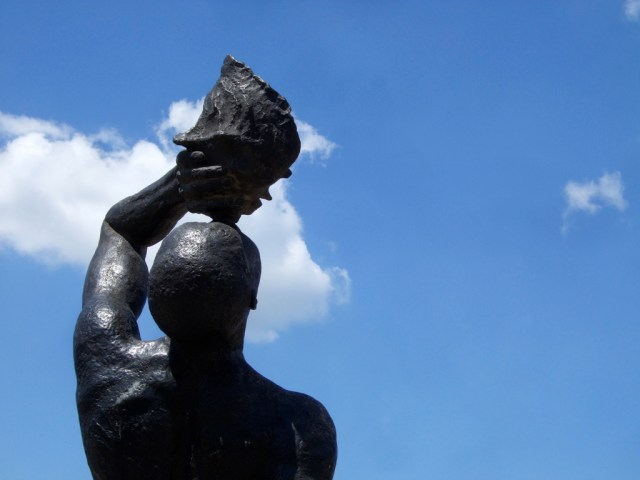
5374133741_4e02068ee9_b
Image: Conch, posted at Flickr by Amy Nelson under a Creative Commons License.

There’s history in stone.

In searching for an image to accompany this poem, I turned up scores of photos of uncredited ‘African masks’ in New York museums, and monuments, forts, edifices, all laid in, brick by millionth brick, by the hands of black slaves.

What is an ‘African mask’? Is it similar to an ‘African textile’, or an ‘African pot’? What have we learned about making Africa a congealed, amorphous continent of pain, and its accompanying culture? It’s the culture of pain Canisia Lubrin‘s after in “Final Prayer in the Cathedral of the Immaculate Conception I”, but also the culture of how black bodies have survived it.

Lubrin invokes “the symmetry of shattered-strong / women”, tattooed and transcendent, even as they’re reduced to little more than slideshows of ‘African culture’. The poem is a daring, image-stilettoed refusal to accept broad-brushstroke canvasing of black pain, or else black joy. The poet sifts through any obscurantist bladderwrack, dives into history, slavery, the dislocation and torture of black humanity, and brings us pearls, lustrous and obsidian with weight and impact.

“Peel back the scales of these untranslatable African songs, reveal / them more syllabled than your “Gloria.”” is my favourite pearl of the poem. This is how Lubrin arrives at ‘African’ definitions that are both specific and encompassing, both one thing and many, all holding hands, all lifting lanterns, all shattering slave-labour structures. This is not an unmarked African mask in a museum on the Upper East Side. This is not an artifact needing stolen back. This is its own stealing back, its own fervent and radical witness.

“See queens and knights left over to check- / mate”, the poem promises us. Or, perhaps, the poem prays in us. It is, after all, a prayer, and a final one. It bows our heads.

Read “Final Prayer in the Cathedral of the Immaculate Conception I” here.
Canisia Lubrin’s first book of poems, Voodoo Hypothesiswas published by Wolsak & Wynn in 2017.

Puncheon and VetiverThis is the eighth installment of Puncheon and Vetiver, a Caribbean Poetry Codex created to address vacancies of attention, focus and close reading for/of work written by living Caribbean poets, resident in the region and diaspora. During April, which is recognized as ‘National’ Poetry Month, each installment will dialogue with a single Caribbean poem, available to read online. NaPoWriMo encourages the writing of a poem for each day of April. In answering, parallel discourse, Puncheon and Vetiver seeks to honour the verse we Caribbean people make, to herald its visibility, to read our poems, and read them, and say ‘more’.
“Place Name: Oracabessa” – Kei Miller

4772396671_968b56d8ac_b
Image: Golden Clouds Villa, Oracabessa, Jamaica, posted at Flickr by Jerry Edmundson under a Creative Commons License.

Vibranium.

I left Black Panther hoping Wakanda was real. Isn’t this part of what Afrofuturism implies? You hold some hope in your mouth for the majesty of African queens and kings, who never have to beg for anything: who can topple empire with the whir of a spaceship’s heart.

As vibranium is to Wakanda, so is oro, gold to the history of conquest. “Place Name: Oracabessa” starts us off with an etymology lesson. “OracabezaGolden Head”. Kei Miller is our tour guide through this place, but instead of brochures, and sticky lollies for the kids, he’s dropping gold into our palms, pulling us back through the keyhole of history. Remember when we read Lorna Goodison, and looked through the keyhole at Columbus and Queen Isabella? This time, it’s a different view, same Agent Orange Colonist. We start at the site of plunder, and work our way back through time, toppling comforts as we go.

The poem is constructed conversationally, with tactical fluidity. You don’t even know your eyes are welling with tears til you’re more than halfway in. You could be pinpricked by Miller’s mellifluous capacity to sing language, offering us “a ship that in 1502 slipped into Orcabessa the way grief / sometimes slips into a room”. The poem isn’t so much concerned with summoning galleons as it is shattering them. Anyone who wonders where the contemporary speculative lives in Caribbean poetry should turn to the poet’s The Cartographer Tries to Map a Way to Zionwinner of the 2014 Forward Prize for Best Collection.

Here, it’s not so hard to imagine James Bond as “a barefoot bwoy from St Mary, Jamaica”, to feel all the weights of gold in your sunbruised, sunlovered hands: everything glows. Everything, we pray, can be reclaimed. Seize the ships, shaken not stirred. Overrun them, laughing.

Read “Place Name: Oracabessa” here.
Kei Miller’s most recent novel, Augustown, was the winner of the 2017 OCM Bocas Prize for Caribbean Literature.

Puncheon and VetiverThis is the seventh installment of Puncheon and Vetiver, a Caribbean Poetry Codex created to address vacancies of attention, focus and close reading for/of work written by living Caribbean poets, resident in the region and diaspora. During April, which is recognized as ‘National’ Poetry Month, each installment will dialogue with a single Caribbean poem, available to read online. NaPoWriMo encourages the writing of a poem for each day of April. In answering, parallel discourse, Puncheon and Vetiver seeks to honour the verse we Caribbean people make, to herald its visibility, to read our poems, and read them, and say ‘more’.

“Capybara” – Anthony Joseph

6903218919_7dd77e6883_b
Image: Agouti, posted at Flickr by Rebecca Siegel under a Creative Commons License.

In Trinidad, hunting season never ends.

Anthony Joseph’s “Capybara” understands. Legal and illegal don’t matter here. What matters is how much you go pay for a fresh-skinned manicou, a bouquet of iguanas blinking by the side of the road, an offertory of blue crabs waiting with bound gundis. Capybara is one way to say agouti, manicou, the large, social species that falls victim to a hunter’s rifle every day in Trinidad, either in or out of the sanctioned season.

The laws under laws move the exoskeleton of “Capybara”. This poem is concerned not with the strictures man imposes, but with the preternatural teeming that runs an island like a ghost carnival. The island is Trinidad, where “In Port of Spain / the cold Capybara’s brain is lifted up and eaten.” The Trinidad of the poet’s verses claims the sepulchral, the sinister, the erotic and the ecclesiastic, in imageries of Akashic coffins; Baptist promises; Deacons brewing turbulence; sisters waiting in Hindu hills; shuddering climaxes on black leather chairs.

Like any suitably uncivilized poem, the poem asks more questions than it, or you, can ever hope to answer. The answers to the questions are not answers. The questions don’t want that ordinariness. They want your intrigue, your gothic attentions, your hunter’s gunsmoke. The answer to the litany of ‘Whos’ in “Capybara” could be you. It could be the addressee of the poem, or the narrator who teases and implores us, with the closing salvo, “I fall in love / too easily.”

The poem gives us many keys; none of them unlock its own doors. Instead, take the capybara-key and turn it into the woodland of yourself: go hunting with the taste of manicou meat rich and rank on your tongue. Dine in all the lit rooms of The Ministry of Light, red-handed.

Read “Capybara” here.
Anthony Joseph’s fictional biography Kitch will be launched at the 2018 NGC Bocas Lit Fest.

Puncheon and VetiverThis is the sixth installment of Puncheon and Vetiver, a Caribbean Poetry Codex created to address vacancies of attention, focus and close reading for/of work written by living Caribbean poets, resident in the region and diaspora. During April, which is recognized as ‘National’ Poetry Month, each installment will dialogue with a single Caribbean poem, available to read online. NaPoWriMo encourages the writing of a poem for each day of April. In answering, parallel discourse, Puncheon and Vetiver seeks to honour the verse we Caribbean people make, to herald its visibility, to read our poems, and read them, and say ‘more’.