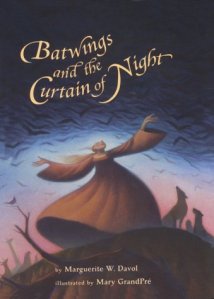
Batwings and the Curtain of Night, written by Marguerite W. Davol, illustrated by Mary GrandPré. Published in 1997 by Orchard Books, New York.
This tale first came to me at the age of 15 or so.
The Mother of All Things shapes the world lovingly, halving its hours into night and day, then bestowing it upon all the creatures of sea, wind, forest and field. Rulers of themselves and their earthly domain, the animals are all drawn to night’s restful canopy, but agree that it is overwhelmingly dark for their navigations. Purposing to alter the face of night itself, they enlist the aid of all the world’s bats in pulling back the vast, inky curtains of nights, to allow more light to peer through. As the Mother of All Things watches on wisely from her vantage point, her animal kingdom valiantly attempts to punctuate the mysterious deep with points of glimmering light, mirroring her own desire to colour the world in radiance, at the first breath of its Creation.
What enchanted me?
Stories that sing different choruses about the beginnings (and, for that matter, the endings) of All Things have always captured my attention and delight, especially when they are compellingly, sincerely told. Batwings and the Curtain of Night is no exception. The language employed by Davol invites itself satisfyingly to being read aloud, fashioned as it is of simple prose, elaborately arranged, with an overall effect of graceful, easy magic. Mary GrandPré’s art, made famous on the Scholastic-edition covers of the Harry Potter series, is an exquisite complement to the narrative. It is imbued with equal measures of light and darkness, mystery and illumination, depth and phosphorescence; therefore its very style patterns near-perfectly the concerns at the book’s core. I cherish every reread of Batwings and the Curtain of Night as a gently-bestowed reminder of all the beautiful things that are wrought from shells of seeming brokenness. (Read it, and you’ll know just what I mean.)
Lines for Life:
“Together they climbed the highest mountain. When they reached the peak, they looked up. The sky, almost dark by now, still seemed very far away. Could they reach it?
The owl said, “We must all fly as high as our hearts will allow.”
With a mighty whirl, the bats and the owl soared toward the sky. Struggling upward, they flew and flew until they thought their hearts would burst. But no one gave up.”
This book would be best beloved by:
♣ anyone who believes in, or has built altars of prayer in honour of, a bountiful, benevolent Mother of All Things.
♣ those who appreciate the thriving truth of multiple meanings in the dawning of our world.
♠ one for whom the bat is no less a mythical, marvellous creature than a roaring lion, or a peacock in his plumage.
Owl Moon, written by Jane Yolen, illustrated by John Schoenherr, published in 1987 by Philomel Books, New York. Winner of the Caldecott Medal in 1988.
I first opened these pages when I was in my early twenties.
In the quiet, deep heartbeat of a winter’s night, with the moon full and expectant against the sky, a girl walks into the woods with her father. The sounds of human and animal life fade away into white-blanketed silence as they walk, exchanging no words. She is going owling for the first time, and in this sacred space of an awestruck initiation, all her senses are livewires that conduct the experience back to her, and through her, though she utters not a syllable. They carry no nets, no bait (save an owl call, offered earnestly), no measures of entrapment whatsoever. Both she and her father know, in varying degrees of detail, but with equal faith, that the only armour needed for a true owling experience is hope.
What enchanted me?
There are rare reads that encourage you to become a better person, every time you read them, which simultaneously exact no toll on you for being exactly the person you are, in the here and now. Owl Moon is such a book. Yolen paints a cinematographically vivid landscape with a carefully collected assembly of words, poetically rendered, without any ornamentation, it seems, but a devotion to preserving passionate rituals between parents and their children. Schoenherr reminds us of the subtlety that truly majestic art wields. We are there, with the girl and her father, trudging relentlessly through knee-high drifts, shielding our faces against frost’s kiss, hopeful determination beating in our hearts. I love that Owl Moon speaks so unequivocally to being resilient, to embracing fear and walking calmly through it to the other side, where peaceful territory awaits. This book will remind you of the most sweetly sacrosant of peregrinations you paced out in the company of the one you called, or thought of, as Mother or Father , despite blood. If you have none on which to full-heartedly reminisce, this book will make you yearn to create some, for the children you have, or will.
Lines for Life:
“When you go owling
you don’t need words
or warm
or anything but hope.
That’s what Pa says.
The kind of hope
that flies
on silent wings
under a shining Owl Moon.”
This book would be best-beloved by:
♣ the children of winter and all her breath-misting revelations, no matter from whence they hail.
♣ believers in silence as a necessary guide on any journey of note.
♣ all parents who wish to share life-affirming magic with their children; all children who wish to learn how to grow up, and stay young, with their parents.
Charting Children’s Literature is a monthly feature at Novel Niche that seeks to highlight the beauty and richness inherent in many of the books written and illustrated with the enjoyment and education of young children in mind. The feature was launched in August 2011, and is set to run for the foreseeable future (to infinity and beyond)!
If you’re interested in bringing to my attention beautiful children’s books I haven’t yet covered, feel free to leave a comment on this page. If you would like to contribute a guest Charting Children’s Literature feature, please make use of the contact form provided. I’m looking forward to hearing from you!
I think that the short fiction form is severely underrated in contemporary reading tastes. It’s a telling (and troubling) sign that short story collections sell with less success than novels do, to the extent that many writers aspiring towards publication are discouraged from dedicating their time to the former, since the latter holds more promise of lucrative gain.
Short stories are brilliant at capturing the crystallization of a moment, an encounter, a single, sustained emotion, feeling or thought that lingers long after the reading. The best can render us speechless and lightning-struck in a handful of pages. They are ideal conversation fountains, and enrich us with minimal time dedication on our part. Perhaps most significantly, they are valuable gateways into the world of reading, for those who are bookshy.
Ellen Rhudy, of the marvellous book blog, Fat Books and Thin Women, runs a weekly feature dedicated to the enjoyment and analysis of one short story at a time. Its tagline is “Always short stories, always ones available online for free”, and I’ve admired the accessibility of this for quite some time. I’m pleased to announce that, with Ellen’s blessing, I’ll be participating in the Story Sundays feature, every week at Novel Niche, adding to the enthusiasm reserved especially for coffee, cigarette or evening-length reads. Ellen’s story this Sunday is “Fire” by Chelsea Laine Wells.
I’m happy to launch the feature with the work of another colleague of mine, the writer Jason McIntyre. Here are my musings on his novelette, The Night Walk Men, which, in the spirit of the free-to-access segment of Story Sundays, he has graciously made free to download. You can access it in the format of your choosing at Smashwords, here.
“Death has no prejudices. None that I’m aware of. Well, unless of course you count a discordant bias for the elderly. Or that heaving soft spot for the unhealthy and for the careless.”
Jason McIntyre continues to write fiction I like, in a genre I’ve always avoided. Reading his work has proven to be a reliable barometer by which to mark my preconceptions, as well as a reminder of the successes that can accompany fictive genre-melding.
The Night Walk Men, a novelette offering from the author of Thalo Blue, is no exception. It is a curious tale of justice, mediated by non-human hands, narrated to us by Sperro, a Night Walk Man, a character who waxes cryptic and revelatory with each of his admissions. He tells an eager, unidentified listener (for all you know, it might be you) of his brotherhood line, of the life-altering, reality-shaping work they carry out, and of an important young girl, affectionately dubbed ‘Gabriella the great’, over whom two prominent Night Walkers fundamentally disagree.
There is no other personage in The Night Walk Men from whom I would have preferred principal narration. Sperro’s encouragingly irreverent demeanour makes the work that much more readable. He spends much of his time on the page protesting that we don’t really want to hear the story he has to convey, though we protest that we do. His list of metaphors for pain, which introduce us to the novelette proper, are achingly valid, all of them aptly delivered without trite flourishes:
“This is going to be coming down from on high. Or finding your spouse in bed with another. Or murder-suicide. Or heavy metal from the neighbour at three in the morning. This is going to be the doctor telling you it’s inoperable. Or a chemical burn on flesh. Or pepper spray and a wrongful conviction. This is going to be a fire eating your life’s work. This is going to be Your First Time. Or Your Last Time.”
There is something in the way that Sperro speaks to the reader which recalls all the meaningful conversations in your life, the ones that span hours, undivided, or ford the rivers of rushing years with their implacable necessity. If you haven’t had conversations like that, there is an arena of your life that’s not yet been fiercely assaulted with investigation, and more’s the pity. I imagine it would be a worthwhile experience to talk to all of the Night Walk Men whom we meet: flinty Sperro, sad, weary Obsidion, unyielding and resolute Montserrat. These three shadowy, solemn figures each merit our attention, elicit our sympathy, and prompt discussion with fellow readers.
Perhaps less engaging is the character of Braille the Rail, a blind, affable saxophonist whose own life imbricates meaningfully with Gabriella’s, at a crucial juncture. I don’t think he’s poorly done, necessarily; I’m quite certain he’d induce me to hunker down on the floor of the train station and belt out a rousing duet with him—after all, he’s written that way. Still, there is something in him that resembles residual stock quality. He almost reads as a composite of every emotionally sensitive, mentally attuned blind man with a penchant for music and wise ruminations we’ve encountered in works of fiction. The constraints of the novelette form may not afford him the same room in which to take root. Nor do we learn much of Gabriela that emotionally binds us to the promise of her slumbering greatness. Perhaps we are meant to empathize far more with the guardians who struggle, labouring beneath the yoke of their extraterrestrial vocations… and if this is McIntyre’s purpose, it is handsomely achieved.
There is something maddening about reading a fictive work that lingers perpetually on the precipice of a big reveal that is never revealed, isn’t there? Many of the questions this novelette raises do not answer themselves. Unless McIntyre is brewing a sequel, the only responses to your burning queries about Gabriella’s fate, or the continued role of the nocturnal sojourners, might well be the ones your own imaginative speculation furnishes. In some instances, this unresolved tension is indicative of nothing so much as authorial laziness or indecision, in the mode of “I didn’t know where to end it, so I just… ended it.” Thankfully, McIntyre’s writing does not give rise to this breed of suspicion. Indeed, the lack of comforting closure by the end of Sperro’s grim discourse could be interpreted as a quiet affirmation of the fact that tidy, linear endings rarely exist—a reality within which the Night Walk Men must function, or else perish.
An hour’s read as cerebrally provocative as it is solidly presented, The Night Walk Men distinguishes itself from normative crime-suspense-thriller dross with its decidedly literary cast. Shot through with shades of the metaphysical, the bleakly humorous and the wildly speculative, if it doesn’t at least make you wonder… then I’m coming straight to your door for the answers.
Jason was gracious enough to answer some questions I had on The Night Walk Men; here’s a transcript of our interview.
The writer, giving his best Sperro impersonation?
‘The Night Walk Men offers us your perspective of eternal guardians, watching over the realms of the living, acting on orders from a source on High. This isn’t necessarily a unique concern (but, of course, these days, what is, right?) What do you think sets your treatment of this archetype in literature apart from the rest?
The candy coating. Don’t laugh; I’m actually being serious when I say that. Let me explain. Most books and films that personify death do so in one of two ways: either showing it as a harbinger of black, horrific nightmares plus all the bad stuff we associate with leaving this world, or as benevolent angels doing everything they can to make our exit peaceful and meaningful in a dramatic way.
The Night Walk Men is about the blue collar working class who are charged with dealing Death. And Life. These people are doing their job. They get orders from a boss in a figurative corner office, whose motives they don’t always understand. These are assembly-line figures who do everything short of punch a clock. Our narrator is bitter, embroiled in a centuries-long tenure he feels is important but that no one fully appreciates, that no one really understands. He and his kin are the writhing, unwashed masses of his occupation. And he is desperate to leave some kind of understanding behind to those he feels might be, ironically, incapable of understanding.
Plus, he’s a sarcastic, heavy-handed fellow. I can’t help but love his brutal honesty, can’t help but love him—warts and all, as the saying goes.
As you know, I enjoyed reading Thalo Blue, one of your full length novels, which I reviewed on Novel Niche in June. If you had to single out one thematic concern that unites Blue with The Night Walk Men, what would it be?
Writing decent fiction is similar to good songwriting. There’s power in the silences, those moments between chords, those moments between melodic movements. If the writing is good, the reader will skim across character, detail, plot and everything else that’s left deliberately out then come up with a result somewhat unique to them, possibly akin to their own sheer imagination, or to drag out my analogy, akin to a melody heard inside one’s own head.
I believe this is why you can see drastic, bi-polar reviews for the same book; some hate it and some love it. If everyone had the same look at the same book, then it would likely be called “Sweet Vampiric Stereotypes Volume Thirty-Nine”.
As for thematic parallels, I must say that all my work, Night Walk Men and Thalo Blue included, deal with the idea that we are not above anything. There is something at work on our lives and in our world that is trying to harmonize with us. Is it a spiritual undertone? You might interpret it that way. Is it a supernatural or paranormal presence? That’s also a valid interpretation.
Will I be so overt as to say what I believe? Perhaps in time. For now, though, I’ll probably just explore these ideas through more stories and see if I can use this exercise as a way to establish what I do believe. And what does make sense to me.
The names you’ve chosen for this novella are spot on! I’d like to know a bit more about what goes into your naming process; has any name you’ve given a character been arbitrary?
They’re all completely arbitrary. What? You thought there was some magic there? Some divination? Nope. None.
Okay, that’s not entirely true. I do give great thought to character names. Have any been without some level of forethought? Sadly no. And when writing—since I write in an entirely linear fashion, despite the sometimes non-linear stories—I will often find myself at a dead stop for fear of introducing a new character called by the wrong thing. I can’t go forward until the name is right.
The process starts in the cranium. I draw ridiculous associations with names that I’ve heard, people I have known, or those from other stories and films. Then I do research and try to combine given names and surnames with some sort of semi-obvious tone to them. I don’t want them to be outright and obvious but perhaps they can be let to stew in a reader’s mind as they read the book. Then, Eureka!, I know why he named her that!
So you’re sitting opposite a stranger on a park bench, and she’s reading “Sweet Vampiric Stereotypes Volume Fang-fourty”. Tell her something about your work, The Night Walk Men in particular, which will make her drop the smut and run to Amazon.com/Smashwords/the other fine e-stores your writing is sold.
Well, I imagine, knowing my own character, I would probably converse with her about anything other than my writing. I might enquire as to what she finds so titillating about the smut, as you call it. But all the while, I’d probably never ‘fess up that I have written anything. In truth, if she’s reading that, she’ll likely never care to give anything of mine a chance.
However, to play along, I’d probably say that this young author is writing something like contemporary baroque lit-fiction, often but not always, with tinges of the paranormal. His characters explore their world with innocence but the world in these books is anything but.
I like to say that my role as a writer is to break your heart, utterly and completely shatter it to pieces. Then, bit by bit, my next task is to put it back together again.
I’ve quoted a set of lines I especially like, to preface my thoughts on your novelette. If you were going to excerpt some of your favourite lines, what would they be, and why do you love them so?
Tough question. I do like the ones you’ve chosen as well.
My feeling is that the more melodic bits can only exist if there are, as I said before, empty spaces around them. If there is too much of this melody, then the whole thing falls under the weight of its noise.
I like many. Some include:
“It’s a strange thing: I suppose a body gets used to laying under a sheet at night and when it doesn’t feel the familiar weight of fabric pressing down over it, it can suddenly feel exceedingly unnatural.”
from Shed, 2010
It’s not written particularly well, but the sentiment is a strong one. Not only does it work well in the story, but it says so much about the human condition.
Another from The Night Walk Men might be this entire paragraph:
“I should tell you that I’ve seen Death. I’ve seen Death nearly every day. Just today, in fact, I witnessed Death walking down McMurchy Street. In what city, I cannot recall. And for what purpose, I cannot tell you. But at what time, that I do remember. It was just before high noon, and He was there, moving south, determined. If you had eyes and were at my side, you’d have seen Him too. He might have been searching for a sick child, might have been looking for a young fellow who didn’t look both ways before crossing.”
Why do I like it? It does a solid job of personifying Death. It is mythical in its quality and I believe every reader will understand the notion of Death seeking out sick children or some young one who didn’t heed the words of his parents while trying to fetch a stray ball.
I’m deeply grateful to Ellen for her consenting to my adoption of the Story Sunday meme; I fully intend on doing it justice and continuing to contribute in the fine style that Ellen’s established (with my own, Novel Niche-esque quirky flair, of course)! I’m also appreciative of Jason taking the time out to respond so thoughtfully and thoroughly to the questions I posed. I look forward to seeing his writing career evolve. His finely articulated, synergistic style is a worthy platform from which many lofty fictive trees can be grown; so here’s to reading in that particular forest… and here’s to countless Sundays of short fiction splendour!
Story Sundays was created by Fat Books and Thin Women as a way to share appreciation for this undervalued fiction form. All stories discussed are available to read free, online. Here’s Fat Books and Thin Women’s Story Sunday archive, and here’s mine. Want to start up Story Sundays on your blog? Yay! Email story.sundaysATgmail.com for details.
“It was happening so fast. He had this funny feeling that it might be him. It might be him that this was all about …
This is how you become a certain way. This is how you become who you are.”
–Jonathan Goldstein
Reading Lenny Bruce is Dead is like channel surfing through a movie that occasionally, and terrifyingly, reminds you of your own life in shocking and embarrassing ways. Goldstein’s style is both guileless and visceral, with a humour and delicacy that reads like the sort of poetry you hesitate to call poetry because poetry doesn’t usually have so much ejaculation in it. It is the seamless contrast between the obscene and the transcendent that gives the writing its profound power. Imagery, gorgeous and decadently crude, completely unconnected to the narrative, lingers for days:
“He liked jerking off to flappers. These women were all dead but their spirit lived on in his erection and when he came, they died all over again.”
There is a sort of magic realism inherent in certain imagery that lends a lucid, dreamlike quality:
“We all saw that we were really the size of Chrysler Buildings and sex was about angels dying from the sheer beauty of it all and that the greatest pornography of all was the human imagination.”
The prose is infused with a longing for which there is no cure, except perhaps to read books like this one.
The novel, the scanty plot of which concerns a young man called Josh whose mother dies and leaves him and his emotionally helpless father alone to cope with her absence, is held together and made cohesive by remembered moments of his life that lend context to the dishevelled present:
“He ran through the snow and all he could see was white. It was as if he was dead and nobody could see him. At the depanneur, he walked through the aisles and pretended he was car exhaust.”
The novel is filled with small, breathtaking moments like that, moments that rip you backwards through time until you are a kid again, eating cereal while watching early 1980s cartoons in your He-Man underpants. It somehow evokes perfectly whatever time period in which you grew up and the time when life was the most confusing. You know you will never be happy like that again, except in retrospect.
The narrative is broken up into tiny increments that are the literary equivalent of snapshots taken randomly out of the album and scattered on the floor. These little vignettes are memories not only of Josh’s childhood and his dead mother. They also include the sordid details about all the girlfriends he has ever had, his relationship with his father, his rabbi, several of his friends, the coming of the Moschiach, and an arch nemesis or two. It isn’t a novel about coming of age, however. It has nothing to do with resolving parental issues, or coming to any conclusions about the mysteries of the human condition. Goldstein’s style has a disquieting morbidity, reminding you at the least likely moments that you are afraid to die. Certain lines of dialogue and internal narrative that perfectly articulate all the insane thoughts you don’t have the courage or imagination to put into actual words. Thoughts too profound to share out loud are expressed so simply, they almost seem mundane:
“He woke up in the middle of the night and felt nothing but that he was alive. This was the panic he kept trying to describe. Being.”
Each paragraph of Lenny Bruce is Dead is a novel of its own. Cut each one out and slip them into fortune cookies. Break one open when you need to reminded that any stupid, shitty forgettable moment of your life is beautiful and irreplaceable, no matter how disgusting or embarrassing it is. It will tell you over and over: You are completely and irretrievably alone, but you are not the only one. There is no prize for most pathetic, least loveable, or easiest to confuse. We’re all in this boat together and it’s sinking, so don’t miss out on any opportunity you get to jerk off or get laid or eat something you know will give you diarrhoea later, but what the hell. “One day there will be no difference between anything.” Goldstein writes, “It’ll all be the exact same thing. One day you’ll look in the dictionary and there will be only one word and you’ll just have to make do.”
There are books you love for reasons you can’t explain. It has little to do with what the book is about. None of the essential plot points are more meaningful to you than the ones in any other book. It isn’t the way the narrative resolves itself perfectly or charmingly unravels at the last possible minute, so you’re never quite sure if you got it or not, or even if you were supposed to. If you worry about whether or not you are “getting” a book, Lenny Bruce Is Dead probably isn’t for you. If you want a book that gets you, even if you don’t get it, then give it a try. I doubt you will be disappointed. And if you are, at least you will feel understood. Goldstein’s narrative is seemingly plotless and disjointed until at the end of it all, you look back and say, Okay. I sort of get it now. Can I just start again, please? I promise I’ll pay attention this time. For what has been called an experimental novel, there is no gimmick here. Just an honest and hilarious and deeply human story that has haunted me for nearly a decade. I’ll keep reading it, again and again, for all the decades to come.
McKinley M. Hellenes is a writer living in the Ruskin area of Mission, British Columbia. Her writing has appeared in various magazines of ill repute. She is currently at work on a novel about Post-War Vancouver and a Feminist look at Holocaust survival, for which she received a Canada Council for the Arts Grant. She spends her days waiting for the seals to come take her away. In the meantime, writing stories suffices.
“For a time, a countless time, there had been nothing more than ceaseless water, stinging bone-sand, and the wind, keening; but suddenly the wind died and the grinding waves smoothed down to uneasy swells. Sounds whispered over the unquiet waters like a chanting of spells; at first they held no more meaning than the mourning wind or the hissing sea-spume, but then came a sound that caught and held, like the anchor of a ship.”
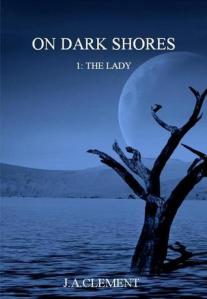
Nereia is a resourceful thief, quite likely the best pickpocket that the small, salt-sprayed fishing town of Scarlock has seen. Though bitterly weary of her trade, she perseveres for the welfare of her sweetly trusting younger sister, Mary. Orphaned since Mary’s infancy, both girls live uneasily in thrall to Copeland, a small-time shady businessman with big-time aspirations, in the acquisition of which he intends to involve Nereia, whether she willingly consents or no. Bolstered by his stoic bodyguard heavy, Blakey, Copeland proves himself distressingly capable of meting out punishment to those who would liberate themselves from his iron grip of control. Despite her prior knowledge of this, Nereia cannot help but make a desperate bid for freedom. In so doing, she pits her gritty resilience against Copeland’s well-crafted cruelty. The quietly slumbering village that witnesses their struggle, and the startling events wrought of its consequences, may well hold more time-brined secrets than its shuttered windows and sea-slick walkways suggest.
Reading the expository opening paragraphs of On Dark Shores 1: The Lady prompted my best hopes for a gracefully constructed and fertilely imagined creative landscape. In these lines, we are introduced to the cast’s main players not by name, but through their dreams, all of which are uneasy, tempest-tossed. Tidings are being washed ashore which will bode ill, we are given to understand, and this hinting at future upheaval is admirably conveyed through Clement’s subtle associations of geographical tumult with individual distress. It is evident that we are reading the work of someone who enjoys implementing literary ornamentation, someone who is mindful of the importance of strongly crafted situations, and equally worthy characters to populate them.
That being established, however, the novel lacks a certain evenness of successful storytelling. There are beautiful, glowing passages, to be sure, but there are also areas which appear to have missed a similar application of consistent, dedicated layering. Much of the novel’s narration is dependent on third-person accounts of events, which provides the writer with a broad canvas for perspectives. Given the number of personages to whose inner thoughts we are privy, the potential richness available from multiple non-omniscient narrative seems only hinted at in promising glimpses, without ever truly being deeply sustained.
Reading Clement’s depictions of the natural terrain of her novel offers the surest marker of appreciation for her descriptive prowess. The polish and gleam in her lines often shines most brightly when she writes about the sea (which, given the title of the series, might be intentionally done, or not.) For instance, it would be difficult to savour the following:
“The drizzle had stopped, but the light was failing across the restless sea; the smoothed steel swells were growing wind-tipped and wild with hissing spray.”
and then declaim Clement as talentless; quite the contrary. If she were a consistently uninspiring, yawn-soliciting producer of paltry prose, that would render this review short and dismissive. The difficulty lies in aligning her bountiful caverns of gorgeous writing with her other fictive terrain that is decidedly less lush. Much of the dramatically-infused dialogue featured in character altercations is less riveting than it could be; this is not to suggest that the author ought to puppeteer her players into uttering phrases only as she would say them. The beauty of dialogue (and third-person limited narration alike) lies in allowing an imperfect, biased, disjointed accounting of things; yet without authorial polish and poise, neither scenario nor character appears in their intentional (and thus convincing) lack of lustre. Instead, the writing suffers; the writing appears unmade, neglected, merely patched up with good intentions and talented flourishes, not soundly caulked through in an expert’s hand.
I do not suggest that there aren’t gems to be unearthed in this first installment of the On Dark Shores series; there are. Previously mentioned is Clement’s proficient sculpting of the geographical vistas of her story; the land and sea speak to us as convincingly as Scarlock’s residents and visitors, at times, perhaps more so. Among the highlights of narrative lie expository snippets from townsfolk who aren’t crucial to the machinations of the main plotline (or are they?) such as Niccolo, the fisherman who, early on, provides a piece of fateful information, and spends the rest of the story accounting to himself for its unintended results. Another minor character who prompts intrigued speculation is the proprietress of the local brothel, referred to enigmatically as Madam. Her past is storied, checkered with less than savoury happenings, and if she becomes a central figure in the events of the series’ next installment, I sense that it will be all for the good. Do not be surprised if you find yourself yearning for more revelations concerning the mystical mother of the Shantari and her monumental upcoming journey. Hungering for elucidation on the second novel’s skeletal premises, beckoning beyond our reach, is an excellent effect engendered by a first-part installment, but not if it comes at the risk of souring or, worse, sapping our interest in the events of the book currently in our hands.
Clement does a formidable job of constructing a world outside of the primary events of the novel; this holds its own drawbacks as well as delights. Often, the concerns and preoccupations of the fringe characters are more compelling than the principal ones. Nereia herself is the most glaring disappointment. She possesses all the requisite building blocks for Clement to create a rollickingly outstanding heroine. Instead, she wanders through the plot’s progression (which is less haphazard and more sketchily dubious, reading as though telling segments of it had been left on the cutting floor) with spirited gumption, certainly, but without the visible progress necessary to substantiate her full self. By this I mean that she owns enough moxy and fortitude to establish her as a warrioress worth our time, without sufficient context-crafting, without the heady, darkly glowing internal monologues and stream of consciousness narration that would have furnaced her fighter’s tale so convincingly.
On Dark Shores 1: The Lady tips itself out of favour by anchoring its plotline with a forcibly forward slant towards the remaining two books in the series, not allowing for the bountiful breathing space to truly come into its own. Its gracious writing style, dedication to fleshing out particular characters and literarily-cast foundation recommend it; its incoherency, implausibility of certain situations and disjointedness make one hope for a far more spectacular sequel. I do hope for it. There is brilliance in this authoress’ dusky world of wailing wind and water…muted, perhaps, but visibly gleaming all the same.
J.A. Clement’s engaging website, Wandering on Dark Shores, features comprehensive updates on her writing process and plans for the full series, as well as a host of purchase links for the first novel. You can also follow her on Twitter, here.
A free electronic copy of this novel was provided by J.A. Clement for review. The opinions expressed in this review are entirely my own, and are not influenced by her generous gift of gratuitous literature.
Winner of the Locus Award for Best Fantasy Novel, 1997.
Shortlisted for the Nebula Award for Best Novel, 1997.
Shortlisted for the World Fantasy Award for Best Novel, 1997.
“Wind and words. We are only human, and the gods have fashioned us for love. That is our great glory, and our great tragedy.”
We’re not in Middle Earth any more, baby.
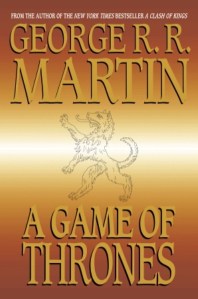
Don’t get me wrong — you’d be hard-pressed to find a more earnest Tolkenian stalwart than your humble reviewer. I begin with Tolkien, not to disparage or dignify Martin by comparison, but to posit that both men have crafted worlds beyond measurable value in the genre of adult fantasy. A Game of Thrones, first in the A Song of Ice and Fire saga (and here is a series that deserves such a title, not other current pretenders that feature incandescent undead and perpetually blue-jeaned werelings), is worthy of a place on the loftiest pedestal you polish for your high fantasy, for reasons both dirty and divine.
Winter is coming. These are the the watchwords of House Stark, proud and patrician defenders of the North of Westeros and rulers of Winterfell, its ancient castle fortress. Presided over by principled Eddard Stark, his loyal wife Catelyn and their five children, Winterfell enjoys a lull of peace before the arrival of Eddard’s best friend, the King of Westeros’s Seven Kingdoms, Robert, who presses the former into becoming his ‘hand’, his second in command and principal advisor, to rule at his side in King’s Landing, many leagues south of Winterfell. Eddard’s beloved bastard son, Jon Snow, seeks his own livelihood elsewhere, denied the companionship and security of a permanent place in the Stark familiarity he’s known his entire fifteen years. He rides even further north, to fringes of civilization and the Wall, a massive ice bulwark spanning 300 feet long and towering 700 feet tall, hewn by Brandon the Builder to defend Westeros against the threat of wild creatures both known and beyond human imagination. Jon “takes the black”, swearing his fealty to the Night’s Watch, a band of ebony-clad soldiers charged with the protection of the Wall against every possible threat. Meanwhile, across the narrow sea from Westeros, wily, dispossesed Viserys Targaryen, last male survivor of the royal line King Robert slew, dreams of nothing but regaining the crown he deems his birthright. He sells his young sister Daenerys in marriage to fierce Dothraki warlord, Khal Drogo, in hopes of attaining a vast legion of horsemen to recapture the kingship at his command. These concerns involve the three-pronged storyline of A Game of Thrones, but they are a mere glimmer behind the bedezined curtain of plots, subplots, and tributaries of storylines stemming from even these.
Two major criticisms I’ve read of A Game of Thrones is that it’s appallingly overconcerned with the sociopolitical intrigues of the monied elite, as well as guilty of favouring a decidedly misogynistic slant. Given that the titular game refers to an ongoing series of intellectual manipulations and sleight of hand coercions for ruling power, I cannot see how the selfsame intrigues would not come to the fore. It is worth noting that it is not always the monied elite players of the game who yearn for power, however. All have aspirations, and the aspirations of all are keenly documented, not merely those of royal bloodlines. The concerns of the peasantry, the commonfolk, the ‘little people’, are admittedly less prevalent, but they do occur. They oil the machinery of the grand conquests; they litter the battlefields of bad decisions. The fact that they do not speak as much surely says a great deal about them, the position they hold in society, and the stratification of society itself. When they do speak, which is not, it ought be noted, a rare occurrence, merely a less frequent one, it is always believably, and in service of plot strengthening, theme reinforcement and general expository goodness.
As for the lack of strong female characters in the novel, yes, there are several less of them than their male counterparts. George R. R. Martin’s prerogative in writing of more men in positions of power than women can hardly be called a misogynist’s work, if this is the sort of creative world he wishes to establish. Refusal to read the book on these grounds seems like lazy feminist pointscoring that owns no basis in logical assertion: would a novel densely populated with women warriors and leaders offend the rights of men? I’m all for reading about the ascent of gorgeously-sculpted women in literature and life, and the stories of Daenerys Targaryen and Arya Stark are well worth the stories of ten less lovingly-limned leading ladies.
A densely worded world needs vibrant, achingly alive characters to populate it, else all its lavish description has been for naught. Martin moulds such figures in abundance, and charges them with the telling of the thousand and one tales within these pages. The narration of the novel is entrusted to eight principal players (excluding the hair-raising prologue, delivered to us by minor figure, Will). They are:
Eddard Stark, Lord of Winterfell, Hand of the King of the Seven Kingdoms, a man burdened beneath the bastion of being almost entirely too good;
Catelyn Stark, Eddard’s loving wife, supportive of his every decision, save his emotional proximity to his bastard son;
Jon Snow, newly-appointed man of the Night’s Watch, who chose to serve for honour but finds the reality decidedly more grim;
Sansa Stark, Eddard and Catelyn’s eldest daughter, exceedingly fair of face and soft of courage, the polar opposite of her sister;
Arya Stark, as steel-tempered as any aspiring knight, and more than many, no less resolute than her brother;
Bran Stark, whose dreams hold far more than the fodder of mere daylight imaginings;
Cersei Lannister, radiant wife of King Robert, who is more than passing attached to her equally lovely twin brother, Jaime;
Tyrion Lannister, also called The Imp, younger brother of Cersei and Jaime, and, as he himself would be quick to point out to you, a dwarf.
The utter lack of authorial omniscience in the narration makes each account from each character sing all the livelier. One becomes so engrossed in the tale told, for instance, in Tyrion’s chapters, which are brimful of well-executed wit, wordplay and self-deprecating humour, that to see them come to a close often elicits a frown of annoyance. Switching from Tyrion’s narration to Arya’s, especially after being left on the crest of a dramatic, jaw-dropping development, or a particularly arch comment from The Imp, seems frustrating for the first page, until Arya’s pugilistic perseverance entirely wins us over. We part ways with her at the end of each of her chapters, musing ‘ah, if I only had a daughter/sister like that… why can’t I be more like Arya, anyway?’
It is in this respect that Martin’s cast reminds me of Tolkien’s: for the archetypal luminescence by which readers best enjoy identifying themselves. There is no underdog who can read Tyrion’s half-bitter, half-humoured introspectives without at least a tinge of knowingness, just as no mother, made frantic with desperate love for her children, can deny that they, like Catelyn Stark, would not cut their hands to the quick, to save a slumbering son. The personages within A Game of Thrones could be used to construct a tarot deck of emblematic figures, each character occupying a central or minor slot. What tempers this universal accessibility, however, is that none are drawn with too thick a brush in one overarching quality. Tyrion, for instance, may distinguish himself from the ruthless egoism of House Lannister and his siblings, but his penchant for exquisite enactments of cruelty makes for spectacular reading. Viserys Targaryen rules over his half-crazed compulsions and his little sister with a mercilessly iron fist, but Daenerys remembers him for his passing peaceful jaunts as well, for his quietly hungry boyhood dreams of a better life for them both, in a kingdom across perilous waters. The impression is sustained in nearly everyone we meet in these pages, of a life preceding their appearance in the narration, a life with all its innumerable associations, foibles and moral complexities. Reading characters who are less richly envisioned, less convincingly wrought, will be all the more telling for having read Martin’s, here.
Neither is the folkloric beating heart of the world of Westeros, and all that lies beyond it, treated with any less attention to detail. A Game of Thrones is prefaced by an exquisitely rendered map, pure cartographic delight in the tradition of Tolkien’s own storytelling legacy. There is history in every fireside account, in every mug of ale passed between hands in each tavern of ill repute. There are gods, both old and new, the ancient weirwood deities of the Godswood, beneath whose heart tree Eddard muses for guidance and polishes his greatsword of executioner’s blood; the pristine new gods of the septons and septas, the star spirits that the Dothraki believe to be the fallen dead. The novel is tapestry, a liberal and forceful commingling of belief systems as rich and dense as freshly shed blood, as deep as the darkest magic.
One could do much worse than to wander from Middle Earth into Westeros.
There is no genre quite like children’s literature when it comes to the creation and sustenance of our most ethereal, elemental dreams. Even the most notoriously bookshy of us remember the tales of our childhood. Even if your favourite youthful adventure or fantasy is not in any book you know, surely it was told to you…whispered in your ear during a rowdy recess break, or murmured across a campfire. If parents allow themselves to release their grip on adult sobriety, they, too, derive an equal pleasure from reading to their children, as their children delight in the listening and the looking, the reaching out to touch ornately patterned pages.
I have never denied myself the joy of reading a child’s book, of immersing myself in the story, of delighting at the quality and expressiveness of the illustration — and I daresay I am the merrier for it. Deciding to embark on this feature sent me back to the bookshelves of my parents’ house, where I grew up, where I often return. Instinctively, I knew just where to find certain titles; memory drew me back to them unerringly. Others I discovered by searching, rummaging through stacks, disrupting fine layers of dust. The revelry of rediscovery was no less than the satisfied thrill of anticipation. I read; I reread. I traced out lines of familiar faces and places, amazed at how it all came back to me, wondering whether it ever really left.
Beginning now and continuing indefinitely (as far as the road may wind, hopefully), Novel Niche will feature two children’s books each month. Some of these books I read when I was in pinafores, thigh-high white socks and brilliant red ribbons. Some I savoured in a business suit and sensible heels. All are beloved to me, and I am pleased to share them with you.
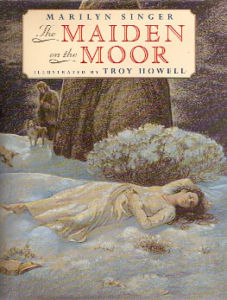
The Maiden on the Moor, written by Marilyn Singer, illustrated by Troy Howell. Published in 1995 by Morrow Junior Books, New York (an imprint of HarperCollins).
This tale first came to me at the age of 21 or so.
On a bitterly cold, windswept night on the moors, two shepherd brothers and their dogs stumble upon a barely-stirring raven haired beauty. Her mystery and fairness of face enchant the younger sibling, who carries her to his humble cottage home to protect her from the unforgiving winter chill. Lonely in the depths of his heart, the young and noble shepherd sings to his slumbering love, in the hope that she will awaken from her frosty reverie and consent to be his constant companion. Awaken she does, when the shepherd is asleep, but it is to take a surprising journey, one nigh-impossible to predict, with both devastating and uplifting results.
What enchanted me?
This book opens with a medieval English verse of “A Maiden on the Moor”, adapted by author Marilyn Singer. The rest of the tale is told in a gracious, gently lilting tongue. Howell’s art is expressively suited to this wintry fable of loss, love and redemption. His hand is at once light and constant; each brushstroke line adds to an interpretation of a landscape both subtle and powerful, peopled by souls governed as much by the magic of the moors as by the demands of their own hearts.
Lines for Life:
“In the evenings, when he returned from his flocks, he sat at her side. At first he, too, was silent. Then he began to talk of his life as a shepherd, his love for the moors. He told her how in the spring the pale yellow flowers perched like birds on the broom brushes. He spoke of summer’s shining days, its sea of heather, purple and green. But he did not speak of the sadness in his heart.”
This book would be best beloved by:
♣ someone who appreciates the beauty of a sad and happy ending, intertwined.
♣ all lonely hearts that long for love.
♣ all bewitched, bewitching maidens who know themselves.
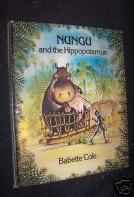
Nungu and the Hippopotamus, written and illustrated by Babette Cole. Published in 1978 by Macdonald and Jane’s, London (now defunct).
I first opened these pages when I was 5 or 6.
An enterprising young boy, Nungu, sets off in search of the mischief-making hippo who has swallowed up the entire Umvuvu River, which once flowed right around Tubu Island in the heart of Africa. Nungu’s grandfather, a fellow Tubu islander, gifts Nungu a special hiccuping medicine, formulated to make Madam Hippo expel the stolen river from her tummy. Armed with this, a particularly tempting pumpkin and his personal store of courage, Nungu sets out with his faithfully lazy donkey Masheety, to find Madam Hippo and restore the Umvuvu to his people.
What enchanted me?
I must have puzzled and puzzled for hours over how an entire river could exist in the belly of a hippo, no matter how magnificent her proportions. Even though I was a wee sceptic, even then, Nungu and the Hippopotamus never failed to delight—it still does. I smile in admiration of Cole’s storytelling, as I contemplate Nungu’s heroic quest: who among us would have gone hippo-hunting in our youth? The author’s illustrations are fine, precise and brimming with charming detail. Each panel is a work of art.
Lines for Life:
“What will you give me in return for this water,” said Madam Hippo.
“Do you like pumpkins?” asked Nungu, as if he didn’t know.
Madam Hippo smiled a great wide smile. “It just so happens that there is nothing I like better,” she said.
I’ve long been of the opinion that there ought to be some measure of subtlety in the writing of sex. A panting slather of erogenous zone names, rubbed together on the page, leaves me distinctly… dry. A preponderance of “bulging, turgid members” meeting “quiveringly helpless mounds” leads to a laziness of craft—just because the parts fit together doesn’t mean a writer need mash them in textually ’til they’re sore, and we’re bored. Portia Klee Jordan’s audacious, poetic and elegantly perverse collection, And Then Her Mouth, works toe-curlingly well for me because it doesn’t aim to evade the subtle artistry of good writing. It dives into it, gaping-mawed, and sucks us in—and we go; willingly, we go.
A principal selling point of this gathering of dirty divulgences is that they’re not a precocious tween’s teeth-cutting panty twisters (though you might stumble across at least one ingenue ripe for the picking among these pages). These are eighteen investigations of a persistently purple desire. The word ‘purple’ comes at us at many a turn in these tales – lurking ’round one too many a corner, for my liking. Still, if it best expresses, for Jordan, a particular aura, a no holds barred zone of throbbing openness, then a few too many purples are a miserly toll, spare change you won’t miss as you speed along this open highway of well-weathered pleasure-seekers. One gets the impression, while reading, of lives dipped deeply in lust and self-examination alike, which flavours each vignette with intensity, fire and fever, meriting belief and arousal. Whether these dirty stories are drawn from the velvet of the author’s own beaded bag of tricks, or not, she is owed a nod of approval for sparing us staid contrivances and sophomoric storylines.
Moral ambiguity makes the sensory ravaging you’re offered from each tale all the sweeter. You’re liable to find a kink for each sexual bent in Jordan’s repertoire, delivered sans ethical interference. In “Pretty Me”, following a nerve-humming exchange with Marcel the drag queen, formerly staid Patricia wrangles a cross-dressing, gender-torquing fetish out of her husband Gerald, with the aid of electrical tape, fishnets and theatrically imposed cruelty. The entirety of “III. Onomatopeter” is a single wicked sentence in celestially sordid punning. “II. Statutory Grape” plies us with the stream of consciousness hunger of a thirty year old observer for a girl whose “breasts are so new they’re surprised to be there”. Far less is on the menu than one might imagine, in “Eat Me”, the concluding piece of the collection, in which Melanie and the narrator have earned their absent gag reflexes for reasons culinary and otherwise. The author keeps scales of reckoning, blind or otherwise, out of her telling. The result: we get to decide how we feel about each scenario, and the freedom of this safe, sultry space is in itself back-archingly good.
My favourite of the eighteen (eighteen being such a primed number for this collection, in quietly declarative ways: the ‘official’ threshold for sexual release, versus the organic compulsion to explore the body/bodies of others much, much earlier than that) is unabashedly, hands-down, skirts-up, “Summer is Cold Here, Linnea”. Beautiful lesbian Dianna finds ways to thaw the nights of her work-imposed Alaskan chill, and intersperses her anatomical explorations with thoughtful missives to her lover Linnea, who (we assume) languishes for her, back home. The narrative cleaves cleanly down a line of epistolary versus confessional styles, rethreading the chasm between the couple, while emphasizing how much grey space there is between what they know about each other, and what they imagine to be true. As Jordan serves this wryly reflective tale that twists into us by turns both tender and intemperate, we marvel at the supple flow of her prose, the authority of her character construction. The introduction of Dianna establishes a plausible portrait of a flesh and blood Sapphist, not a cardboard and estrogen The L Word placeholder.
“Dianna loved women. She loved them. Her personal attachments, the emotional depth requisite for any long-term, soul-serving relationship, these were always with people of her own gender. She knelt down at the altar of worship and buried her mouth overflowing with the physical manifestation of love and awe in the tufted, fleshy crevices of the sex of the Goddess, the Mother of Us All, with whole-hearted, unshaken devotion. And sometimes she had sex with men.”
In the length of time it takes to share a clove cigarette with a dark-eyed stranger, “Summer is Cold Here, Linnea” breathes potent draughts of queer identity interrogation into us, and sweetens their consideration with two artfully lubricated sexual forays. A tour de force in miniature, it’ll leave you just as reflective as ravaged, and solicit many a damp-fingered reread. If you deem the last line of the story to be anything other than the epitome of tongue in cheek wordcrafting, plotwrangling excellence, then let me know—we’re ripe for a debate.
The poetics of Jordan’s pornography establish her as a sensual raconteuse well worth the consideration of the refined reader, the one who’s bookmarked special tracts in his sexual textbooks, the one who’d wager that she knows a thing or three thousand about fiction that enlivens, thickens the breathing, alerts the pulse. These lines from ‘Manipulation, Retribution’ display evidence of how beauteously the author connects our excursions into eros with her deft mappings of human emotion.
“The sounds coming out of my mouth aren’t conscious, aren’t really my own; they are from some other place, some Lovecraftian pit of tentacled grief. I give voice to a sorrow so great it has no name, to a feeling of loss so yawning and empty that from the first it sent us back shaking and looking over our shoulders to the warm cave fire, to rub shoulders with the others of our kind and turn our backs on our understanding of mortality.”
We glean these grief-soaked revelations from the story’s protagonist as he lies across his homemade sawhorse, abandoning his body to a brutal cropping from two courtesans, in the dungeon he and his late lover Martika made, together. ‘Manipulation, Retribution’ is as much a submissive’s playground of utter delight as it is a wise, emotionally spent man’s retrospective on all the things he’s hewn, and all the losses he’s incurred, through living and loving, and the well-stretched canvas he’s made of his life, in the name of non-conventional lust.
If And Then Her Mouth swiftly becomes your 2011 Bible for all things decidedly non-chaste, do let me know. If you’ve been reading those colour-by-numbers guides to literary kinkiness, consider this study in sex and the human psyche your graduation certificate… but please, try not to smear it. Unless, of course, that’s your thing. Portia Klee Jordan wouldn’t judge, I daresay, and neither will I.
You can purchase And Then Her Mouthdirectly from Portia Klee Jordan’s publisher, Xynobooks, as well as peruse their collection of archived and forthcoming titles.
A free electronic copy of this novel was provided by Nick Maloich at Xynobooks for review. The opinions expressed in this review are entirely my own, and are not influenced by his generous gift of gratuitous literature.
“The wash turned from yellow to a concentrated orange, one that screamed inside his head. He screamed too, at least he tried to. It came out of the base of his throat more like a stifled call in a windstorm with gravel and dust kicking at the words. It was the staggered, helpless plea of a man who did not know what was going to happen to him, and it ended in a gagging, choking sound as pressure from the stranger’s hands intensified.”
Sebastion Redfield is terrified. If you were embroiled in the precarious circumstances that surround him at the novel’s inception, you would be, too. Ensconced in the quiet lull of a neighbourhood defined by its lack of fanfare, at rest in his parents’ house (in which neither of his parents reside, any longer, for reasons both distinct and conjoined), Sebastion’s equanimity is shattered by the intrusion of a stranger who wants to steal something far more precious than the good china. In the aftermath of the attack, Sebastion aligns himself with the unlikely company of the psychiatrist assigned to his case, Malin Holmsund, in an effort to piece together the shreds of what they know about his assailant. While struggling to connect the identity dots of his mystery marauder, our protagonist learns in startling increments of just how much he stands to lose…and of just how little he can afford to stay still.
I’d wager that Sebastion, or Zeb, which he prefers, isn’t quite like any other leading literary man I’ve read, which I count as a reinforcing strength of this work. Even (or especially) among his peers, he both suffers and benefits from perceiving the world through a synaesthete’s eyes. His sensory and colour-coded interpretation of his natural environment makes for illuminating, oft-revealing reading. As we consider shapes and scenarios in shades and hues through Zeb’s visage, we are often called on to realign our paradigms for basic sight. A man on the cusp of maturity, we witness Zeb’s formation as he grows, through the author’s use of well-placed flashbacks. Nothing Zeb does or says in his journey towards self-preservation and self-discovery feels off-kilter, perhaps because we have been allowed to take the mark of him at every significant stage of his being. The impression of a life fully formed is what remains, once the last page of the novel has been turned. We feel that we have lived with our leading man, observing the peculiar palette that has been his life up until that very moment, and our reading is all the richer for the sense of this credible roundedness.
McIntyre’s other characters, those who are both pivotal and secondary to the successful engineering of the novel, are laudably represented. Not one of them is delivered gracelessly; not one is packaged without attention to detail. If you find yourself feeling tender stirrings of sympathy for someone in these pages who ought, logically, to defy them, be not alarmed. Villainous hearts are susceptible to tenderness and contrition. Quietly submissive souls spark forth in episodes of rage. Reading Thalo Blue is a timely reminder of the complexity of even those dramatis personae whom we’d like to easily slot into pre-ordered roles.
Good writing does not necessarily a good novel make, but Jason McIntyre is a good writer. When we read, we allow the author an unshakeable level of dominion over our senses—if the writer does his work well, we won’t want to be shaken. It took me no more than a handful of chapters to feel confident that I was in no danger of decrying foul fiction, and knowing this holds its own kind of quiet reassurance. What I loved best about McIntyre’s prose were moments when it lent itself to a sage series of omniscient narrative contemplations, such as this one, in which Zeb has an illuminating early conversation with his lover, Caeli.
“They talked about bigger things mostly, things beyond themselves but instead within the scope of the world at large. And amongst those monstrous topics, they talked about the little things, like the skin on the tops of their coffees, and the sound the soles of their shoes made on gravel as they walked. The hours were consumed.”
Anyone who’s traded silence for the earnestly raging river of this brand of discussion will instantly nod with acknowledgement, and appreciation of the skill with which it’s transcribed. I paused the longest to think of the following offering, which, in the interest of maintaining intrigue, may or may not be about Caeli, too.
“Friends and lovers speak in tongues. They use a language that no one else knows, one that they have invented for themselves only. It’s a secret handshake that either lives forever–or dies, carried off when one of its creators leaves for good.”
In the margins of my notebook, there’s a scribbled thought about this, written moments after I read those lines for the first time. “I know this,” it says. “I’ve lived it. I’ve been the one to take the language away, and I’ve had it taken from me, too.”
I do not suggest that all of McIntyre’s prose moved me equally, but it would be injurious to a writer, I think, if you demanded that each of their lines made you weep at its beauty. Some of the expository paragraphs hold a certain staid predictability, and some of the dialogue, particularly the interchanges surrounding criminal investigations, gave me, I confess, less pleasurable pause. Nonetheless, the overall effect is one of respectable, considered writing, and there is nothing to lament, stylistically speaking.
Opponents of a non-linear plot construction will find Thalo Blue nauseating. As a proponent of experimentation in all areas of literary craft, I was pleased to entangle myself in the meandering, converging threads of Zeb’s life. The reader will find herself thrust a decade backwards, sitting with Zeb and his father on the latter’s sickbed, yanked to the cosily clandestine scene of quite a different boudoir that Zeb shares with Caeli, pushed through the swinging doors on an ice-slicked collision. If the deciphering of which events fit where, and how, makes one tetchy, then I propose more careful reading. The ways in which the novel proceeds will reward a sensitive reader, and stymie one accustomed to a ‘colour by numbers’ approach to their fiction.
This novel earns its chops based on a neat list of accomplishments. Principal among these is its sophisticated residence in a genre of writing about which I am typically leery. Its discernible nicks in an otherwise glowing patina are happily worth the price of admission. A suspense thriller edged with nuances of psychological investigation, Thalo Blue is as much an examination of human behaviour beneath pressure as it is a bildungsroman with bite. If reading it prompts you to search out more of McIntyre’s work, then we’re in the same synaesthete’s landscape of brightly-hued anticipation.
Details on Jason McIntyre’s publications, including Thalo Blue, as well as direct purchase links are accessible from his Amazon.com author page, here. You can also peruse his personal website, The Farthest Reaches, here, where there are links to his Twitter and Facebook pages.
A free electronic copy of this novel was provided by Jason McIntyre for review. The opinions expressed in this review are entirely my own, and are not influenced by his generous gift of gratuitous literature.
Longlisted for the Orange Prize for Fiction in 2008.
“So if we’re all quarks and electrons …” he begins.
What?”
We could make love and it would be nothing more than quarks and electrons rubbing together.”
Better than that,” I say. “Nothing really ‘rubs together’ in the microscopic world. Matter never really touches other matter, so we could make love without any of our atoms touching at all. Remember that electrons sit on the outside of atoms, repelling other electrons. So we could make love and actually repel each other at the same time.”
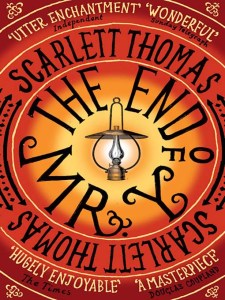
Many a bibliophile has been quoted as saying, ‘Give me books before bread!’, but Ariel Manto’s acquisition of an ultra-rare 19th century tome literally lands her near to poverty. Yet, for a copy of The End of Mr. Y, a literary work with which Ariel is obsessed, the decision is effortless. The fact that everyone who has read the book seems to have disappeared (including Ariel’s Ph.D. advisor, who once gave an academic talk on this ‘curse’) does not dissuade her. Once she reads The End of Mr. Y, she is left with more questions than answers, and a burning desire to follow the journey of Mr. Y himself. Her own journey, replicated on the steps that he—and Ariel believes, her absent advisor—took, sends her spiralling into an alternative realm of reality, called the Troposphere, in which she is able to spatially manoeuvre by piggybacking on the thoughts of others. However, Ariel soon realizes that (a) not all in the Troposphere is as it seems, and (b) she is not alone in her mindsurfing odyssey.
It is hard to figure out whether or not Ariel Manto deserves the reader’s respect. At several points in The End of Mr. Y, attempting to love Ariel can feel like an effort in loving the most (under)doggedly dismal parts of ourselves, the ones we feed with cheap alcohol, too many cigarettes and a lifetime’s dingy disappointments. This doesn’t mean that the novel’s protagonist is poorly-drawn; quite the contrary—she shines by her very lack of lustre. Insofar as a character’s convincingly-rendered moments of unlikeability make her eminently more likeable, Ariel Manto’s a gem.
Emblazoned across the cover of the book is Jonathan Coe‘s assertion that you’ll finish The End of Mr. Y “a cleverer person than when you started.” Unless you are well-versed in quantum physics (and are, in fact, formidably read across the sciences), then this is likely to be true. The novel strikes a deft balance between those things that scientific research has already established to be beyond contention, and those things over which it still debates and troubleshoots.
This is no obvious science textbook distilled into fiction, however, for which we may be glad. Thomas is just as concerned about portraying the ways in which faith coalesces or collides with rational data and quantifiable proof. For example, the concept of multiverses, and the validity of time travel in and among these, is crucial to the novel’s structure. Attention is also paid to communication, to language and speech, to literature and expression, the conduits that determine how we interface with the world, and the reasons why what we perceive to be real may or may not be so.
We wrestle with the grey space between absolute conviction and staggering disbelief, as Ariel does. We watch her mind absorb new ideas, new frameworks for comprehension, and while observing those expand, alter, shift dramatically or incrementally as the novel progresses, we realize we’re hooked. At her lowest ebb, Ariel asks herself whether or not she would do it all again: to have forsaken so much, including a tangible future with a mysteriously familiar man, in search of knowledge, and she knows that she would. Fellow learning junkies will admire the eminently accessible, academic chops of The End of Mr. Y. It’s like summer reading for the unabashedly nerdy logophile and bookish scientist, both.
Reading The End of Mr. Y led me to contemplate the successful sell of gimmick-harnessed literature, which I mean in the most innocuous way possible. The ‘go-thou-no-further’ approach has worked admirably in this novel, as both strategy and context. Thomas prompts us to peer beyond each tarnished veil, which we do, each time, without hesitation. (I’d like to challenge at least one person who tells me that they weren’t tempted to conduct the exact experiment that Ariel does, since I’m reasonably certain they’d be lying.) Telling people not to do something, in the hope that they will proceed to do it, may seem like the easiest sell in literature, as in life. On the contrary, this technique has been so often and so ill-employed, that when it functions in the hands of a talented writer, we tend to take notice. Some of the success of books like these, and this, surely hinge on the adroit manipulation of that very concept.
The author engineers Ariel’s dalliances in the Troposphere (i.e. the parallel realm of thought in which she must mindsurf to progress) in fine and credible style. These passages of the novel often feel to be the most poised and crisply detailed. Whether Ariel is trespassing on the mind of a fundamentally insecure teenager, or that of her unlucky, morose neighbour, or the shadowy agents who’re tracking her down, each windowed interlude is a miniature showcasing of the author’s talent for capturing unique voices.
The end of The End of Mr. Y is unambiguous and indefinite, all at once. Odds are you’ll loathe it, or beam in satisfaction as you close the back cover. Either way, few contemporary novels astutely define “conversation piece” so well as this one. Be they silly talks, long-reaching rambles or heated dialogues, if you don’t have much to discuss, then consider that you just might have left your critical mind in another plane of existence.
Published in 2009. This Edition: HarperCollins, 2010.
Good first sentences can be utterly damning. They allude to the possibility of reading something that will spellbind us, something that, if it is grotesque, is so sublimely grotesque that we are rather glad we lost our lunch over it. (I can only imagine the Marquis de Sade grinning in glee at a well-heeled dowager’s protestation that The 120 Days of Sodom sent her scampering to church for shrift.) If the best part of a book, however, is its opening sentence, that seems to be a cowardly act—to sculpt nothing fine, save one or two arresting lines. When I opened Remarkable Creatures, therefore, and read
“Lightning has struck me all my life. Just once was it real.”
I was wary.
Civilly banished from their London home to the seaside town of Lyme, the unwed and not-particularly attractive Philpot sisters gradually learn to sift out what happiness they can, in their considerably reduced circumstances. Of the three, it is stoic Elizabeth who is drawn to beachcombing for fossils, an exercise she initially selects to occupy her days, free of the male attention she only occasionally craves. As she swiftly becomes enamoured of her fossil collection, particularly of the ancient fish skeletons she hoards, Elizabeth encounters young Mary Anning, the working-class daughter of Lyme’s debt-swamped cabinetmaker. A talented ‘hunter’ (in this context, fossil locator, gatherer and preserver) Mary allows Elizabeth into her own life, in its frequently impoverished yet deeply resilient reality. The two women grow up both alongside and apart from each other, and as their friendship is tested, severely, by bitter jealousy, by the arbitrary hand that assigns social class and station, and by one irresistible man, Elizabeth and Mary learn how much they can both withstand, and what causes them to shatter under pressure.
I’ve not read any other of Chevalier’s books, but after finishing Remarkable Creatures, I acquainted myself with the plot and concerns of each. I feel reasonably justified in remarking that the writer’s forté seems to be in her marriage of engrossing historical situations with finely considered characters. Though I had not heard of them before this reading, Mary Anning and Elizabeth Philpot were real women. It is fascinating to contemplate how much of their lives, as presented to us on Chevalier’s pages, are directly sown from the long hand of history, and how much is invented, conjured out of the ether, to add pathos, verve, humour. Both Mary and Elizabeth are deeply likeable, frustrating and varied characters—no less than human renditions, in short, and we find ourselves caring for their everyday struggles, as well as their protracted longings, sooner than we might have expected. Much historical fiction too often relies on the richness of the situation it attempts to reanimate with prose—The Great Depression, the rise and fall of the Roman empire, the history entire of a small island—that it falters in its investment in people, in breathing life into the past through the vessels that are best suited to carry it—the inhabitants of the work, be they living or purely ghostlike.
It is maddening to read of the circumstances of women in this early 19th century British society, and worse yet to contemplate that the injustices endured by Mary, Elizabeth and others of their sex are still endured, oft-unrecognized, not given the illumination in art or sound policy-making, nearly as much as they warrant. Mary’s loneliness, denied a life of comfortable indulgence, with the financial prospects it affords, is starkly illustrated, in a conversation with the person who has captured and bewildered her heart.
“My life led up to that moment, then led away again, like the tide making its highest mark on the beach and then retreating.
‘Everything is so big and old and far away,’ I said, sitting up with the force of it. ‘God help me, for it does scare me.’
‘There is no need to fear,’ he said, ‘for you are here with me.’
‘Only now,’ I said. ‘Just for this moment, and then I will be alone again in the world. It is hard when there’s no one to hold on to.’
He had no answer to that, and I knew he never would.”
Chevalier’s depiction of the life and times in which the novel is set strikes one as being infused with accuracy, from the recollections of past-times, superstitions, customs and everyday minutiae. We feel as though we’ve wandered onto the set, perhaps, of a BBC production of a period drama, replete with narrow, cobblestoned streets, home-brewed bottles of elderflower champagne, petticoats and workhouse-penury alike. Natural landscape is no less vividly portrayed than the man-made structures of the novel. The beach, for example, is its own character, in every right—it’s unforgiving nature, its mystery, secrecy, the pleasure of its unexpected treasures, and the peril of its capricious cruelties. Anyone who loves the sea deeply cannot help but be moved by Chevalier’s design of it, as well as appreciate the relevance of all that the ocean offers to Mary and Elizabeth, both tangibly and soulfully.
What I loved best about reading Remarkable Creatures is that it did not challenge me. Surely, this sounds like an extraordinary contradiction, but I think one might catch one’s death of illumination-depression, sipping from an eternal literary font of Kafkas, and Joyces. The read was absorbing without being daunting, entertaining without meriting a single furrow of my brow, and if not particularly earthshattering, then distinctly eye-opening. Otherwise, I would not be purposing to read more on the life of Mary Anning, and other women of the 19th century who have been overlooked (until now) in science, engineering and other heretofore-considered ‘masculine’ fields. This, to my mind, is the premier advantage of well-done historical fiction. It transports us, not simply during the hours in which we read it, but when we have turned the last page, then seek knowledge, context and more reading on that era, that set of unique circumstances, elsewhere. Remarkable Creatures has done this, and therefore, perhaps it is unfair to say that it has not challenged me. It has, after all, challenged me to learn more—and is this not one of the best pursuits?
Finally, it is worth noting that the last line of Remarkable Creatures is as good as its first – maybe it’s a little better. I’m looking forward to hearing whether or not you concur.

 Batwings and the Curtain of Night, written by Marguerite W. Davol, illustrated by Mary GrandPré. Published in 1997 by Orchard Books, New York.
 This tale first came to me at the age of 15 or so.
 I first opened these pages when I was in my early twenties.



 Published in 2011 by
 Published in 1996. This Edition:
  This tale first came to me at the age of 21 or so.
 I first opened these pages when I was 5 or 6.
 [This is a review of an erotica collection. It should not be read by anyone who is too young to read erotica.]
 Published in 2011 by Jason McIntyre.
 Published in 2006 by
  Published in 2009. This Edition:
  Novel Niche