Story Sundays: “Jane” by McKinley M. Hellenes

McKinley M. Hellenes

“She is a conventional woman — though she likes to imagine that she hasn’t always been, that once she wasn’t. She was something else, something bolder and guileless. Was she ever guileless? Was she ever bold? She doesn’t remember. Even now, out of the house and slinking her way through the night, she doesn’t feel bold. She feels nothing more than she ever does. She could be anywhere right now, doing anything but what she is actually planning to do.”

A woman goes in search of something one night, after the neatly ordered emblems of her suburban life are tucked away. She takes no one with her. She tells no one where she’s gone. Her purpose is best known to herself, and as she stealthily trawls the city streets for the object of her compulsion and fascination, it seems more than likely that she will encounter it… and encounter it, she does. Once the woman, this unassuming wife and mother, takes the male prostitute to bed, you’d be thinking that the goal of the story has been accomplished, with a few vigorous flesh-tangles and a nostalgic memory stamped into a bored homemaker’s carnal scrapbook. Not so… not when Hellenes is the one holding your attention rapt with each new paragraph, with each sleight of hand prose flourish.

Avid perspicacity in detailing marks every turn of the story’s progression. The writer imbues the most apparently mundane of images, such as the glow from a television screen, with surprising vitality. In so doing, the tv’s glare becomes an “auroral coruscation”, the comforting security of a vehicle is glimpsed as “a chrysalis of steel and tempered glass.” This isn’t verbosity so much as it is prose, given space to consider alternative workday outfits, descriptions that don top hats, similes that barely recognize themselves in their new and unaccustomed lustre. Hellenes polishes language with care, with a steadfast eye and ear for both the visual and auditory occupation of storytelling. When you combine this solicitude with a style that flows both compellingly and naturally, you receive lines like these, detailing the narrator’s steeling of resolve before she approaches the young man.

“She rolls down her window a few inches, like opening a letterbox in a door, and waits. Her heart is beating hard, but in slow-motion, like it is hesitating, deciding whether to keep on going or not each time it floods with a shipment of her blood.”

Duality of perspective can be a tricky navigation in short fiction, if one is aiming for a certain equanimity in voice, and even if one isn’t. If I was nervous about being privy to the prostitute’s train of thought, that concern evaporated within the opening syllables of the window into his consciousness. Indeed, seeing the assignation from his mind as well as hers brought a chorus of musings singing to the surface, not least among them this: that people who conduct sexual transactions, whether money is involved or not, never do so with just each other. There are always any number of spectres, sitting on the edge of the creaking bed, even if they’re never acknowledged (and really, maybe your backstory burns harder in your throat with the effort of having to keep it silent). The precious few words he shares with the woman, compared to the jungle thicket of his thoughts, are testimony to the truth, and usefulness, of some people knowing the deep value of silence, of how much we can hold, how little we ever need to grant.

From the top of the glimmering treasure cache of aspects I love best in this story, the following shines most undeniably: this story will make you investigate your own strongly or loosely held belief systems. I struggle with short fiction that paints a thick swathe of supposedly artful moralizing into its corridors of pseudo-subtext — you know, like a bitterly aching bit about a trip to the abortionist that’s glad-handingly strewn with pro-life sycophancy? Or an oppressive pamphlet piece detailing the cloistered sexploits of two nuns, signalling the erotic dangers of mono-gendered religious life? The problem, it seems to me, is that most writers have already decided, before they’ve written “Once upon a time…”, how they’d prefer you felt about the moral spine of their fiction. Writers like Hellenes merit respect for, well, the respect they confer on their readers. Stories such as “Jane” seem to declare nothing so strongly as: this is life. We live it gracelessly, spontaneously, messily, even when we’re struggling to be cautious. No one is immune to the daily poison or elixir of human interaction. Not everyone gets saved; very few are ever sainted. We can die, and be resurrected, on every stroke of the clock.

Reading “Jane” is a fresh, wrist-grippingly acute reminder of the fact that, though Hellenes undoubtedly is, not every writer of prose is a good writer of short fiction. If you’ve read spellbinding short stories, you’ll know that what’s needed are a different combination of tools from the same craftswoman’s lair — similar instruments, cunningly and piercingly reconfigured. Never trust a novelist who laughs off the challenges of honing a piece for brevity, paring it for tension, lining it with carefully coiled images, mistressing the necessity of each important word, of no trivial elements. It’s the job of the short story writer to ensorcell you in seconds, to ravish your creative nape with a million ink kisses, all bound up in the promise of the opening lines. Hellenes does this. It’s bewitchingly easy enough to think that the author has taken us down these furtive, dimly lit city pavements an entire, stuffed walletful of times. We feel like we’ve already made the journey with our narrator, crouched low in her armoured automotive titan, knuckles gleaming with a brand of audacious trepidation. “Jane” gives us the chance to huddle in the backseat, or to embody the narrator herself, to carefully lay out the crisp offering of hundred dollar bills on the nightstand, to figure out how much of the night we can safely hoard in our post-modern adventuresses’ hearts.

You can read “Jane” by McKinley M. Hellenes here. (This Reading Life)

Story Sundays was created by Fat Books and Thin Women as a way to share appreciation for this undervalued fiction form. All stories discussed are available to read free, online. Here’s Fat Books and Thin Women’s Story Sunday archive, and here’s mine. Want to start up Story Sundays on your blog? Yay! Email story.sundaysATgmail.com for details.

28. Will Grayson, Will Grayson by John Green and David Levithan

Published in 2010 by Dutton Books.

When I first saw Will Grayson, Will Grayson, winking at me from the hardcover bookshelves, I don’t know why I thought it would be science fiction. Perhaps it was the prismatic, kaleidoscopic-reminiscent imagery on the front cover that made me imagine interstellar journeys. Even when I read the front jacket cover’s blurb, the description of fate, delivering both Will Graysons to the same surprising crossroads, led me to conjure up non-terrestrial possibilities. As I read on, I realized that the novel was decidedly non-speculative… but not an iota less fantastic.

Will Grayson, probably best known to his fellow high schoolers as loyal friend to the irrepressible, unabashedly gay Tiny Cooper, has curated a couple simple rules for getting through life relatively unscathed. They are: “1. Don’t care too much. 2. Shut up.” Both devoted to his friend and increasingly bemused by him, Will finds himself struggling to make sense of his role in the shadows that Tiny’s larger than life influence casts. His uncertainty only seems to mount as he wrestles with inconvenient feelings for a girl he maybe likes, maybe doesn’t: she of the quiet cleverness, the parallel music-crush on Neutral Milk Hotel, and the ultra-awesome smile, Jane. In another school, another Chicago town, will grayson, anti-capital letter user, anti-everything-ist, makes it through the tedium of his days by way of furtive online conversations with isaac, a guy he’s never met in person, a guy who gets will on every seeming level of importance. will keeps isaac a solemn secret, even from his more-or-less best friend, maura, a goth girl whose dependence on will runs deeper than he can initially suspect. Will Grayson and will grayson are seeking out entirely different things when their paths converge in the unlikeliest, potentially most scandalous of places, and their lives take on unimagined dimensions, expanding to include new allegiances, bewildering affections, heart-singing revelations… and the most bejewelled, glitteringly decked out high school musical of All Time.

This is a laudable book for many reasons, principal among them the ways in which it de-exoticizes the story of the gay high school student. I expect that there’ll be some opposition to this notion. “Who could be a more outlandish character than Tiny Cooper?” one might ask. It’s true; they don’t get much more delightfully camp, more technicoloured-in with non-heteronormative pride than Tiny does. He revels in his romantic and lifestyle choices, and makes no apologies for them… but this, the authors seem to be saying, isn’t even strictly the point. The point resides in the suggestion that Tiny needn’t be an anomaly, that writing about the lives and loves of any number of Tinys should really be par for the course in capturing the richness and diversity of the young adult’s life, gay, straight, bisexual or otherwise inclined. Tiny himself, in a candid conversation with will grayson, puts it best:

“tiny: you know what? i’m totally at peace with being big-boned. and i was gay before i knew what sex was. it’s just who i am, and that’s great. i don’t want to be thin or conventionally beautiful or straight or brilliant. no, what i really want – is to be appreciated.”

It isn’t just Tiny who struggles with the desire to be embraced for who he is, for what he brings to the table – every character of note, including but not limited to the Wills – feels this instinct deeply. In fact, they feel all their feelings deeply, and the authors never shy away from documenting those feelings with grace, humour and irrepressible honesty. Here’s an example of that unflinching candour from will grayson, as he contemplates Tiny’s declaration of a necessary “mental health day”.

“i think the idea of a ‘mental health day is something completely invented by people who have no clue what it’s like to have bad mental health. the idea that your mind can be aired out in twenty-four hours is kind of like saying heart disease can be cured if you eat the right breakfast cereal. mental health days only exist for people who have the luxury of saying ‘i don’t want to deal with things today’ and then can take the whole day off, while the rest of us are stuck fighting the fights we always fight, with no one really caring one way or another, unless we choose to bring a gun to school or ruin the morning announcements with a suicide.”

The truly beautiful thing? So much of the book is this refreshingly forthright, no matter which Will is narrating. I read Will Grayson, Will Grayson like a nostalgic primer on what it felt like to be marginalized, misunderstood, poorly-quoted, confused, sexually uncertain and bursting with a thousand intense ideas, in my teenage years. Green and Levithan don’t, to their credit, ever explicitly state that your life becomes better when you become an adult. They don’t even pretend that the things you cared about when you’re a teenager will evanesce in importance when you’re saddled with a full-time job and greying hairs. They concentrate on the absolute, inviolable sanctity of your God/dess and the Universe-given right to feel the feelings you’re feeling, no excuses, no regrets. There’s no need to sweep those passionate outbursts beneath the rug, no need to objectify your silences, be they awkward or serene: every bit of you, young person, is valid, has meaning, is worth something on this planet.

In a genre of literature stifled with romantic considerations, (many of them poorly worked out and dubiously contextualized) a book like this is a saving grace. There are concerns of the heart in these pages, to be sure – how the heart breaks, how the heart resists love while plummeting towards it, how the heart seeks like-beating hearts out… but the novel’s epicentre isn’t carnally-propelled, and this is a relief. It would be more accurate to say that the writers throw themselves into tides and currents of the whole heart, not just the chamber that pines for a boyfriend or girlfriend. These are affairs of the heart in their baffling, million moods per minute-ness, making this book required reading for young adults, and those who know that being boldly and beautifully sixteen is just a state of mind away.

Story Sundays: “What You Pawn I Will Redeem” by Sherman Alexie

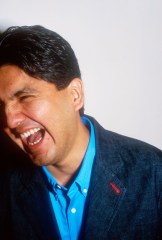
Sherman Alexie

April 2018: I believe the women who have shared their truths  of sexual harassment at Sherman Alexie’s hands, as described here. This Story Sunday is one of Novel Niche’s most viewed posts. Instead of deleting it, I use it as a springboard to uplift and signal boost the work of Native women writers, the very demographic Alexie sought to oppress and delegitimize. I support native women, and I believe their truths of assault and survival. 

If you’ve been keeping tabs on my Story Sunday posts, you’ll know that I’ve been on something of a hiatus. It wasn’t that I didn’t have brilliant, heartbreaking, resurrecting short stories about which to gush; I did, and I do. This story, in fact, has been at the top of that particular list for several months. I fell in love with Sherman Alexie on the basis of this one story, and everything I’ve read by him since has only confirmed my feverish adulation.

You could think of this entire tale as a curious, quirky escapade with the Lost and Found department of life, and you’d not be far off the mark. It centres on the misadventures of Jackson Jackson, a tragicomically titled Spokane Indian who stumbles across his grandmother’s long-lost powwow-dance regalia in the window of a Seattle pawnshop. Woefully bereft of financial resources with which to purchase it from the shopkeeper, Jackson Squared sets out to earn, beg, borrow and/or magick the money (nine hundred and ninety nine dollars, to be precise), in just one day.

Alexie manages with Jackson Squared, in the space of eight pages or so, more than some writers can achieve with their protagonists in three volumes. We’re never quite sure what to make of him, this hilarious, downtrodden, disarmingly pragmatic drifter who, in the story’s opening paragraphs, says of himself:

“I’ve broken a few hearts in my time, but we’ve all done that, so I’m nothing special in that regard. I’m a boring heartbreaker, too. I never dated or married more than one woman at a time. I didn’t break hearts into pieces overnight. I broke them slowly and carefully. And I didn’t set any land-speed records running out the door. Piece by piece, I disappeared. I’ve been disappearing ever since.”

Jackson’s epic, 24-hours-or-less quest reads like an anti-Galahad’s peregrination, his own personal Grail wrapped up in years of deprivation, cultural sidelining, in a certain inured thick-skinnedness that grows from someone understanding his place in the world. Yet for all that potentially suffocating bleakness, this story is more complex, more delicately modulated with grey areas, than to be thought of as a simple indemnification against Caucasian hegemony. It isn’t so clear-cut, Alexie seems to be urging us, as “Down with the paleface!”, though, certainly, if there are threads of that sentiment woven into the narrative, the author doesn’t shy away from them. There are contemplations of the fate/state of the First Nation peoples that are so bitterly steeped in the darkest humour that you’ll wonder whether you’re clever, or cruel, for bursting out in laughter. Here is one such instance, in which Jackson is amicably interrogated by a policeman friend, who finds the former decidedly worse for wear after a night of drunken carousing that’s gone awry.

“He walked around the car and sat in the driver’s seat. “I’m taking you over to detox,” he said.

“No, man, that place is awful,” I said. “It’s full of drunk Indians.” We laughed. He drove away from the docks.

“I don’t know how you guys do it,” he said.

“What guys?” I asked.

“You Indians. How the hell do you laugh so much? I just picked your ass off the railroad tracks, and you’re making jokes. Why the hell do you do that?”

“The two funniest tribes I’ve ever been around are Indians and Jews, so I guess that says something about the inherent humor of genocide.”

We laughed.”

As you’ve likely surmised by now, Jackson Squared is hardly the noblest narrator you’ll encounter. As I did, you might find yourself musing from time to time on how much he deserves to inherit his deceased grandmother’s regalia, after all. You might not admire him, in the final analysis, or want to emulate his series of patchwork-quilted life decisions… but my goodness, how you’ll want to root for him. Keeping faith with Jackson seems like casting your bets for the ultimate, endearing/bemusing underdog.

I’ve read this story more than twenty times now, and with each fresh visitation I find new lines to love, new perspectives to consider, fascinating and aching hypotheticals to mull over. This isn’t the politically correct tale of the noble savage that mainstream media has come to endorse through laziness and misinformation. Shiftily romantic stereotypes found wandering through Alexie’s prose are shot on sight, ribboned with rapier-sharp witticisms, with an unflinching eye that tends towards truth. Alexie’s prose is one of the best compasses for contemporary storytelling that I’ve ever read, and I shall eagerly follow it over the horizon, hoping, like Jackson Squared, that each day brings with it a little more redemption, a little more illuminating grace, a little more food money and fighting chances than the last.

You can read “What You Pawn I Will Redeem” by Sherman Alexie here. (The New Yorker)

Story Sundays was created by Fat Books and Thin Women as a way to share appreciation for this undervalued fiction form. All stories discussed are available to read free, online. Here’s Fat Books and Thin Women’s Story Sunday archive, and here’s mine. Want to start up Story Sundays on your blog? Yay! Email story.sundaysATgmail.com for details.

Talking with Lisa Allen-Agostini about The Allen Prize for Young Writers

Lisa Allen-Agostini. Photo: Richard Acosta

I tell her I’ve been writing since I was 11. A strange thing happens to me when Lisa Allen-Agostini then puts this pointed, precise question to me during our mid-Bocas Festival conversation:

“How did you feel, at 11, as a young writer, beginning to discover your own voice?”

The truth? It was as terrifying as it was liberating. I realized, with the retroactive shock of absolute clarity, of just how isolated I was in my pre-adolescent writing world, of how much I longed, without even articulating it specifically to myself, of someone to let me know: what you’re doing is valid. It isn’t a waste of time. Thankfully, I had my mother’s incredible support in my writing life, as the years went by, but nothing compensates for that 11 year old girl’s absolute uncertainty, her silent, shy worries. I had my mother, and Lisa’s children have her, but we both acknowledge grimly: thousands upon thousands of our nation’s budding writers have had, for so long, no one… and this is the void that The Allen Prize for Young Writers seeks to fill.

“There was no guesswork over my writing ambitions”, Lisa tells me… just as much as there’s been no guesswork about her commitment to furthering the hopes and dreams of young authors and poets. Her love of children’s books has stood her in good stead throughout her life; it didn’t taper off when she became an adult. It’s important to remember the distinction, too, between writing for children, and writing by children, she reminds me. I’ve got to nod in recognition of this, as I know that the latter category often faces severe ordeals in being legitimized, to say nothing of published. This is why initiatives like the well-stocked NGC Bocas Lit Fest’s Children’s Programme bring Lisa joy – because they help mark a clear path forward. The fact that the 16-story collection, Children’s Stories from the Bocas Lit Fest 2011, is available for purchase nationwide: this is significant, too, but how much notice does it receive in our local media? How many good stories do we tell about young people reading and writing, and seeking to script out a future from their passion for literature and storytelling?

Lisa and the winning Allen Prize writers of 2011, at the awards ceremony on the 29th.

The galvanizing moment in Lisa’s writing career came when she won Clico’s annual Put it in Poetry Competition for secondary school students. (Sadly, the prize is no longer active.) The win signalled to her the beginning of infinite possibilities she could imagine for herself and her work. It’s that strength of imagination she hopes to share with The Allen Prize program participants. The foundation is about much more than the bestowing of a cash prize, though that’s one of its highlights. It hosts annual, intensive workshops with established writers in mentorship roles, as well as three seminars yearly, which address multiple aspects of a young writer’s craft, process and everyday concerns. As telling testimony to the practicalities of the program, The Allen Prize also guides and facilitates the potential publication, staging and transmission of participants’ completed works, enabling fresh, promising talent to forge significant relationships that can well last a lifetime.

Lisa and I discuss the worrying dearth of regional young adult fiction, a bemusing irony when one considers the vast popularity of that particular genre in worldwide publishing. We chuckle irreverently over what, to us, seems like the lacklustre presentation (though we use much meaner terms to describe it!) of Caribbean literature in most Trinidadian bookshops (with the notable exception of a special few, such as Joan Dayal’s Paper Based Bookshop at The Normandie). Frankly, Lisa’s tired of Caribbean literature getting the short end of the stick… within the Caribbean, no less, and what gets her hackles up is the underrepresentation paid to young writers in particular. All the better, then, that one of the festival highlights this year celebrated The Allen Prize for Young Writers, rewarding the talent and ambition of our upcoming who’s who in all things local and literary. Held on the last day of full festival activities, the event was a well-attended, inspiring success, and will hopefully serve to draw even more reluctant young writers out from beneath their sequestered stairwells, showing them – look, it’s okay to fully and unapologetically embrace your dreams.

“When I get an idea, an idea worth pursuing, you can be certain that I’ll follow it,” Lisa smiles, and I think I speak for most people when I say that Trinidad and Tobago is the better for Lisa’s unflinching persistence, her fierce dedication which proves that the best stories can be scripted with pencils and crayons just as well as they can with an exclusively adult pen.

For more information on the work that The Allen Prize for Young Writers does, visit their official website, as well as their frequently-updated Facebook page.

Group photo by Rodell Warner, our official 2012 Festival photographer.