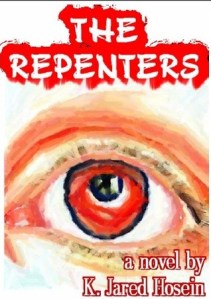
31. The Repenters by K. Jared Hosein

Published in 2011 by K. Jared Hosein.
“And then he walk up to me with a fake smile. I know the smile was fake. I am the man to know bout fake smiles. And I am the last to be offended by them.”

Joshua Sant is busy doing God’s work. This is what he’s been led to believe by the eerily charismatic Judah Weir, a foreigner to Trinidad with seemingly fathomless resources and a singular purpose: salvation. Weir is in the business of making sinners repent, no matter how bloodstained or brutal the path that leads towards a plea for forgiveness. He seeks out those with no necessary talents other than the eager capacity for violence, and the dogged mettle requisite for enforcing it. This is where Joshua comes in, finding the pattern of his previously nihilistic yet unremarkable life changed forever by Judah’s imperative. If this new, financially viable lifestyle is a conduit through which Joshua can keep close to Mouse – a woman who proved to be the saving grace of the former’s upbringing – then it is a path he will take without a flicker of hesitation. Even a semblance of intimacy with his cherished Mouse, Joshua decides, is worth far greater crimes than the ones he commits in Judah’s quarantined hilltop facility.

This novel is not for the faint of heart. Hosein acquaints us early on to what happens when we dredge closeted sins from the basement and make them play in the bright daylight. Is there nowhere we won’t go, I wondered, mid-reading, in this vivisection of the human psyche? You will think you have encountered some of the bleakest mappings-out of individual behaviour, (keep an unblinking eye out for the story of Emil Syrový) and then a previously-unseen corridor will shift into focus, holding enough contemplations to shake you out of your complacency. What keeps this from registering as hyperbolic or overwrought is that the lens through which we observe most of this depravity is Joshua himself. A creature of merciless, arbitrary circumstances, Joshua is so inured to violence that he’s able to calmly mull sentiments like, “Fire is really just another kinda knife” without missing a beat.

Joshua Sant is drawn with a meticulous hand, as are all of the writer’s characters. We understand that they have lived before we meet them in print here, that some will continue to live after the story has been concluded, while others will brush up against far more dubious fates. Whether we’re spending time with Joshua and his Blue Bayou CD, Mouse and her suitcase of books, Sister Kitty and her insatiable penchant for people-pleasing, Hosein turns them all to the light of our scrutiny. Major and minor players alike are primed for our illumination, horror and bleak humour. We believe their best intentions as much as we doubt their worst.

Perhaps you get a headache when your straight highway through fiction takes an unexpected detour. If so, you should probably skip The Repenters, which is a stream of consciousness ramble/rant/pleasure-pain-cruise through one man’s patchwork interpretation of his past, present and days yet to come. Joshua’s coherency is often in dispute, and it is in fact his jagged internalizations that share the most of himself. Witness, for instance, how he unfurls, after visiting some stake-related remodelling on an snarling predator:

“… a bowl of grapes appear before me i take one and eat it. i eat the grapes then the grapes eat me. the grapes feed away on my insides and what a lovely symbiosis it is turning out to be

i think bout waking up

i think bout people waking up and praying to god and kneel before their ten dollar calendars with dead jesus on it or putting the milk or flowers or whatever on the lingums outside. scrubbing up leftovers of ash and feelin so grateful for the day

always secretly wished i could wake up and know what it like to be grateful to wake up

and know how grateful i should be feelin for even bein able to feel grateful for wakin up

i have to be drunk yes”

If you think this is spectacularly weird, then truly you’ve seen nothing. I began the novel with a confident blueprint for continuity and procedure, yet I found myself repinning time-space markers, backtracking to check events and the minutiae that defined them. Eventually, I let go, and let the experience happen to me, which I found to be eminently more satisfying, because of the non-linearity. Hosein neither breaks nor bends any rules of storytelling lightly. Indeed, his attitudes towards storytelling define something I vastly enjoyed in the narrative’s premise.

Books have the power to change your life. It hardly seems like a lesson I’d need to stress, but stories don’t always lend themselves to examining this in voluble and plot-related ways, so it’s a treasure to find it reinforced here. The way that Mouse describes the active art of reading to Joshua, during their first meeting, stands out as rather tender testimony in a work where so much is characterized by moral bankruptcy, greed and savagery. She assures him that, yes, books can take you everywhere, and against the proof of a cloistered, grey existence, the boy believes her. The result is a protagonist who contemplates Exupéry’s The Little Prince as a metaphor for ultimate escape, who regards Judah Weir as a live-action Man-Man from Naipaul’s Miguel Street. There may not be immediate solace to be derived in a life informed by literature, not if Joshua’s daily rigours are to be trusted. Still, reading offers the only consolation we can cling to, sometimes — the assurance that other beings in other places have suffered as much, or worse, than we; that all pain and all joy is relative on a vast, written sliding scale.

Can we ever stop paying for what, and whom, we’ve done wrong? Who gets to mitigate our sins, and who decides how our ethical compasses are calibrated? Is there redemption in repentance? The Repenters asks some of the hardest questions that fiction can put to us, and returns a bloodied basket of answers for us to pick from — and yes, the answers make sense in one light, but they cut at your palms in another. This is the work of the grittiest and most uncompromising storytelling, it seems: not merely to hold the mirror up to what we are, but to peer down the rabbit hole of all we might become, given provocation, misery, and a limitless credit card. By turns both chilling and comedic, Hosein’s novel presses us to take heed of whom we ask for forgiveness. They may or may not be listening.

You can download The Repenters for free, with the author’s permission, here. You can access a frequently updated list of Hosein’s other projects, and contact information, here.

K. Jared Hosein (1986 -…) has been working on his prose and poetry since his early teenage years. In 2009, he penned a poem entitled “The Wait is So, So Long” that would go on to be adapted as a short film that would be featured and win a Gold Key Award at the NY-based Scholastic Art & Writing Awards. He frequently writes to the local newspapers but those pieces are only of political and sociological nature. Although he is currently employed as a Biology and Physics secondary school teacher, he writes fiction frequently to have a significant body of work, to build discipline and to create his own voice and style in the world of West Indian literature.

A free electronic copy of this novel was provided by K. Jared Hosein for review. The opinions expressed in this review are entirely my own, and are not influenced by his generous gift of gratuitous literature.

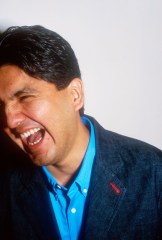
Author portrait by Portia Subran.

30. Missing Angel Juan by Francesca Lia Block

Published in 1995 by HarperTeen.

Deemed a Best Book/Best Pick by the American Library AssociationSchool Library Journal and The New York Public Library, among others.

“… I put the flower in a teacup and look at myself in the mirror I found on the street. I can hardly stand to see my face. Pinchy and hungry-looking. I don’t need a hummingbird around my neck for people to see I am searching for love.”

Witch Baby, snarly-haired drummer girl loner, doesn’t feel like she fits, not really… apart from the times when she’s making music or love or everyday magic with her big-dreaming boyfriend, Angel Juan. Angel keeps the confused, restlessly aching parts of Witch Baby from scattering into the abyss of the latter’s personal demons. He brings her as much tender solace as he does ungovernable fire, so when he announces that he must journey from Los Angeles, where the couple live merrily, to New York, as part of his own vision quest, the bottom falls out from Witch Baby’s world. She must find him, she swears to herself, because life without her anchor Juan is unbearable. With the blessing of her almost-mom Weetzie Bat, and armed with a camera for clear sight, Witch Baby follows her love to New York, where the quotidian glitter beckons differently. Companioned by her ghostly grandfather, Charlie, the pair scour the city, encountering a whirlwind of delight and disaster in not-so-equal measure, keeping the faith that Angel Juan will cross their path before it’s entirely too late.

Here is something to love best about Francesca Lia Block’s writing for young adults: it doesn’t condescend to young adults, which is ironically rare fare in a genre that ought to be highlighted for its compassionate understanding. Block trusts that hearts not straddling the full saddle of adulthood can still articulate, in startling relief, all that they hold, as witnessed in this early letter from Witch Baby to her distant inamorato.

“Dear Angel Juan,

You used to guard my sleep like a panther biting back my pain with the edge of your teeth. You carried me into the dark dream jungle, loping past the hungry vines, crossing the shiny fish-scale river. We left my tears behind in a churning silver pool. We left my sorrow in the muddy hollows. When I woke up you were next to me, damp and matted, your eyes hazy, trying to remember the way I clung to you, how far down we went.

Was the journey too far, Angel Juan? Did we go too far?”

This isn’t parochial writing for young people, either — we’re gifted access to a panorama of intricacies that knit relationships together, or else wrench them apart:  two people loving each other is incomprehensible work, Block seems to be advocating, even with the full current of adoration coursing betwixt their hearts.

A cursory skimming of the novel’s plot might suggest that Witch Baby is 1995’s answer to the dependent Donna — a  comely young woman concerned principally with the acquisition and maintenance of a male partner. Witch Baby isn’t Bella Swan with a more bohemian title, however. Quite the contrary: the former’s observant rollerbladings through New York, and the ways in which she interfaces with the clues lined up for her personal edification, are engineered most tenderly to prompt an alternative ending for young people: that partner-prompted identification is no way to declare your definitive personage.

Block’s writing is luminescently unapologetic, not just in message but also in delivery: it is suffused and star-studded with multiple sonnets to beauty stuffed in each paragraph. Yes, to the angular reader, this lyricism will weigh heavily. The accusation that she writes from behind a gauzy, magically realist smokescreen has hounded the Weetzie Bat books, and in truth, the glitz and the diction-decoration is no less evident in this fourth installment. For some, this will represent too-muchness, and the reading will represent pulling factual teeth. For others, there will be revelry, merry traipsing through a heavily-imaged carnival. The language and the life it inhabits on the page are technicolour, certainly, but I’d posit that the aforementioned smokescreen doesn’t exist. If there is a barrier between the sober world of absolutes, and the way in which Block uses words, consider it instead to be a perfumed veil, a safety net for the suspension of your disbelief.

“A conspicuous love of vegetarian food runs through the book like a peaceful hippie emblem,” I wrote in the margins of my journal while reading. It’s true: Witch Baby’s family lives off their cornucopia of love and non-meat products, feasting on “vegetarian lasagna, edible flower salad and fruit-juice-sweetened apple pie” the night that Angel Juan breaks his terrain-altering news. The Jamaican cab driver who transports Witch Baby to her first destination in New York tells her that she won’t find many angels in that meat-packing district, with its implied dream-crushing, carnivorous redolence. Indeed, the consumption of a deliciously meaty hamburger is pivotal in Witch Baby’s squaring off against a soul crushing nemesis. At first, I was inclined to think of this as a little… precious. This waned, though, upon the consideration that the author’s prerogative, maybe particularly with young adult writing, is to shape the sort of world that best inspires our ardent commitment to living. If this means a world of nutty Guru Chews, armloads of fresh produce and honey-flavoured tea, one could arguably do worse.

What makes Witch Baby better than Bella Swan? Maybe it’s the fact that the sounds of drumming makes her come alive, even when she’s crushed beneath the weight of missing her beloved. It might have something to do with her ruminations on a pair of Egyptian mummies, her wondering

“if that king and queen ever screamed at each other and cried in the night with pain and desire or if they always looked so sleek and lazy-lotus-eyed.”

Perhaps it’s linked to the ways in which she can find inspiration winking behind and before the lens of her camera, the way she thinks about time and space, the fact that she curates bulletin boards of universal suffering. Missing Angel Juan can’t be said to show Witch Baby at her best, since it plummets her into the messy business of personal landscaping. Instead, it offers a portrait of a girl in the full-throated glow of her electric, sexy drumbeat of self-discovery. This could be said to be the writer’s most nimbly-articulated message, the one she hopes you will carry close to your chest, stitched into the folds of your skirts: that Witch Baby is beautiful, that so are you.

Duane Allicock’s Thoughts on The Man Who Ran Away by Alfred H. Mendes

Published in 2006 by The University of the West Indies Press. Edited by Michèle Levy.

While reading this short story collection, I couldn’t help but come away with the sense that, had Alfred Mendes existed during a time without such fierce intellectual competition, his name and talent would have stood a greater chance of being sufficiently acknowledged and lauded. Alas, coming of age and into your own in a period when you occupied the same space with a figure such as C. L. R. James, all but guaranteed that you would always be relegated to the shadows cast by the glare which reflected off that West Indian luminary.

Include the names of a few other younger, but very promising authors, such as Lamming, Naipaul and even Selvon, who would eventually become internationally acclaimed, and you begin to realize why the name Alfred H. Mendes continues to receive honourable, but never effusive mention in the West Indian canon. Which is a shame, because what was discovered while reviewing the work of this Trinidadian writer of Portuguese descent, is that the man not only crafted eloquent literature, but articulate West Indian literature. In the end, there’s just that indefinable ‘something’ that results in some brands becoming ubiquitous, while causing others to remain so obscure, that when you do mention them, people get that ‘eureka moment’ and mutter, “Oh yeah, I’d forgotten about that…”

Like many authors of his generation, Mendes continued to mine a timeframe during an era about which he felt passionate, and for him, the tales told remained rooted in the decades of the 1920s and 30s, a preference which is of such great significance, that it is included in the work’s title. The title story is the first in the collection, and sets the tone for what, essentially could be an exploration of what a familiar Trinidadian song writer referred to as our “Old Time Days”. While the Nappy Mayers composition carried more than a whiff of rosy-eyed nostalgia, Mendes’ depiction cannot be charged with attempting to gloss over any of our lesser desirable qualities.

His portrayal of Trinidadian society in eleven of the twelve stories which span these years, maintains an appreciation for the complications inherent in a society as multiethnic and multicultural as ours, and the limited impact that a century had had on modifying the prevailing attitudes of the members of a society connected by the colonial experience. This observation is not meant to imply that all the reader should expect is thinly veiled, heavy handed rhetoric, clothed in a literary facade; far from it. A writer as competent as Mendes operates with subtler brush strokes, and introduces realistic characters, many of whom are memorable and would perhaps even be familiar to someone who may have grown up during this time. The persons are, in spite of class, ethnicity or gender, often shown to be products of their era, with their attitudes and assorted prejudices to their fellow Trinidadian informed and haunted by this shared colonial experience.

Of the stories themselves, I will say that Mendes, who had a self-avowed passion for describing the natural beauty of our West Indian environment, renders it with aplomb, in none more so than the stories “Malvina’s Nennen”, and “Colour”, the sole inclusion whose setting is not in based in Trinidad. I’ll also admit that although most of the characters are fairly well drawn, there are moments where the stories that they inhabit left me unsatisfied, and with a distinct sense that, like the content of many a popular music album, they were included to make up the numbers. There is even an instance where I found the plot and climax of an earlier offering being essentially plagiarized. Not even the brevity of the repeated tale could redeem it for me, and that final shortcoming, brevity, is what brings me to my major grouse with this collection.

I will readily acknowledge that it is the quality, and not necessarily the quantity of words used which can make a story not merely resonate with a reader, but elevate it to the level of the truly memorable. Yet, I will also go on record and state that Mr. Mendes handicapped himself with some of the shorter inclusions in this collection. However, on those occasions when he gave his muse free reign to roam wherever it pleased, the compositions, though lengthy, are really something to behold, and likely to elicit the most emotionally charged reaction from the reader.

What may irritate the Tobagonian who reads this collection though, is that although the subtitle does specifically acknowledge Trinidad as the setting of choice, for some inexplicable reason, he also chose to make Grenada the setting of his final story, a decision which might be interpreted as an affront to our sister isle.

Although editor Michèle Levy, readily recommends this work by Mendes as a useful “text for university literature courses”, I’m once more left with the impression of the author’s abilities not simply being under marketed, but undervalued. Admittedly, he may be regarded as a torchbearer whose light shines less brilliantly than the authors mentioned earlier, but confining him to the stuffy setting of a class filled with English undergrads may expose him to a fresh round of ridicule and apathy which might very likely cause him to ‘turn over in his grave’.

I’ve often found that the only way that an artist like Mendes becomes more recognizable, is to sell his strengths to a wider readership, rather than a niche clientele. Often times a connoisseur, maybe even an influential one, will come along and pay top dollar for an obscure collection because of the very flaws which provide it with its unique character. With that awareness in mind, permit me to offer that person looking for a new vintage of literary wine to sample, something from one of the lesser known vinters, a Mr. Alfred Mendes. Now, some of what you taste you’re going to love, others you’ll wish you had more of, and some you’ll simply spit out. Just remember though, that when everyone else is gushing over the finer points of their Cabernet Naipauls, and their Pinot Lammings, you can take delight in having tasted something not only unique, but equally well aged.

Duane Allicock hails from the island of Trinidad and lives for reading, cycling and running; in that order. When not pursuing any of these passions, he prefers to immerse himself in listening to music, or the silence of the Mount Saint Benedict monastery, pondering on life’s humorous ironies.

A First Letter from Lizzy Bennet

I love writing letters. Some time ago, for a postal swap, I was asked to write a fictional introductory missive, adopting the personage of one of my best-beloved literary characters. I was urged to really get under her skin; to share a glimpse of the kind of woman she was; to, if not plumb her depths, then present her truly, with all the eager possibilities a first letter can afford. When I put pen to paper then, I thought it would be interesting to meet Lizzy fairly early into the events of Pride and Prejudice… before too many dances have passed, before several sparks can fly: you know, before much of that high-spirited Regency rabble-rousing gets thrown down.

Here is what I wrote.

Dear Morgan,

It is my distinct pleasure to be writing to you on this rainy, windswept evening…grey clouds pattern the sky, while the deepening chill in the wind signals to me that winter draws ever closer. As I sit at my writing desk, safely and securely ensconced in the bedroom I share with my dear sister Jane, at our father’s Longbourn estate, I wish most sincerely that you and all those you love are in the very best of health and happiness.

It always pleases me greatly to pick up my quill in celebration of a new and lively correspondence; I do so abhor those dreadful social functions at which one must smile, and simper, and pretend to be charming and easily charmed at every occasion – though, t’is true, I do love a lively dance! There are few activities in my twenty-year old existence, thus far, that enrich the spirit, tingle the toes and bring hearty laughter to the lips as a rollicking country dance!

As you may have guessed by now, my name in full in Elizabeth Bennet, but my family members and friends usually call me Lizzie or Eliza, as it suits them. My mum is often wont to call me Elizabeth when she is out of sorts with me for my peculiar habits and mulishly stubborn choices, which is more often than I suppose I should own to! I have lived my entire life at Longbourn, and am the second eldest of five sisters, but closest, I confess, to my eldest sister Jane, who is the very soul of goodness and sweetness, never thinks ill of anyone, even when perhaps she ought, and has the most charitable heart of any man, or woman, of my acquaintance. She has recently become enamoured, in her quiet way, of a dashing, if slightly dim young man called Mr. Charles Bingley, and I have high hopes for them eventually forming a serious attachment. I can think of few, if any, who deserve a life of happiness as much as Jane.

I suppose it ought to be my major preoccupation in life to endeavour myself matched to a young man of suitable prospects, or a man who makes a decent figure a year, as my mother would put it (though I think she would describe the matter much more loosely than that, alas. Apart from Jane and my dear father, I admit that I am not close to any of my other family members, though I certainly do feel fondness for the rest of them; they do not know me in the way that Jane and Papa do). Honestly, I find that I cannot seriously burden myself with fawning over every man who seems to have a laden purse and gives me an inviting glance at an interminable country ball.

I hope you will not think it too silly, Morgan, but I wish to marry for love… I wish to meet a man with whom I can hold forth in vigorous, sustained conversation and debate! A man who loves to read, to take long, contemplative walks, but above all, a man who will not be afraid to be truly himself with me, in every way, as I should surely feel free to do in his company. I have witnessed the ways in which an unhappy marriage of convenience can erode the lives of two people, slowly and excruciatingly. I do not want that to be my fate… I think I would prefer the life of a so-called ‘old maid’, for at least I would be allowed to be myself, and much happier for it, I firmly believe.

You know, at the same dance at which my sister made the happy acquaintance of Mr. Bingley, I too had an encounter with a man, but I cannot claim that I took any level of pleasure in it. Indeed, not! I found this man in question, Mr. Darcy, to be rather haughty and full of himself. He looked the entire time as though the event was decidedly beneath him (but I could not help but wonder if he was merely uncomfortable and awkward, and decided that a frosty illusion of control would make him seem superior?) Either way, I feel certain that he and I shall not be fast friends – far from it.
Apart from hoping that I shall one day find a partner for the sake of true love – oh, I do hope I don’t sound like a hopeless romantic! – I try my best to be realistic on all points, especially since I live in a household of, for the most part, exceedingly silly females. I spend much time with my thoughts, as well as in the glorious open woods and trails. I adore walking. It gives me deep personal strength, and the space I need to think, to reflect and to have wondrous conversations with Jane, Papa or my dear childhood friend, Charlotte Lucas. I particularly like spending time with Charlotte; we’ve known each other since infancy, and have shared so much that we’re often of one mind on most things. She is a beacon of common sense, a practical, good-natured and wonderful friend. I may not have the most enthralling life, from any outsider’s perspective, but I am lucky to have been gifted the presence of dear friends and wonderful books. Reading transports me to new and exciting worlds daily… but I do often long to see more of the world, to travel far and wide, to take control of my own destiny, wherever it may lead.

Mr. Darcy’s sisters, incidentally, were also at the ball I mentioned earlier. My mother was very much taken in with them, as is her way to be impressed by young ladies of great finery (and one of them has married well, so I suppose she is moved to flattery by that as well). I confess to you that I cannot trust them, nor think of them so kindly. I felt their criticizing eyes on me and my family, particularly my frivolous younger sisters, Kitty and Lydia. Now, I cannot claim to approve of the ways in which Kitty and Lydia will carry on, flirting with all the young and dashing gentlemen as they do – but why should standards of behaviour be different for a woman’s social conduct, I ask you, as opposed to a man’s? I have observed that a man may generally behave as he will without direct criticism, but it is an entirely different tale for a woman. I do hope that I will live to see more equality in the ways men and women are treated! I will strive, in my own small way, to make changes.

I have greatly enjoyed writing with you, Morgan. I am off to the post now with Charlotte for a leisurely walk, to think, laugh, and mail this letter to you!

Wishing you great happiness and health, now and always, affectionately,

~Eliza Bennet

At the great encouragement of my talented romance writing friend, Morgan Kelly, I’ve shared this letter. Perhaps it will incite scorn in the Austen purists; perhaps it will delight those more open to the notion that we can live freely and unreservedly with the books we love, entering into conversations with the characters who inhabit them. I have many other ideas for future literary letters, including a narcissistic rant from American Psycho‘s Patrick Bateman to himself (because who else would he write to, anyway?), and a blotted parchment ramble from Wide Sargasso Sea‘s Antoinette, to her curiously distant English husband (and, just maybe, a response from him, in one of his weaker moments.) I hope you’ve enjoyed encountering Elizabeth in this non-canon fashion! It was a pleasure to strive towards inhabiting her thoughtspace, gleaning a sliver of her concerns, listening to her passionate heart beat in time with the pen’s thoughtful, considered slant.

Black and white images used (from top to bottom):
Woman Writing Letters by Charles Dana Gibson
Elizabeth Bennet by LindseyKal
Elizabeth Confronts Darcy by Edwin Phillips
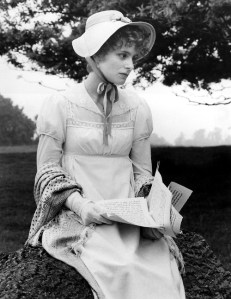
Elizabeth Garvie as Elizabeth Bennet in Pride and Prejudice (1980 BBC adaptation)

29. The Descendants by Kaui Hart Hemmings

Published in 2008. This Edition: Vintage Books, 2011.

Matt King’s life, all things considered, could do with a major overhaul. His wife, Joanie, has been in a coma for twenty-three days, courtesy of a boat-racing accident. Matt finds himself flounderingly out of depth in the management of his two daughters: rebellious, drug-recovering Alex, and exuberant, highly peer-pressurized Scottie. Lurking in the background of this familial implosion is the weight of a decision Matt must make: as principal trustee to a collective of Hawaii’s wealthy, royalty-descended landowners, he must say to which highest bidder huge tracts of heritage land should be sold. As time ticks by, and Joanie’s future prospects look increasingly grim, Alex stuns Matt with the revelation that Joanie has been unfaithful to him for some time. Bundling up his daughters, Matt takes them on an unexpected trip to locate the man Joanie possibly loves more than him, so he, too, can pronounce final farewells at her bedside.

It isn’t hard to fathom the reasons why this novel inspired a touching, thoughtful film adaptation. (As you can see, the book’s cover features a haunted George Clooney gazing into the distance, perched on Hawaiian littoral, flanked by sandcastles.) This is one of those books that reads as though there’s a script already imbedded in the prose, waiting to be lifted, licensed and imaged for the screen. Almost every good point I can make about the visual imagery of the descriptions tie in to how stunningly well they salute the mind’s eye. Witness, for instance, this picture of Scottie, who, having gone on an impromptu mini-adventure with her father to Alex’s boarding school, arrives decidedly the worse for wear.

“Scottie looks thrilled by the situation. Her red sores are bright in the hall’s fluorescent light. Her T-shirt says VOTE FOR PEDRO, whatever that means, and her hair is sticking up in places and matted down in others. In one section near her ear, the hair is held together by some unknown substance. She had fruit punch on the plane, and her lips and chin are stained the colour of raw meat.”

The images Hemmings conjures are consistently entertaining, moulded and primed for dark, honest humour, as well as aching sadness. The most notable include impressions of Matt’s difficult, likeable daughters, but also of Matt himself, and the way he perceives everyone and everything around him — tourists; his daughters’ cohorts; hospital staff; the ways in which other people perceive him; his fellow landowning descendants; the shifting structures of Hawaiian landscapes. Matt is a faithful archivist of the place he’s from, the place he loves, and his daily photobooks of observation afford rich, deeply funny insights into a place typically thought of in terms of multicoloured leis and roasted pig cookouts on pristine beachfront.

We think of the impossible caverns of love and grief as thorny terrain to demystify, and perhaps some of the best fiction shies away from putting such things into quantifiable, qualifiable terms. The opposite approach is explored in these pages, with Matt the compass for one man’s perambulations through the messy business of re-evaluating one’s love while simultaneously preparing for the worst. This isn’t to suggest that our protagonist is the only person in the novel whose experiences aren’t linear. Conversely, Matt’s interactions with his daughters, with his in-laws, with Alex’s sort-of-but-not-really boyfriend, Sid, all work like character references in a stuffed docket for emotional complexity. No one loves in singular colours; no one tolerates loss on a full palate of either beatitudes or vices. In one of my favourite passages of the novel, Matt reflects on a rare, treasured memory: his perpetually self-sufficient wife seeking comfort in his arms, immediately following a harrowing trauma.

“She sank down to the rocks, pulling me down with her, and then she lunged into my chest and wept. We were in the most awkward position on those rocks, but I remember not being able to move, as though the slightest movement might upset either her or the moment. Even though she was sobbing in my arms, it was a nice moment for me, to be stronger than her, to be needed by her, and to see her so fragile.”

The torment truly sinks in when Matt contemplates, right on the heels of this, the excruciating possibility that Joanie has dismantled her armour thusly for the man of her affair, too… and, most damning of all, there’s no reliable way of confronting either of them. Matt, like so many people stricken with the dead weight of an infidelity involving two silent sources, is saddled with a lifetime’s worth of maddening, perhaps debilitating hypotheticals.

Immersing yourself in Matt’s bleak and blackly comic inner monologues is as thrilling as it is because it grants you the relief of uncensored permission: to feel fully all those ideas that aren’t politically correct, to hate your children and love them; to hate your wife and love her; to want to be the best person and the worst all bound up in one festering, grinning knot of humanness.

Reading The Descendants is a shotgun ride in the author’s dodgy pickup truck, skirting some emotional landmines, rattling full-on into others. This, really, is what I love best about the novel: it confronts the non-poetic shit storm that reality quite often resembles, without any fumblings towards a sense of… literary rightness. There aren’t any perfect similes for pain, or, if there are, Hemmings doesn’t concern herself with trying to unearth them for our benefit. Truly, cosmically horrific things are as likely to happen to you as they are to the person alongside you in the bus.

How you feel about this book will depend largely, I think, on whether or not you require, or secretly long for, a primer on how to navigate life successfully, with minor bruising. If you find it hard to fathom that there can be one good way to be a worthy father, lover, landowner, descendant, or decent human being, then you’ll be hard-pressed to read something more organically attuned to the general state of loving, grieving and every curious, maddening human state from here to there.

I pledged to give away all the books I bought myself in 2012. I’m giving this book to my exuberant and all-round excellent friend and fellow writer, Leshanta, whose work I’ll be featuring at Novel Niche in a future coming to you shortly. 

Story Sundays: “Jane” by McKinley M. Hellenes

McKinley M. Hellenes

“She is a conventional woman — though she likes to imagine that she hasn’t always been, that once she wasn’t. She was something else, something bolder and guileless. Was she ever guileless? Was she ever bold? She doesn’t remember. Even now, out of the house and slinking her way through the night, she doesn’t feel bold. She feels nothing more than she ever does. She could be anywhere right now, doing anything but what she is actually planning to do.”

A woman goes in search of something one night, after the neatly ordered emblems of her suburban life are tucked away. She takes no one with her. She tells no one where she’s gone. Her purpose is best known to herself, and as she stealthily trawls the city streets for the object of her compulsion and fascination, it seems more than likely that she will encounter it… and encounter it, she does. Once the woman, this unassuming wife and mother, takes the male prostitute to bed, you’d be thinking that the goal of the story has been accomplished, with a few vigorous flesh-tangles and a nostalgic memory stamped into a bored homemaker’s carnal scrapbook. Not so… not when Hellenes is the one holding your attention rapt with each new paragraph, with each sleight of hand prose flourish.

Avid perspicacity in detailing marks every turn of the story’s progression. The writer imbues the most apparently mundane of images, such as the glow from a television screen, with surprising vitality. In so doing, the tv’s glare becomes an “auroral coruscation”, the comforting security of a vehicle is glimpsed as “a chrysalis of steel and tempered glass.” This isn’t verbosity so much as it is prose, given space to consider alternative workday outfits, descriptions that don top hats, similes that barely recognize themselves in their new and unaccustomed lustre. Hellenes polishes language with care, with a steadfast eye and ear for both the visual and auditory occupation of storytelling. When you combine this solicitude with a style that flows both compellingly and naturally, you receive lines like these, detailing the narrator’s steeling of resolve before she approaches the young man.

“She rolls down her window a few inches, like opening a letterbox in a door, and waits. Her heart is beating hard, but in slow-motion, like it is hesitating, deciding whether to keep on going or not each time it floods with a shipment of her blood.”

Duality of perspective can be a tricky navigation in short fiction, if one is aiming for a certain equanimity in voice, and even if one isn’t. If I was nervous about being privy to the prostitute’s train of thought, that concern evaporated within the opening syllables of the window into his consciousness. Indeed, seeing the assignation from his mind as well as hers brought a chorus of musings singing to the surface, not least among them this: that people who conduct sexual transactions, whether money is involved or not, never do so with just each other. There are always any number of spectres, sitting on the edge of the creaking bed, even if they’re never acknowledged (and really, maybe your backstory burns harder in your throat with the effort of having to keep it silent). The precious few words he shares with the woman, compared to the jungle thicket of his thoughts, are testimony to the truth, and usefulness, of some people knowing the deep value of silence, of how much we can hold, how little we ever need to grant.

From the top of the glimmering treasure cache of aspects I love best in this story, the following shines most undeniably: this story will make you investigate your own strongly or loosely held belief systems. I struggle with short fiction that paints a thick swathe of supposedly artful moralizing into its corridors of pseudo-subtext — you know, like a bitterly aching bit about a trip to the abortionist that’s glad-handingly strewn with pro-life sycophancy? Or an oppressive pamphlet piece detailing the cloistered sexploits of two nuns, signalling the erotic dangers of mono-gendered religious life? The problem, it seems to me, is that most writers have already decided, before they’ve written “Once upon a time…”, how they’d prefer you felt about the moral spine of their fiction. Writers like Hellenes merit respect for, well, the respect they confer on their readers. Stories such as “Jane” seem to declare nothing so strongly as: this is life. We live it gracelessly, spontaneously, messily, even when we’re struggling to be cautious. No one is immune to the daily poison or elixir of human interaction. Not everyone gets saved; very few are ever sainted. We can die, and be resurrected, on every stroke of the clock.

Reading “Jane” is a fresh, wrist-grippingly acute reminder of the fact that, though Hellenes undoubtedly is, not every writer of prose is a good writer of short fiction. If you’ve read spellbinding short stories, you’ll know that what’s needed are a different combination of tools from the same craftswoman’s lair — similar instruments, cunningly and piercingly reconfigured. Never trust a novelist who laughs off the challenges of honing a piece for brevity, paring it for tension, lining it with carefully coiled images, mistressing the necessity of each important word, of no trivial elements. It’s the job of the short story writer to ensorcell you in seconds, to ravish your creative nape with a million ink kisses, all bound up in the promise of the opening lines. Hellenes does this. It’s bewitchingly easy enough to think that the author has taken us down these furtive, dimly lit city pavements an entire, stuffed walletful of times. We feel like we’ve already made the journey with our narrator, crouched low in her armoured automotive titan, knuckles gleaming with a brand of audacious trepidation. “Jane” gives us the chance to huddle in the backseat, or to embody the narrator herself, to carefully lay out the crisp offering of hundred dollar bills on the nightstand, to figure out how much of the night we can safely hoard in our post-modern adventuresses’ hearts.

You can read “Jane” by McKinley M. Hellenes here. (This Reading Life)

Story Sundays was created by Fat Books and Thin Women as a way to share appreciation for this undervalued fiction form. All stories discussed are available to read free, online. Here’s Fat Books and Thin Women’s Story Sunday archive, and here’s mine. Want to start up Story Sundays on your blog? Yay! Email story.sundaysATgmail.com for details.

28. Will Grayson, Will Grayson by John Green and David Levithan

Published in 2010 by Dutton Books.

When I first saw Will Grayson, Will Grayson, winking at me from the hardcover bookshelves, I don’t know why I thought it would be science fiction. Perhaps it was the prismatic, kaleidoscopic-reminiscent imagery on the front cover that made me imagine interstellar journeys. Even when I read the front jacket cover’s blurb, the description of fate, delivering both Will Graysons to the same surprising crossroads, led me to conjure up non-terrestrial possibilities. As I read on, I realized that the novel was decidedly non-speculative… but not an iota less fantastic.

Will Grayson, probably best known to his fellow high schoolers as loyal friend to the irrepressible, unabashedly gay Tiny Cooper, has curated a couple simple rules for getting through life relatively unscathed. They are: “1. Don’t care too much. 2. Shut up.” Both devoted to his friend and increasingly bemused by him, Will finds himself struggling to make sense of his role in the shadows that Tiny’s larger than life influence casts. His uncertainty only seems to mount as he wrestles with inconvenient feelings for a girl he maybe likes, maybe doesn’t: she of the quiet cleverness, the parallel music-crush on Neutral Milk Hotel, and the ultra-awesome smile, Jane. In another school, another Chicago town, will grayson, anti-capital letter user, anti-everything-ist, makes it through the tedium of his days by way of furtive online conversations with isaac, a guy he’s never met in person, a guy who gets will on every seeming level of importance. will keeps isaac a solemn secret, even from his more-or-less best friend, maura, a goth girl whose dependence on will runs deeper than he can initially suspect. Will Grayson and will grayson are seeking out entirely different things when their paths converge in the unlikeliest, potentially most scandalous of places, and their lives take on unimagined dimensions, expanding to include new allegiances, bewildering affections, heart-singing revelations… and the most bejewelled, glitteringly decked out high school musical of All Time.

This is a laudable book for many reasons, principal among them the ways in which it de-exoticizes the story of the gay high school student. I expect that there’ll be some opposition to this notion. “Who could be a more outlandish character than Tiny Cooper?” one might ask. It’s true; they don’t get much more delightfully camp, more technicoloured-in with non-heteronormative pride than Tiny does. He revels in his romantic and lifestyle choices, and makes no apologies for them… but this, the authors seem to be saying, isn’t even strictly the point. The point resides in the suggestion that Tiny needn’t be an anomaly, that writing about the lives and loves of any number of Tinys should really be par for the course in capturing the richness and diversity of the young adult’s life, gay, straight, bisexual or otherwise inclined. Tiny himself, in a candid conversation with will grayson, puts it best:

“tiny: you know what? i’m totally at peace with being big-boned. and i was gay before i knew what sex was. it’s just who i am, and that’s great. i don’t want to be thin or conventionally beautiful or straight or brilliant. no, what i really want – is to be appreciated.”

It isn’t just Tiny who struggles with the desire to be embraced for who he is, for what he brings to the table – every character of note, including but not limited to the Wills – feels this instinct deeply. In fact, they feel all their feelings deeply, and the authors never shy away from documenting those feelings with grace, humour and irrepressible honesty. Here’s an example of that unflinching candour from will grayson, as he contemplates Tiny’s declaration of a necessary “mental health day”.

“i think the idea of a ‘mental health day is something completely invented by people who have no clue what it’s like to have bad mental health. the idea that your mind can be aired out in twenty-four hours is kind of like saying heart disease can be cured if you eat the right breakfast cereal. mental health days only exist for people who have the luxury of saying ‘i don’t want to deal with things today’ and then can take the whole day off, while the rest of us are stuck fighting the fights we always fight, with no one really caring one way or another, unless we choose to bring a gun to school or ruin the morning announcements with a suicide.”

The truly beautiful thing? So much of the book is this refreshingly forthright, no matter which Will is narrating. I read Will Grayson, Will Grayson like a nostalgic primer on what it felt like to be marginalized, misunderstood, poorly-quoted, confused, sexually uncertain and bursting with a thousand intense ideas, in my teenage years. Green and Levithan don’t, to their credit, ever explicitly state that your life becomes better when you become an adult. They don’t even pretend that the things you cared about when you’re a teenager will evanesce in importance when you’re saddled with a full-time job and greying hairs. They concentrate on the absolute, inviolable sanctity of your God/dess and the Universe-given right to feel the feelings you’re feeling, no excuses, no regrets. There’s no need to sweep those passionate outbursts beneath the rug, no need to objectify your silences, be they awkward or serene: every bit of you, young person, is valid, has meaning, is worth something on this planet.

In a genre of literature stifled with romantic considerations, (many of them poorly worked out and dubiously contextualized) a book like this is a saving grace. There are concerns of the heart in these pages, to be sure – how the heart breaks, how the heart resists love while plummeting towards it, how the heart seeks like-beating hearts out… but the novel’s epicentre isn’t carnally-propelled, and this is a relief. It would be more accurate to say that the writers throw themselves into tides and currents of the whole heart, not just the chamber that pines for a boyfriend or girlfriend. These are affairs of the heart in their baffling, million moods per minute-ness, making this book required reading for young adults, and those who know that being boldly and beautifully sixteen is just a state of mind away.

Story Sundays: “What You Pawn I Will Redeem” by Sherman Alexie

Sherman Alexie

April 2018: I believe the women who have shared their truths  of sexual harassment at Sherman Alexie’s hands, as described here. This Story Sunday is one of Novel Niche’s most viewed posts. Instead of deleting it, I use it as a springboard to uplift and signal boost the work of Native women writers, the very demographic Alexie sought to oppress and delegitimize. I support native women, and I believe their truths of assault and survival. 

If you’ve been keeping tabs on my Story Sunday posts, you’ll know that I’ve been on something of a hiatus. It wasn’t that I didn’t have brilliant, heartbreaking, resurrecting short stories about which to gush; I did, and I do. This story, in fact, has been at the top of that particular list for several months. I fell in love with Sherman Alexie on the basis of this one story, and everything I’ve read by him since has only confirmed my feverish adulation.

You could think of this entire tale as a curious, quirky escapade with the Lost and Found department of life, and you’d not be far off the mark. It centres on the misadventures of Jackson Jackson, a tragicomically titled Spokane Indian who stumbles across his grandmother’s long-lost powwow-dance regalia in the window of a Seattle pawnshop. Woefully bereft of financial resources with which to purchase it from the shopkeeper, Jackson Squared sets out to earn, beg, borrow and/or magick the money (nine hundred and ninety nine dollars, to be precise), in just one day.

Alexie manages with Jackson Squared, in the space of eight pages or so, more than some writers can achieve with their protagonists in three volumes. We’re never quite sure what to make of him, this hilarious, downtrodden, disarmingly pragmatic drifter who, in the story’s opening paragraphs, says of himself:

“I’ve broken a few hearts in my time, but we’ve all done that, so I’m nothing special in that regard. I’m a boring heartbreaker, too. I never dated or married more than one woman at a time. I didn’t break hearts into pieces overnight. I broke them slowly and carefully. And I didn’t set any land-speed records running out the door. Piece by piece, I disappeared. I’ve been disappearing ever since.”

Jackson’s epic, 24-hours-or-less quest reads like an anti-Galahad’s peregrination, his own personal Grail wrapped up in years of deprivation, cultural sidelining, in a certain inured thick-skinnedness that grows from someone understanding his place in the world. Yet for all that potentially suffocating bleakness, this story is more complex, more delicately modulated with grey areas, than to be thought of as a simple indemnification against Caucasian hegemony. It isn’t so clear-cut, Alexie seems to be urging us, as “Down with the paleface!”, though, certainly, if there are threads of that sentiment woven into the narrative, the author doesn’t shy away from them. There are contemplations of the fate/state of the First Nation peoples that are so bitterly steeped in the darkest humour that you’ll wonder whether you’re clever, or cruel, for bursting out in laughter. Here is one such instance, in which Jackson is amicably interrogated by a policeman friend, who finds the former decidedly worse for wear after a night of drunken carousing that’s gone awry.

“He walked around the car and sat in the driver’s seat. “I’m taking you over to detox,” he said.

“No, man, that place is awful,” I said. “It’s full of drunk Indians.” We laughed. He drove away from the docks.

“I don’t know how you guys do it,” he said.

“What guys?” I asked.

“You Indians. How the hell do you laugh so much? I just picked your ass off the railroad tracks, and you’re making jokes. Why the hell do you do that?”

“The two funniest tribes I’ve ever been around are Indians and Jews, so I guess that says something about the inherent humor of genocide.”

We laughed.”

As you’ve likely surmised by now, Jackson Squared is hardly the noblest narrator you’ll encounter. As I did, you might find yourself musing from time to time on how much he deserves to inherit his deceased grandmother’s regalia, after all. You might not admire him, in the final analysis, or want to emulate his series of patchwork-quilted life decisions… but my goodness, how you’ll want to root for him. Keeping faith with Jackson seems like casting your bets for the ultimate, endearing/bemusing underdog.

I’ve read this story more than twenty times now, and with each fresh visitation I find new lines to love, new perspectives to consider, fascinating and aching hypotheticals to mull over. This isn’t the politically correct tale of the noble savage that mainstream media has come to endorse through laziness and misinformation. Shiftily romantic stereotypes found wandering through Alexie’s prose are shot on sight, ribboned with rapier-sharp witticisms, with an unflinching eye that tends towards truth. Alexie’s prose is one of the best compasses for contemporary storytelling that I’ve ever read, and I shall eagerly follow it over the horizon, hoping, like Jackson Squared, that each day brings with it a little more redemption, a little more illuminating grace, a little more food money and fighting chances than the last.

You can read “What You Pawn I Will Redeem” by Sherman Alexie here. (The New Yorker)

Story Sundays was created by Fat Books and Thin Women as a way to share appreciation for this undervalued fiction form. All stories discussed are available to read free, online. Here’s Fat Books and Thin Women’s Story Sunday archive, and here’s mine. Want to start up Story Sundays on your blog? Yay! Email story.sundaysATgmail.com for details.

Talking with Lisa Allen-Agostini about The Allen Prize for Young Writers

Lisa Allen-Agostini. Photo: Richard Acosta

I tell her I’ve been writing since I was 11. A strange thing happens to me when Lisa Allen-Agostini then puts this pointed, precise question to me during our mid-Bocas Festival conversation:

“How did you feel, at 11, as a young writer, beginning to discover your own voice?”

The truth? It was as terrifying as it was liberating. I realized, with the retroactive shock of absolute clarity, of just how isolated I was in my pre-adolescent writing world, of how much I longed, without even articulating it specifically to myself, of someone to let me know: what you’re doing is valid. It isn’t a waste of time. Thankfully, I had my mother’s incredible support in my writing life, as the years went by, but nothing compensates for that 11 year old girl’s absolute uncertainty, her silent, shy worries. I had my mother, and Lisa’s children have her, but we both acknowledge grimly: thousands upon thousands of our nation’s budding writers have had, for so long, no one… and this is the void that The Allen Prize for Young Writers seeks to fill.

“There was no guesswork over my writing ambitions”, Lisa tells me… just as much as there’s been no guesswork about her commitment to furthering the hopes and dreams of young authors and poets. Her love of children’s books has stood her in good stead throughout her life; it didn’t taper off when she became an adult. It’s important to remember the distinction, too, between writing for children, and writing by children, she reminds me. I’ve got to nod in recognition of this, as I know that the latter category often faces severe ordeals in being legitimized, to say nothing of published. This is why initiatives like the well-stocked NGC Bocas Lit Fest’s Children’s Programme bring Lisa joy – because they help mark a clear path forward. The fact that the 16-story collection, Children’s Stories from the Bocas Lit Fest 2011, is available for purchase nationwide: this is significant, too, but how much notice does it receive in our local media? How many good stories do we tell about young people reading and writing, and seeking to script out a future from their passion for literature and storytelling?

Lisa and the winning Allen Prize writers of 2011, at the awards ceremony on the 29th.

The galvanizing moment in Lisa’s writing career came when she won Clico’s annual Put it in Poetry Competition for secondary school students. (Sadly, the prize is no longer active.) The win signalled to her the beginning of infinite possibilities she could imagine for herself and her work. It’s that strength of imagination she hopes to share with The Allen Prize program participants. The foundation is about much more than the bestowing of a cash prize, though that’s one of its highlights. It hosts annual, intensive workshops with established writers in mentorship roles, as well as three seminars yearly, which address multiple aspects of a young writer’s craft, process and everyday concerns. As telling testimony to the practicalities of the program, The Allen Prize also guides and facilitates the potential publication, staging and transmission of participants’ completed works, enabling fresh, promising talent to forge significant relationships that can well last a lifetime.

Lisa and I discuss the worrying dearth of regional young adult fiction, a bemusing irony when one considers the vast popularity of that particular genre in worldwide publishing. We chuckle irreverently over what, to us, seems like the lacklustre presentation (though we use much meaner terms to describe it!) of Caribbean literature in most Trinidadian bookshops (with the notable exception of a special few, such as Joan Dayal’s Paper Based Bookshop at The Normandie). Frankly, Lisa’s tired of Caribbean literature getting the short end of the stick… within the Caribbean, no less, and what gets her hackles up is the underrepresentation paid to young writers in particular. All the better, then, that one of the festival highlights this year celebrated The Allen Prize for Young Writers, rewarding the talent and ambition of our upcoming who’s who in all things local and literary. Held on the last day of full festival activities, the event was a well-attended, inspiring success, and will hopefully serve to draw even more reluctant young writers out from beneath their sequestered stairwells, showing them – look, it’s okay to fully and unapologetically embrace your dreams.

“When I get an idea, an idea worth pursuing, you can be certain that I’ll follow it,” Lisa smiles, and I think I speak for most people when I say that Trinidad and Tobago is the better for Lisa’s unflinching persistence, her fierce dedication which proves that the best stories can be scripted with pencils and crayons just as well as they can with an exclusively adult pen.

For more information on the work that The Allen Prize for Young Writers does, visit their official website, as well as their frequently-updated Facebook page.

Group photo by Rodell Warner, our official 2012 Festival photographer.

Paper Based: 25 Years of Bookselling Excellence

This year's shortlisted titles (bottom row) on display in the bookshop window!

A few days before the adrenaline high of the 2012 NGC Bocas Lit Fest was launched, I had the opportunity to sit in the lobby of the Hotel Normandie with Joan Dayal, the proprietress of Paper Based Bookshop, which occupies a cozy nook of the hotel foyer. It’s a little disconcerting to me that more Trinbagonians don’t know about Joan and her shop, which is one of the reasons I felt compelled to interview her in the first place. Paper Based shouldn’t be a well-kept secret, as romantic as that notion seems… it is a supportive bastion for all things Caribbean and literary. Really, when one thinks of acquiring the next Earl Lovelace novel, or the upcoming release from a promising, fresh regional talent, Paper Based is the place to turn, first.

The heart of what fuels a business founded in books, Joan tells me, is a love of reading. She’s quick to add that many other pragmatic concerns must run alongside this bibliophilia, otherwise one might find oneself at the helm of a sinking ship. Thankfully, that sort of demise seems never to have been on the cards for Joan, who runs her establishment with generous helpings of acumen, of a keen investment in the literary pulse of the people, of a solid commitment to research in reading trends. She has kept in touch with what readers want to read, with how readers appreciate the feel of a bookshop that’s not mired in profit margins, in a way that I daresay larger conglomerate booksellers tend to miss.

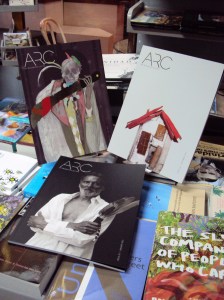
Gorgeous ARC magazines proudly preening!

Joan and Paper Based’s loyalty to the Bocas Lit Fest has its roots in the very reception of the idea of an inclusive literary festival on these shores. She tells me of her early talks with festival director Marina Salandy-Brown, wherein the two lamented the dearth of ground-level, home-brewed celebrations of our islands’ writers, readers and publishers. What distinguishes their conversations from so many that are had, cross-island, about the state of local literary appreciation, is that Salandy-Brown, along with a core collective of supportive individuals (of which Joan is and continues to be a proud member) purposed to actually do something about it. The result is what we’re currently enjoying – four unfettered days and nights of bookish delight, and a festival calendar that extends far beyond this event-crammed long weekend. Joan is visibly proud when she speaks of Paper Based’s role as the festival’s booksellers’ coordinator. I imagine of how difficult it would be to encounter this warm enthusiasm in an impersonal, unapologetically commercial paperback pusher, and, even mid-interview, I’m flooded with gratitude for the very existence of Paper Based – a telling marker that Joan is doing multiple things right, in an age where brick and mortar bookstores are literally crumbling beneath the yoke of financial sustainability, both home and abroad. Times are hard, we both agree… but the people keep reading.

As I’d hoped it would, my talk with Joan really runs the gamut. We muse on the evolving trends in publishing, principal among them the rapid ascent of the e-book’s popularity, of the fact that Kindles, Nooks and Kobos have become as indispensable as mobile phones to so many. We discuss the difficulties inherent in sourcing book orders from foreign countries, and the exorbitant costs of shipping, issues which have been aired at the inaugural meeting of the Caribbean Literature Action Group (CALAG), which convened one day before the festival launch. With bold, necessary initiatives like CALAG and the Bocas Lit Fest on the rise, the future seems bright for the world of Caribbean arts and letters, doesn’t it? In the midst of this, Joan reminds me, it’s important to continue encouraging our vibrantly promising talent, a mission to which Paper Based has dedicated itself over the years.

A certain book blogger poring over Rahul Bhattacharya's novel, The Sly Company of People Who Care.

A bookshop loved equally by both readers and writers, Paper Based held its 25th anniversary celebrations on March 3rd, to a deeply appreciative audience. Andre Bagoo, one of this year’s featured festival writers, had his work read by Barbara Jenkins and Jaime Bagoo. Other writers sharing their work included novelists Lawrence Scott (who read from his forthcoming poetry collection), prolific and celebrated author Earl Lovelace, winner of this year’s fiction category prize for Is Just A Movie, and poet-academic Jennifer Rahim. From every description I’ve heard of it, it sounds like it was a fantastic event, and I’m dreadfully sorry to have missed it. I’ve since resolved to make up for it by attending every single future Paper Based event that occurs while I’m present in Trinidad. Having been to a couple in the past, I can attest to the knowledge that they are a rare treat for those who enjoy author-reader interaction and stimulation.

It is quite impossible to wish someone like Joan Dayal anything but all the best, given her quiet generosity, her unflagging devotion to our regional arts, and her personal investment in our nation’s attitudes to reading, and so I wish her the bookish best, repeatedly! Here’s hoping that Joan and I can sit down in another twenty-five years, to chat once more about Paper Based’s rousing, and encouraging, successes.

Many thanks to Joan Dayal for her willingness to be interviewed, for her generosity in response and availability. This interview was originally posted on the Bocas Lit Fest blogPhotos by Keroy J. Chee Chow.

Paper Based Bookshop is located at The Normandie, 10 Nook Avenue, St. Anns, Trinidad. Its opening hours are Mon.-Fri.,10.00 – 18.00, and Sat.,10.00 – 16.00. To get in touch, you can call the shop, at +1 868.625.3197, email at paperbasedbookshop@gmail.com, and visit the well-updated Facebook page.