Mama’s Saris, written by Pooja Makhijani, illustrated by Elena Gomez. Published in 2007 by Little, Brown and Co., New York.
This tale first came to me in my early twenties.
A young girl wants to celebrate her seventh birthday party in the finest style possible, and for her, this means the right to wear one of her mother’s intricate saris. As her mother produces the infrequently worn, much-treasured collection from its storage space beneath the bed, her daughter pleads, cajoles and sulks, seemingly to no avail. Each sari the mother holds up from the leather suitcase has its own story. The one she selects for herself to wear at her child’s birthday celebration is brilliantly orange, trimmed with a carmine hem, and it was also donned on the day she brought her infant daughter home for the first time. Others, in colours of ripe fruit; the ink-dark midnight sky; the wide, blue ocean, are paraded before the daughter, and finally, sensing the young girl’s urgency, the mother comes to a momentous decision that will frame the day in heightened significance for them both.
What enchanted me?
Which girl hasn’t wanted, in one way or another, to walk in her mother’s heeled, perfumed, glittering footsteps? Mama’s Saris strikes keen chords of remembrance and nostalgia for me, as I have been that giddy, optimistic protagonist, perched on my mother’s bed, my arms arrayed in purloined bangles every colour of the rainbow, yearning for an induction into the mysterious magic of my first sari. Author Makhijani expresses it well in the note that introduces us to the story:
“I wrote Mama’s Saris after realizing that my own fascination with my mother’s fancy clothes was not unique. It seemed as if each of my female friends, regardless of ethnicity or age, remembers being captivated by her mother’s grown-up clothes. By dressing up like their mothers (and emulating everything else that they did), they would be just as beautiful, too.”
Gomez’s art partners itself with Makhijani’s prose in an exquisite, sensorially aware marriage that is, simultaneously, rapturous to behold and arresting to read. Each page unfurls before us like a yard of ornately bedezined sari cloth, stitched with remarkable love, attention to detail, and master (mistress!) craftswomanship.
Lines for Life:
” ‘What about this one?’ I point to a sari that I don’t think I’ve seen before. It is orange like fire with edges that look like they have been dipped in red paint.
‘I wore that sari the day we brought you home from the hospital.’ Mama smiles. ‘All your aunties and uncles came to greet you.’
‘Wear it again today!’
Mama unfurls it. It shines like the afternoon sun.”
This book would be best-beloved by:
♣ anyone for whom the sari is a sublime expression of beauty and artistry.
♣ mother and daughter duos eager to infuse their lives—and dress up dates—with even more revelry!
♣ those who skip and lilt, exultantly, at the place where traditions are delicately and deliberately passed on, those torches that bloom through the years.
Owl At Home, written and illustrated by Arnold Lobel. Published in 1975 by Scholastic Books, New York.
I first opened these pages when I was less than five.
Owl At Home is an offering of five short tales in the life of Owl, an affable, thoughtful gentle-bird who seems to delight in his own company, as well as in exploring the world around him. In “The Guest”, Owl learns that some visitors simply won’t adhere to expected protocol, when he invites Winter past his threshold on a particularly chilly night. “Strange Bumps” tells the story of Owl’s fear of two mysterious lumps that appear near the foot of his bed when he lies down, and how he deals with their persistent recurrence. A kettle full of weeping, prompted by ruminations on the saddest things, such as forgotten pencil stubs and never-seen sunrises, fills the kettle for Owl’s delicious, albeit slightly salty, “Tear-Water Tea”. “Upstairs and Downstairs” reveals Owl’s frustration over his inability to exist both on the landing as well as at the foot of his twenty-stepped staircase. Finally, in “Owl and the Moon”, our avian friend finds that a contemplation of the moon near the seaside doesn’t necessarily end when he folds his wings and prepares to head home.
What enchanted me?
I’m tempted to say, “Everything!”, and conclude this section thusly.
It’s important to know that this was one of the first books I learned to read. Owl At Home didn’t just teach me about proper pronunciation, basic grammar and syntax governance, though. It schooled me in self-sufficiency, creative zeal, an Owlian zest for life, of the wonder of imagination and the power of suggestion. Owl didn’t *need* a Mrs. Owl, or a flock of owl-lets. He wouldn’t have been diminished by their presence, sure, but more importantly, the absence of their presence didn’t diminish *him*. I don’t think I mused on it so lucidly at four, but I loved his aloneness, even then, and the way in which his solitude didn’t make him lonely, or morose. We could all stand to borrow a page or three from Owl’s book… a book which I can still read today, and delight in, and laugh with, and smile til my face aches, just as much as I did when I was unfamiliar with the intricacies of the shoelace. You won’t be able to read this book (to yourself, or to your children) and tell me you’re not at least tempted to try out that Tear-Water Tea recipe. Come on… you’re thinking up at least five sad things right now. Go fetch a kettle, mate.
Lines for Life:
“Owl watched the moon. It climbed higher and higher into the sky. Soon the whole, round moon was shining. Owl sat on the rock and looked up at the moon for a long time. “If I am looking at you, moon then you must be looking back at me. We must be very good friends.” ”
This book would be best-beloved by:
♣ ramblers, ponderers, pocket sages, anti-politicos, and all people who’ve wanted to be both upstairs and downstairs at least once in all their lives.
♣ everyone. Everyone. This book is for everyone. It’s for you. It’s still, and always will be, for me.
Charting Children’s Literature is a monthly feature at Novel Niche that seeks to highlight the beauty and richness inherent in many of the books written and illustrated with the enjoyment and education of young children in mind. The feature was launched in August 2011, and is set to run for the foreseeable future (to infinity and beyond)!
If you’re interested in bringing to my attention beautiful children’s books I haven’t yet covered, feel free to leave a comment on this page. If you would like to contribute a guest Charting Children’s Literature feature, please make use of the contact form provided. I’m looking forward to hearing from you!
Nuri’s childhood is well-heeled, sensitively moulded; he does not lack for parental affection, though it is frequently distilled with eccentricity. The recipient of uncommon, and uncommonly shown, affection from his parents, he finds himself, at a tender age, thrown into a bemusedly altered state when his mother succumbs to a mysterious illness. In an attempt to restitch the tenuous fabric of their familial comfort, Nuri and his father, former political dissident of international reknown, Pasha, vacation at the Magda Marina Hotel, a sweltering beachside resort dotting Alexandria’s coastline. It is there that father and son encounter the entrancingly beautiful, yellow bikini-clad Mona. Their interactions with her form the basis of a complicated, acutely felt triangular relationship that spans erotic awakenings, unspoken betrayals, and the passage of many years, indelibly altering each participant in its perfumed wake. When Nuri and Mona are left reeling in the aftermath of Pasha’s abduction, the mire of bureaucratic red tape and festering resentments through which they must navigate leave them sceptical as to just how precise their lifelong impressions have been, of the man they love most.
Something about reading Matar’s prose puts one in mind of wandering through the dense foliage of a half-sentient dream, wherein the author delineates, blurs and casts colours of sound and light over our keenest emotive reactions, wearing the robes of a master chiaroscurist. Seemingly ordinary expositions are transmogrified so that we drink his imagery beneath a sea that is mapped somewhere between our own imagination meeting his. Rarely do we doubt this authenticity of voice, which renders the work as easy to absorb (for the reader who appreciates fineness of form) as the purest air. Lexically, stylistically, Matar barely makes a misstep, and in this regard, each page is a pleasure.
Threads of the disturbingly and entrancingly erotic hem each page of Anatomy of a Disappearance, and they don’t strictly apply to the characters one might pair by default, either, which is what makes the implementation of this ragged desire all the better. Insofar as the tri-pointed bond among stoic Pasha, mercurial Mona and frequently discomfited Nuri himself can be said to be its own personage, that unnamed fourth character that embodies their inharmonic disunion feels eros across the board. Some of the best passages of the novel thickly hint at never-to-be-resolved shards of sexual tension between father and son; the foundations of this are even more intriguing to parse than every sweaty boudoired flirtation that Nuri and Mona trade, predictably. Those open to the multivalence of burgeoning sexuality will find this aspect of the reading richly, thoughtfully cast.
Emotional complexity could be said to be the feeling cornerstone of the novel; this marries seamlessly with the thematic exploration of the survivor’s impasse: of what remains to be done once a loved one’s enforced absence drags itself past the point of rational hope. The novel is also constructed as much on the skeletal considerations of a bildungsroman, making the aching peregrinations of Nuri all the more valid. We both feel for him, and feel that his suffering, his sense of displacement at his typecastedly stolid British boarding school, his fumblings through the onsault of sexual prerogative, are necessary and credible. If Matar has Nuri flounder and regret for the sake of sustaining depth, then it is skilfully done, not without compassion, not without (more importantly), reminding us of how easily replaceable his childhood and teenage difficulties are, with any of our own, barring (or including) the shadow of a father one fears may never return, or be returned.
At times, Nuri grapples for an identity outside of the distant cloak of his father’s presence, and the complexity of his reaction to feeling this is vividly imparted—his reluctance, guilt, shame, bravado, swirl all together, blotting onto the page our impressions of him as a meticulously drawn protagonist, worthy of our attention, sympathy and solicitude. In one of the most perspicaciously hopeful scenes of the novel, an adult Nuri pauses in the midst of a solitary walk, to consider the apartment block before him.
“The stone buildings stood dimly in the night, and, looking at them, I felt a deep longing to inhabit their rooms. To make love and eat and bathe and sleep in there, to quarrel and make promises, to sit with friends and talk into the night, to listen to music, read a book, write a letter, consider the position of a new object, watch flowers in a low vase, watch them at different times of the day, clip their stems and replace their water daily, move them away from a harsh light, a drafty passage, draw out their time.”
Occasionally, the contemplation over whether Pasha will ever reenter Nuri’s life becomes subtly secondary to the question of whether or not Nuri will ever successfully navigate a personhood with which the latter can be content, away from Pasha’s all-encompassing orbit. Truly, Nuri works against the threat of his own inevitable disappearance, specifically in how he can make his life count, before the decline, in how he can etch himself visibly into a world where he, not Pasha, can own the starring role.
Some books seem so quietly, inexorably suffused with the idea of the best they could be that they never quite, to phrase it with seeming, but unintentioned unkindness, get over themselves. Anatomy of a Disappearance is one of the most thoughtful, thinking person’s reads I’ve had the pleasure to know this year, but perhaps much of its internal grey space is never externally worked out across the page. The result is a study of the intricately plotted map of minefielded human interaction, which may yield more casualties of clarity than clearly charted coordinates… which, when you’re reminded of Tolstoy’s oft-quoted opening liner on family, seems to be less disingenuous than damned honest.
A free electronic copy of this novel was provided by the Random House Publishing Group (The Dial Press imprint) for review, through NetGalley. The opinions expressed in this review are entirely my own, and are not influenced by their generous gift of gratuitous literature.
“Twice in the night she woke up and reread the letter again and then a third time in the morning before sending it on her way to the Saavedras where she worked as a maid, and where she received the wailing, youngest son Vicente before she’d even put down her bag. She hadn’t taken to this last boy as she had to the older Saavedra children, but today she felt so full of promise she kept Vicente in her arms all morning. She had just sent a letter. To a man who might want to meet her. The greatness of the possibility felt like an apple inside her, round and shiny every time she thought of it.”
Nelda Soto is lonely. She does things to assuage her loneliness that are understandable to the similarly lonely, and perhaps pathetic to the mercilessly popular. When, at her more gregarious, practically-minded sister Maria’s urging, she responds to an ad in the personals section of the Peruvian Sunday paper, she invites the beginnings of an unusual correspondence. Javier, the man whose personal ad she answers turns out, of course, to be rather disparate from her stolid yet earnest romantic ideals, but sooner than later, Nelda becomes hard-pressed to imagine her life without him. When an essential, previously guarded truth about Javier’s exact location comes to light, it is the thought of the song-fragments (which are really poem-fragments) and curious thoughts he’s shared that compel Nelda to seek him out, despite the potential embarrassment to herself. This, and what Nelda discovers upon encountering Javier face to face, form the essence of Idra Novey’s tender, deceptively simple short story of unexpected kinship and the universally shared quest for human comfort, “The Man from the Ad”.
The story is more than a seeming retrospective take on a romantic’s search for meaning; what makes it fodder for future rumination is how detail-dotted it reads, even when those details have been artfully concealed by Novey’s hand. For instance, near the beginning of the narration, we learn this:
“It was 1979, six years into the Pinochet dictatorship, and Maria assured Nelda that the newspapers reported nothing but good news now. Nothing was going wrong in the country anymore. It was an ideal time to find someone through the paper.”
This is clever, unflaggingly clever of the author—to document an entire substory of horror and wartime woe beneath a pleasant, postal façade. The idea of no bad news being reported in the thick, unremitting onslaught of one of history’s most brutal dictatorships is stymying. With a hair’s breath’ difference of perspective, we realize that Novey could be telling us a very disparate story. It might be to her eternal credit that she does not. There is something garishly enticing about reading of a fairly innocuous, if oddball, courtship, whose players have not gone unsoiled by the tragedies of the time, and yet, none of the horrors one might expect never quite reveal their faces. Some of the best writing is enforced entirely in the name of baiting us, hooking us on expectations and delivering the opposite of what we think we’re going to be told, no? There are subtle hints and suggestions of that in this story, giving it volume and history once we’re aware enough to distinguish them where they lie.
Pen and paper correspondents will doubtless appreciate the uneven, awkwardly meeting layers of experience in Nelda’s letters to Javier, and his responses to her. Her declarations are just that: baldly, self-consciously declarative, in which she makes no secret of her intent, in which her solitary, longing heart is evident between every forthright line. Javier’s replies are perfumed with the mysterious, including random queries regarding Nelda’s epicurean tastes, and snippets of the poems of César Vallejo, who Nelda mistakes for a possibly-leftist contemporary singer… and yet, at their core, both sets of letters are about the writer seeking to draw out the pleasure of the other. So, Nelda wishing Javier a Happy Easter, in advance, because she remembers his initial request for a “thoughtful correspondence”, and Javier sending Nelda these lines from C. Vallejo:
“It’s the fourteenth of July.
Five o’clock in the afternoon. It rains
Over the third corner of a dry page
And it rains more from below than above.”
are born from the same impulse: to be beloved, to show gratitude for the presence of another in one’s life who finds one worthy of every care.
Exquisitely composed, “The Man from the Ad” contains enough reflections on desire tempered by distance, on what constitutes our carnal responses, on companionship and the unlikely places in which it dwells, to carry you through a week of reflections, and then some. Perhaps it will inspire you to toy with phrasing for your very own personal ad… because, wartime or not, we’re always reaching out for a little extra affection, aren’t we?
You can read “The Man from the Ad” by Idra Novey here. (Guernica)
This Sunday, Ellen, the creator of the Story Sundays feature, shares her thoughts on “White Boy” by Murray Dunlap. You can read her post at her blog, Fat Books and Thin Women, here. This week, we’re also joined by the lovely Jennifer of Books, Personally, who shares her thoughts on “Weimaraner” by Kate Lorenz, here.
Story Sundays was created by Fat Books and Thin Women as a way to share appreciation for this undervalued fiction form. All stories discussed are available to read free, online. Here’s Fat Books and Thin Women’s Story Sunday archive, and here’s mine. Want to start up Story Sundays on your blog? Yay! Email story.sundaysATgmail.com for details.
“You were born with the gift of rain. Your life will be abundant with wealth and success, but life will test you greatly. Remember—the rain also brings the flood.”
I’ll open this review with a tiny confession of sorts; I’m a bit of a sucker for quirky titles and quotations featured at the beginning of any literary work. The effect it has on me is akin to what the average man may experience while driving, and suddenly spotting a pretty woman jogging in the opposite direction. We’re both likely to get whiplash; me, from craning my neck to try and read what’s written on the spine of the shelved book and him from the fender-bender he will inevitably cause.
Now that I’ve gotten that off my chest, Tan Twan Eng’s debut novel The Gift of Rain, is the kind of work which could have piqued my interest from the title alone, but the aptly selected quotation from Jean-Dominique Bauby’s The Diving Bell and the Butterfly pretty much ensured that I would read on. Partly because I was intrigued, but primarily because those two aspects are merely decorative icing; to be certain about how the creation tastes, I have to consume the sample.
The story told is as common and familiar as rainfall is to the island of Penang in Eng’s novel; that of an autobiographical tale recounted by an individual who is in his twilight years. The character in question is Phillip Hutton, a half Chinese, half British native of Penang who, in his early seventies, is the lone resident of the mansion which has been in his family for generations. What precipitates the telling of his story, and simultaneously stirs him from years of self imposed solitude is the arrival of two entities, both of which are obliquely related to him by varying degrees of separation.
The most unfamiliar element in the equation goes by the name of Michiko Murakami, a Japanese woman of similar age, whom Phillip, though never having met her before, remains convinced that she has for a long time “…been set upon a path that would lead her to the door of my home.” This is because Phillip once heard her name spoken by his long deceased friend and sensei, Hayato Endo, during the very tumultuous years when he came of age; namely the Japanese invasion of Penang in World War II. As a mutual person of interest, Michiko’s arrival instantaneously carries him back to that era.
However it’s his listening to her ‘fill in the gaps’ about the life of this enigmatic ghost from his past which cements the effect. The final impetus to his confronting the memories of that period though, is the result of a pair items innocuously presented as gifts; an old katana and a letter, written by Endo in 1945, which had only recently reached Michiko prior to her meeting Phillip. So, with all these seemingly random, but related set pieces in the appropriate positions, Phillip Hutton, “…gently unfolded” his “life, exposing what was written, letting the ancient ink be read once again.”. Thus begins a story in which the action, save for those occasional key intervals in the tale where both the elderly narrator and the reader might require a quick break to refresh themselves, principally occurs during those six years of the war.
Now, I’ll admit that the aforementioned story-telling mode is fairly effective for this type of narrative, and the connection which Eng establishes with the reader, through Michiko, is accomplished so deftly that one could literally imagine Phillip Hutton as a real person. By the end of this novel I could feel his pain, loss and identify with his moments of anxiety and ambivalence in having to choose between his loyalty to friends and greater causes, which in his case, is defending his family and the country he called home. I could even empathize with the sense of grief and alienation he often experienced when, despite having the best of intentions, every completed action made him feel like he was being hurtled along the road to hell.
There remain certain elements in the story however, which reminded me that although this is eloquently composed fiction, by a very capable writer, it is still a debut novel. My first grouse is with the coalescing of those parts which introduce Phillip in his teenage years. Whenever you do read Gift you may beg to differ with me, but in hindsight, I was left with a sense of contrivance in how Eng attempted to weave together the circumstances of Phillip and Michiko’s initial encounter. I’ll admit, stranger things have happened than a mailed package meandering around Asia for more than four and a half decades, but the plausibility of the prospect produces a strain which could break that aforementioned ancient katana.
Another feature that I found equally double edged was the presentation of genders in this debut. Having studied and read my fair share of works across cultures from the bildungsroman genre, it was a welcome change to observe a young man’s transition from youth into adulthood, facilitated no less by his exposure to a martial art, in this case aikido. Even the treatment of the growth of the father-son relationship is handled in a way that, like Phillip Hutton, I could imagine myself echoing his observation about “the best of fathers” who endure their sons’ “callousness with dignity and silence”. As the novel progressed however, I began to notice a pattern; almost every critical relationship in Eng’s book is distinctively male. Be it Phillip and Kon, a fellow student of aikido, training partner and friend, Phillip and his father Noel, Phillip and his grandfather, and the most profound, Phillip and Endo.
I’m not saying that there’s a dearth of female characters, some of whom, like Phillip’s sister, Isabel, and his Aunt Mei, are drawn in a relatively satisfying manner. Yet the reality is that as figures in this work, they don’t seem to exist in their own right, but are merely supporting characters in the drama of Phillip Hutton’s life, and only gain significance when they assist him in discovering a key facet about himself. The female relationships in Gift are thus often tenuous, strained, and too often the female member met a tragic end.
Furthermore, there’s a specific white elephant in the room that needs to be acknowledged, and that is the relationship between Phillip and his sensei. As bonds go, it is indeed one of a very intense loyalty, and the subject of serious conflict, not merely between Phillip’s family, and friends, but also Endo and the latter’s associates. There’s also a fair amount of anguish present between the two characters, so much so that my ‘gaydar’ kept detecting a barely concealed homoerotic vibe to what is shared between the student and teacher.
There are moments where I found that that the two talk and even act like a couple. What’s more, even though Michiko speaks of the romantic affection she had for Endo, and Phillip states that he heard Endo utter her name, I don’t recall it being spoken of by Endo in similar terms. I’d also have never guessed that he had a past love waiting for him from the manner in which he and Phillip would stand near each other, and Endo would occasionally caress Phillip’s face, or another seemingly innocuous part of his anatomy. There’s one scene in the work, where Eng has Endo rubbing Phillip’s bruised muscles after a particular vicious round of training at the Japanese consulate that is rendered in such a tender tone, that were it not for the imagined scent of liniment, you could expect the moment to proceed in a particular fashion.
Admittedly the author never has a physical consummation of this intimacy occur, seemingly content to have the two circle each other, bound by their duty to family, country and the tenets of aikido. It’s an ambiguous portrayal that, alas, could leave parties on either side of the gay/straight divide feeling equal parts unsatisfied or uncomfortable with the writer, wishing he didn’t vacillate.
Rest assured though, these identified objections to The Gift of Rain ultimately do not detract from the work being a most noteworthy debut. Eng is at his absolute best when illustrating his natural environment, and I recommend that future readers look out specifically for his description of a boat ride Phillip takes with Michiko to observe fireflies. Also, when incorporating the key moments of Penang’s history during that era into the narrative, Eng doesn’t allow himself to get carried away. He is also adept at capturing the capriciousness of the time, both for many of the key characters, and also that of the ordinary citizens, none of which is presented quite so well as the fate which befalls an elderly piano teacher.
Ultimately, I could see this work resonating with both those who have never had a father figure in their life, while making those who did, remember the pleasant and less pleasant moments of growing up. The colonial subject will identify with both the personal and national feelings of abandonment, especially at critical moments in the experiences. Phillip Hutton’s story also speaks to the fact that personal alienation touches both the affluent as well as the impoverished. In the end, I, like Phillip didn’t gain a full appreciation for his ‘gift’ until the close of the work and I wouldn’t want to spoil the epiphany for anyone. Just know that when the revelation arrives and you turn the final page, the denouement will feel, in a word, gifted.
Duane Allicock hails from the island of Trinidad and lives for reading, cycling and running; in that order. When not pursuing any of these passions, he prefers to immerse himself in listening to music, or the silence of the Mount Saint Benedict monastery, pondering on life’s humorous ironies.
This is the short story you wish you’d written if you were a writer who allowed herself a broader swathe of cruelty over her reader. That’s the prevailing thought I’ve cultivated from multiple readings of “Winter Break”, a quick cigarette’s length of a read to which I know I shall return, to have my heart bruised, bewildered and grudgingly made envious, all over again.
A British couple, growing semi-stolidly, predictably into their middle age, endures an uncomfortable journey to their vacation resort, chauffeured by a distinctly disagreeable driver. As their taxi rattles unceremoniously over pockmarked roads, subject to sudden, miniature avalanches of earth clods from the mountain slopes that frame their travel, the wife muses about the alternate plans she’s quietly, without apparent bitterness, curated in her secret heart, despite her repeated renunciations of them, prompted by her husband, Phil. It is through her eyes that this seemingly lukewarm hotel odyssey unfolds, through her sole perspective that the journey to the hotel resort begins and ends.
This linear, single-voiced narration seems to work best in most short fiction; “Winter Break” is no exception. The unnamed wife (leaving her nameless adds a layer of cleanliness, somehow, giving us the right to apportion her any name we choose, or no name at all; there is something surgically precise about an unnamed protagonist, is there not?) is satisfyingly complex. Her in-transit thoughts are as scattered, easily jolted as the ride to the Royal Athena Sun itself. In the time it takes for them to manoeuvre their way from the disconcertingly humid airport lounge, to the terracotta-tiled hotel entrance, we are able to glean the impression of the full life of her marriage to Phil, to acknowledge it as its own chafing, unevenly impressioned identity.
Indeed, the marriage could be said to be a character within its own right. The weight of it seems to occupy as much room in the backseat of the taxi as either of the marriage partners. There is a distressing heft to all the concessions our narrator has made to Phil during the tenure of their union, the most apparent being the latter’s overt reluctance to procreate. The way in which Mantel articulates Phil’s passive-aggressive manipulation of his wife’s own will in the matter is exquisitely executed:
“Once, a year or two into their marriage, he had confessed to her that he found the presence of small children unbearably agitating …
He nodded miserably. “A lifetime of that,” he said. “It would get to you. It would feel like a lifetime.”
Anyway, it was becoming academic now. She had reached that stage in her fertile life when genetic strings got knotted and chromosomes went whizzing around and reattaching themselves. “Trisomies,” he said. “Syndromes. Metabolic deficiencies. I wouldn’t put you through that.”
Anyone who’s been in a relationship in which their partner has wielded subtle or overt pressure over their choices can attest to the curious emotional miasma that emerges at the hands of this studied, almost sympathetic negation of their own autonomy. It rankles just as much as it bemuses, making one wonder at intervals (as our narrator no doubt wonders) just how much one wanted what one claimed to, in the first place.
Most short fiction pieces seem to save their visceral pull for the very end; few do it as blindingly well as this one. Without giving too much away, this is what I mean by enviously enforced writerly cruelty. Mantel drives us through a landscape that we discern to be well-plotted but not particularly hair-raising, then sends us careening off an unforeseen cliff without so much as a backward glance—and this is the very best way in which the story could have ended, arguably. If anyone can conjure up a superior ending, once they’ve read the original, I would be thrilled to hear about it. It transforms what would have been a very fine story into something fictively exceptional, and if the price of that is a perpetually unanswered cache of questions, so much the better, no?
Too many short stories are caulked with excessive kindness; they could stand to be improved by some authorial amorality. “Winter Break” is a concise case study in witnessing, simultaneously, far too little, and far too much, for one’s own good. If I taught a course in short fiction writing, it’s the kind of story I’d distribute to my students, saying, “Discuss this. Tell me about human kindness, or the distinct lack thereof, about the tricks we make our minds play, and the times we wish we could trick ourselves out of seeing what we’ve seen.”
You can read “Winter Break” by Hilary Mantel here. (The Guardian)
This Sunday, Ellen, the creator of the Story Sundays feature, shares her thoughts on “This Is All the Orientation You Are Gonna Get” by John Jodzio. You can read her post at her blog, Fat Books and Thin Women, here.
Story Sundays was created by Fat Books and Thin Women as a way to share appreciation for this undervalued fiction form. All stories discussed are available to read free, online. Here’s Fat Books and Thin Women’s Story Sunday archive, and here’s mine. Want to start up Story Sundays on your blog? Yay! Email story.sundaysATgmail.com for details.
Shortlisted for the International IMPAC Dublin Literary Award, 2011.
“He was still whole, there were still things that one man alone was worth.”
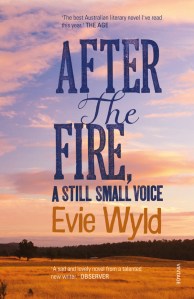
Frank Collard turns to the wild, and his grandparents’ rustic outpost in the swamplands, when an abusively disastrous relationship shatters his heart. Lonely, he gradually inches away from being corralled by the teeming landscape that surrounds his shack, to becoming a part of it, blending gracelessly and gruffly into the local milieu. Though he adapts the semblance of a normal life, rooted in work and earnest, albeit thorny, social interaction, he shares little of the past he’s fled. His reluctance to unburden himself of old hurts mirrors the journey of his father Leon, an extraordinary maker of cakes who found himself hard-pressed into military service, feeling it change him perhaps irreparably, as it did his own father, who volunteered eagerly, yet found vital parts of himself effaced by the reality of war.
There is the distinct impression one sometimes receives, when reading of something grand, or sweeping, or otherwise elaborately contrived, that a character has just done in the book one’s reading. The feeling is akin to furrowing the brow and exclaiming, “Well, that’s just not how real people behave, is it?” It is worth noting right here that Evie Wyld’s book is built on the structure of something unflinchingly honest—even the way it flinches is honest. While reading, one gains the impression of absorbing something stripped to barebones and left in the sun to roast, of prose subjected to a rigorous, flinty syntax, studded through with alarming pinpricks of raw beauty.
Wyld is at her best, here, when discussing grief, and the book could be considered a generationally unfolding sorrow-documentary, of a kind that dampens our eyes and makes us suck in our breath, with the laughter we laugh when things are good and proper miserable, so that to laugh about it is the only sane recourse. What is particularly laudable is the manner in which Wyld inserts gut-spasming woe into the most domestic and non-extraordinary of settings. Witness, for instance, Frank’s messy navigation of girlfriend-withdrawal, in the aftermath of a nasty confrontation that effectively seals their rupture:
“The toast pinged up, and, crying, he buttered it and daubed it with jam, inhaling deeply and letting out long shaky breaths. He ate it breathlessly between hiccups. His mouth, which at that moment had nothing to do with him, would not stop making the sound ‘Aaaaaaaa’ like a stiff door opening. He lay on the floor, a smear of jam on his cheek, and mashed the last of the bread into a wet pap with an open bawling mouth. The crusts sat on the floor. He swallowed and breathed in sharply, then cooled his crying to a whimper, then to sniffling and then just to staring. The sun moved across the kitchen floor, regardless.”
The author writes this so convincingly that we accept a grief so cavernous as to unman Frank, a relentless sadness that chokes, rendering useless the elegant protestations of studied melancholy. There are no fainting couches here, no dainty snifflings into handkerchiefs. I especially love the way in which Frank’s mouth “…at that moment had nothing to with him…”, reminding us that when we are this transported outside ourselves with a surfeit of intense emotion, even our anatomy feels remote, conducted by another, out of our sight, outside the realm of interest.
Though Frank and his father lead separate, near-diametrically opposed lives on the page, the ways in which Wyld unites their divergent stories with lashings of past trepidation, of an unquantifiable sense of void, are skilful and subtle. Both men feel themselves hunted and haunted by the nigh-unassailable sensation of being pursued into unknowns. Nothing in their resentment-riddled, mysteriously ill-articulated communion, or lack thereof, allows for the sharing of this unified phobia; neither of them knows the other suffers in a language so well suited to his unique understanding. The reader wonders, for the duration of the reading, whether or not it would make a difference to their relationship if, for instance, Frank were ever told of the dreadful doubts Leon nursed while at war:
“Tears on his face, he felt the teeth of a terrible thing on the back of his neck, breathing through its nose on him, in, out, hot, pant.”
Some may find it unrewarding that the exact cause of the father-son malaise remains largely unearthed. It can be galling to consider that Frank and Leon might have fallen out over some poorly edited snafu, a minor discrepancy that wounded both their masculine prides; perhaps Frank’s girlfriend wonders at this, as she tries to sift through the rubble that nourishes a long-term vow of silence. Personally, the ambiguity marshalling the quietness between these men works admirably; it leaves it to the reader to devise reasons, grand or minute, and it prompts speculation over how much of the events of the last chapter of the novel coloured Frank’s perception of Leon, and Leon’s musings over Frank. This is good writing, the skilfully underscored balance of omitting just enough, of never bludgeoning the reader over the head with detail; those of a discerning, thoughtful bent will notice appreciatively (while those inclined to fast-food in their literature will probably have put the book down by now).
Grief and terror couple and uncouple against a background of settings one would initially think too bland (save for the backdrop of Leon’s outpost and battlefield, which Wyld blesses with no war paint, just irksome bush scratching the legs and loosing the bowels of boys pretending at soldiers) to support their movement through the chapters. Yet none of the settings read as anything less than exquisitely suited to the unfolding of each private, stunted drama. The dirt and insect-framed jungle wilderness that surrounds Frank’s shack, the family bakery in Parramatta to which Frank returns, despite himself, in search of his father (the same bakery in which his father once turned out elaborate baked goods in a thorough, calm manner; the very bakery in which he courted Frank’s future mother), the home of Frank’s sole friendly family unit, in the unkempt northlands: all these locations in the novel are implacable, inviting themselves near-perfectly for Frank’s fumbling self-discovery. The author infuses as much detail (without rendering her landscapes in a saturated style) to these places, making them represent geographic markers as well as placeholders for the full range of human emotional discord and desire, as if to suggest that cartography remains immune, for the most part, to the petty dramas with which we map our time on earth. This makes Frank’s sadness and stubbly conflicts simultaneously relevant to him, and gloriously, disturbingly irrelevant, given the sweeping dismissal of Enough Time: a fact of which Frank himself seems all too cognizant for much of the novel.
Yet the mission statement of Wyld’s book, if there can be said to be but one, is not as reductive as “Life causes despair to run roughshod all over you; therefore, despair.” The gnarled, honest interactions he shares with Sal, the precocious child of the aforementioned family unit, are some of the best passages of the book, and attest to the contrary of prevailing desolation. Their unlikely bond speaks instead to the surprising friendships that can be worked at when embarrassment and artifice are cast aside. Beset at every dirty, suspicious corner with the long arm of the past, Wyld’s grittily redemptive novel seems to whisper, “This is the way you come back to yourself; this is how to banish spells of unremitting dark: gracelessly, naturally, with pain—the only way possible.”
It’s interesting when the writer of a piece of fiction begins his story by calmly declaring that one of his techniques bears no dint of conceit, when, in fact, it is typically thought of as conceited. McCall Smith starts “Rain” by sharing his thoughts on authorial intrusion, that dismantling of the layered screen separating world-constructor and world-absorber; he admonishes it while in the process of implementing it, so that we wonder, “What is the good of this? Why won’t you simply launch into the story proper?”
The story proper is a simple one, without fantastic artifice, or suspenseful leaps of faith. It concerns the intertwined lives of two men, Riv and Ian, who meet, fall in love and decide to build their lives together—two men who are initially surprised but humbly, happily gratified to find in the other’s contrasting Self a near-perfect mirror of reflecting desires. Their dreams turn to having children; after deliberation they decide to employ the services of a flighty surrogate who seems, nonetheless, suitable for the procedure. Riv and Ian decide on a mixed-batch donation, so neither will be entirely certain which of them turns out to be the father of their future child. As their wisely supportive doctor friend, who arranges the specifics of the procedure, remarks:
“The danger, I would imagine, would be resentment. If one of you knew that you were the real father, then you could start assuming that your word carried more weight than the one who wasn’t. Humanity is messy. People behave in ways they’d never dream they’d behave in. Let me assure you of that.”
So what happens, then, when both Ian and Riv begin to cultivate their separate, private doubts, suspicions and secret musings over their son David’s parentage—specifically, which one of them is the father? They both, independent of the knowledge of the other, turn to their doctor friend for a paternity test, but neither of them receives the results they expect, altering the fabric of what they believe in an unexpected, nigh-impossible to predict manner.
I have always been a fan of McCall Smith’s elegantly understated, economical writing style, having enjoyed his Isabel Dalhousie novels supremely over the years. They are akin to a certain brand of literary indulgence that bears the sweet taste of a known formula, while bearing none of the bitter dregs of a truly frown-worthy fictive style. “Rain”, titled partially in homage to W. Somerset Maugham‘s short story of the same name, is crafted on the same standards of fine tale-telling to which one grows accustomed after a steady diet of McCall Smith. His authorial perspicacity and emotional involvement in the development of his characters, and the situations in which they find themselves, is both gentle and unsentimental. The result is that we enjoy the lives of these men; we appreciate what they endure even when they are sad, out of sorts with themselves, each other, and the world. We recognize in their interludes of woe and joy familiar skins of our old, new and unborn experiences, ones we can pull over our own bones like overcoats, marvelling at how well they fit, at how seemingly easily they speak to what we know, and the places we’ve been, the places we have yet to go.
Why the title “Rain”, though, you might still be wondering? A story titled in partial homage still needs to have its name bear some relevance to the concerns of the narrative itself, no? Rightly so… and rain is important in this sweetly sad reminiscence of a tale. It frames, in torrents both obscuring and revealing, the principal exchanges at the heart of the piece. It is to a background of rain that worst fears are confirmed, and under the same deluge that glimmers of redemptive hope, even in the face of atrocious deception, are glimpsed. McCall Smith stitches in these fine lines of symbolic significance without having to bash his reader over the head with them, repeatedly; this adds to the story’s understated, undeniable appeal.
Divided into paragraph-length chapters that span years, possibly a decade, possibly more, the story holds the weighted significance of a shared segment of a lifetime’s worth of memory, without the pages and pages devoted to slow, steady exposition one might normally associate with this level of development. We learn as much about Ian and Riv by what McCall Smith does not say about them, as by what he makes plain in his prose. Some may find the chapter assignation cloying, but I can only conclude that it is enforced with the same display of thoughtfulness that the author evinces in other chief aspects of his narration.
You might be able to read “Rain” twice in the length of time it takes you to walk from your house to the post office on the corner, but if you read it today, I daresay you will enjoy a Sunday speckled with the finest calibre of thoughtful thoughts… and what more could you ask for, from a short story, than to be reminded of all the rain that’s framed the best and worst moments of your life up to this point?
You can read “Rain” by Alexander McCall Smith here. (New Statesman)
This Sunday, Ellen, the creator of the Story Sundays feature, shares her thoughts on ‘Aviator on the Prowl’ by Kalpana Narayanan. You can read her post at her blog, Fat Books and Thin Women, here.
Story Sundays was created by Fat Books and Thin Women as a way to share appreciation for this undervalued fiction form. All stories discussed are available to read free, online. Here’s Fat Books and Thin Women’s Story Sunday archive, and here’s mine. Want to start up Story Sundays on your blog? Yay! Email story.sundaysATgmail.com for details.
“It will have blood; they say, blood will have blood. Stones have been known to move and trees to speak; Augurs and understood relations have By maggot-pies and choughs and rooks brought forth The secret’st man of blood. What is the night?” Macbeth, (III.iv.121-125)
I’m a girl who’s down with particularly good horrific suspense… reading it, that is. Spare me the legions of chainsaw-wielding, lip-sewing stalkers of screens both silver and small, but if your writing can thrill me past any temptation of sleep, keep me pacing, prompt my fumblings for a totem of familiarity, or rip a gasp out my throat, then you’re good. The real question I ought to ask Jason McIntyre, author of Thalo Blue and The Night Walk Men, weaver of wickedly unsettling prose, then, is this: “Just how afraid should we be about your latest literary offering, Bled?”
Tell us, Jason… how much blood are we really in for? Should I be wielding my special anti-sanguinary parasol, for good measure? Here’s his response.
Why is blood so creepy?: discussing my new book, Bled
There’s no denying that there’s blood in my new book. After all it’s front and centre: the title is Bled, after all. And there’s a big dab of it right on the cover, hot red against stark white.
So what’s with suspense and horror writers’ fascination with the stuff? It’s visceral, I suppose. It’s the stuff we are all made of. Pumping in all our veins is this common material. Without it we would die.
And if we see some of it (or lots of it, as the case may be) it probably means we’re on the very cusp of dying. Or hurting. Since suspense is often about what it is to hurt, and horror is often about what it’s like to have hurt inflicted, it makes sense that blood would be bound up in these kinds of fiction.
But how much blood is in my new book Bled, anyhow? Is there just gobs and gobs of it? If you read this story, will you have to get on your waders and dive in?
I can tell you that it’s not gory for the sake of it. There are some difficult scenes but my catalogue would never be called gratuitous. Nor would Bled. In fact, I would venture to say I’m not a horror writer at all. Bled is much more about the human condition, much more about facing imperious odds and seeing if one can come out alive. If there’s a lasting legacy with the story, if readers can remember something other than the bloody cover, I do hope it is this: people can push back when they’ve been pushed too far.
So, what do you think of the title and cover? Does blood make you squeamish? Does it excite you? If it does, I might be tempted say you do like horror. But I bet you’ll like this book anyway.
Ah, yes. That’s the sound of my parasol billowing open to meet the wind. While I wrestle on a spatter-resistant raincoat, have a look at this spine-tingler of a teaser trailer, then tell me you’re not all the more intrigued. I was.
If that made you hungry for more than a minute’s revelations, sink your teeth into this description.
Bled: About the Novella
She only wanted to leave. But he took that option from her. Now she wants it back.
Set on the same island as the reader favorite Shed, the latest literary suspense novella from bestselling author Jason McIntyre picks up the Dovetail Cove saga with this story of one lonely woman… trapped.
Tina McLeod is on the cusp of a new life. Extraordinary change is rare in her world but this newsflash means she can finally leave her small island town for good. No more pouring coffee for townsfolk in Main Street’s greasy spoon, no more living under the weight of her born-again mother. That is, until Frank Moort comes in for his usual lunch and dessert on an ordinary Friday in May.
Bled sees things turn backwards and upside down for each of them. Their encounter is prolonged and grotesque, the sort of thing splashing the covers of big city newspapers. Both are changed. And neither will come out clean on the other side.
A story about taking what’s not yours, Bled explores pushing back when you’ve been pushed too far. It paints in red the horrors from our most commonplace of surroundings: right out in the open where nothing can hide behind closed doors and shut mouths.
About the Author
Jason contemplates labelling all Bled proceeds as blood money.
Jason McIntyre has lived and worked in varied places across the globe. His writing also meanders from the pastoral to the garish, from the fantastical to the morbid. Vibrant characters and vivid surroundings stay with him and coalesce into novels and stories. Before his time as an editor, writer and communications professional, he spent several years as a graphic designer and commercial artist.
McIntyre’s writing has been called darkly noir and sophisticated, styled after the likes of Chuck Palahniuk but with the pacing and mass appeal of Stephen King. The books tackle the family life subject matter of Jonathan Franzen but also eerie discoveries one might find in a Ray Bradbury story or those of Rod Serling.
Jason McIntyre’s books include the #1 Kindle Suspense, The Night Walk Men, Bestsellers On The Gathering Storm and Shed, plus the multi-layered coming-of-age literary suspense Thalo Blue.
I’ll be reading Bled this weekend, garbed in all my protective gear, clot-resistant umbrella at the ready. Can I withstand the carmine-coloured assault and remain untouched? More importantly, why would I ever want to? Bring on the psyche-unravelling, spinal-tremor-eliciting, literary maelstrom.
You can purchase Bled directly from Amazon, here. Peruse the Bled feature over at Books, Personally, hosted by my dear friend Jennifer, here. Stop by Jason’s website, The Farthest Reaches. Follow him on Twitter, and ‘like’ his Facebook fan page. With all that virtual love, perhaps his next book will be about fairies and unicorns, and blithe forest creatures of eternal light? No, probably not.
A free electronic copy of this novel was provided by Jason McIntyre to the reviewer.
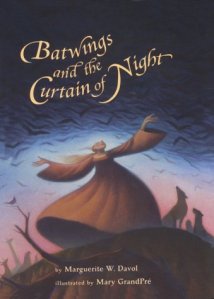
Batwings and the Curtain of Night, written by Marguerite W. Davol, illustrated by Mary GrandPré. Published in 1997 by Orchard Books, New York.
This tale first came to me at the age of 15 or so.
The Mother of All Things shapes the world lovingly, halving its hours into night and day, then bestowing it upon all the creatures of sea, wind, forest and field. Rulers of themselves and their earthly domain, the animals are all drawn to night’s restful canopy, but agree that it is overwhelmingly dark for their navigations. Purposing to alter the face of night itself, they enlist the aid of all the world’s bats in pulling back the vast, inky curtains of nights, to allow more light to peer through. As the Mother of All Things watches on wisely from her vantage point, her animal kingdom valiantly attempts to punctuate the mysterious deep with points of glimmering light, mirroring her own desire to colour the world in radiance, at the first breath of its Creation.
What enchanted me?
Stories that sing different choruses about the beginnings (and, for that matter, the endings) of All Things have always captured my attention and delight, especially when they are compellingly, sincerely told. Batwings and the Curtain of Night is no exception. The language employed by Davol invites itself satisfyingly to being read aloud, fashioned as it is of simple prose, elaborately arranged, with an overall effect of graceful, easy magic. Mary GrandPré’s art, made famous on the Scholastic-edition covers of the Harry Potter series, is an exquisite complement to the narrative. It is imbued with equal measures of light and darkness, mystery and illumination, depth and phosphorescence; therefore its very style patterns near-perfectly the concerns at the book’s core. I cherish every reread of Batwings and the Curtain of Night as a gently-bestowed reminder of all the beautiful things that are wrought from shells of seeming brokenness. (Read it, and you’ll know just what I mean.)
Lines for Life:
“Together they climbed the highest mountain. When they reached the peak, they looked up. The sky, almost dark by now, still seemed very far away. Could they reach it?
The owl said, “We must all fly as high as our hearts will allow.”
With a mighty whirl, the bats and the owl soared toward the sky. Struggling upward, they flew and flew until they thought their hearts would burst. But no one gave up.”
This book would be best beloved by:
♣ anyone who believes in, or has built altars of prayer in honour of, a bountiful, benevolent Mother of All Things.
♣ those who appreciate the thriving truth of multiple meanings in the dawning of our world.
♠ one for whom the bat is no less a mythical, marvellous creature than a roaring lion, or a peacock in his plumage.
Owl Moon, written by Jane Yolen, illustrated by John Schoenherr, published in 1987 by Philomel Books, New York. Winner of the Caldecott Medal in 1988.
I first opened these pages when I was in my early twenties.
In the quiet, deep heartbeat of a winter’s night, with the moon full and expectant against the sky, a girl walks into the woods with her father. The sounds of human and animal life fade away into white-blanketed silence as they walk, exchanging no words. She is going owling for the first time, and in this sacred space of an awestruck initiation, all her senses are livewires that conduct the experience back to her, and through her, though she utters not a syllable. They carry no nets, no bait (save an owl call, offered earnestly), no measures of entrapment whatsoever. Both she and her father know, in varying degrees of detail, but with equal faith, that the only armour needed for a true owling experience is hope.
What enchanted me?
There are rare reads that encourage you to become a better person, every time you read them, which simultaneously exact no toll on you for being exactly the person you are, in the here and now. Owl Moon is such a book. Yolen paints a cinematographically vivid landscape with a carefully collected assembly of words, poetically rendered, without any ornamentation, it seems, but a devotion to preserving passionate rituals between parents and their children. Schoenherr reminds us of the subtlety that truly majestic art wields. We are there, with the girl and her father, trudging relentlessly through knee-high drifts, shielding our faces against frost’s kiss, hopeful determination beating in our hearts. I love that Owl Moon speaks so unequivocally to being resilient, to embracing fear and walking calmly through it to the other side, where peaceful territory awaits. This book will remind you of the most sweetly sacrosant of peregrinations you paced out in the company of the one you called, or thought of, as Mother or Father , despite blood. If you have none on which to full-heartedly reminisce, this book will make you yearn to create some, for the children you have, or will.
Lines for Life:
“When you go owling
you don’t need words
or warm
or anything but hope.
That’s what Pa says.
The kind of hope
that flies
on silent wings
under a shining Owl Moon.”
This book would be best-beloved by:
♣ the children of winter and all her breath-misting revelations, no matter from whence they hail.
♣ believers in silence as a necessary guide on any journey of note.
♣ all parents who wish to share life-affirming magic with their children; all children who wish to learn how to grow up, and stay young, with their parents.
Charting Children’s Literature is a monthly feature at Novel Niche that seeks to highlight the beauty and richness inherent in many of the books written and illustrated with the enjoyment and education of young children in mind. The feature was launched in August 2011, and is set to run for the foreseeable future (to infinity and beyond)!
If you’re interested in bringing to my attention beautiful children’s books I haven’t yet covered, feel free to leave a comment on this page. If you would like to contribute a guest Charting Children’s Literature feature, please make use of the contact form provided. I’m looking forward to hearing from you!
I think that the short fiction form is severely underrated in contemporary reading tastes. It’s a telling (and troubling) sign that short story collections sell with less success than novels do, to the extent that many writers aspiring towards publication are discouraged from dedicating their time to the former, since the latter holds more promise of lucrative gain.
Short stories are brilliant at capturing the crystallization of a moment, an encounter, a single, sustained emotion, feeling or thought that lingers long after the reading. The best can render us speechless and lightning-struck in a handful of pages. They are ideal conversation fountains, and enrich us with minimal time dedication on our part. Perhaps most significantly, they are valuable gateways into the world of reading, for those who are bookshy.
Ellen Rhudy, of the marvellous book blog, Fat Books and Thin Women, runs a weekly feature dedicated to the enjoyment and analysis of one short story at a time. Its tagline is “Always short stories, always ones available online for free”, and I’ve admired the accessibility of this for quite some time. I’m pleased to announce that, with Ellen’s blessing, I’ll be participating in the Story Sundays feature, every week at Novel Niche, adding to the enthusiasm reserved especially for coffee, cigarette or evening-length reads. Ellen’s story this Sunday is “Fire” by Chelsea Laine Wells.
I’m happy to launch the feature with the work of another colleague of mine, the writer Jason McIntyre. Here are my musings on his novelette, The Night Walk Men, which, in the spirit of the free-to-access segment of Story Sundays, he has graciously made free to download. You can access it in the format of your choosing at Smashwords, here.
“Death has no prejudices. None that I’m aware of. Well, unless of course you count a discordant bias for the elderly. Or that heaving soft spot for the unhealthy and for the careless.”
Jason McIntyre continues to write fiction I like, in a genre I’ve always avoided. Reading his work has proven to be a reliable barometer by which to mark my preconceptions, as well as a reminder of the successes that can accompany fictive genre-melding.
The Night Walk Men, a novelette offering from the author of Thalo Blue, is no exception. It is a curious tale of justice, mediated by non-human hands, narrated to us by Sperro, a Night Walk Man, a character who waxes cryptic and revelatory with each of his admissions. He tells an eager, unidentified listener (for all you know, it might be you) of his brotherhood line, of the life-altering, reality-shaping work they carry out, and of an important young girl, affectionately dubbed ‘Gabriella the great’, over whom two prominent Night Walkers fundamentally disagree.
There is no other personage in The Night Walk Men from whom I would have preferred principal narration. Sperro’s encouragingly irreverent demeanour makes the work that much more readable. He spends much of his time on the page protesting that we don’t really want to hear the story he has to convey, though we protest that we do. His list of metaphors for pain, which introduce us to the novelette proper, are achingly valid, all of them aptly delivered without trite flourishes:
“This is going to be coming down from on high. Or finding your spouse in bed with another. Or murder-suicide. Or heavy metal from the neighbour at three in the morning. This is going to be the doctor telling you it’s inoperable. Or a chemical burn on flesh. Or pepper spray and a wrongful conviction. This is going to be a fire eating your life’s work. This is going to be Your First Time. Or Your Last Time.”
There is something in the way that Sperro speaks to the reader which recalls all the meaningful conversations in your life, the ones that span hours, undivided, or ford the rivers of rushing years with their implacable necessity. If you haven’t had conversations like that, there is an arena of your life that’s not yet been fiercely assaulted with investigation, and more’s the pity. I imagine it would be a worthwhile experience to talk to all of the Night Walk Men whom we meet: flinty Sperro, sad, weary Obsidion, unyielding and resolute Montserrat. These three shadowy, solemn figures each merit our attention, elicit our sympathy, and prompt discussion with fellow readers.
Perhaps less engaging is the character of Braille the Rail, a blind, affable saxophonist whose own life imbricates meaningfully with Gabriella’s, at a crucial juncture. I don’t think he’s poorly done, necessarily; I’m quite certain he’d induce me to hunker down on the floor of the train station and belt out a rousing duet with him—after all, he’s written that way. Still, there is something in him that resembles residual stock quality. He almost reads as a composite of every emotionally sensitive, mentally attuned blind man with a penchant for music and wise ruminations we’ve encountered in works of fiction. The constraints of the novelette form may not afford him the same room in which to take root. Nor do we learn much of Gabriela that emotionally binds us to the promise of her slumbering greatness. Perhaps we are meant to empathize far more with the guardians who struggle, labouring beneath the yoke of their extraterrestrial vocations… and if this is McIntyre’s purpose, it is handsomely achieved.
There is something maddening about reading a fictive work that lingers perpetually on the precipice of a big reveal that is never revealed, isn’t there? Many of the questions this novelette raises do not answer themselves. Unless McIntyre is brewing a sequel, the only responses to your burning queries about Gabriella’s fate, or the continued role of the nocturnal sojourners, might well be the ones your own imaginative speculation furnishes. In some instances, this unresolved tension is indicative of nothing so much as authorial laziness or indecision, in the mode of “I didn’t know where to end it, so I just… ended it.” Thankfully, McIntyre’s writing does not give rise to this breed of suspicion. Indeed, the lack of comforting closure by the end of Sperro’s grim discourse could be interpreted as a quiet affirmation of the fact that tidy, linear endings rarely exist—a reality within which the Night Walk Men must function, or else perish.
An hour’s read as cerebrally provocative as it is solidly presented, The Night Walk Men distinguishes itself from normative crime-suspense-thriller dross with its decidedly literary cast. Shot through with shades of the metaphysical, the bleakly humorous and the wildly speculative, if it doesn’t at least make you wonder… then I’m coming straight to your door for the answers.
Jason was gracious enough to answer some questions I had on The Night Walk Men; here’s a transcript of our interview.
The writer, giving his best Sperro impersonation?
‘The Night Walk Men offers us your perspective of eternal guardians, watching over the realms of the living, acting on orders from a source on High. This isn’t necessarily a unique concern (but, of course, these days, what is, right?) What do you think sets your treatment of this archetype in literature apart from the rest?
The candy coating. Don’t laugh; I’m actually being serious when I say that. Let me explain. Most books and films that personify death do so in one of two ways: either showing it as a harbinger of black, horrific nightmares plus all the bad stuff we associate with leaving this world, or as benevolent angels doing everything they can to make our exit peaceful and meaningful in a dramatic way.
The Night Walk Men is about the blue collar working class who are charged with dealing Death. And Life. These people are doing their job. They get orders from a boss in a figurative corner office, whose motives they don’t always understand. These are assembly-line figures who do everything short of punch a clock. Our narrator is bitter, embroiled in a centuries-long tenure he feels is important but that no one fully appreciates, that no one really understands. He and his kin are the writhing, unwashed masses of his occupation. And he is desperate to leave some kind of understanding behind to those he feels might be, ironically, incapable of understanding.
Plus, he’s a sarcastic, heavy-handed fellow. I can’t help but love his brutal honesty, can’t help but love him—warts and all, as the saying goes.
As you know, I enjoyed reading Thalo Blue, one of your full length novels, which I reviewed on Novel Niche in June. If you had to single out one thematic concern that unites Blue with The Night Walk Men, what would it be?
Writing decent fiction is similar to good songwriting. There’s power in the silences, those moments between chords, those moments between melodic movements. If the writing is good, the reader will skim across character, detail, plot and everything else that’s left deliberately out then come up with a result somewhat unique to them, possibly akin to their own sheer imagination, or to drag out my analogy, akin to a melody heard inside one’s own head.
I believe this is why you can see drastic, bi-polar reviews for the same book; some hate it and some love it. If everyone had the same look at the same book, then it would likely be called “Sweet Vampiric Stereotypes Volume Thirty-Nine”.
As for thematic parallels, I must say that all my work, Night Walk Men and Thalo Blue included, deal with the idea that we are not above anything. There is something at work on our lives and in our world that is trying to harmonize with us. Is it a spiritual undertone? You might interpret it that way. Is it a supernatural or paranormal presence? That’s also a valid interpretation.
Will I be so overt as to say what I believe? Perhaps in time. For now, though, I’ll probably just explore these ideas through more stories and see if I can use this exercise as a way to establish what I do believe. And what does make sense to me.
The names you’ve chosen for this novella are spot on! I’d like to know a bit more about what goes into your naming process; has any name you’ve given a character been arbitrary?
They’re all completely arbitrary. What? You thought there was some magic there? Some divination? Nope. None.
Okay, that’s not entirely true. I do give great thought to character names. Have any been without some level of forethought? Sadly no. And when writing—since I write in an entirely linear fashion, despite the sometimes non-linear stories—I will often find myself at a dead stop for fear of introducing a new character called by the wrong thing. I can’t go forward until the name is right.
The process starts in the cranium. I draw ridiculous associations with names that I’ve heard, people I have known, or those from other stories and films. Then I do research and try to combine given names and surnames with some sort of semi-obvious tone to them. I don’t want them to be outright and obvious but perhaps they can be let to stew in a reader’s mind as they read the book. Then, Eureka!, I know why he named her that!
So you’re sitting opposite a stranger on a park bench, and she’s reading “Sweet Vampiric Stereotypes Volume Fang-fourty”. Tell her something about your work, The Night Walk Men in particular, which will make her drop the smut and run to Amazon.com/Smashwords/the other fine e-stores your writing is sold.
Well, I imagine, knowing my own character, I would probably converse with her about anything other than my writing. I might enquire as to what she finds so titillating about the smut, as you call it. But all the while, I’d probably never ‘fess up that I have written anything. In truth, if she’s reading that, she’ll likely never care to give anything of mine a chance.
However, to play along, I’d probably say that this young author is writing something like contemporary baroque lit-fiction, often but not always, with tinges of the paranormal. His characters explore their world with innocence but the world in these books is anything but.
I like to say that my role as a writer is to break your heart, utterly and completely shatter it to pieces. Then, bit by bit, my next task is to put it back together again.
I’ve quoted a set of lines I especially like, to preface my thoughts on your novelette. If you were going to excerpt some of your favourite lines, what would they be, and why do you love them so?
Tough question. I do like the ones you’ve chosen as well.
My feeling is that the more melodic bits can only exist if there are, as I said before, empty spaces around them. If there is too much of this melody, then the whole thing falls under the weight of its noise.
I like many. Some include:
“It’s a strange thing: I suppose a body gets used to laying under a sheet at night and when it doesn’t feel the familiar weight of fabric pressing down over it, it can suddenly feel exceedingly unnatural.”
from Shed, 2010
It’s not written particularly well, but the sentiment is a strong one. Not only does it work well in the story, but it says so much about the human condition.
Another from The Night Walk Men might be this entire paragraph:
“I should tell you that I’ve seen Death. I’ve seen Death nearly every day. Just today, in fact, I witnessed Death walking down McMurchy Street. In what city, I cannot recall. And for what purpose, I cannot tell you. But at what time, that I do remember. It was just before high noon, and He was there, moving south, determined. If you had eyes and were at my side, you’d have seen Him too. He might have been searching for a sick child, might have been looking for a young fellow who didn’t look both ways before crossing.”
Why do I like it? It does a solid job of personifying Death. It is mythical in its quality and I believe every reader will understand the notion of Death seeking out sick children or some young one who didn’t heed the words of his parents while trying to fetch a stray ball.
I’m deeply grateful to Ellen for her consenting to my adoption of the Story Sunday meme; I fully intend on doing it justice and continuing to contribute in the fine style that Ellen’s established (with my own, Novel Niche-esque quirky flair, of course)! I’m also appreciative of Jason taking the time out to respond so thoughtfully and thoroughly to the questions I posed. I look forward to seeing his writing career evolve. His finely articulated, synergistic style is a worthy platform from which many lofty fictive trees can be grown; so here’s to reading in that particular forest… and here’s to countless Sundays of short fiction splendour!
Story Sundays was created by Fat Books and Thin Women as a way to share appreciation for this undervalued fiction form. All stories discussed are available to read free, online. Here’s Fat Books and Thin Women’s Story Sunday archive, and here’s mine. Want to start up Story Sundays on your blog? Yay! Email story.sundaysATgmail.com for details.

 Mama’s Saris, written by Pooja Makhijani, illustrated by Elena Gomez. Published in 2007 by Little, Brown and Co., New York.
 A young girl wants to celebrate her seventh birthday party in the finest style possible, and for her, this means the right to wear one of her mother’s intricate saris. As her mother produces the infrequently worn, much-treasured collection from its storage space beneath the bed, her daughter pleads, cajoles and sulks, seemingly to no avail. Each sari the mother holds up from the leather suitcase has its own story. The one she selects for herself to wear at her child’s birthday celebration is brilliantly orange, trimmed with a carmine hem, and it was also donned on the day she brought her infant daughter home for the first time. Others, in colours of ripe fruit; the ink-dark midnight sky; the wide, blue ocean, are paraded before the daughter, and finally, sensing the young girl’s urgency, the mother comes to a momentous decision that will frame the day in heightened significance for them both.
 Owl At Home, written and illustrated by Arnold Lobel. Published in 1975 by Scholastic Books, New York.
 Owl At Home is an offering of five short tales in the life of Owl, an affable, thoughtful gentle-bird who seems to delight in his own company, as well as in exploring the world around him. In “The Guest”, Owl learns that some visitors simply won’t adhere to expected protocol, when he invites Winter past his threshold on a particularly chilly night. “Strange Bumps” tells the story of Owl’s fear of two mysterious lumps that appear near the foot of his bed when he lies down, and how he deals with their persistent recurrence. A kettle full of weeping, prompted by ruminations on the saddest things, such as forgotten pencil stubs and never-seen sunrises, fills the kettle for Owl’s delicious, albeit slightly salty, “Tear-Water Tea”. “Upstairs and Downstairs” reveals Owl’s frustration over his inability to exist both on the landing as well as at the foot of his twenty-stepped staircase. Finally, in “Owl and the Moon”, our avian friend finds that a contemplation of the moon near the seaside doesn’t necessarily end when he folds his wings and prepares to head home.
 Nuri’s childhood is well-heeled, sensitively moulded; he does not lack for parental affection, though it is frequently distilled with eccentricity. The recipient of uncommon, and uncommonly shown, affection from his parents, he finds himself, at a tender age, thrown into a bemusedly altered state when his mother succumbs to a mysterious illness. In an attempt to restitch the tenuous fabric of their familial comfort, Nuri and his father, former political dissident of international reknown, Pasha, vacation at the Magda Marina Hotel, a sweltering beachside resort dotting Alexandria’s coastline. It is there that father and son encounter the entrancingly beautiful, yellow bikini-clad Mona. Their interactions with her form the basis of a complicated, acutely felt triangular relationship that spans erotic awakenings, unspoken betrayals, and the passage of many years, indelibly altering each participant in its perfumed wake. When Nuri and Mona are left reeling in the aftermath of Pasha’s abduction, the mire of bureaucratic red tape and festering resentments through which they must navigate leave them sceptical as to just how precise their lifelong impressions have been, of the man they love most.
 Published in 2008 by
  Duane Allicock hails from the island of Trinidad and lives for reading, cycling and
 Published in 2009. This Edition:


 This tale first came to me at the age of 15 or so.
 I first opened these pages when I was in my early twenties.
 Novel Niche