“Gently chew to soften the ridges” – Bogi Takács

9530828589_29f0ea8e35_k
Image: DNA?, posted at Flickr by Thomas Wensing under a Creative Commons License.

What is the code of how we come together? What alchemy or biology makes us fuse, sunder, reignite?

Bogi Takács’ “Gently chew to soften the ridges” is an open window to interspecies coupling, consensual and warm and so intimate you swear you can scent the tenderness. There’s pain here, but it’s sanctioned. In fact, in the hands of the lover administering and conduiting it, it feels welcome. Takács’ speaker is inhuman, and addresses their companion in the familiar ‘you’ of second-person present. ‘You’ are there, gripping your beloved’s protrusions, wiping the sweat on your trousers and swearing. ‘You’ are there, and you “rasp your tongue against my palate, push / fingers inside my mouth, reach inside, trigger / my gag reflex it is the most intimate please.

These small, italicized pleases synapse through the poem, and they work like any faithful transmitters do, conveying urgency and heat, compulsion and fear. Absolutely, fear. I think fear might be the most astounding part of what Takács is doing here. Isn’t a naked, gnarled kind of terror at the door of us everytime we strip before the one(s) we’ve chosen? Sometimes it shrieks; sometimes it mutely scratches, but always it seasons the sweat we give, the come we leak, the wings we hide, then splay.

It’s the fear this poem doesn’t talk about that makes it so extraordinary. Fear at the wolves of orthodoxy at the door, perhaps — but a real, gripping fear that this ritual might not be completed is at the core of the work. Will these two reach their fluid-bond? Can the bones be telescoped, can those limbs be hung from the ceiling in the name of love? You should read the poem to find out, pulling yourself loose from your human moorings as you do. You should reach for the protrusions.

Read “Gently chew to soften the ridges” here.
Bogi Takács writes, edits and reviews speculative fiction. Visit their Patreon here.

bon voyage.jpgThis is the fourth installment of Other Kinds of Men, a speculative poetry reader in honour of Ursula K. Le Guin. Speculative writing, which encompasses the major genres of mythology, fantasy and science fiction, has often given voice to the most relentless and ungovernable urgencies of this age, and any other. Le Guin understood this: that to write about dragons, ice worlds and other seeming oddities was, in fact, to write into the messy, riotous complexity of ourselves. Here’s to dragons, and here’s to Ursula.


“The Sea Never Says It Loves You” – Fran Wilde

8332011781_c1fe30a88e_h
Image: The dark and destructive deep blue sea, posted at Flickr by Michael Greenhill under a Creative Commons License.

Marriages between humans and the natural world are how we make sense of the ungovernable loves within us. I understand how people can yearn to pledge their troth to giant sequoia, and I feel deeply for would-be selkie children who must be dragged, blue-fingered and yawping with need, from the sea.

Fran Wilde’s “The Sea Never Says It Loves You” gives us a human-ocean relationship that begins as a high school romance. This kind of anthropomorphism isn’t new to speculative writing, and Wilde layers the world of the poem, in which sea and mate court, procreate and share a life, with a bittersweet kind of indulgence. Notice the prevailing tense here is conditional: the poet isn’t telling us this is a definite life, but frames a world of sargasso and Sunday night drive-ins, where an exceptional kind of love is possible… not without cost.

Sometimes, Little Mermaid-esque, the price you pay for incredible beauty is utter silence. In the final stanza of the poem, the object of the sea’s affection finds themselves stranded on the shore of a lifelong quietude: “And you are bathed in salt spray, wishing. / Wishing you were water, / or that the sea would whisper from a shell the name of the first song / you danced to / Or say the name it gave you before it swallowed you up.” 

Writing that often seems to reach for the most arcane, the most removed of speculative concepts, often tunnels deepest inward: this is what Wilde’s poem does. We might not all be able to conceive of the sea loving us, or of bearing its “fish-pale, seaweed-haired shell”. But surely we know more than we’re willing to admit, of the silences we’ve bartered in the names of a giant, toppling want. Surely that’s what it means, to sink or swim.

Read “The Sea Never Says It Loves You” here.
Fran Wilde’s most recent novel, Horizon, was published in 2017 by Tor Books.

bon voyage.jpgThis is the third installment of Other Kinds of Men, a speculative poetry reader in honour of Ursula K. Le Guin. Speculative writing, which encompasses the major genres of mythology, fantasy and science fiction, has often given voice to the most relentless and ungovernable urgencies of this age, and any other. Le Guin understood this: that to write about dragons, ice worlds and other seeming oddities was, in fact, to write into the messy, riotous complexity of ourselves. Here’s to dragons, and here’s to Ursula.
“I Saw the Devil in the Cane Fields” – Shastra Deo

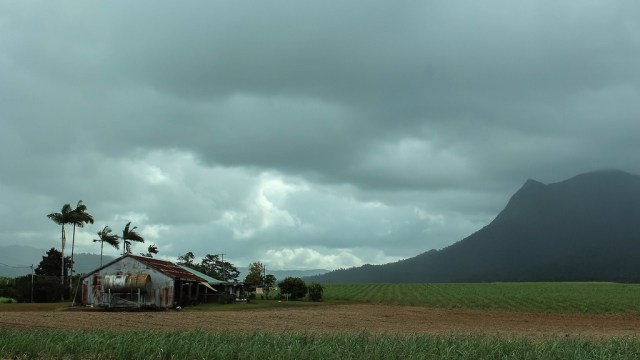
Cane Fields Near Innisfail
Image: Cane fields near Innisfail, posted at Flickr by Andym5855 under a Creative Commons License.

Is the Devil a speculation?

He feels real, in Shastra Deo’s poem, which is set in Australia’s cane fields. I found this extraordinary, unsettling piece while I was researching for a previous reading series, and I found myself unable to let it go. Maybe I love it because it’s spare. Maybe I love it because it hints at brutality. Maybe I love it simply because it marries two things I’ve thought about my whole life: the devil, and the cane field. If you’re from Trinidad, and adjacent to, or a member of, the Indo-Trini community, you’ll understand how cane, the physical and emotional proximity to it, is never really far. I didn’t go looking for Australia’s cane fields, but Deo’s poem summons them, and I feel myself falling into this poem like it’s a life, or a shard of one, I could have lived. Devil and all.

If the speaker of the poem is afraid of the Devil, they don’t tell us much about it. Instead, we get to see speaker and ultimate sinner in gentle, familiar gestures: “The devil held my hair back / as I washed my face in the kitchen sink.” Soon after that, “The devil and I sat at opposite ends / of the tiny dining table and listened to the roaches / scuttle beneath the refrigerator.” What Deo leaves for us is an uneasy ample space for us to brocade finer details, if we wish it. Are there words uttered, between the Devil and the speaker, whose hands smell of burnt sugar, who we meet at the beginning of the poem, nose bleeding and bordered by solitude?

When the Devil goes walking towards Cairns, I’m almost sad to see him leave. I almost want to run for my own country’s cane fields, to see who I might meet.

Read “I Saw the Devil in the Cane Fields” here.
Shastra Deo’s first collection of poems, The Agonist, was published in 2017 by UQP.

bon voyage.jpgThis is the second installment of Other Kinds of Men, a speculative poetry reader in honour of Ursula K. Le Guin. Speculative writing, which encompasses the major genres of mythology, fantasy and science fiction, has often given voice to the most relentless and ungovernable urgencies of this age, and any other. Le Guin understood this: that to write about dragons, ice worlds and other seeming oddities was, in fact, to write into the messy, riotous complexity of ourselves. Here’s to dragons, and here’s to Ursula.

“My God, It’s Full of Stars” – Tracy K. Smith

5474189038_07e886b534_o
Image: Supernova Remnant Cassiopeia A (NASA, Chandra, Hubble, 02/23/11), posted at Flickr by NASA’s Marshall Space Flight Center under a Creative Commons License.

I think we see God through the aperture. I think that’s how we’re able to hold her on our tongue without burning up.

Tracy K. Smith’s “My God, It’s Full of Stars” gives us God through the peephole of the universe’s countless eyes. It’s a diorama-in-verse, of how to be open to wonder, to exhilaration, to the messy, catastrophically gorgeous parameters of the world, whether you are the child of a scientist who once worked on the Hubble Telescope, whether you are 2001: A Space Odyssey‘s Dave himself, “whisked into the center of space, / Which unfurls in an aurora of orgasmic light / Before opening wide, like a jungle orchid / For a love-struck bee”.

The poem takes its time on us, and in us. In its five moments, I feel less that the poem constructs atop itself, and more that it builds inward. It makes excavations of the very void we call absence, tunneling into it to taste, for example, “the blank / Surface of the moon where I see a language built from brick and bone”, “Atlantis buried under ice, gone / One day from sight, the shore from which it rose now glacial and stark.”

Perhaps the very void we call barren, billowing darkness is itself a misnomer, as the poem’s third section asks. What if energy we can’t sense is cuddling up to us in every second? What if we can never adjust our personal scientific equipment — our head, our heart — to an aperture that allows enough God in? “My God, It’s Full of Stars” becomes the most extraordinary kind of coping mechanism that exists: a valve that measures both our inability to process the universe, and a route to stay wide-eyed despite frustration. We needn’t know the name of every star, to say we love and fear the night.

Read “My God, It’s Full of Stars” here.
Tracy K. Smith’s newest collection of poems, Wade in the Water, was published in 2018 by Graywolf Press.

bon voyage.jpgThis is the first installment of Other Kinds of Men, a speculative poetry reader in honour of Ursula K. Le Guin. Speculative writing, which encompasses the major genres of mythology, fantasy and science fiction, has often given voice to the most relentless and ungovernable urgencies of this age, and any other. Le Guin understood this: that to write about dragons, ice worlds and other seeming oddities was, in fact, to write into the messy, riotous complexity of ourselves. Here’s to dragons, and here’s to Ursula.

“Bring Back” – Rosamond S. King

30775198_33d08d1bcd_b
Image: IMG_9737, posted at Flickr by Liberté, Égalité, Safari under a Creative Commons License.

There are more things to worship than the childhood gods you’ve been given to hold. Ask Rosamond S. King’s “Bring Back”, which opens her staggering, revisionist debut collection of poems, Rock | Salt | Stone. Revising what, you ask? “Bring Back” takes you by the black wrist, expeditions you to the unsheltered cradle of your nursery rhymes. Pull a halcyon classic down from the shelf of memory, and hum to it: “My Bonnie Lies Over the Ocean”. Good. Now reopen your eyes, and sing the tune to the gods of your choosing.

Eshu is here. Oshun. Ogun. “Abiku cries down by the river / Don’t bring back that body to me.” The dreamscape of the poem draws on Yoruba creation, a realm that has never spared any thought to the lullabies of white empire. Have you heard Rosamond incant this poem? If yes, you’re not likely to ever forget the call it stirs in your bones. The poet’s sense of daring, saddled up to her dervish of linguistic play, are everywhere in these spare, yet history-dense lines. If the verse were only historically resonant, that would be one hallmark, but King sings them into being. They are dread chants, concealing as they are baring, invitational as they are tendrilled with secrecy.

The poem tells us: “My history lies under the overt / My heritage beyond the seen”. Is this not, of itself, its own mystery of faith? All I need do is dwell on the resonance of Rosamond’s voice, and I’m drawn back in time to this invocation: her voice, the only fixed star by which to steer myself to a history, a herstory, a gleaming black knot, unravelling in the firmament. It’s not a gauntlet, this poem: why, it’s a map to a place you thought you would be denied welcome. Dream in.

Read “Bring Back” here.
Rosamond S. King’s Rock | Salt | Stone won the 2018 Lambda Literary Award for Lesbian Poetry.

This is the thirtieth installment of Here for the Unicorn Blood, a Queer POC Poetry Reader which runs from June 1 – June 30. Historically, June commemorates the 1969 Stonewall Riots, heralded as the birth of the modern LGBTQ+ rights movement in the United States. #PrideMonth’s global significance, its unabashed celebration of queerness, its marshalling of non-heteronormative joy, resistance and tenacity, motivates this close reading series, which specifically engages the work of POC Queer Poets, in international space. People of colour have been vital to queerness before queerness had a name: this is one way to witness that, to embed my reading practice in it, and to raise my brown, queer fist in yes.
“Full Metal Oji-Cree” – Joshua Whitehead

5946686018_3166efc63e_b
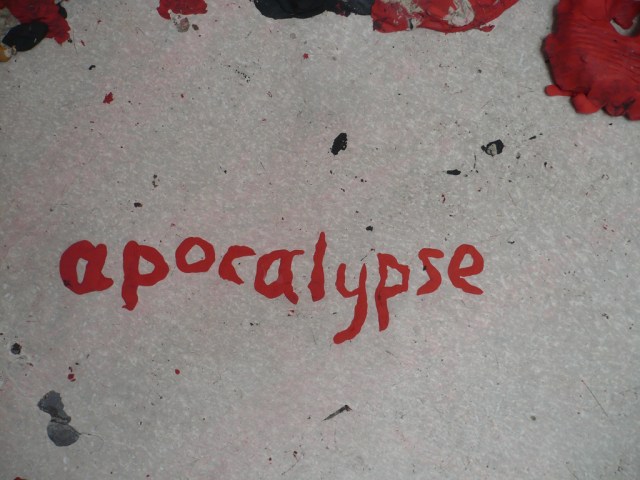
Image: Apocalypse, posted at Flickr by Charles Hutchins under a Creative Commons License.

What form do you take in the future? In Joshua Whitehead’s “Full Metal Oji-Cree”, the revolution is upon us, and it’s hybridized, mechanized and fuelled by this truth: “us indians sure are some bad ass biopunks”. Think less steampunk-as-aesthetic, more your grandmother’s arm, robotic, wielding a machete beaded with oppressor-blood. The blood of ‘the native’ isn’t here for white consumption in this future. There are no ‘noble savages’. That racist language has been expelled, and in this future — which feels very much like the now — “the prehuman becomes the precursor to (rez)urrect / the posthuman in the transhuman / so fuck you / well survive this too”.

What I love about this poem is its gleaming, weaponized indifference to convention, on both thematic and stylistic levels. “Full Metal Oji-Cree” feeds itself on the nullification of “terra myths”, the bombardment of settler claims, the razing of the current world order. No more righteous cowboys, Clint Eastwooding all over your tv screens. No more Abraham Lincolns, no more olive branches. If you want reconciliation from this poem, you’ve come to the wrong place. Fuck reconciliation, says this poem’s speaker, who can call for backup from his bloodline and receive it in the tens. We’re past that. We’ve alchemized-weaponized that futility, that abuse-masquerading-as-alms, into something brighter, better, well-oiled and unmissable, even if the world should burn down. We, the poem’s speaker tells us, will survive it. Hell, haven’t we been surviving it all this time?

My favourite lines of the poem, the ones I’ve stuck up in rainbow coloured bone-pins to the astral ceiling of my survivor’s tent, are “there are indo-robo-women fighting cowboys on the frontier / & winning finally”. Because yes, please. Let the future be now, and let it be full of transhuman woman warriors, staking old white men with bloodsplatter on their technobeads, glowing.

Read “Full Metal Oji-Cree” here.
Joshua Whitehead’s collection of poems, full metal indigiqueer, was published in 2017 by Talon Books.

This is the twenty-ninth installment of Here for the Unicorn Blood, a Queer POC Poetry Reader which runs from June 1 – June 30. Historically, June commemorates the 1969 Stonewall Riots, heralded as the birth of the modern LGBTQ+ rights movement in the United States. #PrideMonth’s global significance, its unabashed celebration of queerness, its marshalling of non-heteronormative joy, resistance and tenacity, motivates this close reading series, which specifically engages the work of POC Queer Poets, in international space. People of colour have been vital to queerness before queerness had a name: this is one way to witness that, to embed my reading practice in it, and to raise my brown, queer fist in yes.

“Sailor’s Knot” – Omar Sakr

14569975634_1a5acd7542_k
Image: DSC_5135, posted at Flickr by sch0705 under a Creative Commons License.

Contains references to violence against children.

Does a capsized ship show you its weakest side? Omar Sakr’s “Sailor’s Knot” is a bruised punch of a poem. Yes, a bruised punch: a vehicle of violence that is itself wounded. It curates the history of pain and substance abuse that marks a mother’s relationship with her child. When called on the telephone, the mother tells her child, “‘my son, a lifetime of never submitting, / not to any man or god, yet the angels / I can feel them dancing on my skin. / Who’s laughing now?’”

The poem’s speaker, the mother’s son, shares news about his mother’s character dispassionately, in ways we sense are intended to injure. She is a woman who never calls, except for cash: a woman described in the voice of an unnamed cousin as “drug-fucked”. In fact, no one in this tableau of hurt and dislocation is given a name. Mother. Son. The figures could be anyone, but the ache and anguish is specific. The cellular memory of this homegrown violence resides in every punishment ever administered from mother’s fist to son’s back: “Maybe every beating / she gave me was warning / to flee a sinking ship.”

Even in the act of total emotional submerging, there’s no escaping the legacy of the mother in “Sailor’s Knot”. What I love about this poem is that it’s methodical and meaningful in its hurt. It uses maritime lexicography, trades in imageries of rope and floundering, to tell us about what can never be rescued, for mother and son alike. Even above the ocean, sometimes that pain meanders upwards, like “empty plates & knives
floating to the ceiling.” What has been passed from parent to offspring here is not so easily voided as casting something to the sea: whether it takes a few weeks or a lifetime, the sea will return it.

Read “Sailor’s Knot” here.
Omar Sakr’s These Wild Houses was published in 2017 by Cordite Books.

This is the twenty-eighth installment of Here for the Unicorn Blood, a Queer POC Poetry Reader which runs from June 1 – June 30. Historically, June commemorates the 1969 Stonewall Riots, heralded as the birth of the modern LGBTQ+ rights movement in the United States. #PrideMonth’s global significance, its unabashed celebration of queerness, its marshalling of non-heteronormative joy, resistance and tenacity, motivates this close reading series, which specifically engages the work of POC Queer Poets, in international space. People of colour have been vital to queerness before queerness had a name: this is one way to witness that, to embed my reading practice in it, and to raise my brown, queer fist in yes.

“Can You Speak English?” – Natalie Wee

3154008188_2a99590c04_b
Image: Israeli-Egyptian border, posted at Flickr by Cornelius Kibelka under a Creative Commons License.

The borders seem obvious now, but endangered bodies have always known the point of no return, and persisted past it, anyway. In Natalie Wee’s “Can You Speak English?”, a migrant family dares to arrive in America, where their unmapping begins as soon as the first checkpoint: they are called Haunting, instead of Huan Ting. If it seems innocuous, it isn’t. It is “A single / exhale dislocating phantom from girl.” This is how the splitting of self, to accommodate the expectations – the demands – of empire: this is how it starts. Not always with a blow. But with a word. And a word, after that. You can’t say it’s less menacing until or unless you’re the one whose mother tongue is being ransomed.

The poem casts up aching parallels between speaking the alien tongue of English and giving birth. When the mother of the family is menaced by the fluorescence of the next checkpoint, her stuttering syllables are described by the poem’s speaker as stillbirths. The act of creating this language for white consumption is as violent as is “birthing an unwanted / child to a pallid land that does not know it”. The entire poem explores this seemingly subtler, yet no less cruel navigation of language as an instrument of muzzling: how the tongue you are told you must learn to speak can be your ultimate silencing.

We are told, by the poem’s speaker, that “both a well-aimed question & / any instrument of torture require satisfaction / to cease their patient cutting.” What then becomes of you when you do not surrender to the demands of your torturers, for speech or for other safeguards showing you belong? As is chillingly fitting, the poem does not have answers for us. It cradles a mother’s skull, measuring the words before they fall to the ocean floor.

Read “Can You Speak English?” here.
Natalie Wee’s Our Bodies & Other Fine Machines was published in 2016 by Words Dance Publishing.

This is the twenty-seventh installment of Here for the Unicorn Blood, a Queer POC Poetry Reader which runs from June 1 – June 30. Historically, June commemorates the 1969 Stonewall Riots, heralded as the birth of the modern LGBTQ+ rights movement in the United States. #PrideMonth’s global significance, its unabashed celebration of queerness, its marshalling of non-heteronormative joy, resistance and tenacity, motivates this close reading series, which specifically engages the work of POC Queer Poets, in international space. People of colour have been vital to queerness before queerness had a name: this is one way to witness that, to embed my reading practice in it, and to raise my brown, queer fist in yes.

“肉骨茶 (Meat Bone Tea)” – S. Qiouyi Lu

13257856225_b4595fc5eb_h
Image: 烏龍, posted at Flickr by Yohmi under a Creative Commons License.

We feed and water what we hope will remain. In S. Qiouyi Lu’s “肉骨茶 (Meat Bone Tea)”, the uninitiated may interpret the tea as delightfully carnivorous: not so. Bak kut teh is pork ribs, simmering in a sauce of complex, fragrant flavours: the tea, oolong, is served at the side. That much you can learn from Wikipedia. What does the poem teach us about the complexity, the simplicity of consuming?

S. Qiouyi Lu’s speaker inventories spices and herbs like celestial bodies. Before their gaze, “Angelica and polygonatum swirl petal–soft as blossoms; / dioscorea bobs and forms the white sands of a riverbank.” There is ceremony to the movement and intermarriage of food here, seasoned by the deft, considered precision with which words are dropped into the edible sea of the poem. One senses reverence in the commingling of particles and entities forming this dish, and laced into every morsel, the anticipation of sharing it. We might easily say that poems about food reveal other, non-dietary appetites. If that holds true, what does the speaker of this poem eat, besides meat bone tea? Of what external and interior forces are their metaphysical diets formed — and who is the beloved, dining with them?

What I love best about this poem is that it’s both a laid table, beckoning, and a mouth, parting for succour. It’s a menu for our senses – each item that makes the meal is vividly detailed – and a place for us to come, to be fed. With the arrival of the friend, the “I” voice grows into “we”: two souls, sitting across from each other, a feast awaiting them. You might picture this repast unfurling in a cloister of the unnamed cosmos, and who could call you wrong? Lift your chopsticks. Inhale the aroma of broth. This, too, heals you.

Read “肉骨茶 (Meat Bone Tea)” here.
S. Qiouyi Lu’s writing can be read on their website.

This is the twenty-sixth installment of Here for the Unicorn Blood, a Queer POC Poetry Reader which runs from June 1 – June 30. Historically, June commemorates the 1969 Stonewall Riots, heralded as the birth of the modern LGBTQ+ rights movement in the United States. #PrideMonth’s global significance, its unabashed celebration of queerness, its marshalling of non-heteronormative joy, resistance and tenacity, motivates this close reading series, which specifically engages the work of POC Queer Poets, in international space. People of colour have been vital to queerness before queerness had a name: this is one way to witness that, to embed my reading practice in it, and to raise my brown, queer fist in yes.