45. Never Mind by Edward St. Aubyn (Patrick Melrose # 1)

Published in 1992. This edition: Picador, 2012.

I feel compelled to share with you that my hands are shaking, a little, as I write this down. Reading books like these pry at the elusive answer to the unspoken question of how deeply an experience, literary or otherwise, can mark us, until we begin to chafe gracelessly against the semaphore of its instruction.

Never Mind is the first of British author Edward St. Aubyn’s novels centred on his alter ego protagonist, Patrick Melrose. I came to these books because I was curious about Patrick, about what fictional forces have led to the concretization of his status as one of contemporary English literature’s most formidably-hewn characters, and his author as one of the best living English writers producing work in that language.

I stayed out of horror and awe, both infused with the kind of reverence you don’t even realize you’re giving up willingly while you read. Whether you levy your slackjawed, glassy-eyed admiration freely or with begrudging restraint, it takes no more than a very few pages to realize that prose, in St. Aubyn’s hands, is effortlessly sovereign. He writes with the sort of sleight of hand beauty that might make poets weep, and he has the good grace to wipe his plate clean of indulgent treatments in diction, in the assignation of flasks to purses, of wineglasses to fiercely shaking digits, of bespoke canes to corridor umbrella stands,  immutable and indifferent, receptacles cast in porcelain, green glass and untraceable decay.

Though the origins of decrepitude evade certain timelines, the origin points of disease in the novel’s chief players are subject to a much more rigorous scrutiny. St. Aubyn uses fiction like a paring knife, cunningly training the blade on a single day in the lives of five year old Patrick and his parents, David and Eleanor. The Melroses are expecting a small contingent — two other couples — of dinner guests, a pleasant, intellectually undemanding evening at Eleanor’s family house in the South of France.

Cognizant of the frequently baffling starts and stops of adult humours, the self-sufficient Patrick easily ventures into his private world of childhood play, roaming the grounds of a vast garden that extend into the Melrose holdings. In the imaginatively fertile clutches of this verdant terrain, Patrick is the undisputed king. There is an unashamed curiosity, fringing on tenderness, that the young boy conducts with members of the animal family — behaviours notably missing from his interactions with his parents, or the vaguely warm yet mostly distant maid, Yvette.

“…Patrick had only seen the tree frog twice, but he had stood still for ages staring at its sharp skeleton and bulging eyes, like the beads on his mother’s yellow necklace, and at the suckers on its front feet that held it motionless against the trunk and, above all, at the swelling sides which enlivened a body as delicate as jewelry, but greedier for breath. The second time he saw the frog, Patrick stretched out his hand and carefully touched its head with the tip of his index finger, and it did not move and he felt that it trusted him.”

On this day, Patrick doesn’t espy his favourite lucky tree frog. A different sort of visitation awaits him, one that will alter the pattern of his internal weather, not simply for the remainder of the evening’s social pleasantries, but for a time we cannot, with the limitations of our gaze, yet glimpse.

It would be difficult enough to bear if Patrick’s parents were uniformly, homogeneously wicked, but the inverse is true. Eleanor mires herself near-constantly in drink, to escape the cruelty meted out by David, who administers amoral punishments in line with what he considers his judicious purview. During the course of the miserable spectacle of a dinner party, Eleanor’s miseries are relentlessly pursued across the page. The stifling tedium of her emotional subservience to David is measured out as if in stiff fingers of drink, each furtive gulp of liquor entering her gullet an ineffective balm against days and nights laced with peaceable terror.

Reading David is a master class in pain – in the gnarled roots of its provenance, and in the steady, wincing gait of its unsteady yet triumphant time on earth. We learn more, reading David, than is easy or comfortable to hold, and the more we know about him, the less we wish we knew. In the crucible of his motivations, he reads like an aged Briton of a Patrick Bateman, with his bloodlust diverted into a series of grotesque amusements best served over a course of game and unpalatable, expensive wine. During dinner, having perceived himself vaguely slighted by the antics of his subordinate colleague’s comely-but-gormless girlfriend, David plots.

“Never mind, thought David, I can get her later. In the pursuit of knowledge, there was no point in killing the rabbit before one found out whether its eyes were allergic to shampoo, or its skin inflamed by mascara. It was ridiculous to ‘break a butterfly upon a wheel.’ The proper instrument for a butterfly was a pin.”

Immediately following a calculated act of brutality upon which the novel’s scope and shape hinges, I shared this feverish message with a St. Aubyn devotee: “Reading the first of the Patrick Melrose novels is destroying me in the most delicate of increments. I feel like I’m being precisely gutted, every nick and scrape of my emotional defenses perfectly tallied in this… god, this assiduous, bare-but-gleaming prose. It’s beautiful and terrible, and in the full vein and spirit of so many things I want to do with my own writing that I could weep. It’s a treasure. It’s like reading horror stories in the bright sunshine and feeling ghosts slide up and down your spine like inky regrets. I can’t wait to see how Patrick survives, what he survives. What he becomes. I dread it and I long for more.”

It’s true. It’s all still true. What St. Aubyn proves, in Never Mind, is that there be monsters everywhere, verily, in the safest of places, in the most simperingly polite of cloistered alcove repartee. The writer, you feel, is pinning down an entire poisoned institution to the mat, forcing it to rap its perfumed knuckles to bitumen, snarling at it to give.

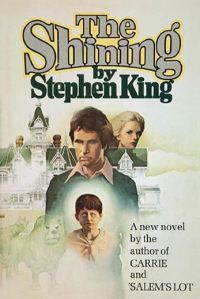
44. The Shining by Stephen King

First published in 1977. This edition: 2012, Anchor Books)

Cradled in the majestic, foreboding arms of the Colorado Rockies, the Overlook Hotel seems like nothing so much as a salvation/sanctuary, a real boon for the Torrance trio. Jack Torrance, patriarch, middling writer of possible promise (he once had work published in Esquire, which is saying something) and forcefully-retired preparatory school English teacher, knows that managing the Overlook during its sealed-up winter months is an ace of a job. For reasons that make him sick to his stomach to contemplate, performing commendably here, for six sequestered months, is his last chance in a variety of ways. He’s determined not to muck it up, and with the emotional support of his cheerful wife Wendy and dutiful son Danny, Jack thinks his first tenure at the grand hotel could be just the chance he needs to solidify his autonomy and finish the first draft of his three-act play.

Soon before departing for Floridian warmth, empathetic Overlook cook Dick Hallorann assures Danny, “I don’t think there’s anything here that can hurt you.” Halloran also gives a name to the prescience Danny’s always had, calling it “the shining”. Though Dick shines on a lesser level, Danny’s psychic powers are starkly, eerily majestic, revealing both Jack’s ever-pressing compulsion to drink and Wendy’s crushing anxieties. Danny’s shining is the brightest spark the Overlook has encountered in an age, and the hotel wants him. The spectre-lined chambers know just which desperate, drink-deprived man they can use, to help draw little Danny deeper into their carpeted, chandeliered clutches.

No, this isn’t like the Hotel California, since, in addition to not being able to never leave, you really can’t check out any time you like, either. King situates the glacial furnace of the novel’s primary activity in a place where retreat is nigh-impossible, where the hope of external rescue hangs as precariously as a loose tooth from a bloody thread of gum. Further to this, the storyboard conflicts – Man vs Nature, Man vs Self – are so orderly, so cleanly hewn in their make that they might have popped straight from the pages of a “How to Storytell” primer. Therein lies the ghoulish, fantastic rub, though – this is aching, jealousy-makingly-good storytelling. King’s third novel sees him harness deceptively simple constructs and then stun us between the eyes with the consistent power of worldmaking that fires on all cylinders.

First Edition cover, Doubleday, 1977.

What works well for The Shining is a discernible dearth of heavy turns, though the narrative does occasionally pat itself on the back with unnecessary, sometimes corny insertions. (If I were as tremendous a third book as this one, I’d probably be stroking my own spine with inky compliments, too.) We feel, when we read Jack, that we *are* Jack, from the moment we’re fidgeting in Ullman’s office, hating the officious little prick’s guts, promising vindictive retributions that our new boss might not quite deserve, but by God, it’s the principle of the thing, it’s to do with being humiliated and just how unjustly one can turn the knife back on one’s oppressor matters, it does. When we’re reading Wendy, we’re Wendy, a woman who fiercely adores her son, a woman who’s timed the steady degradation of her marriage against the repetitive clink of scotch and gin bottles, a lady who’s startled by the surges of her own uncommon intelligence. She stifles her own better judgments with hausfrau-esque personal admonitions that resonate with a sickly thud of commingled girlish naiveté and calculated despair, measured out in mental hair twirls through restless, well-manicured fingers.

Perhaps most astonishing and gratifying is the fact that when we read Danny, we are Danny. We’re five, and not too far gone from nights of bedwetting. We regress to thumbsucking states when confronted by the ire-fuelled interactions of the Mummy we cherish and the Daddy we idolize. We want things to be right, knowing from the very beginning that the Overlook is wrong, and we learn far sooner than we should about all the slithering, Room 217-dwelling manifestations of just how wrong wrong can be. King’s embodiment of Danny’s precarious, nuanced mental journeys is stunningly navigated. We’re there with him, fumbling in the labyrinths of his exceptional mind, our hands held up to fend off bogeymen of corporal and ethereal formations. We’re there with him even when we most want not to be.

2006 edition cover, Hodder.

Certainly, this book is scary. It’s more than a scream-by-numbers investigation, though. At its best, The Shining pierces through to the telltale heart of psychological decay, of the most earnest of human intentions lain low by a roque mallet. It’s a portrait of personal devastation as convoluted as anything Dorian Gray could conjure, and then some. Jack’s progressive decline is the novel’s snarling beast, and it’s even more terror-inducing than encounters with topiary creatures in feet of fresh snowfall, because Jack is you, and me. Jack is anyone who’s fought tooth and nail against the siren call of the thing they most love and fear. In his hubris, his clever arrogance, his petulant protestations against situations his own shortcomings have engendered, you know that he’s you on the days you want to erase from the ledger. Jack is proof that we can’t outrun ourselves, and oh, how brutally and systematically this reminder thuds from the pages.

If you’re new to Stephen King, as I was (and still am, since one novel doesn’t an adept make), maybe you might not want to read this one in the dark. Maybe it’ll come for you in the dark regardless, like it did for me, demanding to be read in silence, with a light borne aloft, while the rest of the house slept. Read about how this inhuman place makes human monsters, of how imaginary friends can reveal the truth lingering in a chiaroscuro world running parallel to this one. You might dismiss the horror as not supernatural enough, maybe. Or, like me, you might find your body blistering with wintry fear when you learn that King’s paranormal horror beats (bleats?) with the dogged persistence of a very human heart.

Don’t be surprised if surviving The Shining catapults you into the dimly-lit corridors of King’s considerable oeuvre. At the very least, it’ll make you want to take your medicine.

Story Sundays: “The Gun” by Lisa Allen-Agostini

Lisa Allen-Agostini
Lisa Allen-Agostini

Justin is a good boy. He minds his little sister, Lichelle, when their mother teeters off the edge of responsibility, when her presence at either the dinner table or the ironing board is conspicuously absent after a night of unspecified work. It is Justin who fastidiously readies Lichelle for school, Justin who hands over twenty of his own dollars for a textbook she needs, a textbook she will be physically punished for not having. Brother and sister pass by the enterprising young Pedro on their way to school, Pedro’s faithful, mange-riddled pothound Mackie trailing in their wake. Pedro, with his dapper threads and ready supply of crisp notes, is well disposed to treat Justin kindly: it is thanks to Pedro that Justin wears a pair of spotless Clarks to school. After classes, Justin goes to check Pedro at the latter’s request. While liming beneath a mango tree, Justin accidentally dislodges Pedro’s gun from its concealment cubby. The gun in Justin’s hands is dense, a previously unknowable entity coming to life in his hands, a thing of great promise and dread.

Allen-Agostini’s biting use of urban Trinidadian vernacular reads like a welcome two-fingered salute against the edicts of writing dialogue by conventional, powdery-wigged standards. The narrative is arguably at its strongest when it issues directly from the mouths of Pedro, Lichelle and Justin, as well as the story’s more peripheral characters: the overbearing schoolteacher haranguing Justin over his tardiness; the elaborately coiffured receptionist who somehow manages to conjecture that Justin has been late six days in a five-day schoolweek. What the characters say becomes entrenched in the manner in which they say it, and the writer is good at fuelling the exchanges of direct speech with just enough spatial context to sell us the scene convincingly, while steering away from an expository paint-by-numbers approach. Witness, for instance, Pedro’s gentle admonition towards his less fiscally endowed friend, when the latter refuses the chance of an evening toke.

“If is money you ain’t have, you know that is not a problem, faddah.” Pedro slipped the bag backing into his pocket and flicked away a seed from the handful of weed he had been cleaning as he leaned against the mango tree. “You know you’s my boy. Ent we play pitch together? Ent I give you them Clarks you does wear to school? A ten dollars ain’t nothing, faddah.”

Pedro’s mannerisms reveal his practiced swagger, his fingers dismissing the seed a tiny testament to previously-acquired proficiency with handling the marijuana. One gets the impression that ten dollars may be ‘nothing’, perhaps, but that all manner of transactions between the two, those which attest to Pedro’s magnanimity — whether over a ten dollar spliff or a pair of shoes worth hundreds — will be catalogued, mentally recorded and set down in an invisible ledger of accounts. As the story’s suggestive antagonist, Pedro is a formidable piece of characterization: affable, kitted out in the respectable accoutrements of his profession, young, far from unintelligent, and deadly.

Yet the treatment of villainy in Allen-Agostini’s story is far less simplistic than holding up one streetwise little boy for vilification. A single juvenile weed-peddler may do well for a less involved treatment of the roots of urban domestic decay, but not here: here, the finger-pointing can justifiably waggle in multiple directions. For all that she is conspicuously absent in the story, Justin and Lichelle’s mother’s weighty shadow dominates the children’s familial disarray. Nothing is even remotely intimated of the pair’s father. What we absorb of the mother is revealed through her off-stage actions: the sounds of her slapping her daughter, the sight of a sequined bra sticking out of an overflowing clothes barrel, the silence that Justin uses in response to “Eh heh? And where your mother was?”

As with the best writing that knows how to cleverly conceal its bruise-making declarations, “The Gun” is good at knocking you where you least expect it. Consider the markers of measurement used by Justin to gauge the gun’s weight.

“Hefting it in his hand, he thought it was about the weight of his sister’s bottle, which he still had to make her every night even though she was going on six. No, it was heavier than that. Maybe the weight of the pot he made her porridge in, a battered old iron pot with fat, round handles on either side. The gun’s barrel was smooth. He had never felt anything like it.”

Virtually every experience endured by the protagonist is filtered through his solicitude for his sister. He categorizes his interest in the death-delivering weapon through the objects he uses to help keep Lichelle alive. We want nothing more than to root for this solemn boy-adult, flung unceremoniously into the daily duties of a grown man. He is less of a cape-collared, stolidly-hewn hero against Trini lower class wars, and more someone who does what he must because no one else does, or can, or will, in a series of meticulous, stoic gestures that make him all the more heroic.

“The Gun” reminds the reader of the often-vacant desperateness of hope: we hope that Justin will continue going to school, even though his needs seem insufficiently and obliquely-met within those walls. We hope that he will not abandon his painstakingly pressed uniform to sidle alongside Pedro’s dubious, pistol-toting ranks of sequined shirts and solid blocks of ganja. We hope that even the most starved and runtish of common-breed puppies will survive to endure another uncertain day, and we wonder at the quality, consistency and base worth of hope as a precious, limited virtue.

You can read “The Gun” by Lisa Allen-Agostini here. (sx salon) Author photograph by Richard Acosta.

Story Sundays was created by Fat Books and Thin Women as a way to share appreciation and engage in discussion on the short fiction form, which often receives less attention than full-length works. All stories discussed are available to read free, online. Here’s Fat Books and Thin Women’s Story Sunday archive, and here’s mine.

Charting Children’s Literature: Rosa, Dark Emperor & Other Poems of the Night

A special, ultra-vibesy shout-out to Novel Niche’s official illustrator (and my dear friend), writer and artist Danielle Boodoo-Fortuné, whose newly-commissioned artwork for NN filled me with a burst of creative zeal, inspiring me to relaunch this particular series. Thank you, Danielle! 🙂 *showers you with leaves*

Rosa, written by Nikki Giovanni, illustrated by Bryan Collier. Published in 2005 by Henry Holt and Company.

This story first came to me in my mid-twenties.

RosaIt’s December 1st, 1955. After a day of work at her seamstress’ job in Montgomery, Alabama, Rosa Parks boards a city bus from its hateful Coloureds entrance, and takes a seat in the vehicle’s neutral section, where both blacks and whites can sit. Looking forward to returning home and cooking her husband something special, Parks’ positive daydreaming is interrupted by the bus driver’s belligerent demands that she surrender her seat to a white passenger. As anyone with a smidgeon of knowledge on the African-American Civil Rights Movement will tell you, Rosa Parks refused – not with equal hostility, but with a calm, undaunted resolve that has etched her name into history books, monuments and national holidays. Giovanni’s faithful, poetic retelling of Parks’ story takes the reader onto that very bus, and beyond it, to the Montgomery Bus Boycott that her actions springboarded into life. It includes the nomination of Martin Luther King, Jr. as the official spokesperson for anti-segregation laws, sparking a nonviolent movement towards equality in the Constitution of the United States.

What enchanted me?

Rosa Parks’ story isn’t, or shouldn’t be, new to most adults with any cognizance of the struggle against segregation in the U.S., but it might be in danger of being forgotten, if the story ever ceases to be told. This feels like a difficult concept for me to swallow, but several conversations with young people have assured me, repeatedly, of how easy it is to forget — and I balk to think at all the truthful, useful things I myself have forgotten.

Giovanni frames this true encounter with racism’s snarling maw in a way that glides effortlessly off the page. She fills up the narrative with impressions of Rosa as she was: calm, grounded, honest about her motivations in refusing unfair treatment: not because she was physically tired, but because she was exhausted of being trampled by an unfair hierarchy. Books such as these are a boon to young readers, who interface with history’s heroines and heroes, as well as to the adults who read them aloud. For adults, they act as pillars of printed remembrance, of real stories that ought never be forgotten.

A 2006 Caldecott Honor Book, Rosa is beautifully illustrated in watercolour images and collage treatments by Bryan Collier, creating warm and immersive effects. His pictoral imaginings of the life that Parks led, up til and beyond her powerful act of resistance, complement Giovanni’s clear, strong prose. Collier received the 2006 Coretta Scott King Book Illustrator Award for his work in Rosa. 

Lines for Life:

“She sighed as she realized she was tired. Not tired from work but tired of putting white people first. Tired of stepping off sidewalks to let white people pass, tired of eating at separate lunch counters and learning at separate schools. […] She thought about her mother and her grandmother and knew they would want her to be strong. She had not sought this moment, but she was ready for it.”

This book would be best-beloved by:

♣ An avid junior historian who’s curious about investigating the past, and not hesitant to name pioneers for social justice as her role models, in lieu of pop stars.

divider 2

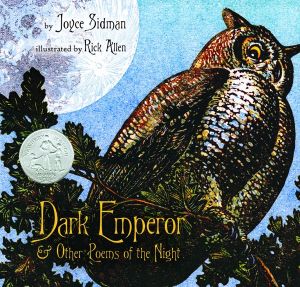
Dark Emperor & Other Poems of the Night, written by Joyce Sidman, illustrated by Rick Allen. Published in 2010 by Houghton Mifflin Books for Children.

I was in my mid twenties when these poems fell into my palms.

This collection begins with a nocturnally winsome invocation, “Welcome to the Night”, in which these dark hours are described with as much liveliness and imaginative engagement as any merry daylight revel:

“The night’s a sea of dappled dark,
the night’s a feast of sound and spark,
the night’s a wild, enchanted park,
Welcome to the night!”

Subsequent poems are dedicated to specific woodland creatures: snails; moths; owls; trees; spiders; porcupettes; crickets; mushrooms; efts; bats, and the moon. Each poem reveals the ways in which these night companions investigate and explore their domain, during the hours between evening’s first footfall and the dawn’s pearly herald of a new day. For every poem, too, there is a column of accompanying factual text, detailing the physical properties, habits and characteristics of the poem’s subject.

What enchanted me?

A 2011 Newberry Honor Book, Dark Emperor is precisely the sort of children’s book that will be read to Baby/ies Novel Niche, should one/s ever be bouncily forthcoming. Barring that possibility, however, this remains a book for both treasuring closely and sharing widely, which is why I’ve two copies and plans to acquire more. Sidman’s poems are laden with the prancings, rustlings and winkings of these sylvan inhabitants, and each piece is a resonant embodiment of its focus. In “Dark Emperor”, from which the book derives its title, Sidman hones in unerringly on the great horned owl’s imperious majesty, wondering in verse at

“What symphonies of 
squeaks and skitters, darts
and rustles, swell the vast,
breathing darkness of your realm?”

The owl as foreboding predator; the spider as confident peddler of survival instincts; the steadfast and nurturing guardianship of the oak tree: these character sketches and several others await the reader, bound to fascinate children with any love for the earth’s wild and unexplored places. The factual supplements will interest older children who are getting their hands and chemistry sets messy with documenting their environmental observations.

Rick Allen’s relief printed lino cuts are individual vistas of panoramic and precise astonishment, allowing a revisitation of familiar animals and haunts with eyes that will appreciate the artist’s intricacy, his use of shadow and light, his measured and brilliant application of pigment. Allen’s art holds hands eagerly and elegantly with Sidman’s, and the results are worth reading and rereading: they make the perfect invitation to a night-time slumber party of imaginative revels, beneath the glow of a  moon waxing towards fullness.

Lines for Life:

“Where are the diving sweeps of the nighthawk
and where its haunting cry?
Where is the thrum of crickets,
the throbbing of frogs?
Where are the great flocks of travelers
whose soft wings whispered to me,
wave upon wave,
beating toward some distant wood?”

from “The Moon’s Lament” (an ubi sunt)

This book would be best-beloved by:

♣ A wee expeditioner with good, clean dirt beneath his fingernails, a magnifying glass hanging from a string ’round his neck, and a heart filled with investigative zeal that tracks muddy footprints right into the night forest’s teeming core.

Charting Children’s Literature is a monthly feature at Novel Niche that seeks to highlight the beauty and richness inherent in many of the books written and illustrated with the enjoyment and education of young children in mind. The feature was launched in August 2011, and is set to run for the foreseeable future (to infinity and beyond)!

If you’re interested in bringing to my attention beautiful children’s books I haven’t yet covered, feel free to leave a comment on this page. If you would like to contribute a guest Charting Children’s Literature feature, please make use of the contact form provided. I’m looking forward to hearing from you!

Story Sundays: “Earl Grey” by Sharon Millar

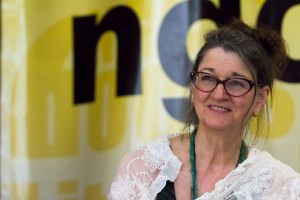
Sharon Millar
Sharon Millar

When we meet Leah, the central figure of Sharon Millar’s short story, “Earl Grey”, she is trying to keep her thoughts well below room temperature. The room she’s in is the sweltering, westward-facing kitchen of a Santa Cruz cocoa estate house on the mend, run by Leah and her comparatively unruffled husband, Henri. Leah isn’t given to a coolness of touch, most times, but it matters more than mildly now that she create a perfect quiche, because Henri’s mother, Sally, is visiting the estate for the first time, to have tea. To Leah’s mind, the formidable Sally, a matriarch of tea parties that manage to be both inventive and exquisite, will be expecting nothing less than perfection, and a cool-handedness that Leah hasn’t previously been able to plate up. According to Henri, all his mother will require boils down to far less than what Leah imagines. As the hour of Sally’s arrival looms closer, and Leah’s quiche takes a less-than-savoury turn for the worse, the question of what the mother in law will receive begins to linger as oppressively as the midafternoon Trinidad sun.

Sharon Millar’s writing is as necessary and brutal as a matador witnessing his first bullfight, which seems an odd analogy given the apparent domesticity of a story like “Earl Grey”. Culinary and cultivating notions infuse the narrative: Leah follows (and detracts) from a quiche recipe primed for the sublime; she savours this science of cooking far less than the pleasure of a fresh cocoa pod, brought to her by Henri as a palliative against his mother’s arrival. These ideas of growth and fruition permeate the text, signalling that the relationships between what can be harvested, and what might be prepared, aren’t always seamless or simpatico. We can engage in food-artistry that turns the stomach, even if it appears from the oven like a master-quiche maker’s dream.

Leah’s relationship with her mother-in-law both embodies and transcends the expectations of well-chronicled bacchanal surrounding two women who pick at the same and separate ribs of a man, tugging for prominence on either side. Millar conducts these palpable and unseen tensions so convincingly that we feel we’ve rather taken the measure of the sublimely awful Sally without having heard her own voice on the page. We feel for Leah, with her earnest, pathetic quiche-wrangling, whether or not we’ve got crotchety husband-or-wife-mothers of our own, lurking in the recesses of our every misstep, judging while offering platitudes that are barely half-baked. Leah’s expectations, projected onto the surface of the pastry that has not yet disappointed her, are clearly defined islands of hurt, bound up with good intentions. In her anticipations for the serene procession of the evening’s events, one reads the dismantling of past attempts at graceful encounters, of the dogged desire to be thought useful, presentable, well-manicured.

“She imagines the quiche, perfectly fluted at the edges, the pastry lightly browned, the bacon, spinach, and tomatoes in layers of green and brown and red. She has become a woman who can make a quiche and this woman has cool hands. She will serve the quiche to her mother-in-law. They will sit on the lawn. Leah will be careful to invite Sally to sit in the garden, not the yard. She will chat amicably about the small joys of the farm, the pleasures of seeing the cocoa move from jewel coloured pod to rich dark chocolate.”

What stings the worst (and therefore, the best) about “Earl Grey” that it’s a short story obliquely about cooking but persistently about failure. As Leah is forced to consider, the burnt edges of our incompatibilities with others will pursue us, even in the places we feel comfortable, even in land that’s our own to claim proudly. Nowhere, and nowhere, are we immune to the smoother, sharper hands of another, telling us all we need to know about ourselves by embodying everything that we ourselves are not. That Millar reigns in this modulated torment in even swathes of unerring exposition is a semaphore to her rich, bruising talent. The story hurts and compels, and we want more. We want to see what lies on the other side of ruined savouries and reanimated cocoa estates, what beats in the hearts of complex, guarded women offering up too much of themselves in the service of wrongsided idols. “Earl Grey” reads briskly, the length, perhaps, of a tightly palmed cup of chai, but if your pulse is attuned to short fiction that navigates delicate terrain searingly,  then you will need to read it again, with several cups of tea and many aching wonderments within arm’s reach.

You can read “Earl Grey” by Sharon Millar here. (Draconian Switch, .pdf – allow a minute or two for full issue to load.) Author photograph by Ross Millar.

Story Sundays was created by Fat Books and Thin Women as a way to share appreciation and engage in discussion on the short fiction, which often receives less attention than full-length novels. All stories discussed are available to read free, online. Here’s Fat Books and Thin Women’s Story Sunday archive, and here’s mine.

The 2013 NGC Bocas Lit Fest – A Blogger’s Logbook [Day Two]

Those who weren’t involved in the second day of Bocas activities this year, but were in Port of Spain as afternoon dripped into evening, will likely remember it as “that time it rained semi-profusely, and Town flooded”. (My friend and colleague Kevin Hosein blogged briefly about Bocas, and more indepthly about the extreme floodiness of the day, over at his Tumblog, Little Jumbie.) Admittedly, the gushing grey rivers of drainwater looping around the traffic-clogged roads prompted minor alterations to the Bocas schedule’s last few events of the day, since a handful of scheduled panelists were trapped within their hotels, unable to reach the National Library for neither love nor pirogue access.

Despite this, Day Two of #bocas2013 was as engaging and imaginatively challenging as Day One. The Bocas team donned their (mostly metaphorical) galoshes and steered the festival participants and attendees through the evening’s dampness — if you were already at the Library by the time the rains hit, I’ll wager it was one of the few places in Town where the spirits were enthusiastically treading water and clamouring for more words.

Here’s my Blogger’s Logbook, Day Two. Click on the summary titles in bold to go to the full posts on the official Bocas website!

One on One – Marina Warner

Marina Warner responds to a question from the audience, during her panel.

Writer and mythographer, Marina Warner, in conversation with novelist Lawrence Scott (author of the 2013 OCM Bocas Prize longlisted Light Falling on Bamboo.) Warner spoke principally of her seminal, recently reissued work, Alone of All Her Sex: The Myth and the Cult of the Virgin Mary, as well as her 2011 book, Stranger Magic: Charmed States & the Arabian Nights.

New Talent Showcase – Sonia Farmer

Sonia Farmer, with Loretta Collins Klobah's 2012 OCM Bocas Poetry prizewinning collection, The Twelve Foot Neon Woman.
Sonia Farmer, with Loretta Collins Klobah’s 2012 OCM Bocas Poetry prizewinning collection, The Twelve Foot Neon Woman.

The second of this year’s New Talent Showcase readers, Bahamian poet and publisher Sonia Farmer shared selections of her writing. She also displayed stunning handcrafted and letterpressed titles released by her small press, Poinciana Paper Press.

One on One with Olive Senior

Olive Senior addresses her rapt audience during her One on One session.

The veteran Jamaican writer held court — if you were there, and witnessed not a solitary free seat to be acquired, you know what I mean! — on her poetry; on the experience of writing a novel later on in her life; on inspiration and advice for young writers, and many other gems, in conversation with Michael Bucknor.

One on One – Irvine Welsh

Scottish author Irvine Welsh, engaging with a question at the Bocas Lit Fest.

The author of Trainspotting; Skagboys and several other novels; short fiction collections and plays, talked with BC Pires about the “spectacularity” of failure and the ways in which the publishing world has evolved — not necessarily wholly for the better. (Also, kudos were given to Margaret Thatcher.)

Next up – Day Three of the Blogger’s Logbook!

Previous entries:
Blogger’s Logbook, Day One.

All photographs by Maria Nunes, Official Festival Photographer.

The 2013 NGC Bocas Lit Fest – A Blogger’s Logbook [Day One]

For the first time this week, when I woke up this morning I didn’t feel compelled to race into Port of Spain with my notebook at the ready and a blue Staff Badge slung around my neck. Goodness, I thought, it’s over. This year’s Bocas is actually over. 

Anyone who’s been behind the scenes at a literary festival can likely understand my simultaneous physical and mental exhaustion-elation combo. The Bocas Lit Fest continues to be a whirling dervish of an institution, picking up momentum and reach with each passing year. This was the festival’s third, and I’m thrilled to have reprised my role as Festival Blogger and Social Media Coordinator, which means I spent each of the four festival days (April 25th to 28th) mad-enthusiastically livetweeting and liveFacebooking. Now that the literary dust is beginning to settle, I’ve begun my comprehensive post-festival blog coverage. Today was Blogger’s Logbook Day One! Here’s a tidy breakdown of what I covered — click on the summary titles in bold to go to the full posts on the official Bocas website!

Festival Welcome – Writers vs. Politicians

Festival foundress Marina Salandy-Brown gives the official Festival Welcome address!

This was the festival’s first official event, which served to set the tone for one of our Edinburgh World Writers’ Conference panels on Day Three, titled “Should Literature be Political?” (more of that on Day Three’s coverage!). Four local luminaries read excerpts from politically-charged passages of fiction, written by four Caribbean authors.

Father Figures – Colin Grant and Hannah Lowe

Poet Hannah Lowe reads from her collection, Chick.

A panel of poetry and memoir, featuring the work of Hannah Lowe and Colin Grant, both writing about their Jamaican-British fathers, as well as the complicatedness of family life and the experience of enacting remembrance through writing.

New Talent Showcase – Danielle Boodoo-Fortuné

Danielle Boodoo-Fortuné reads a selection of her prizewinning poems.

Each year, Bocas selects three emerging writers of great promise who are close to completing their first manuscript of work. This year, Trinidadian poet (and my friend) Danielle Boodoo-Fortuné was the first to be featured. I wax lyrical and occasionally mushy in my blog post, so to hear me gush over her brilliant and heartstopping verse, go there!

Fiction – Courttia Newland and Ifeona Fulani

Courttia Newland, author of The Gospel According to Cane, responds to a question.

Two fiction writers, Courttia Newland and Ifeona Fulani, read from their newly released books and discuss technique; form and dialogue use in their own narratives, as well as in the stories of others.

Join me tomorrow, as I wrap up Day One’s blogs, and cover a cross-section of panels, readings and events from Day Two!

All photographs by Maria Nunes, Official Festival Photographer.

On [actually] buying books again: of Bread and Literature.

Glorious deckle edges! My best friend was appropriately gleeful.

Goodness, it’s been a while, Novel Niche.

I’ve been girding my loins getting ready for the third annual NGC Bocas Lit Fest, a celebration of books, writers, publishers and literary folk of every description, that takes place in Port of Spain, Trinidad, in the last few days of each April since 2011. Working for the Bocas Lit Fest is both a pleasure and a gauntlet: it reinforces the best reasons (and perhaps even some of the inconvenient truths!) revolving around why I love this reading and writing life. It also packs a wallop: this year’s festival features over sixty events within a four day period (official festival programme here) — and this year, I’ve the terrifying distinction of being on the actual programme as a member of the New Talent Showcase: i.e. a spotlight on an up an coming writer of promise. Yes. Appropriately thrilled and terrified.

Recentlyish, I went book-hunting for a collector’s edition of To Kill a Mockingbird as a birthday present for my best friend. Her boyfriend and I ventured to The Reader’s Bookshop in St. James, a money-sucking, brilliant indie shop consecrated to otherwise elusive fictive finds. We scored Harper Lee in glorious deckle-edgedness, to be sure, and for the first time in what seems like a long time, I bought books for myself, too. My reading life has been guided greatly by work purpose; I’ve been reading the fiction, poetry and non-fiction submissions that have been sent into my review piles. I’ve not had to reach for my wallet for the sake of good literature for quite some time, and this makes me lucky, I know.

Reading voraciously becomes an expensive habit, and I’ve had conversations with myself that meandered along an interior dialogue of “Do I really want this new A. S. Byatt? Oh, yes. Will I be content to borrow it from the library? Oh, no. Am I really attached to the idea of buying that brand-name bread? Nope. Byatt wins.” I cannot fathom that I’ll always have a steady stream of review books in my future, either — is it quite mad to think that I look forward to more “bread or literature” talks with myself? Because I do. It’s a good reminder of being grateful for what matters within the weird realm of my own personal hierarchy of needs. Sometimes scripture is more essential than pumpernickel.

Here’s what I bought.

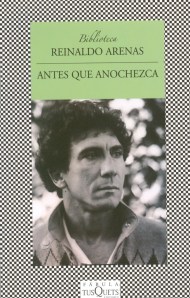
Antes Que Anochezcathe Spanish language Before Night Falls by Reinaldo Arenas (incidentally, I bought my best friend the English translation last Christmas, and wrote about it briefly in my last Yuletide & Resolution blog post). Arenas was both prolific and persecuted, a Cuban writer of plays, poems and novels. Antes Que Anochezca is his 1992 autobiography, and it marks the first Spanish work I’ll read, in full, after a long hiatus from this, my second tongue. Spanish often makes crisp, instant sense to me in ways that English doesn’t always — which may seem addled, but possibly resonates with other bilingual folk. My reading will be rusty; I’ll probably borrow Best Friend’s copy of the English version and read the pair in tandem, chapter by chapter. The revelations are sure to be immense, intense, and catalytic in terms of fleshing out my Spanish reading to the places I would like it to journey.

EarthTrembleAny novel titled And Let the Earth Tremble at Its Centers  becomes an “I must have you in lieu of bread” acquisition. This is the first novel of Gonzalo Celorio’s to have been translated into English, an undertaking of the Texas Pan American Literature in Translation series. (Marginalia: in its original 1999 Spanish publication, it was released by the same Tusquets Editores who released Antes Que Anochezca on their Fábula line.) It’s translated by Dick Gerdes, and foreworded by Ruben Gallo, author of Freud’s Mexico: Into the Wilds of Psychoanalysiswho says in his opening comments that Celorio’s novel “belongs to a genre with a long history in Mexican letters: the literary portrait of Mexico City.” And Let the Earth Tremble at Its Centers hailed me out on the strength of its seeming wondrous weirdness: a tenet that goes far with me in writing, if the weird is shored up by skill and storyline.

Since it was published in 2010, I’ve thought about Basharat Peer’s Curfewed Night more than occasionally. Peer, a Kashmiri journalist and political commentator, writes about the “culture of intimidation” in his homeland: of censorship, violence and the horrific relationship between the two. The first memoir on Kashmir by a Kashmiri on growing up in that valley, the book is described by reviewer Shelly Walia (full review in The Hindu here) as “a heart-rending account of a placid valley where life has been made sour by the ignominy of politics, where the language of politics has excluded the voices of the people.” Walia concludes that Curfewed Night’s laurelling achievement is that the work is neither parochial nor ethnocentric, but human. Seeing it on the non-fiction shelves was a jolt to the heart: a reminder of what I owe it to myself to read. A beautiful hardcover, it was too expensive and worth the price of many loaves of bread. No way I would have been happy leaving the shop without it.

I also ordered a book from the shop. I went back to collect it yesterday.

PEA literary treatment I’ve admired on my colleague’s blogs for some time is a multi-tiered reading project: handling an impressive beast of a tome in segments, and offering a reader’s diary alongside the gradual covering of sections. Currently, Iris on Books is doing it with the daunting War and Peace (here’s her most recent check-in) and I’m fairly certain that on the heels of the successful musical film adaptation, Victor Hugo’s Les Misérables is enjoying similar, concerted analysis on book sites. While not as long as either Les Mis or War and Peace, the tetralogy of Parade’s End by Ford Madox Ford is a formidable slog, standing at 836 pages in that dense, vaguely offputting-but-not-really-once-you-get-into-it 10.5 Dante MT typeface. It is, if the rumours are true, the quintessential novel about war, and has been heralded as “possibly the greatest 20th-century novel in English” by John Gray, the New Statesman‘s principal book reviewer (snippet quote here). I’ve seen the BBC Two miniseries, gorgeously written for the screen by Tom Stoppard, and can attest to it being a stunning, trenchant production. I’m really looking forward to reading Parade’s End meticulously and thoroughly, and to sharing my annotations, essays and musings on the blog as I go (I already predict character sketches; reviews of each tetralogy; themed postings on WWI, desire and gender!) — it will, I think, be a consummately nerdy, cerebral experience.

I have become less and less interested in the long-term acquisition of Things, in almost every area save books. If it’s true that every time we spend money, we cast a vote for the kind of world we’d like to create, then I suppose based on my wallet habits, my ideal world would resemble a cavernous library, with nominal shelf space for my odd earrings; sheaves of handmade paper; sensible shoes, and bread.

43. Visit Sunny Chernobyl by Andrew Blackwell

Published in 2012 by Rodale Books.

“The reason I find myself beating the same thematic horse on every continent isn’t that the polluted places of the world aren’t polluted. It’s that I love them. I love the ruined places for all the ways they aren’t ruined.”

If Andrew Blackwell’s book were a boy you used to date, he’d be the cardigan-clad loner who’d nick your dad’s best weed and keep you up all night with hot, intellectual discourse. He’s not necessarily the one you want for homecoming, but God, how you’d like to travel the world in his post-anarchic company.

And travel the world you will, in Visit Sunny Chernobyl. Oh, the places you’ll go!

♦ Northern Alberta, to check out some oil sands mining;
♦ Port Arthur, Texas, where the oil craze had its inception;
♦ Sailing towards, and around, the North Pacific Ocean’s trash vortex;
♦ The Amazon, where they do bad things to trees;
♦ Guiyu and Linfen in Southern China, where computers go to die;
♦ Trailing the course of the Yamuna, India’s largest tributary of the Ganges —
♦ and, of course, Chernobyl.

Why? Before Blackwell’s official pollution-tourism peregrinations kicked off, he took a three-day tour of Kanpur, in India. While poking through its toxins, he felt that ineffable je ne sais quoiness, a sense of inverted beauty pyramids, and of how commodification is altering the earth. This sparked, if you will, a wildfire of curiosity. Blackwell wanted to take a different sort of trip — think, less Sandals resorts, more salmonella. Amp up the scum, peer into the fetid abyss, see what we’ve done and how much fun we’ve had doing it: the concept alone is a brilliant inversion of leisure ethics, but I suppose my biggest qualm, pre-reading, was how well this smashing concept could bear out.

It bears out, chiefly because Blackwell is good company on the page. Just self-deprecating enough, perceptive, and disposed to listen to the stories of others, his eco-disaster yarns spin the reader into the journey, instead of leaving her on the sidelines. You’re there, in the thick of it, breathing in the filth, wading through the plastic, listening for telltale radioactive beeps that keep time with your heart. You are implicit in the wreckage (and, ironically, you are, which you know already.)

For the most part, the writer shies away from political spillage and proselytization. What’s gratifying is a distinct lack of punch-pulling about po-correctness: witness Blackwell’s take on Yellowstone’s dismantling of the human element, for example.

“Native Americans were excluded from Yellowstone at its creation. Though people had been present in the area that was to become the park for thousands of years, native American practices of hunting and planned burning were anathema to a view of nature as sacrosant from human involvement. […] The creation of Yellowstone formalized the idea that human beings have no place in a protected wilderness — unless they are tourists.”

Blackwell shines at this good-guy acerbic commentary: the shots he takes against various Big Bads make for hilarious, “Oh man I just snorted in public while reading this” moments. That said, there is a slick sense of… overcompensation, at times, in the distribution of chuckles and the peppering of narrative with cutesy, charming pop culture references. The non-fiction is made easy for us, turning the genre bewilderingly trendy and urbane, a regular jaunt through diseased playscapes and rotting carousels, but (and yes, this sounds poisonously bitchy) sometimes it seems too easy. I wouldn’t have minded suffering a little more.

What the book isn’t is a definitive guide. Readers will be disappointed if they come away from its chapters expecting a top-tier education in radiation, or the history of deforestation in South America. Where Blackwell excels is dismantling the academia around these and other bodies of knowledge. His walkthroughs of pollution tourism basics reflect his desire not to offend unschooled minds: sympathetically, the reader has her hand held and guided through the gritty specifics of how oil can plummet out of the earth, of how keyboards can be stripped to their basic, valuable components.

A clear gleam of beauty is often twined into the twisted maw of darkness: this is true about as much in fiction as it is reality. This uneasy yet fascinating duality is a concept Blackwell mines thoroughly on his travels. “There is a kind of destruction that has beauty in its weapon,” he comments, listening to an Amazonian landowner’s awed description of masses of forestland, burning unchecked into the night. The author links this awe to the manner in which refinery flares were described to him, during his time in Port Arthur, Texas.

Gratifyingly, Blackwell moves a step beyond simple enumeration of these beautiful, catastrophic developments; he pushes the reader’s gaze towards the imaginary scale where beauty is demarcated, asking her to consider its ourobourosian structure. “The beauty or ugliness of a place didn’t have that much to do with what it looked like,” Blackwell says, when given a curious eyewitness account of a Canadian tar sands mining site. He expands on this thought:

“Beauty depends on what we think is right. How else could we have come to think that unnatural objects like cities or farms or open roads were beautiful? That’s what I wanted to see. The rind of beauty that must exist in every uncared-for corner of the world.”

Visit Sunny Chernobyl probably won’t make you see recycling in a new light. I doubt it’ll strike up some nascent passion for greenhouse architecture, or Greenpeace enlisting. Maybe that’s because this doughty traveller’s guide isn’t sponsored by preventative psychology. It’s not saying, “We should save the Earth before we ruin it.” Oh no. It’s intoning, “Hey, we’ve already ruined the Earth. Vast tracts of her, in fact. But it turns out the Earth gets the last laugh, always. She’s indomitable; we’re plastic-addled specks.” Prospecting for information and rippling semaphores of grace, with our hazmat suits on: this might be something we do more and more enthusiastically as we mark out our days.

Yuletide Books of 2012, and a 2013 Resolution

Last year, if you recall, I didn’t get my mother any Christmas books (it was a shameful moment, not necessarily redeemed by the fact that I got her loads of other shiny pretties), so this year, I improved my previous standings: I got her one. (In my 2011 Yule haul post, I mentioned getting my mum three others, but those were all given to her at different occasions during the year — Valentine’s, Easter and the like. Yes, Easter/Divali/the Summer Solstice can be for book giving too, Nichers!)
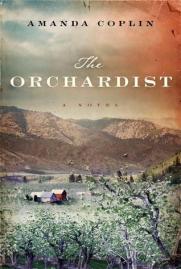
The Orchardist by Amanda Coplin (2012, Harper) is, at first glance, an almost outrageously handsome book. It seems to tell you, by the very look of it, that it will be both durable to hold and magnificent to read. Coplin’s story is described by Holloway McCandless (what a gorgeous name, right) of Shelf Awareness as “an extraordinarily ambitious and authoritative debut”, which, when one thinks of debuts, is what one wants to hear. Set in the rural reaches of the Pacific Northwest at the end of the twentieth century, The Orchardist has one of those plots that gives you faint goosebumps under your arms and across your nape, just considering it. It involves a kind, reclusive man interfacing with two young pregnant girls who trespass on the fringes of his land and the cockles of his heart. There’s trauma, and acts of redemption, and the bedrock of an America that scarcely resembles the one of 2013. My mother has already read it, and loved it. She deemed it “serious, important writing”, a moving, beautiful story, movingly and beautifully told.
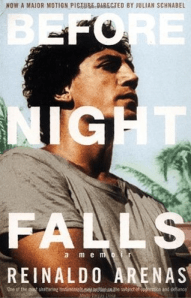
I gave more than one Christmas book last year, however. To my best friend, I gifted Before Night Falls by Reinaldo Arenas (1994 reprint, Penguin). It is her favourite memoir in film, and we both predict/hopefully anticipate that it will be her favourite memoir in print, too. (An outrageously goodlooking image of Javier Bardem from the 2000 movie is plastered across its front cover, which, one imagines, would spike impulse sales considerably.) The New York Times Review of Books describes Arenas’ prose reminiscences as “a book above all about being free”, charting in often painfully honest chapters the episodes of sexual persecution that have defined his queer autonomy, and political suppression that has stifled his creative work. Nor, one notes grimly, are the two methods of censorship mutually exclusive. This is the world on which so much of the Cuban writer’s fiction is founded, and Before Night Falls grants the reader the freedom of access to anti-regime, anti-persecutory reading: freedoms that Arenas himself often worked and lived without.

My brothers gave me three books, two of which suit each others’ company as impeccably as cucumber sandwiches and Darjeeling tea: North Parade Publishing collector’s edition copies of Jane Austen’s Sense & Sensibility and Northanger Abbey. Perhaps alarmingly, or predictably, I’ve read no Austen in her totality other than that which I studied, because, well… I don’t know. One needs to be in the precisely perfect alignment of mind and disposition to delve into Austen for pleasure. These volumes might well lend themselves to that faster than the others in my possession. Incredibly portable, endearingly tiny, and interspersed with charming black and white illustrations, these are true keepsakes. I will endeavour to fill out my collection with the remaining titles, and actually strive to read them all.

The third of the books from my brothers is the hauntingly-covered Her Fearful Symmetry by Audrey Niffenegger (2009, Alfred A. Knopf), whose super popular The Time Traveller’s Wife endeared me in no way towards it. (Please remember that I am a book snob, and that book seemed to have “Oprah’s Book Club” smeared all over it. For all I know, it could be a good read.) Her Fearful Symmetry seems more promising, telling the tale of two intensely bonded sisters, Julia and Valentina, and their acquisition of a London apartment that looks over the impressive Highgate Cemetery, home to the bodies of several departed luminaries. As ghost stories go, it seems a juicy, engrossing tale, with, I hope, a shiver or two tucked inside.

My mother gave me seven books this year, a diverse and merrily motley lot. James McBride’s Song Yet Sung (2008, Riverhead), is heralded by the New York Daily News as “a gripping tale filled with acts of cruelty and humanity that surface at unexpected times — and in unexpected people.” Set in the days preceding the Civil War, it hones in on the fugitive journey of Liz Spocott, a runaway slave cursed/blessed with visions of a disturbing future. Beset by bounty hunters, wading through swampland, Liz’s journey is at once intensely personal and emblematic of a larger, more disquieting conversation, one that McBride explores with utter candour and grace. The only reason I don’t read books like this immediately is because I’m afraid of what they’ll do to my insides. I always get around to them, though. They are necessary.

Ivan Turgenev’s First Love (2005 reprint, Barnes & Noble Books) is widely celebrated as one of that prolific Russian author’s most favoured pieces of short fiction. “Anyone who has ever been in love,” the blurb of this edition proclaims, “will be touched by this tale of passion and disillusionment.” Given that my previous year was characterized by mostly contemporary reads in both fiction and non-, First Love feels both mirthful and apropos: a reminder that a look, a glance, a well-considered waltz backwards into the archives of classical literature can elicit rejuvenating effects. Coming in at just under seventy pages, I don’t think I’d be remiss in casting this slim volume as a potential Story Sunday pick, sometime later down in the 2013 calendar.

Run by Ann Patchett (2008 reprint, Harper) is touted by Jonathan Yardley of Washington Post Book World as “a thoroughly intelligent book, an intimate domestic drama,” one that deals, above all else, with concerns of family. Patchett’s fourth novel, Bel Canto, thrust her into the spotlight: the three books that preceded it received acclaim, certainly, but not quite in the way that the PEN/Faulkner award-winning Bel Canto did. Run‘s biggest worry, out the gate, must have been on how it would stack up –even if Patchett didn’t trouble herself on this issue, the critics would. The author is talked up by The New York Times Book Review as being “more hammer and nails than glue and lace”, which is enough to make me wheel back and take serious note, on its own. I haven’t even read Bel Canto, though, so here’s what I’ll do: read Ann Patchett backwards, like my fingers are tamped down on a VCR’s rewind button. We’ll see what insights and revelations emerge.
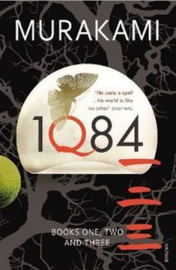
1Q84Arguably the sexiest thing beneath the Christmas tree addressed to me, Haruki Murakami’s 1Q84 (2012 reprint, Vintage) is going to be the first book I read by this legend of an author. I am excited. I am so excited. This book seems strange and compelling and entirely unpredictable, and I want to know it, the way you would want to know the dark, Aragorn-esque stranger in the corner of the tavern. The Times calls it “a work of maddening brilliance”, and so wide is the net of global recognition flavoured with quirky, creatively fecund singularity that Murakami’s cast around him, one is inclined to agree vigorously even before reading the first page. Set in Tokyo’s 1984, the novel follows the intertwined stories of Tengo and Aomame as they venture deeper and further down rabbit holes of parallel worlds and suspicious ghostwriting assignments. I would like to repeat, just for the record, that I am so excited.

Mario Vargas Llosa’s The Dream of the Celt (2012 reprint, Farrar, Straus and Giroux) is described in the last lines of its blurb as a novel that dares to push the envelope where historical fiction is concerned. It illuminates the life of Roger Casement, the Irish nationalist whose humanitarian work deeply discomfited those accused of its crimes, notably the British in Northern Ireland. Convicted and executed by the British, stripped of his rank and title, Casement’s pioneering work was so sullied by his disgraceful end that real interest in his legacy only peaked again in the 1960s. This novel feels formidable, masterful and deeply rewarding. I shall have to acquire a copy in its original Spanish, and read the two side by side.

Edited by R. V. Branham, Curse + Berate in 69+ Languages (2008, Soft Skull Press) is a reminder that my mum is possibly more of a badass than I will ever be. There is very little I can say explicitly about this irreverent, whimsical, yet clearly superbly researched book that won’t get Novel Niche slapped with an NC-17 rating, which really is the core of the compendium’s, er, charms. Disclaimer: Wanting to use several of these gorgeous, filthy expressions doesn’t make you a bad person, but inventing and engineering social encounters so that they escalate into verbal bloodbaths, just so you can shout out “trust fund hippie” in French, or “five-faced hypocrite” in Tagalog: well, that’ll probably get your Miss Manners card revoked.

I’m not joking. My Fantasies: An Erotica Journal by David Russell and Gary Silver (2006, Clarkson/Potter Publishers, Random House) is precisely the sort of book my mother would give me, with or without any expectations that I’d fill in the lined pages, which feature helpful prompts such as “Here are my instructions for the perfect massage…” This gift, I think, is most telling: of how few boundaries there are in the discussion of what governs good and bad in printed matter, in the creator & progeny relationship of which I am one half. What is even more endearing, and comforting, is that this is the way it has always been — not that my mum was giving me erotica to read when I was in pinafores, no, but that the conversation on reading has never felt stilted, blinkered or reined in by dictates of “You shouldn’t”, or “Good/chaste/charming girls don’t read those awful things.” Panelled with quotes by the usual suspects (Pablo Neruda; Gustave Flaubert; The Kama Sutra; Rumi), and tastefully (yet pulse-tinglingly?) peppered with illustrations in unobtrusive sepia, this pocket journal is precious, darling: a fitting accoutrement to the love you’re making or dreaming up.

From she who knows the mettle and measure of my reading life with as much intimacy as my mother, I received The Children’s Book, by A. S. Byatt (2009, Alfred A. Knopf). For a long time in my teenaged years, I would tell anyone who asked that my favourite book was Byatt’s Possession. It was. Never had I read something so perfectly, ornately itself, if that’s at all coherent — this unabashed love letter to epistolary ardour, to the secret lives of writers and the conventions of two ages colliding into each other. Everything Byatt writes feels forged in a master (a mistress!) class of writing well, and I cannot fathom that The Children’s Book, loosely based on the life of English children’s book author E. Nesbit, will feel any differently. I don’t have the full measure of The Children’s Book (and when does one have the full measure of a book, ever, really?) but I can tell that it will lend itself to cloistered, intense readings. I will read it so fixedly that the rest of the world will fall away, and people and places will seem strange, when I return to them again.

Now, to my resolution. It’s simple, really.

In 2013, I resolve to read for pleasure as I damned well please. 

I know that sounds a little repetitive and haughty, but let me explain. Over the past year, the work I do has been sharply characterized more and more by what could be called professional reading: reading tailored to published reviews, blog posts, and social media commentary. It’s like what I do at Novel Niche, but also not quite: each job owns its distinctive tone, and none is a mirror image of the way I write about books and an involved reading life here. Vast tracts of my time are spent with books in various official review piles, and this is bloody fantastic, but it’s also work. The distinctions are subtle but the end tasks remain thrilling. There are precious few things I would rather be doing professionally.

That said, when I read for pleasure, without a deadline or copy edit attached, I intend to do so while revelling in the freeness of choice, and the fullness of that particular range. Maybe I’ll read a book on a carousel, or in a park with a vagrant sitting next to me all day, muttering about the weather. Maybe I’ll read at a funeral. Maybe I’ll read manga and review it like classical literature. I might finally begin reading more books in Spanish, in public transit. Incomplete memoirs published without endings; Japanese erotica with or without tentacles; books I’ve had stowed away with the best intentions for years; books that Rory and Jess enjoyed poring over together in between smooches; books that Jesus Christ might pick up in a Barnes and Noble: I’m cutting any vestiges of reading propriety that could potentially be lingering.

A reading life isn’t a prolonged Advanced Honours Literature class, or at least it shouldn’t be. There is no way to do it wrong, unless perhaps you never open a cover. So this year, I’m resolved on making no resolutions other than opening as many covers for pure pleasure as I can lay my hands on. I look forward to your company, Novel Nichers, and to the continued joys of the round circle of commentary, clickage and steadily good vibrations that I always want to encourage here. Merry, mirthful 2013!