“La Brea” – Andre Bagoo

17348563976_9408e89838_k
Image: Pitch Lake Trinidad and Tobago 35 cents Elizabeth II, posted at Flickr by Mark Morgan under a Creative Commons License.

You can live your entire life on an island, and never know the length and breadth of it. This is true, Andre Bagoo’s “La Brea” tells us, for many of the people in Trinidad who know the Pitch Lake, but have never seen it. Estimated to hold ten million tons of natural asphalt, the lake is reported to be two hundred and fifty feet deep, spanning a surface area of one hundred acres. Yet what do these figures mean, to the everyday curiosity of Trinidadians? How do you navigate the borders, the depths, of this lake you can’t swim, without ever having been?

La Brea, the home of the Pitch Lake, is like any other place on the map in T&T: if held under the microscope of scrutiny, it can become a contradiction in fascinating terms. Consider that the roads in La Brea are said to be terrible, though the primary use of asphalt is in road construction. Why, if you worried at that enough, you’d have the beginnings of a dark fairytale. This is what I love best about Bagoo’s poems: a seeming-innocuous thing has ridges, edges, subduction zones, the work of millennia of friction. “La Brea” gets under you, tectonically. It captures what happens in a place like Trinidad, in a place that is, precisely, Trinidad:

“Here, when it rains,
the difference between east and west, north
and south, between past and present, blurs, lost
objects once swallowed whole come
out again”

We arrive here through no seeming contrivance of language: Bagoo’s diction is smooth, simple, unfettered as freeflowing petroleum. We arrive to the surface of the lake, without ever having made the trip physically. We are warned that it might consume us, if we wade in, if we dare past the borders of what we can trust.

Read “La Brea” here.
Andre Bagoo’s third collection of poems, Pitch Lake, was published in 2017 by Peepal Tree Press.
This is the fifteenth installment of Here for the Unicorn Blood, a Queer POC Poetry Reader which runs from June 1 – June 30. Historically, June commemorates the 1969 Stonewall Riots, heralded as the birth of the modern LGBTQ+ rights movement in the United States. #PrideMonth’s global significance, its unabashed celebration of queerness, its marshalling of non-heteronormative joy, resistance and tenacity, motivates this close reading series, which specifically engages the work of POC Queer Poets, in international space. People of colour have been vital to queerness before queerness had a name: this is one way to witness that, to embed my reading practice in it, and to raise my brown, queer fist in yes.
“Operation Unicorn: Field Report” – Minal Hajratwala

13815169473_d7a8c56d6d_k
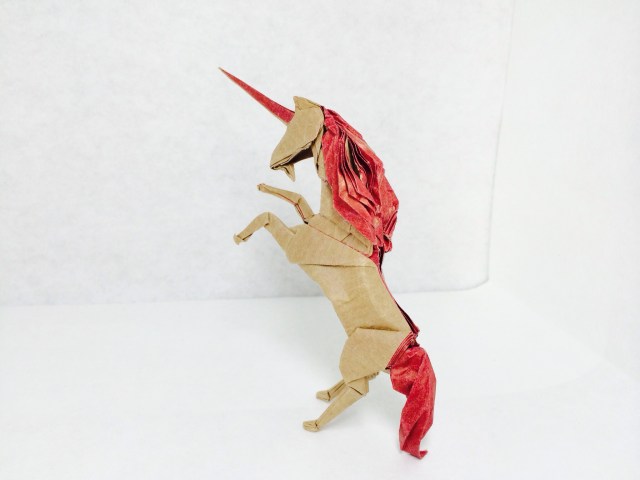
Image: Unicorn, posted at Flickr by Peter Liu under a Creative Commons License.

If you believe in unicorns, most people probably think you’re fey. Minal Hajratwala’s poem believes you’re a scientist ahead of the terrestrial curve.

In “Operation Unicorn: Field Report”, the poem’s unnamed speaker is a collective, a group of statistic enquirers who have taken their study of unicorning to the wild. Where better to find a unicorn in her natural habitat? What I love about this poem is its dogged — horned, if you prefer – refusal to treat the unicorn as an abstract fantasy. No, the creature is a tactile being, and better yet, the science we’ve so far invented has light years to go to catch up with those silvery hooves. Thus the poem is a longing for what it cannot quantify, except in the data of longing, of mystery, of the arcane:

“They say from time to time a virgin

finds a gemstone tooth, a hoof of sapphire.
Upon inquiry, however, no such objects could be produced.”

Who better to love a unicorn than a scientist, than someone who might comprehend her innate majesty – someone who seeks to qualify the base components of which awe is formed? If you were so desirous, you could read Hajratwala’s poem as an ode to queerness. For how swift and fleet are we pursued, and how nimbly do we evade an ultimate understanding. It makes sense that explorers, going in search of that elusive, glimmering possibility, find themselves stranded in the act of conquest. Charitable cartography, after all, is still an act of precision-mapping, is still a desire to say, a brook-a stream-a mountain is exactly here, at this fixed point. Well, the unicorn dances away from you, intrepid expeditionary posse. The unicorn says, I am a force to be reckoned with, and honey, you haven’t even got names for the tools to try.

Read “Operation Unicorn: Field Report” here.
Minal Hajratwala’s debut collection of poems, Bountiful Instructions for Enlightenment, was published in 2014 by The (Great) Indian Poetry Collective.

This is the fourteenth installment of Here for the Unicorn Blood, a Queer POC Poetry Reader which runs from June 1 – June 30. Historically, June commemorates the 1969 Stonewall Riots, heralded as the birth of the modern LGBTQ+ rights movement in the United States. #PrideMonth’s global significance, its unabashed celebration of queerness, its marshalling of non-heteronormative joy, resistance and tenacity, motivates this close reading series, which specifically engages the work of POC Queer Poets, in international space. People of colour have been vital to queerness before queerness had a name: this is one way to witness that, to embed my reading practice in it, and to raise my brown, queer fist in yes.

“Everyday, Feminism” – Kai Cheng Thom

7233074212_c81a6da472_k
Image: Mirror, mirror, mirror, posted at Flickr by Timothy Neesam under a Creative Commons License.

“mirror, mirror, what do you see
make me a woman / but make me free”

What do you ask daily of your looking glass? For the central figure in Kai Cheng Thom’s “Everyday, Feminism”, the prayer is for powerful femininity, but also freedom. The two rarely come yoked. It’s not a lesson in which the poem’s protagonist needs much education. In most places they walk, the world casts daggers at them, like the man sneering “ni hao, faggot” on the metro: a reminder that the intersections of racism and queer hatred often combine to create multiply-bladed aggressions.

Here is what the poem encapsulates pitch-perfectly for me: the complex, gross nature of these hatreds, how portioned they are in disgust, repressed or poorly-concealed perversity, self-loathing, sanctimonious hypocrisy. What I also root for in “Everyday, Feminism” is its sense of how suffering meted out to the female-identified falls with cruelty, and unevenly-tiered injustice. Listen to the poem explain it, in clear, vodka-sharp language: “every / way you look at it, the body’s a battleground / for any woman, though / not every woman / is my girl-in-arms.”

How, then, do you map your womanhood onto your own body, when so much of the world is convinced you shouldn’t have it? Watch the poem turn to the mirror of its own intuition, as an answer. The subject cradles their lover in their arms, remembering the words of Audre Lorde. In the word of that Lorde, they muse again “on how for some, survival is a revolutionary act”. That the body has endured the mockery of metro men, of the world’s hegemony, bladed and blunted, against it, is its own fierce, unfuckwithable act of getting through. The mirror of your own indefatigable fire cannot lie, no matter how many people try to burn you at their own, lesser stakes.

Read “Everyday, Feminism” here.
Kai Cheng Thom’s debut collection of poems, a place called No Homeland, was published in 2017 by Arsenal Pulp Press.

This is the thirteenth installment of Here for the Unicorn Blood, a Queer POC Poetry Reader which runs from June 1 – June 30. Historically, June commemorates the 1969 Stonewall Riots, heralded as the birth of the modern LGBTQ+ rights movement in the United States. #PrideMonth’s global significance, its unabashed celebration of queerness, its marshalling of non-heteronormative joy, resistance and tenacity, motivates this close reading series, which specifically engages the work of POC Queer Poets, in international space. People of colour have been vital to queerness before queerness had a name: this is one way to witness that, to embed my reading practice in it, and to raise my brown, queer fist in yes.

“Ode to Northern Alberta” – Billy-Ray Belcourt

35535302461_45ddf84542_k
Image: Canada Day, posted at Flickr by Kurt Bauschardt under a Creative Commons License.

Why do we return to the places that most want to grind our bones to nothing? “Ode to Northern Alberta” is an anti-hymnal for a psychogeography. It is a record one makes of the ruins. Like many of my favourite things, it ends at the beginning, with the account of the speaker’s mooshum running away from a Joussard residential school in the 1950s, returning “despite knowing / heaven is nowhere near here”. Belcourt leaves the poem unpunctuated in its ending, and nothing could be more fitting: I feel the void suggested by this maw. I feel the speaker’s mooshum tracing his steps back to the site of unfathomable dislocation, because nowhere else smells like the kind of survival he can understand. It isn’t only that we keep coming back because we can’t help ourselves in rational terms. We return because of blood dependency, too, because of the unwritten contract we make with a place when we’re given to it, without our say-so.

This spare, whittled poem burns its own fuel to keep itself going, and yet is laden with a richness of images, each of which could be the kindling for whole new poems. Witness:

“cree girls gather in the bush
and wait for the future.
in the meantime
they fall in love with the trees
and hear everything.”

We know then, how the poem ends. How does it begin? With an open-palmed declaration of pain, stamped on the features of the traveller returning home, like a passport: “here, no one is birthed / only pieced together.” Don’t look to this ode to sustain your belief in ultimate redemption from anything, for stories of local boys made good under arid conditions and desperate sufferances. There’s love here, but it costs. There’s love to live on, but is this love a worthy residence?

Read “Ode to Northern Alberta” here.
Billy-Ray Belcourt’s debut collection of poems, This Wound is a Worldis the winner of the 2018 Griffin Poetry Prize.

This is the twelfth installment of Here for the Unicorn Blood, a Queer POC Poetry Reader which runs from June 1 – June 30. Historically, June commemorates the 1969 Stonewall Riots, heralded as the birth of the modern LGBTQ+ rights movement in the United States. #PrideMonth’s global significance, its unabashed celebration of queerness, its marshalling of non-heteronormative joy, resistance and tenacity, motivates this close reading series, which specifically engages the work of POC Queer Poets, in international space. People of colour have been vital to queerness before queerness had a name: this is one way to witness that, to embed my reading practice in it, and to raise my brown, queer fist in yes.

“Telemachus” – Ocean Vuong

7360280062_ec15e15594_b
Image: Shipwreck, posted at Flickr by bibliojojo under a Creative Commons License.

I keep returning to “Telemachus”. I’ve written about it for Novel Niche before, and normally that would be enough, only the poem keeps cresting over me. You know when you think you can anticipate a wave? Even as a strong swimmer, there are bound to be waves that will surmount you, other than the opposite. In this brief, lungful offering from Ocean Vuong, I never make it all the way back to shore.

We’ll never be free of our fathers. The poem, by its manifested actions, could be summarized in one line: a son drags his father from the sea. He scans him with love and with fear, for signs of life. The world around them has changed: “Because the city / beyond the shore is no longer / where we left it. Because the bombed / cathedral is now a cathedral / of trees.” The urgency of the poem is as ecological as it is anything else: with brevity and with pain, the poet maps the liquefied, shifting landscape surrounding these two men. How does the world around you look in, when you are cradling your might-be-dead father in your own waterlogged arms? What happens when you cannot save the man who, with more certainty than the face of God, is the creator of your image?

“Telemachus” does for me what, if one could swim, a cross-Atlantic foray in the wide sargasso might do for a diver from the future. It covers great distance at the speed of sound, untrenching intimacies, deep-mining for lustrous secrets, breathing with the gills of glowing discovery. And it ends how a drowning begins, with the son taking in the death, the sins, the life of the father. Ouroboratic and endless as wakes breaking on a beach where rescues are made, this poem is the language of resuscitation.

Read “Telemachus” here.
Ocean Vuong’s first collection of poems, Night Sky with Exit Wounds, won the 2017 T.S. Eliot Prize, and the 2017 Felix Dennis Prize for Best First Collection.

This is the eleventh installment of Here for the Unicorn Blood, a Queer POC Poetry Reader which runs from June 1 – June 30. Historically, June commemorates the 1969 Stonewall Riots, heralded as the birth of the modern LGBTQ+ rights movement in the United States. #PrideMonth’s global significance, its unabashed celebration of queerness, its marshalling of non-heteronormative joy, resistance and tenacity, motivates this close reading series, which specifically engages the work of POC Queer Poets, in international space. People of colour have been vital to queerness before queerness had a name: this is one way to witness that, to embed my reading practice in it, and to raise my brown, queer fist in yes.
“Rope / Tongue” – No’u Revilla

2558846073_8ac3f15301_b.jpg
Image: Tied in a Colored Knot, posted at Flickr by Damien Cox under a Creative Commons License.

When young, we reach for everything that wants us, for many things that don’t. In No’u Revilla’s mesmeric “Rope / Tongue”, sexually audacious girlhood is layered between the origin story of a grandmother, ancestress who “jumped into the ocean with her legs spread, landed, and the / water turned to foam.” Coiled in the language of the poem, passing between grandmother and her scions, is rope, thick and stretching across the pier with sexual suggestivity. The rope is a boardwalk, a promenade to erotic self-discovery, a bridge to the worlds of power — and learning how to straddle it.

You might think this poem is a tidy back-and-forth between past and present feminisms, but the rope that stiffens between your legs while you read, that rope carries you in and out of conventional temporality, like the seeking tongue of a lover in dreams and waking life. If Revilla makes the major metaphor of “Rope / Tongue” evident from its title, what follows is not a disappointment; it’s a corded detailing that makes you squirm and nod, yes. I, too, have straddled things not meant for me, marvelling at the rush of blood-excitement between my thighs. I, too, have measured longings for “sex in tents on cliffs in the morning out of wedlock, / of making eyes biting lips saying “I want” “I will” “I do” / and meaning the fuck out of it.”

Meanwhile, the grandmother dives, a lizard shapeshifter, sovereign of the rope with thirteen children issuing from her. Grandmother’s reckoning with the rope is different to the revels of her young: in this way, herstory braids upon itself, the poem tells you: both furtive orgasms and fertile motherings emerge, slick with the water. Submerge, tangle with the tides, a rope-tongue in your mouth, and see how you rise, barnacles blooming over your bare breasts.

Read “Rope / Tongue” here.
No’u Revilla’s chapbook, Say Throne, was published in 2011 by Tinfish Press.

This is the tenth installment of Here for the Unicorn Blood, a Queer POC Poetry Reader which runs from June 1 – June 30. Historically, June commemorates the 1969 Stonewall Riots, heralded as the birth of the modern LGBTQ+ rights movement in the United States. #PrideMonth’s global significance, its unabashed celebration of queerness, its marshalling of non-heteronormative joy, resistance and tenacity, motivates this close reading series, which specifically engages the work of POC Queer Poets, in international space. People of colour have been vital to queerness before queerness had a name: this is one way to witness that, to embed my reading practice in it, and to raise my brown, queer fist in yes.

“Traces of Invasion” – Adam Lowe

2194013048_0aa5edbb00_o
Image: More Hugs & Kisses, posted at Flickr by Tamara under a Creative Commons License.

The fidelity of the heart is capricious, no matter how unbuckled. Ask the speaker of “Traces of Invasion”, who’s busy rifling through his man’s apartment for traces of another man. Where will he uncover the interloper? Who, after all, is the interloper? The magnificence of this stilettoed, melt-on-you-like-molten-butter poem is its crystalline vagueness. It dances on points of suspension, smears fuck-you messages in lipstick on vanity mirrors, and asks you to fill in the blanks.

We don’t know whether the speaker of this poem, the one scouting through the/his man’s digs, is the boyfriend proper, is the fly-by-night shag of the week, is one-third of a seamlessly calibrated trinity. The terms and conditions aren’t fully revealed, but oh, “Traces of Invasion” shows us the stakes, when love’s a tradeable entity — which it always, always is. Listen to the speaker’s sotto voce rage, his honeyed vitriol, when he says

“Does he know? Does he see me
in the streaks of your mirror, or
smell me in the carpet when you
fuck him bareback on the floor
where you like to fuck me?”

I’m so alert to the ways Lowe serves us these trifle-and-gunsmoke slices of revelation, of bitter disappointment and brined satisfaction: clean, and clear, and right between the eyes. It isn’t easy for a poem to do this, to wind itself around you without the commonly-perceived artifice of poetic apparatus. The apparatus, in Lowe’s hands, is like a gun you could take apart in your sleep, like a vibrator that knows the inside of your body better than any man’s rawboned, callused knuckles.

The poem isn’t only a bacchanal. Read beneath the crumpled sheets. Actually, no, inhale them. What we’re after isn’t just sex. We want, despite every wisdom urging us otherwise, to be lived in, to sleep late, loving.

Read “Traces of Invasion” here.
A writer and publisher, Adam ‘Beyonce’ Lowe was a 2013 LGBT History Month Poet Laureate.

This is the ninth installment of Here for the Unicorn Blood, a Queer POC Poetry Reader which runs from June 1 – June 30. Historically, June commemorates the 1969 Stonewall Riots, heralded as the birth of the modern LGBTQ+ rights movement in the United States. #PrideMonth’s global significance, its unabashed celebration of queerness, its marshalling of non-heteronormative joy, resistance and tenacity, motivates this close reading series, which specifically engages the work of POC Queer Poets, in international space. People of colour have been vital to queerness before queerness had a name: this is one way to witness that, to embed my reading practice in it, and to raise my brown, queer fist in yes.

“He Stood Near My Bed” – Cheryl Boyce-Taylor

2422802744_69ee4da056_b
Image: slave house, posted at Flickr by Ryan Kendrick Smith under a Creative Commons License.

How do we word grief, in the house belonging to mothers?

Cheryl Boyce-Taylor’s “He Stood Near My Bed” is an elegy. It gives a date: March 22nd, 2016. It surrounds that date with lamentations and wailing. Listen to the poem, to what it implies by its use of white space, the vacancy around that date. The brief column of whys that precedes March 22nd, 2016 deftly vaccuums the sorrow. It’s starkly omnipresent, both fecund and ungovernable.

The poem takes us through the halls of the beloved child, “boy who smelled like popcorn and freshly picked tangerines”, a boy who is the “red Arima dirt road”. When the poem opens, this boy asks his mother about the origin and function of prayer, of the recipients of that divine asking. “He Stood Near My Bed”, through stations of loss, moves itself into a prayer, so that by poem’s end, the bereft speaker, wounded and brittle in her grief, says, “dear glorious morning   hold him dear raven / dear wings that carry us   hold me.”

This entire poem is an ache, a witnessing of death that is both heartrending on a factual level, and radiantly alert in its use of language to convey that spirit-rupture. When the poem carries me to the House of Slaves on Gorée Island, I feel my throat constrict with an airless tension. It is a place, the poem’s speaker tells us, where “our spine fades  into the walls”. These sites of historic pain reverberate with the weight of the dead. The mother’s body, as a site of mourning, can do no less.

An activation of “how sharply loss wounds the body”, this poem is its own pallbearer, its own brigade of tears: and of a remembrance, too, when all was joy in the smile of a young boy, questioning our prayers.

Read “He Stood Near My Bed” here.
Cheryl Boyce-Taylor’s fourth collection of poems, Arrival, was published in 2017 by Northwestern University Press.

This is the eighth installment of Here for the Unicorn Blood, a Queer POC Poetry Reader which runs from June 1 – June 30. Historically, June commemorates the 1969 Stonewall Riots, heralded as the birth of the modern LGBTQ+ rights movement in the United States. #PrideMonth’s global significance, its unabashed celebration of queerness, its marshalling of non-heteronormative joy, resistance and tenacity, motivates this close reading series, which specifically engages the work of POC Queer Poets, in international space. People of colour have been vital to queerness before queerness had a name: this is one way to witness that, to embed my reading practice in it, and to raise my brown, queer fist in yes.

“Lingerie” – Jay Bernard

8894467210_e43c515781_k
Image: Bra Lace Detail 2, posted at Flickr by Littlelixie under a Creative Commons License.

Depending on how you look at it, how you layer it on your body, lingerie can be a softness, or a weaponry. Both, like as not. In Jay Bernard’s “Lingerie”, a bra – this simple, torturous chamber – becomes a mechanism of distance and anti-desire, between the poem’s speaker and their mother. A bra can smoulder the senses, even when it isn’t burning.

I’m most compelled by the poem’s bone-whittled, seemingly spare declarations, such as “But our basket was filled with / eggs and seven day bread. / It is why, at twelve, I had sagging breasts.” Later on, the poem despairs of the lack of a good bra, asking, “how many lovers would / be crushed in that sickening / fold where each breast hung / soft and fat and waxen?” I love this uneasy intimacy, the way the speaker’s body becomes a ground-zero of ruthless personal commentary. This description of breasts, almost as unwelcome invaders, as alien appendages seeking – nay, demanding – genteel homes, is its own way to contain the sprawling hurt and isolation of the poem.

It’s a world in which the speaker and their mother square off over a sea of suckling flesh, where images of the speaker’s youth – an innocent, nuzzling child – contrast with the final visual filters of the poem. In them, the speaker encases their breasts in armoured, pantheresque black, a stern rejoinder to the prawn white, pigskin-soft concoctions with which the poem opens. The mother of the poem does not speak, she’s addressed, and in the latter half of “Lingerie”, we feel the speaker’s orbit pulling further and further away from that initial galaxy of bosom-as-tether. By poem’s end there is no warm respite for the pains of what is conventionally called ‘womanhood’, only a sleek black prison for the entrapment of softness. What chafes may yet protect us.

Read “Lingerie” here.
Jay Bernard’s Surge: Side A, produced by Speaking Volumes, won the 2017 Ted Hughes Award for New Work in Poetry.

This is the seventh installment of Here for the Unicorn Blood, a Queer POC Poetry Reader which runs from June 1 – June 30. Historically, June commemorates the 1969 Stonewall Riots, heralded as the birth of the modern LGBTQ+ rights movement in the United States. #PrideMonth’s global significance, its unabashed celebration of queerness, its marshalling of non-heteronormative joy, resistance and tenacity, motivates this close reading series, which specifically engages the work of POC Queer Poets, in international space. People of colour have been vital to queerness before queerness had a name: this is one way to witness that, to embed my reading practice in it, and to raise my brown, queer fist in yes. 

“The 17-Year-Old & the Gay Bar” – Danez Smith

3997480206_d5f9a9e98c_b
Image: shot glasses, posted at Flickr by bl0ndeeo2 under a Creative Commons License.

Gaywakening. We all come to it, queer fam. Or we do if we’re lucky. What happens when it happens for us at seventeen, and we’re a Catherine Wheel of hormones and idealisms, glitter lipstick tucked in our back pockets, antiwar decals on our messenger bags? Danez Smith’s “The 17-Year-Old & the Gay Bar” comprehends the short fuse of that tall hunger, of wanting to chase everything you can with your mouth first, see if you’ll live to regret it, later.

It’s the strokes of stylistic flair in the poem that most move me, the way the word “dash”, set on its own line, feels like a canyon, a broad-hipped homecoming for the bodies of other men. I love, too, the embodiment of “whiskey coke” as new-appointed lord and saviour, a move that feels both insouciant and deeply invested in a whole avenue of self-care previously denied one. A gay bar, after all, can be a sanctuary. The poem alerts us to this from the very first line: “this gin-heavy heaven, blessed ground to think gay & mean we.” Sometimes all the acceptance you’ve thought to ask for comes from sticky pleather seats, before-midnight drink specials, colourful condoms dispensed like candies from the all genders bathrooms, the weight of a boy’s tongue in your mouth when you are yourself, in this moment, a boy with a needy, sugared tongue, wanting it lit.

What the poem captures perfectly is the twinned, double-forking spiral of young abandon and its mirror-awareness: “i want my new god to look at the mecca i built him & call it damn good / or maybe i’m just tipsy & free for the first time”. Because so what, if in this one, outstandingly queer moment, you say more than you mean? Beneath the strobe lights, you find you can say anything, at all.

Read “The 17-Year-Old & the Gay Bar” here.
Danez Smith’s second full-length collection, Don’t Call Us Dead, was published in 2017 by Graywolf Press.

This is the sixth installment of Here for the Unicorn Blood, a Queer POC Poetry Reader which runs from June 1 – June 30. Historically, June commemorates the 1969 Stonewall Riots, heralded as the birth of the modern LGBTQ+ rights movement in the United States. #PrideMonth’s global significance, its unabashed celebration of queerness, its marshalling of non-heteronormative joy, resistance and tenacity, motivates this close reading series, which specifically engages the work of POC Queer Poets, in international space. People of colour have been vital to queerness before queerness had a name: this is one way to witness that, to embed my reading practice in it, and to raise my brown, queer fist in yes.