“Ghazal for Becoming Your Own Country” – Angel Nafis

3977237190_979d2aa10a_o
Image: Wedding ring 3, posted at Flickr by Furcifer pardalis under a Creative Commons License.

Before I dreamed of having a queer community, I had to learn what it was like to be queer alone. Solitary, too, is the central figure of Angel Nafis’ “Ghazal for Becoming Your Own Country”. “The body prayers home”, advises the second line of the poem, and what follows is a linked belt of invocations, each buckle a mandate. The address of these lines is both tender and stern, rising like a road that bites the ankles into daily blisters and kisses the ragged skin better by moonlight. Such is the ouroboros of self-dependency, for those who travel with no dependents, for those who take their census of one.

The speaker, who addresses the poem’s self-appointed bride in second person, offers no platitudes, only ways to survive: “Fuck the fog back off the mirror. Trust the road in your name. Ride / Your moon hide through the pitch black. Gotsta be your own bride.” These directives have little sugar to ease their swallow, but there’s sweetness in this ghazal: look to the honey and nectar in the penultimate stanza. True, the honey is burnt. True, the nectar coats arms and hands, like gloves of efficient purpose. Yet, isn’t this repurposing, this bitter refining of the dulcet, its own queer survival?

Nafis takes the ghazal form by several of its classic tenets, including the utterance of the poet’s own name in the final line of verse. “Angel, put that on everything.” How tactile, and malleable, does the poem issue forth its own unkillability. We read, walking through “goodest grief”, the scent of burnt honey haloing us, wrists blotted with the blueprint of too-hot milk, our bridal raiment scored with the marks of tough travel, and what persists for us is that we have not curled up to die, easy or at all.

Read “Ghazal for Becoming Your Own Country” here.
Angel Nafis’ first collection of poems, BlackGirl Mansion, was published in 2012 by Red Beard Press / New School Poetics.
This is the fifth installment of Here for the Unicorn Blood, a Queer POC Poetry Reader which runs from June 1 – June 30. Historically, June commemorates the 1969 Stonewall Riots, heralded as the birth of the modern LGBTQ+ rights movement in the United States. #PrideMonth’s global significance, its unabashed celebration of queerness, its marshalling of non-heteronormative joy, resistance and tenacity, motivates this close reading series, which specifically engages the work of POC Queer Poets, in international space. People of colour have been vital to queerness before queerness had a name: this is one way to witness that, to embed my reading practice in it, and to raise my brown, queer fist in yes. 
“Femme futures” – Leah Lakshmi Piepzna-Samarasinha

2850115284_912a4956f0_b
Image: pastel swing, posted at Flickr by Isuru Senevi under a Creative Commons License.

What do we mean when we say the future is female? That the past has been. That the present must be. That in every age of woman, we raise fists and rip saris to staunch bloodflow, no matter who opposes us.

To image the future, Leah Lakshmi Piepzna-Samarasinha’s poem gives us a past. It’s one of a strong collective of Sri Lankan women, dauntless and excited, determined and agile in the face of struggle: “We do things like, oh, start the first rape crisis center in Jaffna / in a war zone in someone’s living room.” The women in this first movement of “Femme futures” know when to stand their ground, and when to flee in pursuit of sustaining their resistance. This is the womanhood of the narrator’s past, her “appamma and great aunties” of the 1920s, who were radical and revolutionary in their time.

There is that love into which you are sometimes born, “Femme futures” reminds us, and there is the “radical sisterlove” you must hew yourself, from the utterly-real imaginarium of books, inventions, and the people you have yet to meet. As the poem builds upon the base of its three movements, it roves from historical sisterhood, to the community of disability, “where crips limp slowly, laugh, have shitty and good days / recalibrate the world to our bodies instead of sprinting trying to / keep up / Make everyone slow down to keep pace with us.”

As the poem casts its gaze – unapologetically crip, undauntedly queer – to the future, it imagines compassion; co-construction in safe spaces; all the ways queer women can build their own possibilities, hand in hand in hand. It’s about “the money in the bank and the ways we grip our thighs / back to ourselves”. Oh, women like this change the world. You know they always have.

Read “Femme futures” here.
Leah Lakshmi Piepzna-Samarasinha’s memoir, Dirty River: A Queer Femme of Color Dreaming Her Way Home, was published in 2015 by Arsenal Pulp Press.

This is the fourth installment of Here for the Unicorn Blood, a Queer POC Poetry Reader which runs from June 1 – June 30. Historically, June commemorates the 1969 Stonewall Riots, heralded as the birth of the modern LGBTQ+ rights movement in the United States. #PrideMonth’s global significance, its unabashed celebration of queerness, its marshalling of non-heteronormative joy, resistance and tenacity, motivates this close reading series, which specifically engages the work of POC Queer Poets, in international space. People of colour have been vital to queerness before queerness had a name: this is one way to witness that, to embed my reading practice in it, and to raise my brown, queer fist in yes. 

“Vows (for a gay wedding)” – Joseph O. Legaspi

2611296015_aa0ce876a7_b
Image: Maggie & Beeper, posted at Flickr by marieimy under a Creative Commons License.

I needle at the notion of queer ‘difference’. Do we sin differently, rejoice in ways distinct from straight folks? The stirring liturgy of Joseph O. Legaspi’s “Vows (for a gay wedding)” take love by the tufted bird-throat, first. It centres the survival, the gentleness and homeroosting, of queer desire. It foregrounds a love that, like any other love, often wends a treacherous route to the altar, but gets there, and basks in its honeyed self-possession. Pick up your rainbow-coloured rice, kinspeople. Welcome to the wedding.

Breach the declarative oasis of Legaspi’s poem, and you find proof of ‘queer difference’, which is not perhaps in the fact of loving, but in its legislation. Scarcely two lines into the narrative, the poem’s speaker says, “Our often-misunderstood kind of love deems dangerous. / How it frightens and confounds and enrages. / How strange, unfamiliar.” The poet handles this outward fear and anger with all the delicacy required of balance, allowing us to see it as a physical force: levied against those who love, received with equidistant strangeness by those against whom it’s levied.

But these vows aren’t for the picketers; they’re for the ones getting married. Frankly, the poem is a tenderness. It’s a declaration of bravery, of constancy, of the balm of being well-matched to one’s mate in perilous times. What I love best about Legaspi’s poem is that it conjures an almost animal, mineral, natural assuredness of love’s succour, one the world of men does not assure. It’s a world where the rooftops are “barbaric”, the wilderness “nourishing”; it’s our world, in short, where we who are queer find ourselves loving in it. I love this poem because it reconnoitres us to the roots of loving, no matter who bangs on the doors of the forest with hate. Isn’t that worth a vow?

Read “Vows (for a gay wedding) here.
Joseph O. Legaspi’s Threshold was published in 2017 by CavanKerry Press.

This is the third installment of Here for the Unicorn Blood, a Queer POC Poetry Reader which runs from June 1 – June 30. Historically, June commemorates the 1969 Stonewall Riots, heralded as the birth of the modern LGBTQ+ rights movement in the United States. #PrideMonth’s global significance, its unabashed celebration of queerness, its marshalling of non-heteronormative joy, resistance and tenacity, motivates this close reading series, which specifically engages the work of POC Queer Poets, in international space. People of colour have been vital to queerness before queerness had a name: this is one way to witness that, to embed my reading practice in it, and to raise my brown, queer fist in yes. 

“Poem in Noisy Mouthfuls” – Chen Chen

635493391_8c479bbfe6_o.jpg
Image: Gnikolay the Gnome, posted at Flickr by rumolay under a Creative Commons License.

Sometimes, there’s razing the heteronormative superstructures of the world. Other times, there are handfuls of salty, hot popcorn, eaten with a wide mouth. Do the two cancel each other out, on a queer ballot?

I love the irreverent interrogation of Chen Chen’s “Poem in Noisy Mouthfuls”, in which junk food juxtaposes unwilling migration, and italicized conversations run to both sombre and pugnacious ends. The poem gives itself breathing room, even if all the space is uncomfortable, made of constraints and saturated fats. The poem’s speaker asks us, or themselves, “& don’t we need to get lost? Lost, dizzy, stubbly, warm, stumbling, / whoa—that’s what it felt like, 17, kissing a boy for the first time.”

It’s rare to find the kind of narrative that feels stumbled-upon, self-referential without being deferential, without the apology of its own internal monologues, asides and Hamletian pickings at the fourth wall. And surely a poem can do this, break its own nervous, kinetic quickstep of rhythm (wherein the break becomes absorbed into the rhythm) to laugh, to pick its own scab, to shit (one of my favourite Chen Chen poems is about shitting) without abnegating any sense of its own beauty.

What’s beauty, to a poem, to a queer poem? I love the quickwitted honesty in these lines, the vinegary awareness, the way that structurally, the poem peppers itself with questions, with ampersands linking “boys & heat, scruff & sweet”. This is the poem holding itself by its own scruff, wriggling a little on the hook of all these questions, no definite pronouncements but the hunger for popcorn, for a boy’s mouth, for the confidence of one’s own maw, needing the salt and the slick. I come back to this space for its queer activation, for all the ways it says I stuff myself, never satisfied, never salted enough.

Read “Poem in Noisy Mouthfuls” here.
Chen Chen’s first full-length collection of poems, When I Grow Up I Want to Be a List of Further Possibilitieswas published in 2017 by BOA Editions.

This is the second installment of Here for the Unicorn Blood, a Queer POC Poetry Reader which runs from June 1 – June 30. Historically, June commemorates the 1969 Stonewall Riots, heralded as the birth of the modern LGBTQ+ rights movement in the United States. #PrideMonth’s global significance, its unabashed celebration of queerness, its marshalling of non-heteronormative joy, resistance and tenacity, motivates this close reading series, which specifically engages the work of POC Queer Poets, in international space. People of colour have been vital to queerness before queerness had a name: this is one way to witness that, to embed my reading practice in it, and to raise my brown, queer fist in yes. 

“My Brother My Wound” – Natalie Diaz

Image: ferris wheel, posted at Flickr by Peter Roome under a Creative Commons License.

If the wound is the place where light enters us, how does our pain leak from us?

Natalie Diaz’s “My Brother My Wound” is an unstitching. The poem reveals increasing losses, through calculations of need and absence, by the way a pair of siblings regard each other. Of sharp and injurious urgency is the poem composed: Diaz lancets the reader open, as the narrator is surgically opened, by wilderness, by the menace of cutlery, by what one body can use to cleave into another for residence.

How moved I’ve always been that the brother of this poem uses a fork to stab a Jesus Wound into the speaker’s side. Forget rapiers and their jewelled scabbards, at least for the purposes of this particular dinner table: I like the grim, domestic assurance of the poem, that almost any object can be used to guarantee entry. It’s the fork, in this case, that lets the light in, lets the brother trample over the speaker’s ribs.

Every corner of this poem startles me. It’s in the cohabitation of words I don’t expect to see together, no matter how many poems I read: mouth as nest; Mars erupting from the stomach; the Ferris wheel that lives inside us, we who allow at least one human passenger aboard. I experience Diaz’s poem breathlessly — not the flush of romantic suspense, but the vertiginous thrill of being unsure when I might topple, when I might be at most risk.

What of the wound, of the path it makes in the human body, in the human capacity to suffer for the sake of being a light unto others? “It wouldn’t stop bleeding. / He reached inside / and turned on the lamp —  / I never knew I was also a lamp”, says the speaker, already perforated for love, already leaking light.

Read “My Brother My Wound” here.
Natalie Diaz’s When My Brother Was An Aztec was published in 2012 by Copper Canyon Press.

This is the first installment of Here for the Unicorn Blood, a Queer POC Poetry Reader which runs from June 1 – June 30. Historically, June commemorates the 1969 Stonewall Riots, heralded as the birth of the modern LGBTQ+ rights movement in the United States. #PrideMonth’s global significance, its unabashed celebration of queerness, its marshalling of non-heteronormative joy, resistance and tenacity, motivates this close reading series, which specifically engages the work of POC Queer Poets, in international space. People of colour have been vital to queerness before queerness had a name: this is one way to witness that, to embed my reading practice in it, and to raise my brown, queer fist in yes. 

“Deux Lapins” – Nicholas Laughlin

36707623872_b69d33b4ae_k
Image: ABD_2573–Anaglyph Photo/3D, posted at Flickr by relaxednow under a Creative Commons License.

We come, startled and thirsty, to the rim of the world.

Where that is depends on where you’ve journeyed. In “Deux Lapins” by Nicholas Laughlin, two rabbits are travelling together. What more plot might you need?

This poem isn’t a brocade. Think a deception of embroidery. The images the poet perforates in us are many, but they do not choke, or teem, or even spill. They glint in the gloaming. They rustle in the highveldt. They have chipped their ankles on the jaws of the Andes, and set the empty spaces with clusters of Sar-e-Sang lapis lazuli. How else to explain it, the unsick fever of reading this poem, the need to reach for a rabbit and climb right out of your life, into the unease of another?

If “Deux Lapins” were part of a feast, it’d be the blood-dotted cloth napkin you’ve held up to hide the ortolan hunger. Unfold the napkin and let the marks show you a map, both old and unquestionably certain to get you lost. Get lost, which I mean in the best sense. Take a hike, with your pockets weeping, dangerous gems falling from you to mark the way back to where you haven’t yet started.

“O copper, jade, enamel, little saints, / roses for the rabbits of the mountains, purses of blood, / spendthrift travellers”, announces the poem, by way of inscrutable direction. Yet what need for clarity, when you have a mouthful of indigo, a bruise-basket of pebbles, a silence of roses for either ransom or dowry? Every image in this poem is its own codex. Every announcement of the poem is its own open door, alerting you, sojourner, to a path.

It isn’t safe. Take a rabbit or two, as you ascend the Andes, as you swim to the true marine.

Read “Deux Lapins” here.
Nicholas Laughlin’s first book of poems, The Strange Years of My Lifewas published by Peepal Tree Press in 2015.

Puncheon and VetiverThis is the thirtieth and final installment of Puncheon and Vetiver, a Caribbean Poetry Codex created to address vacancies of attention, focus and close reading for/of work written by living Caribbean poets, resident in the region and diaspora. During April, which is recognized as ‘National’ Poetry Month, each installment will dialogue with a single Caribbean poem, available to read online. NaPoWriMo encourages the writing of a poem for each day of April. In answering, parallel discourse, Puncheon and Vetiver seeks to honour the verse we Caribbean people make, to herald its visibility, to read our poems, and read them, and say ‘more’.

“Di Great Insohreckshan” – Linton Kwesi Johnson

1756331326_cb0984a4ca_b
Image: Linton Kwesi Johnson, posted at Flickr by Bryan Ledgard under a Creative Commons License.

What does Babylon fear more than a raised black fist?

Black intelligence, perhaps. Black formation. “Di Great Insohreckshan” by Linton Kwesi Johnson gives no quarter, takes no prisoners, because this is war. Never mind that it happened in 1981 in Brixton — it’s been happening ever since, and since ever before. Sometimes black people fight it with words in dockets, with homilys and manifestos read from the safety of a high wall. Sometimes, black war means burning tyres, shattering windows, and running policemen ragged with their own batons. If you’re not in the mood for a pair of raised fists, then back back from all now. Johnson’s putting nothing in reserve: this is a praisesong, a battle-chant, of black exhilaration.

The 1981 Brixton Riots brought white Britons’ animosity toward black Caribbean migrants roaring to the foreground. It didn’t invent that racism. That racism was always there. It’s there right now. “Di Great Insohreckshan” roars back, meeting violence with violence, reporting the facts as they happened, then crowing of them on the mountaintop of stacked, smoking car parts.

In short lines, drawn bowstring-taut, Johnson delivers each word like a note, pealed brassy and sharp. The poem drives itself to an uproarious conclusion: an ending that is a promise, a bloodied vow, a harbinger of what happens “wen wi run riat all owevah Brixtan / wen wi mash-up plent police van / wen wi mash up di wicked wan plan”.

The narrator of the poem freely admits he wasn’t there, but longs to be. What a day, he tells us, writ large in the black capacity for staying right here. For standing up and saying no. What happens when you gather ammunition against ‘stop and search’? You need no Lord to tell you you’re royal. You proclaim it with rhetoric and riot.

Read “Di Great Insohreckshan” here.
Linton Kwesi Johnson’s Selected Poems was published by Penguin in 2006.

Puncheon and VetiverThis is the twenty-ninth installment of Puncheon and Vetiver, a Caribbean Poetry Codex created to address vacancies of attention, focus and close reading for/of work written by living Caribbean poets, resident in the region and diaspora. During April, which is recognized as ‘National’ Poetry Month, each installment will dialogue with a single Caribbean poem, available to read online. NaPoWriMo encourages the writing of a poem for each day of April. In answering, parallel discourse, Puncheon and Vetiver seeks to honour the verse we Caribbean people make, to herald its visibility, to read our poems, and read them, and say ‘more’.
“Letter after Dionne Brand” – John Robert Lee

12530852744_2c1676f517_b
Image: poetry in transit, Dionne Brand, posted at Flickr by Pearl Pirie under a Creative Commons License.

Revolutions of generosity will sustain us.

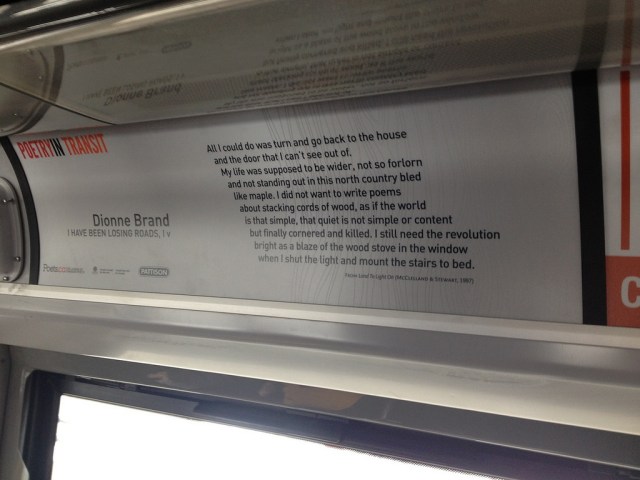
This is true of any community, and feels especially true of artists working across all media: those who trade daily in unknowable risk, who face down familial censure and public scorn, those who are never far from peril or vertigo, but who do the work because they must. In John Robert Lee‘s “Letter after Dionne Brand”, the poet uses the 15th century Spanish “glosa”, a form that begins by quoting a beloved quatrain of another poem. It then builds itself on that basis, incorporating each line of the quatrain as the last line of every new stanza. If it sounds complex, Lee’s use smooths it with love, polishes it with care. Many poems are salutary, seeking the approval of other writers. Few step into such an unabashed, glowing appreciation for their subject’s verse, and inextricably, their fellow poet’s life.

Lee meanders us with a dulcet-toned precision through the creative inroads Brand conjures for him, with her reading: “ossuaries, yes, of failed states and their politricks / babies broken on beaches, Mediterranean / drowned in overladen caravels / our islands’ doomed alleys mocking / my sodden eyelashes and the like —“. We see here how comfortably, with the careful efforts of devotion, the poet settles his lines against Brand’s, not cannibalizing her language nor curtailing it, but seeking — and finding — a companionship in verse.

Make no mistake: this is a poem of overjoy, of incantatory wonderment. It speaks, obviously, to Lee’s generosity, but eclipsing even this, his hewing of form and meaning to meet the glosa’s ebullient, reflective needs. How much we gain, when we openly chant each other up the pew-lines of our affinity, in this way, and in others. How much we multiply our hearts’ reserves, by throwing open the gates.

Read “Letter after Dionne Brand” here.
John Robert Lee’s Collected Poems 1975-2015 was published by Peepal Tree Press in 2017.

Puncheon and VetiverThis is the twenty-eighth installment of Puncheon and Vetiver, a Caribbean Poetry Codex created to address vacancies of attention, focus and close reading for/of work written by living Caribbean poets, resident in the region and diaspora. During April, which is recognized as ‘National’ Poetry Month, each installment will dialogue with a single Caribbean poem, available to read online. NaPoWriMo encourages the writing of a poem for each day of April. In answering, parallel discourse, Puncheon and Vetiver seeks to honour the verse we Caribbean people make, to herald its visibility, to read our poems, and read them, and say ‘more’.

“ossuary VIII” – Dionne Brand

8621668747_821c396607_k
Image: 2013-02-01, posted at Flickr by Guillaume Baviere under a Creative Commons License.

You can slip into a place like a lover, like a memory.

“ossuary VIII” by Dionne Brand is one phalange-trail from the poet’s Ossuariesa book-length poem that moves to the rhythm and percussion of bonework. I confess rapture: it is not possible to ‘read’ Ossuaries. Rather, it happens that you wake up with the book enacting you, in the middle of the night, sorting your vertebrae, cording your ribs with vines, gold-wiring your mandible. To take one bone for scrutiny from this great skeleton is a kind of unfairness, but also a key of its own composition. You unlock the ossuary of yourself with your own relic, or with nothing.

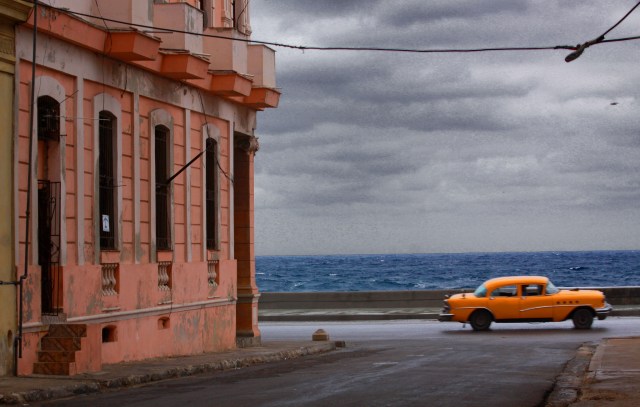
Yasmine arrives in Havana. She tastes, without knowing, the language. She maps the orbit of her room in a perfection of forty-four steps, “a room so redolent with brightness / cut in half by a fibrous bed, / made patient by the sometimish stove, / the reluctant taps, the smell of things filled with salt water”. The palabra she sifts for herself is compañera. It tells us something of how Yasmine walks through La Habana, of how the city enacts itself upon her as she opens herself to its oiled air, its wrecked avenidas, its “great sea wall / of lovers and thieves”.

No rough end-stopped lines here, only the smoothness of selective commas to flow the poem: each stanza is an immersion, tugging you into the bright, cheerful heat, washing you in Spanish you don’t quite understand, shining on your orange dress, spittling you with sea spray, saying: are you sure you haven’t lived here, your entire life? Are you so wholly certain you might ever leave, compañera? 

What does the transient call home? What language does the sea speak when it asks you, por favor, to stay?

Read “ossuary VIII” here.
Dionne Brand won the 2011 Griffin Poetry Prize for her collection, Ossuaries.

Puncheon and VetiverThis is the twenty-seventh installment of Puncheon and Vetiver, a Caribbean Poetry Codex created to address vacancies of attention, focus and close reading for/of work written by living Caribbean poets, resident in the region and diaspora. During April, which is recognized as ‘National’ Poetry Month, each installment will dialogue with a single Caribbean poem, available to read online. NaPoWriMo encourages the writing of a poem for each day of April. In answering, parallel discourse, Puncheon and Vetiver seeks to honour the verse we Caribbean people make, to herald its visibility, to read our poems, and read them, and say ‘more’.


“To My Lover’s Partner, Upon Their Separation” – Lauren Alleyne

4298364465_9c4d18842b_b
Image: Beasts, posted at Flickr by G.e.o.r.g.e under a Creative Commons License.

It might be true that we hunger most for what we least deserve.

Lauren Alleyne’s “To My Lover’s Partner, Upon Their Separation” is a lovers’ poem. It is also a sorrowing, a clearing in a field where abandon has sprung, where wine has been licked from the mouth of another, where we who love, and lose that love, have fallen to our knees. The poem assembles a trinity — yes, an unholy one. A threesome of people who should never share an elevator, but who’ve among themselves triangulated bodily fluid, betrayal, and drunken scrolls of three am s/t/exts. Lose my number, bitch jostling for inbox space alongside Wear what you wore the first time, when you come for me again. 

Even the happiest of polygamists will tell you that multiples mean you increase your math. What arithmetic, then, do the byproducts of longing — those who didn’t consent to each other’s chemistry in their lives — what math do they perform? Apologies, perhaps. Refusals, certainly. The narrator of the poem offers not an act of contrition, but a statement of defense: “I wanted nothing / but to sip at your river / and slip away. / Instead, I swallowed the beast. / Sometimes it howls in your voice.”

Alleyne’s poem is a contortionist, arcing backward to expose the ravaged throat, the hipbone-stars of every ragged desire we feel for each other. The limbs of the poem move around us, four movements like four human stems watered by our secrecies, our small chapbooks of greed and need. We are, as the poem says, all fodder. This is true whether we’re sinning, or the ones sinned against: look how we all tremble, in our gingerbread houses waiting for the bears to batter down the candied doors. Look how we’re beast and fugitive.

Read “To My Lover’s Partner, Upon Their Separation” here.
Lauren Alleyne‘s Honeyfish won the 2018 Green Rose Prize, and will be published in 2019 by New Issues Press.

Puncheon and VetiverThis is the twenty-sixth installment of Puncheon and Vetiver, a Caribbean Poetry Codex created to address vacancies of attention, focus and close reading for/of work written by living Caribbean poets, resident in the region and diaspora. During April, which is recognized as ‘National’ Poetry Month, each installment will dialogue with a single Caribbean poem, available to read online. NaPoWriMo encourages the writing of a poem for each day of April. In answering, parallel discourse, Puncheon and Vetiver seeks to honour the verse we Caribbean people make, to herald its visibility, to read our poems, and read them, and say ‘more’.