
“Witch’s Brew” – Lev Mirov

27176234898_07bb119119_k
Image: Art board cooking – Credit to https://toolstotal.com/, posted at Flickr by John Jones under a Creative Commons License.

If you’re going to trust anyone who beckons you to an unfamiliar table, trust your local witch first. Sure, it didn’t work out so great for Hansel and Gretel, but that’s only one, sanitized part of the story. Me, I always like to hear the witch’s side, and to drink the witch’s brew, too.

Lev Mirov’s poem is an invocation to the table. What’s on offer is “Grandmother’s old bone-broth soup, salted with the tears of the dead / smoked from the resin of dream-trees growing when the world was young”. I love “Witch’s Brew” because it’s seasoned and peppered with what seems like incredible suggestion, but also tastes like the meals of home. It’s a reminder that the best speculations are often in the very place where your navel string is buried. Surely, your grandmother’s soup can raise the dead. It might be said in jest, but you know there’s a part of you that believes it. Mirov’s speaker leans into that gustatory openness, hands you a wooden ladle, asks you to inhale the richness of the fare. All you need to pay for it is your unburnt tongue, your faith in grandmother-magic.

And it is magic. One bowl has the power to let the “gods of misrule take the faces your mother knows them by / and hail you with the family names as a friend.” The closeness of the poem’s speaker, addressing you in second-person present, curls into you like the wafting of that Sunday kitchen aroma, and no matter the kind of soup you grew up on, you can smell it while you read these lines.

Food might be natal magic. We eat of and from our mothers, our they-who-bore-us, to stay alive. Sometimes we need to eat into that remembrance, to find our own brew, and swallow.

Read “Witch’s Brew” here.
Lev Mirov’s poetry has appeared in Strange Horizons, Liminality Magazine, Through the Gate, and other places. Visit his Patreon here.
bon voyage.jpgThis is the sixth installment of Other Kinds of Men, a speculative poetry reader in honour of Ursula K. Le Guin. Speculative writing, which encompasses the major genres of mythology, fantasy and science fiction, has often given voice to the most relentless and ungovernable urgencies of this age, and any other. Le Guin understood this: that to write about dragons, ice worlds and other seeming oddities was, in fact, to write into the messy, riotous complexity of ourselves. Here’s to dragons, and here’s to Ursula.

“Gently chew to soften the ridges” – Bogi Takács

9530828589_29f0ea8e35_k
Image: DNA?, posted at Flickr by Thomas Wensing under a Creative Commons License.

What is the code of how we come together? What alchemy or biology makes us fuse, sunder, reignite?

Bogi Takács’ “Gently chew to soften the ridges” is an open window to interspecies coupling, consensual and warm and so intimate you swear you can scent the tenderness. There’s pain here, but it’s sanctioned. In fact, in the hands of the lover administering and conduiting it, it feels welcome. Takács’ speaker is inhuman, and addresses their companion in the familiar ‘you’ of second-person present. ‘You’ are there, gripping your beloved’s protrusions, wiping the sweat on your trousers and swearing. ‘You’ are there, and you “rasp your tongue against my palate, push / fingers inside my mouth, reach inside, trigger / my gag reflex it is the most intimate please.

These small, italicized pleases synapse through the poem, and they work like any faithful transmitters do, conveying urgency and heat, compulsion and fear. Absolutely, fear. I think fear might be the most astounding part of what Takács is doing here. Isn’t a naked, gnarled kind of terror at the door of us everytime we strip before the one(s) we’ve chosen? Sometimes it shrieks; sometimes it mutely scratches, but always it seasons the sweat we give, the come we leak, the wings we hide, then splay.

It’s the fear this poem doesn’t talk about that makes it so extraordinary. Fear at the wolves of orthodoxy at the door, perhaps — but a real, gripping fear that this ritual might not be completed is at the core of the work. Will these two reach their fluid-bond? Can the bones be telescoped, can those limbs be hung from the ceiling in the name of love? You should read the poem to find out, pulling yourself loose from your human moorings as you do. You should reach for the protrusions.

Read “Gently chew to soften the ridges” here.
Bogi Takács writes, edits and reviews speculative fiction. Visit their Patreon here.

bon voyage.jpgThis is the fourth installment of Other Kinds of Men, a speculative poetry reader in honour of Ursula K. Le Guin. Speculative writing, which encompasses the major genres of mythology, fantasy and science fiction, has often given voice to the most relentless and ungovernable urgencies of this age, and any other. Le Guin understood this: that to write about dragons, ice worlds and other seeming oddities was, in fact, to write into the messy, riotous complexity of ourselves. Here’s to dragons, and here’s to Ursula.
“The Sea Never Says It Loves You” – Fran Wilde

8332011781_c1fe30a88e_h
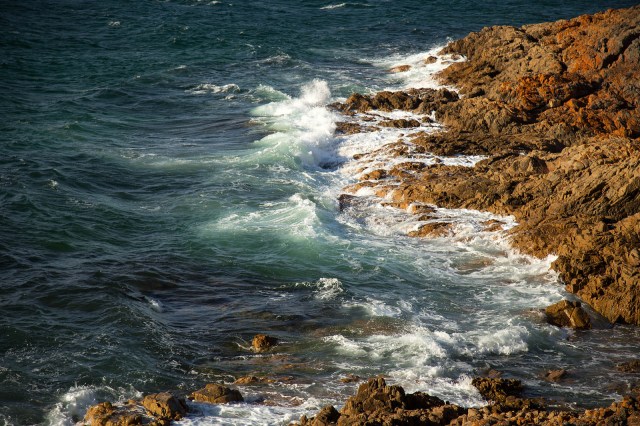
Image: The dark and destructive deep blue sea, posted at Flickr by Michael Greenhill under a Creative Commons License.

Marriages between humans and the natural world are how we make sense of the ungovernable loves within us. I understand how people can yearn to pledge their troth to giant sequoia, and I feel deeply for would-be selkie children who must be dragged, blue-fingered and yawping with need, from the sea.

Fran Wilde’s “The Sea Never Says It Loves You” gives us a human-ocean relationship that begins as a high school romance. This kind of anthropomorphism isn’t new to speculative writing, and Wilde layers the world of the poem, in which sea and mate court, procreate and share a life, with a bittersweet kind of indulgence. Notice the prevailing tense here is conditional: the poet isn’t telling us this is a definite life, but frames a world of sargasso and Sunday night drive-ins, where an exceptional kind of love is possible… not without cost.

Sometimes, Little Mermaid-esque, the price you pay for incredible beauty is utter silence. In the final stanza of the poem, the object of the sea’s affection finds themselves stranded on the shore of a lifelong quietude: “And you are bathed in salt spray, wishing. / Wishing you were water, / or that the sea would whisper from a shell the name of the first song / you danced to / Or say the name it gave you before it swallowed you up.” 

Writing that often seems to reach for the most arcane, the most removed of speculative concepts, often tunnels deepest inward: this is what Wilde’s poem does. We might not all be able to conceive of the sea loving us, or of bearing its “fish-pale, seaweed-haired shell”. But surely we know more than we’re willing to admit, of the silences we’ve bartered in the names of a giant, toppling want. Surely that’s what it means, to sink or swim.

Read “The Sea Never Says It Loves You” here.
Fran Wilde’s most recent novel, Horizon, was published in 2017 by Tor Books.

bon voyage.jpgThis is the third installment of Other Kinds of Men, a speculative poetry reader in honour of Ursula K. Le Guin. Speculative writing, which encompasses the major genres of mythology, fantasy and science fiction, has often given voice to the most relentless and ungovernable urgencies of this age, and any other. Le Guin understood this: that to write about dragons, ice worlds and other seeming oddities was, in fact, to write into the messy, riotous complexity of ourselves. Here’s to dragons, and here’s to Ursula.
“I Saw the Devil in the Cane Fields” – Shastra Deo

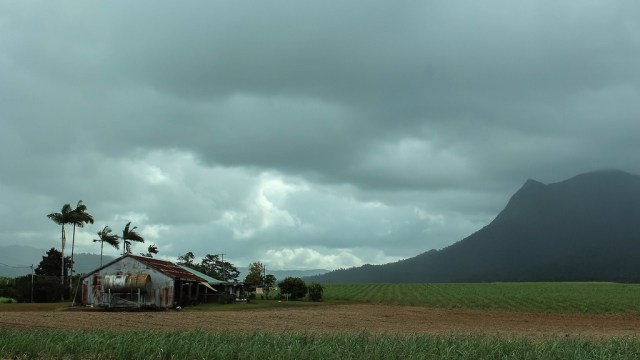
Cane Fields Near Innisfail
Image: Cane fields near Innisfail, posted at Flickr by Andym5855 under a Creative Commons License.

Is the Devil a speculation?

He feels real, in Shastra Deo’s poem, which is set in Australia’s cane fields. I found this extraordinary, unsettling piece while I was researching for a previous reading series, and I found myself unable to let it go. Maybe I love it because it’s spare. Maybe I love it because it hints at brutality. Maybe I love it simply because it marries two things I’ve thought about my whole life: the devil, and the cane field. If you’re from Trinidad, and adjacent to, or a member of, the Indo-Trini community, you’ll understand how cane, the physical and emotional proximity to it, is never really far. I didn’t go looking for Australia’s cane fields, but Deo’s poem summons them, and I feel myself falling into this poem like it’s a life, or a shard of one, I could have lived. Devil and all.

If the speaker of the poem is afraid of the Devil, they don’t tell us much about it. Instead, we get to see speaker and ultimate sinner in gentle, familiar gestures: “The devil held my hair back / as I washed my face in the kitchen sink.” Soon after that, “The devil and I sat at opposite ends / of the tiny dining table and listened to the roaches / scuttle beneath the refrigerator.” What Deo leaves for us is an uneasy ample space for us to brocade finer details, if we wish it. Are there words uttered, between the Devil and the speaker, whose hands smell of burnt sugar, who we meet at the beginning of the poem, nose bleeding and bordered by solitude?

When the Devil goes walking towards Cairns, I’m almost sad to see him leave. I almost want to run for my own country’s cane fields, to see who I might meet.

Read “I Saw the Devil in the Cane Fields” here.
Shastra Deo’s first collection of poems, The Agonist, was published in 2017 by UQP.

bon voyage.jpgThis is the second installment of Other Kinds of Men, a speculative poetry reader in honour of Ursula K. Le Guin. Speculative writing, which encompasses the major genres of mythology, fantasy and science fiction, has often given voice to the most relentless and ungovernable urgencies of this age, and any other. Le Guin understood this: that to write about dragons, ice worlds and other seeming oddities was, in fact, to write into the messy, riotous complexity of ourselves. Here’s to dragons, and here’s to Ursula.

“My God, It’s Full of Stars” – Tracy K. Smith

5474189038_07e886b534_o
Image: Supernova Remnant Cassiopeia A (NASA, Chandra, Hubble, 02/23/11), posted at Flickr by NASA’s Marshall Space Flight Center under a Creative Commons License.

I think we see God through the aperture. I think that’s how we’re able to hold her on our tongue without burning up.

Tracy K. Smith’s “My God, It’s Full of Stars” gives us God through the peephole of the universe’s countless eyes. It’s a diorama-in-verse, of how to be open to wonder, to exhilaration, to the messy, catastrophically gorgeous parameters of the world, whether you are the child of a scientist who once worked on the Hubble Telescope, whether you are 2001: A Space Odyssey‘s Dave himself, “whisked into the center of space, / Which unfurls in an aurora of orgasmic light / Before opening wide, like a jungle orchid / For a love-struck bee”.

The poem takes its time on us, and in us. In its five moments, I feel less that the poem constructs atop itself, and more that it builds inward. It makes excavations of the very void we call absence, tunneling into it to taste, for example, “the blank / Surface of the moon where I see a language built from brick and bone”, “Atlantis buried under ice, gone / One day from sight, the shore from which it rose now glacial and stark.”

Perhaps the very void we call barren, billowing darkness is itself a misnomer, as the poem’s third section asks. What if energy we can’t sense is cuddling up to us in every second? What if we can never adjust our personal scientific equipment — our head, our heart — to an aperture that allows enough God in? “My God, It’s Full of Stars” becomes the most extraordinary kind of coping mechanism that exists: a valve that measures both our inability to process the universe, and a route to stay wide-eyed despite frustration. We needn’t know the name of every star, to say we love and fear the night.

Read “My God, It’s Full of Stars” here.
Tracy K. Smith’s newest collection of poems, Wade in the Water, was published in 2018 by Graywolf Press.

bon voyage.jpgThis is the first installment of Other Kinds of Men, a speculative poetry reader in honour of Ursula K. Le Guin. Speculative writing, which encompasses the major genres of mythology, fantasy and science fiction, has often given voice to the most relentless and ungovernable urgencies of this age, and any other. Le Guin understood this: that to write about dragons, ice worlds and other seeming oddities was, in fact, to write into the messy, riotous complexity of ourselves. Here’s to dragons, and here’s to Ursula.