Shakirah Bourne’s Thoughts on Summer Lightning, by Olive Senior

Published in 1986 by Longman Books.

Winner of the Commonwealth Writers’ Prize, 1987.

A good piece of literary fiction focuses on style, psychological depth and deep, powerful characters. It often tackles important issues that are usually controversial and complex, and the writing not only entertains the reader, but allows for some introspection on society, and perception of self. Olive Senior’s Summer Lightning and Other Stories encompasses all of the aforementioned elements, highlighting several social issues in Jamaica, through the eyes of naive and engaging characters.

Olive Senior’s writing style is very simple and conversational, although it addresses deep issues. It is entertaining, with sharp details, often ironic and filled with humorous dialogue. For instance, when a protagonist Beccka innocently asks the Archdeacon “Please Sir, do angels wear brassieres?” or when Beccka is told to pray for her Aunt Mary and responds, “No. Not praying for nobody that tek weh mi best glassy eye marble”. One of the more outstanding qualities of her work is Senior’s ability to combine dialect and Standard English, reflecting the rhythmic language and slang of Jamaica without the general reader losing any understandability of the plot and story. For example, a quote from the story “Real Old Time T’ing”,

“Nuh the one-eye Doris he still have a look after him and she so busy dropping pickney year after year that what she know bout keeping house could write on postage stamp.”

Without the use of dialect, some of the words would be less impactful on the reader. Moreover, her use of dialect and Standard English not only differentiates characters, setting natives and foreigners apart, but symbolizes themes such as social class and acceptance/rejection of culture. This is seen in the story, “Ascot”, where the narrator and Ascot grew up in the same village. The narrator stayed in the village and continued to speak Jamaican English and Patois, as opposed to Ascot who left for America to improve his life, which meant disregarding Jamaican Creole and speaking in Standard English with an American accent.

Style and language are just a few ways Olive Senior illustrate themes in her stories, enriching their psychological depth. One seemingly simple narrative is filled with multilayered issues with societal contradictions and social perceptions. The story “Summer Lightning” tells of a young boy living with his aunt and uncle, who is given a small garden room to play in. It is his secret and private room until an old man who stays with his family a few weeks every year “for nerves” arrives, and as the story evolves we learn that the old man has vulgar intentions for the boy. This simple story explores religion; the perception of Rastafarianism in particular, as the aunt both feared and respected one of the characters, Bro. Justice. Bro. Justice approached the boy’s aunt out of concern for the boy’s safety and she “took it as an occasion to lecture him about his appearance, his manners, his attitude…and heard nothing of his mutterings of “Sodom” and “sin”. Bro. Justice’s warnings could have also been ignored because the old man was probably a wealthy, white man, thus exploring the theme of status, and how injustices are ignored depending on a person’s colour, wealth and class. Senior uses a powerful use of symbolism in this story; the only character that has a name, Bro. Justice is used as a representation of Rastafarian culture, as well as justice.

Senior also makes good use of symbolism in “The Boy Who Loved Ice Cream” where the ice cream represented the loss of an object. Throughout the entire story Benjy’s aching love for ice cream, which he had never tasted, was described in vivid detail, “you didn’t chew it, but if you held it in your tongue long enough it vanished, leaving an after-trace that lingered and lingered like a beautiful dream”. Alas, with such beautiful description, the reader empathized with the Benjy’s thirst for the unknown, and is devastated when his dream to taste ice cream is tragically destroyed because of the suspicious and jealous nature of his father:

Benjy is crying Papa Papa and everything is happening so quickly he doesn’t know the point at which he loses the ice cream…and he cannot understand why Papa has let go of his hand and shouting and why Mama isn’t laughing with the man anymore…”.

Senior illustrates the theme of relationships through Benjy’s eyes, allowing the message to be so much more powerful, as it is a clear glimpse of the society, seeing all the irrationalities and inequalities without bias. All of her characters are unique, and the reader becomes easily attached, cheering when they are victorious and sharing in every loss and pain.

Overall, Senior’s work is the full Caribbean package; full of life and excitement, explores many societal issues and themes, history, and culture, all the while being simple to read and humourous. For these reasons, I believe that it is an excellent portrayal of an example of valuable literary fiction.

Shakirah Bourne is an award winning short story writer from Barbados who is not afraid to voice what others try to keep secret.

As a fellow participant in The Cropper Writers’ Residential Workshop for 2010, I was honoured and pleased to interact with Shakirah and her distinctive writing style! Check out her Twitter and Facebook Fan Page, both dedicated to providing resources and advice for struggling up-and-coming writers.
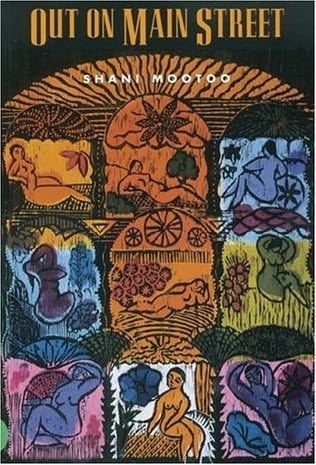
6. Out on Main Street by Shani Mootoo

Published in 1993. This Edition: Raincoast Books, 2002.

Out on Main Street, the first short fiction publication of Indo-Trinidadian-Canadian writer Shani Mootoo, is a collection of nine stories with origins that are both Caribbean and Canadian, diasporic and contintental, here and there. Work like this represents nothing so much as it does a bridge, symbolizing, representing and contextualizing histories and customs only guessed-at or generalized. Mootoo’s epigraph (unattributed, presumably her own quotation) to the collection admonishes gently against the broad sweep of nostalgic generalization:

Which of us, here, can possibly know the intimacies of each other’s cupboards “back-home”, or in which hard-to-reach corners dust balls used to collect?

(Or didn’t?)

One’s interpretation of fact is another’s fiction, and one’s fiction is someone else’s bafflement.

There is no apparent taint of pomposity in Mootoo’s prose… no setting forth of her fiction as canonical or authoritative on any section of the Indo-Trinidadian diasporic experience. Perhaps she is writing strongly from remembrance, as do many Caribbean writers no longer living in the Caribbean. It seems more likely that her remembrances of Trinidadian rituals, customs and rites, specifically those pertinent to religious and cultural Indo-Trinidadian minutiae, are infused with the startling (though not unwelcome) presence and immediacy of Canada.

The narrator of Mootoo’s titular tale speaks straight from the Trinidadian streets. Her language is familiar, her manner inviting, her story foreign, but she, you feel instinctively, is someone you know. She might be the person whose presence you loathe, crushed against her chest in stifling City Gate crowds—and yet to overhear her tale in a crowded Vancouver bar might induce comfort, a sense of place and easy familiarity you do not reject, despite your homegrown aversions.

The unnamed narrator is simultaneously uncomfortable and fiercely protective of her brownness. She parries encounters with ‘legitimate’ Indians from India, hostilely, but not without cost to her shakily complex characterization of herself. It is confusion that she seems intent on avoiding, as she bitterly comments to her aesthetically feminine girlfriend, Janet.

“Yuh know, one time a fella from India who living up here call me a bastardized Indian because I didn’t know Hindi. And now look at dis, nah! De thing is: all a we in Trinidad  is cultural bastards, Janet, all a we. Toutes bagailles! Chinese people, Black people, White people. Syrian. Lebanese. I looking forward to de day I find out dat place inside me where I am nothing else but Trinidadian, whatever dat could turn out to be.”

Janet’s lover is simultaneously proud and wary of her crew-cut, non-heteronormative status, of her implicit possessiveness over her prettier mate who catches the attention of men, when she does not. Mootoo stands the Trinidadian-Canadian pair apart from the more obvious, militantly open couple of Sandy and Lise, who wear their “blatant penchant fuh women” as comfortably as they do their Birkenstocks. In a society that is, by comparison, thought to be far more sexually progressive than that of the Caribbean islands, it remains no less tricky for the narrator and Janet to navigate access routes to being free and comfortable in their brown, queer identity.

The other stories of Out on Main Street are no less concerned with the sometimes-rewarding, sometimes-damning navigation toward finding reliable pieces of oneself. In “Sushila’s Bhakti”, the titular character, a Trinidadian-Canadian artist who struggles with her skewered self-perception as “a goodBrahmingirl”, seeks out a path to prayer that does not contradict her unwillingness to bow before a patriarchal, omnipotent God. Sushila wrestles with the notion of where she really comes from, the precise marker by which she might measure the authenticity of her origins.

“I want to connect with my point of origin. Not the point of origin as in “Who-made-me-God-made-me,” nor the point at which we are said to have flipped over from animal to human, but rather the origin of Indian-ness. … What is my point of origin? How far back do I need to go to feel properly rooted?”

Sushila uses saffron for her art, colouring her hands deep orange, obliterating traces of white or pink from her fingernails. She claims the art of mehendi from its unused place in her early Trinidadian memories, channels it into her work, imbues her canvas with purpose until, exultantly, she begins to see herself in the work. Her saffron-mehendi creations feel far more organically connected to her than her pitiable attempts to fuse herself to a Canadian artistic identity through attempted landscapes and still life. Mootoo seems to be advocating using the tools of a multi-cultural identity to transcend the need to be rigidly defined. The message is implicit: that the search can be its own reward, and that it can be devoid of heartache. Ultimately, Sushila realizes that her identity need not conform to any documented or storied history—that it only need be her story.

In these stories live women who adore women, uncertainly but helplessly. There are wives who love and fear their somnolent husbands, and stir in the dark while their men snore, coaxing mysteries from the earth. There are terrified girlfriends who learn exactly on which side of abuse lies vengeance. There are  families who honour and hurt each other as best they can.

In the swirl of diaspora, where Hindi alphabets meld into modern art galleries, there are stories in this collection that read like home.

4. The Road by Cormac McCarthy

Published in 2006. This Edition: Picador, 2007.

Winner of the 2006 James Tait Black Memorial Prize for Fiction.

The Times’ Book of the Decade.

Winner of the 2007 Pulitzer Prize for Fiction.

Shortlisted for the National Book Critics Circle Award, 2006.

“I will do what I promised, he whispered. No matter what. I will not send you into the darkness alone.”

A man and his son travel through a burnt and ravaged America, moving slowly towards the coast. On their journey, they are beset by threatening, sickening remnants of their dying landscape. They forage for food and supplies with varying degrees of failure and success. Their main objects of quotidian significance are a squeaky-wheeled shopping cart and a gun running low on bullets.

The unnamed father-son pair inch laboriously towards the warmer sea climate, since they both know that another frigid winter in their current environment will be the death of them. The father intermittently hacks up blood in heaving spasms, signs of an illness that he attempts to hide from his child. His wife has deserted them through suicide, her self-perceived last humane act in a world that was crumbling into fire and ruin, even before her son was born into it.

The man and his son have no dearth of reasons to be feckless, foul, feral. Instead, perhaps slightly implausibly (but only to the jaded), they are good. They affirm to each other that they ‘carry the fire’, that they are lightbringers, of a kind, in a time when thick clouds of falling ash darken the skies and men dine on each other – literally – to fend off starvation.

What makes The Road remarkable? Why does it stand out from the groan-worthy stack of literary post-apocalyptica that fawningly reuses the same three and a half tired tropes with fervent aplomb, gore and sexy zombie mayhem? This book isn’t like that. There’s no tastefully deformed protagonist, boot planted atop a still-spasming cryptwalker, musket smoke melding into a chemical induced fog. There are no blade-brandishing, half cyborg, half humanoid babes with rapier wits and… well, rapiers?

The Road can seem pretty damned irritating at first, with its truncated sentences, abrupt pauses, stops and starts, its jerky narrative openings, which also feature a distinct disregard for contraction-specific apostrophes. Once you accustom yourself to the manner in which McCarthy tells the story, however, it is unlikely that you’d want it told any other way. The prose is not just sheer minimalistic brilliance—that on its own would be accomplishment enough. The narration is shot through with spare, elegantly-wrought images, recollections and half-starved thoughts from the father which stun doubly: for their enchanting and harrowing symbolism, and for their startling beauty. The father’s ruminations are borne of starvation, hypothermia, desperation, and threaded together with an undeniable nostalgia for times without atrocities, in a way that provokes tears… tears and thoughts of what our own wonderings might be.

Who will benefit the most, from a reading of this novel?

A mother. An environmentalist. A thinker of quiet and often desperate thoughts. A person who thinks environmentalism is a waste of time. An over eater. A carrier of light. A thief. A person who has been close to death. A person who barely considers death. A person who cannot conceive of a time where money and books will be useless. An anti conspiracy-theorist.

Anyone who thinks that humanity is reckless. Anyone who thinks that humanity is visionary.

A father and a son.

I cannot remember encountering a book that has so strongly deserved to be read, for all its tender warning, its horrific spectacle, its imaginings of things that are awfully credible, for a very long time. This is a book that deserves your attention. My only regret? That I didn’t read it sooner.

“No lists of things to be done. The day providential to itself. The hour. There is no later. This is later. All things of grace and beauty such that one holds them to one’s heart have a common provenance in pain. Their birth in grief and ashes. So, he whispered to the sleeping boy. I have you.”

3. Wicked: The Life and Times of the Wicked Witch of the West by Gregory Maguire

Published in 1995 by HarperCollins.

“To the grim poor there need be no pour quoi tale about where evil arises; it just arises; it always is. One never learns how the witch became wicked, or whether that was the right choice for her – is it ever the right choice? Does the Devil ever struggle to be good again, or if so is he not a devil? It is at the very least a question of definitions.”
I like stories that unravel myths, fairy tales, and moral fables. I applaud the successful taking of an origin story, turning on its head and shaking it, emptying its pockets of archetypal copper pieces, of stereotypical silver doubloons. We have all been fed a steady diet of literary truths, whether or not we’ve ever picked up a book of our own volition. They surround us, circling in the air. They are the nursery rhymes our mothers and fathers murmured as they tucked us into bed. They are the talismans, artifacts and artifices we wear around our necks: our religious symbolism, our ethnic pride, our clannish representations of belonging. Old truths, especially those about good and evil, either comfort or dismay us accordingly. Most people are not concerned with questioning or interrogating the truths we’ve been told about the nature of sin versus virtue. Most people would be profoundly uncomfortable with even the suggestion that good and evil can be mutual partners in a never-ending symbiotic tango.

Such people will probably reject the premise of Wicked out of hand… and will not get past the first few chapters. Those who do not—those who are willing to have their preconceptions challenged—will fare far better. For readers predisposed to an appreciation of magic with a distinct adult rating: this is your stop.

Wicked is scripted, at a cursory glance, on the barebones of the world contained in L. Frank Baum’s The Wonderful Wizard of Oz. The Land of Oz that we encounter in Maguire’s novel is of his own geographical hand, drawn with detailed cartographic attention to specifics, peculiarities, the crafting of a believable and compelling otherworld. Oz is a land of wildly disparate regions and territories: the vast, windswept deserts of the Vinkus, the industrially prosperous Gillikinese state, the marshlands and stilt-legged dwellings of Quadling County, the prairie stead of Munchkinland. All paths and roads, including those made of yellow brick, lead to the glinting urban landscape of the Emerald City, where very little is ever as it seems.

The novel’s main narrative hinges on Elphaba, a green-skinned, clever, antisocial girl born to the Munchkinlander couple of itinerant preacher Frexspar and his beautiful, restless wife, Melena Thropp. Elphaba’s story—her strange, largely friendless childhood in Munchkinland, her rebellious, iconoclastic years at Shiz University, her encounters with condemnation, curiosity, concern and confusion all – these inform the heart of the book, but are not on their own, as it were, their vital organ. The voice of the novel is contained in other major characters (and periodic narrators) as well: in the tragicomedic maturing of beautiful Galinda, in the wise, brash motives of Fiyero, in the restless longings of Melena, the surprising intelligence of Sarima, the love-struck earnestness of Boq. Wicked‘s five sections—Munchkinlanders; Gillikin; City of Emeralds; Into the Vinkus; The Murder and its Afterlife—span several generations. Lives are lost, friendships are won, friendships and kinships made, shattered, found in unlikely places. Wars are waged, both political and personal; victims and villains work together in close quarters. Maguire is no respecter of tidy, seamless resolutions, or neatly pigeonholed plots. Characters’ lives run messily into each others’. This is no singular tale of a warty witch wreaking vengeance on a Kansas ingénue, though if you look for that single-mindedly, you will doubtless find it. The novel leaves itself dangerously, (or wonderfully) ambiguous on many points about which most readers will likely yearn for specificity. You would be hard-pressed to not find a concern that didn’t prick directly and perhaps uncomfortably at your personal conscience in these pages.

What makes us human, and how do we advocate our superiority over animals? What about that pesky infidelity business, when confronted with the possibility of true connection—or just a really good meeting of bodies, if not minds? When does sex stop being sexy and start being just damned strange? Do we prefer our prettiest society girls with or without a sobering grip on reality? What are the ethical implications of endowing mechanical creations with limited sentience, and forcing them to do our bidding? What makes one girl beautiful, and another… reprehensible?

Perhaps the most intriguing question of all lies in just how much we’re willing to do for a pair of gorgeous, self-validating shoes.

“She dropped her shyness like a nightgown, and in the liquid glare of sunlight on old boards she held up her hands – as if, in the terror of the upcoming skirmish, she had at last understood that she was beautiful. In her own way.”

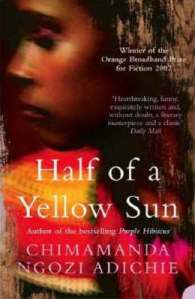
2. Half of a Yellow Sun by Chimamanda Ngozi Adichie

Published in 2006. This Edition: Harper Perennial, 2007.

Winner of the Orange Prize for Fiction, 2007.

“ ‘Why don’t you want the money?’ Kainene asked him.

‘What will I buy with the money?’ he asked.

‘You must be a foolish man,’ Kainene said. ‘There is much you can buy with money.’

‘Not in this Biafra.’ ”

Half of a Yellow Sun is a meeting place for stories, told by three vastly different, irrevocably connected characters. Ugwu, a precocious boy from an impoverished village, is sent to tend house for the eccentric, eloquent Odenigbo, a lecturer at Nigeria’s Nsukka University. Overcome by the incredible improvement in his living situation, Ugwu becomes quickly devoted to pleasing his ‘Master’, as he insists on referring to the enigmatic lecturer and fervent anti-establishment nationalist. It is not long before the distractingly beautiful Olanna, the daughter of a wealthy, influential Lagos statesman, eschews her pampered circumstances to move in with her lover Odenigbo. Olanna’s gentle compassion towards Ugwu endears him to her, as simultaneously, her potent sensuality leaves the boy achingly aware of her allure. Neither is Olanna’s sensuality lost on Richard, a sensitive, thoughtful British national, who falls quickly under the spell of Olanna’s acerbically witty, less comely twin sister, Kainene.

The novel is about the marriage of circumstance and coincidence that envelops these five, set against the backdrop of the 1967-1970 Nigerian-Biafran War.

Wait. Do you think, as you open the first pages of this, Chimamanda Ngozi Adichie’s sophomore novel, that you’re in for a torrid, sexy drama-romance lightly pedestalled atop an intriguing war-torn background? The novel’s background is its foreground. This novel’s setting is immediate… it is pertinent, at all times, to the concerns of the book, to its intertwining themes of love, loss, betrayal and survival. If you began with this book knowing little, as did I, of the Nigerian-Biafran conflict, you will not end it in the same manner. More than that, it is likely that you will be prompted to discover more, to unearth historical documents, to explore archived discussions, news posts and articles on the Internet. It is what I did, and why? I believe that, once you have read this novel, o discerning blog-reader, you may well understand that I was simply compelled to do so. It has been a long time since I’ve stumbled across a read this immersive.

I am no stranger to the powerful world of African (and African-Diaspora) literature. I have trembled and sighed at the bone-chilling moral fable of Achebe’s Things Fall Apart. I have laughed, belly-deep, and wondered just as deeply, over the Brother Jero plays of Wole Soyinka. I confess that I have wept at the most excruciating passages of Ngũgĩ wa Thiong’o’s A Grain of Wheat. Maya Angelou’s works—autobiographic and poetic—pull directly and insistently at my heartstrings and my conscience. I could go on, but I shall not, apart from adding that Adichie deserves a seat at any table where great, moving, soul-stirring African works of literature are being discussed. Indeed, Achebe himself invites Adichie to sit at that table, with the assertion that she is “a new writer endowed with the gift of ancient storytellers.”

In Half of a Yellow Sun, it becomes evident, after only a few chapters have elapsed, that one is reckoning with a master storyteller, and no mistake. The novel’s timeline spans a near-decade, but the passage of time under Adichie’s plot-weaving is anything but linear. We may be unsure, as we read, of who says what, and perhaps even of who is speaking for whom. The writer reels us in with the expectancy of revelation, offering snatches of insight at telling intervals—and the skill resides, in retrospect, on not being exactly sure when we were reeled in. All is revealed, save one thing, by the novel’s end. That one thing lifts the story Adichie tells to the highest point of its possibility, transforming a potentially fitting ending to one that turns itself over in our minds for months, for as long as we keep even a sliver of this story on our mental bookshelves.

The characters of Half of a Yellow Sun are drawn with an expert hand, both in their evolution over the time of the novel (how they are altered by the horrors of surviving in civil unrest, how they remain the same), and in the scope of their relationships with each other. The discerning reader will sigh, and marvel, at Ugwu’s growth, at Olanna’s secret thoughts, at Kainene’s deceptive coldness. There will be amused concern at Richard’s alienated foibles, and grateful acceptance of his growing familiarity with an intoxicating landscape, as well as the woman who intoxicates him. One will wonder at how Olanna can possibly love Odenigbo, in his most abysmal moments, and exclaim, a chapter later, that she could love no other man so wisely, or so truly.

Then, there is the war itself… surely a volatile, capricious character in its own right. To become acquainted with the face of war can be a disconcerting thing, even with the comforting veil of distance, of sitting in one’s plump, overstuffed armchair, sipping tea while murmuring disconsolately over bombings in locales with exotic names. This novel works towards stripping away that veil of comfort. Whether it can be said to be entirely successful is up for debate, but surely it edges us closer to the seat of conflict, to the heart of the criminality and humanity of war. To care about a war when it has not happened to us—when it has not touched our lives personally—this can be a difficult thing to prompt in even a sensitive, educated reader. Adichie does this. She has us smell the smell of burning flesh, taste the sourness of dirty water. She has us dig in the rubble for those we love, and in so doing we learn, perhaps (even if we do not admit it readily to ourselves) how we would fight, flee, suffer or survive, in the context of our own wars.

1. Unless by Carol Shields

Published in 2002. This Edition: Fourth Estate Harper Collins, 2003.

Winner of the Ethel Wilson Fiction Prize, 2003.

Shortlisted for the Orange Prize, 2003.

Shortlisted for the Booker Prize, 2002.

Shortlisted for the Giller Prize, 2002.

Shortlisted for the Governor General’s Award for Literary Merit, 2002.

“I’m sorry, but I have no plans to be charming on a regular basis. Anyone can be charming. It’s really a cheap trick, mere charm, so astonishingly easy to perform, screwing up your face into sunbeams, and spewing them forth. … Of all the social virtues, charm is, in the end, the most unrewarding.”


Reta Winters enjoys modest success as a writer of coffee-table fiction, and greater acclaim as the primary translator of the works of literary academic, Dr. Danielle Westerman. Reta is the loving, even-handed matriarch of her nuclear household, comprised of her affable physician husband, Tom, and their three beautiful, talented teenage daughters: Norah, Christine, Natalie. One day, Reta’s eldest daughter, Norah, inexplicably retreats from the world around her to sit, indigent, on a street corner. The only clue behind the reason for Norah’s about-face hangs around her neck, a cardboard sign that says, in black marker, goodness.

If you demand much more in terms of a discernible plot than that, it would be a good time to slip Carol Shields’ Unless back in place on the bookshelf, in lieu of something… structurally meatier? More dense? Don’t be fooled, though—the book itself is no lightweight; neither can it be called the ‘coffee-table fiction’ dished up by Shields’ protagonist. Most of Unless reads like the diary-journal of a woman torn by grief, given over to reflections of her absurd, tragic hand. Reta’s ruminations are by turns funny, bitter and harrowing… and who doesn’t love a satisfying emotional stroll through a diary, especially when it’s someone else’s?

One wonders how Reta’s grief stocks up against notions of universal suffering—can a middle aged, upper middle class woman’s travail of a daughter deciding to play hobo hardcore compare, truly, to tales of the genuinely dispossessed, the structurally, financially bereft? Think of Unless as a semi-conscious case for the very real possibility that it may, it can, and it does.

Readers unaccustomed to a precise confessional narrative may find Shields’ prose tough—specifically, slow-going. Her style seems careful above all else. This is not a novel of many passionate outbursts, and even when passionate utterances are uttered, they seem filtered through the sobering veil of realization of loss, of an acceptance of devastation. It is a novel that does not rely on or require shock value, staggering loopholes, a thrilling dénouement, to make itself acutely felt.

Norah, of whom little is heard directly, save for one manic outburst of aching humanity (one of the novel’s high points, for me) is the perennial good child wounded by the whole wide world, enacting passive vengeance against cruelty through her self-imposed vagrancy. Reta is ‘unwomanned’, ‘unpersonned’ by a grief unsure of what sort of language it can legitimately adopt… much of her malaise is in not knowing, of terrible imaginings, of the futility, after all, of her overwhelming maternal love.

There is more to Reta’s wonderings than her stifling loss. There is the rest of her life, recounted to us, but with the knowledge of Norah’s alienation sounding a persistent background reminder. Reta writes (or, Shields writes as Reta writing) about writing, about finely calibrated, awkward exchanges with the farcical gem of Arthur Springer, her unctuous, self-absorbed editor, who flatters her work near-obscenely in one breath while forcefully proposing massive rewriting overhauls with the other. Secondary characters in Unless are largely drawn with a discerning hand. The little they say, with the exception of Springer, whose chief delight resides in his inability to shut up, is telling.

Reta’s unmailed letters to (mostly) male academics pepper the chapters and are some of the strongest selling points of her articulate rage. She rails against the masculine hegemony of exclusivity that has locked Norah out, or, even more aptly, split Norah from her mother’s arms. The unsent letters are bitter, often brutal, but also incredibly funny, as letters written as an aide to frantic conversations with oneself usually are.

A feminist novel, or a novel that’s ostensibly about gender wars? Sure, if you’re a feminist or gender theorist, then undoubtedly. A novel that will change your life? Um, probably not. This is not, after all, one of the fawning book reviews Reta says she scribbled in her youth—a subtle dig at the earnest undergraduate book reviewer, maybe?

I like this novel. It answers no questions, and makes nothing clearer except the ambiguity driving our personal missions for redemption. Goodness is what you make of it; human goodness seems largely predicated upon the ways we respond to grief—both our own and the sorrows of others.

A wise, fine tale, for a thinker, best suited to rainy Sundays, contemplation or cups of tea (or just as easily not… a packed Priority Bus Route maxi on a sweltering Wednesday afternoon will also do, just less elegantly). Pocket idealists, beware! There’s a touch of intense reality to this one that will sting you sore if you’re easily depressed. Unless is perfect for the reader who knows and appreciates the reminder that, in the face of indiscriminate woe, there is less quick fixing than slow adjustment.