30. Missing Angel Juan by Francesca Lia Block

Published in 1995 by HarperTeen.

Deemed a Best Book/Best Pick by the American Library AssociationSchool Library Journal and The New York Public Library, among others.

“… I put the flower in a teacup and look at myself in the mirror I found on the street. I can hardly stand to see my face. Pinchy and hungry-looking. I don’t need a hummingbird around my neck for people to see I am searching for love.”

Witch Baby, snarly-haired drummer girl loner, doesn’t feel like she fits, not really… apart from the times when she’s making music or love or everyday magic with her big-dreaming boyfriend, Angel Juan. Angel keeps the confused, restlessly aching parts of Witch Baby from scattering into the abyss of the latter’s personal demons. He brings her as much tender solace as he does ungovernable fire, so when he announces that he must journey from Los Angeles, where the couple live merrily, to New York, as part of his own vision quest, the bottom falls out from Witch Baby’s world. She must find him, she swears to herself, because life without her anchor Juan is unbearable. With the blessing of her almost-mom Weetzie Bat, and armed with a camera for clear sight, Witch Baby follows her love to New York, where the quotidian glitter beckons differently. Companioned by her ghostly grandfather, Charlie, the pair scour the city, encountering a whirlwind of delight and disaster in not-so-equal measure, keeping the faith that Angel Juan will cross their path before it’s entirely too late.

Here is something to love best about Francesca Lia Block’s writing for young adults: it doesn’t condescend to young adults, which is ironically rare fare in a genre that ought to be highlighted for its compassionate understanding. Block trusts that hearts not straddling the full saddle of adulthood can still articulate, in startling relief, all that they hold, as witnessed in this early letter from Witch Baby to her distant inamorato.

“Dear Angel Juan,

You used to guard my sleep like a panther biting back my pain with the edge of your teeth. You carried me into the dark dream jungle, loping past the hungry vines, crossing the shiny fish-scale river. We left my tears behind in a churning silver pool. We left my sorrow in the muddy hollows. When I woke up you were next to me, damp and matted, your eyes hazy, trying to remember the way I clung to you, how far down we went.

Was the journey too far, Angel Juan? Did we go too far?”

This isn’t parochial writing for young people, either — we’re gifted access to a panorama of intricacies that knit relationships together, or else wrench them apart:  two people loving each other is incomprehensible work, Block seems to be advocating, even with the full current of adoration coursing betwixt their hearts.

A cursory skimming of the novel’s plot might suggest that Witch Baby is 1995’s answer to the dependent Donna — a  comely young woman concerned principally with the acquisition and maintenance of a male partner. Witch Baby isn’t Bella Swan with a more bohemian title, however. Quite the contrary: the former’s observant rollerbladings through New York, and the ways in which she interfaces with the clues lined up for her personal edification, are engineered most tenderly to prompt an alternative ending for young people: that partner-prompted identification is no way to declare your definitive personage.

Block’s writing is luminescently unapologetic, not just in message but also in delivery: it is suffused and star-studded with multiple sonnets to beauty stuffed in each paragraph. Yes, to the angular reader, this lyricism will weigh heavily. The accusation that she writes from behind a gauzy, magically realist smokescreen has hounded the Weetzie Bat books, and in truth, the glitz and the diction-decoration is no less evident in this fourth installment. For some, this will represent too-muchness, and the reading will represent pulling factual teeth. For others, there will be revelry, merry traipsing through a heavily-imaged carnival. The language and the life it inhabits on the page are technicolour, certainly, but I’d posit that the aforementioned smokescreen doesn’t exist. If there is a barrier between the sober world of absolutes, and the way in which Block uses words, consider it instead to be a perfumed veil, a safety net for the suspension of your disbelief.

“A conspicuous love of vegetarian food runs through the book like a peaceful hippie emblem,” I wrote in the margins of my journal while reading. It’s true: Witch Baby’s family lives off their cornucopia of love and non-meat products, feasting on “vegetarian lasagna, edible flower salad and fruit-juice-sweetened apple pie” the night that Angel Juan breaks his terrain-altering news. The Jamaican cab driver who transports Witch Baby to her first destination in New York tells her that she won’t find many angels in that meat-packing district, with its implied dream-crushing, carnivorous redolence. Indeed, the consumption of a deliciously meaty hamburger is pivotal in Witch Baby’s squaring off against a soul crushing nemesis. At first, I was inclined to think of this as a little… precious. This waned, though, upon the consideration that the author’s prerogative, maybe particularly with young adult writing, is to shape the sort of world that best inspires our ardent commitment to living. If this means a world of nutty Guru Chews, armloads of fresh produce and honey-flavoured tea, one could arguably do worse.

What makes Witch Baby better than Bella Swan? Maybe it’s the fact that the sounds of drumming makes her come alive, even when she’s crushed beneath the weight of missing her beloved. It might have something to do with her ruminations on a pair of Egyptian mummies, her wondering

“if that king and queen ever screamed at each other and cried in the night with pain and desire or if they always looked so sleek and lazy-lotus-eyed.”

Perhaps it’s linked to the ways in which she can find inspiration winking behind and before the lens of her camera, the way she thinks about time and space, the fact that she curates bulletin boards of universal suffering. Missing Angel Juan can’t be said to show Witch Baby at her best, since it plummets her into the messy business of personal landscaping. Instead, it offers a portrait of a girl in the full-throated glow of her electric, sexy drumbeat of self-discovery. This could be said to be the writer’s most nimbly-articulated message, the one she hopes you will carry close to your chest, stitched into the folds of your skirts: that Witch Baby is beautiful, that so are you.

29. The Descendants by Kaui Hart Hemmings

Published in 2008. This Edition: Vintage Books, 2011.

Matt King’s life, all things considered, could do with a major overhaul. His wife, Joanie, has been in a coma for twenty-three days, courtesy of a boat-racing accident. Matt finds himself flounderingly out of depth in the management of his two daughters: rebellious, drug-recovering Alex, and exuberant, highly peer-pressurized Scottie. Lurking in the background of this familial implosion is the weight of a decision Matt must make: as principal trustee to a collective of Hawaii’s wealthy, royalty-descended landowners, he must say to which highest bidder huge tracts of heritage land should be sold. As time ticks by, and Joanie’s future prospects look increasingly grim, Alex stuns Matt with the revelation that Joanie has been unfaithful to him for some time. Bundling up his daughters, Matt takes them on an unexpected trip to locate the man Joanie possibly loves more than him, so he, too, can pronounce final farewells at her bedside.

It isn’t hard to fathom the reasons why this novel inspired a touching, thoughtful film adaptation. (As you can see, the book’s cover features a haunted George Clooney gazing into the distance, perched on Hawaiian littoral, flanked by sandcastles.) This is one of those books that reads as though there’s a script already imbedded in the prose, waiting to be lifted, licensed and imaged for the screen. Almost every good point I can make about the visual imagery of the descriptions tie in to how stunningly well they salute the mind’s eye. Witness, for instance, this picture of Scottie, who, having gone on an impromptu mini-adventure with her father to Alex’s boarding school, arrives decidedly the worse for wear.

“Scottie looks thrilled by the situation. Her red sores are bright in the hall’s fluorescent light. Her T-shirt says VOTE FOR PEDRO, whatever that means, and her hair is sticking up in places and matted down in others. In one section near her ear, the hair is held together by some unknown substance. She had fruit punch on the plane, and her lips and chin are stained the colour of raw meat.”

The images Hemmings conjures are consistently entertaining, moulded and primed for dark, honest humour, as well as aching sadness. The most notable include impressions of Matt’s difficult, likeable daughters, but also of Matt himself, and the way he perceives everyone and everything around him — tourists; his daughters’ cohorts; hospital staff; the ways in which other people perceive him; his fellow landowning descendants; the shifting structures of Hawaiian landscapes. Matt is a faithful archivist of the place he’s from, the place he loves, and his daily photobooks of observation afford rich, deeply funny insights into a place typically thought of in terms of multicoloured leis and roasted pig cookouts on pristine beachfront.

We think of the impossible caverns of love and grief as thorny terrain to demystify, and perhaps some of the best fiction shies away from putting such things into quantifiable, qualifiable terms. The opposite approach is explored in these pages, with Matt the compass for one man’s perambulations through the messy business of re-evaluating one’s love while simultaneously preparing for the worst. This isn’t to suggest that our protagonist is the only person in the novel whose experiences aren’t linear. Conversely, Matt’s interactions with his daughters, with his in-laws, with Alex’s sort-of-but-not-really boyfriend, Sid, all work like character references in a stuffed docket for emotional complexity. No one loves in singular colours; no one tolerates loss on a full palate of either beatitudes or vices. In one of my favourite passages of the novel, Matt reflects on a rare, treasured memory: his perpetually self-sufficient wife seeking comfort in his arms, immediately following a harrowing trauma.

“She sank down to the rocks, pulling me down with her, and then she lunged into my chest and wept. We were in the most awkward position on those rocks, but I remember not being able to move, as though the slightest movement might upset either her or the moment. Even though she was sobbing in my arms, it was a nice moment for me, to be stronger than her, to be needed by her, and to see her so fragile.”

The torment truly sinks in when Matt contemplates, right on the heels of this, the excruciating possibility that Joanie has dismantled her armour thusly for the man of her affair, too… and, most damning of all, there’s no reliable way of confronting either of them. Matt, like so many people stricken with the dead weight of an infidelity involving two silent sources, is saddled with a lifetime’s worth of maddening, perhaps debilitating hypotheticals.

Immersing yourself in Matt’s bleak and blackly comic inner monologues is as thrilling as it is because it grants you the relief of uncensored permission: to feel fully all those ideas that aren’t politically correct, to hate your children and love them; to hate your wife and love her; to want to be the best person and the worst all bound up in one festering, grinning knot of humanness.

Reading The Descendants is a shotgun ride in the author’s dodgy pickup truck, skirting some emotional landmines, rattling full-on into others. This, really, is what I love best about the novel: it confronts the non-poetic shit storm that reality quite often resembles, without any fumblings towards a sense of… literary rightness. There aren’t any perfect similes for pain, or, if there are, Hemmings doesn’t concern herself with trying to unearth them for our benefit. Truly, cosmically horrific things are as likely to happen to you as they are to the person alongside you in the bus.

How you feel about this book will depend largely, I think, on whether or not you require, or secretly long for, a primer on how to navigate life successfully, with minor bruising. If you find it hard to fathom that there can be one good way to be a worthy father, lover, landowner, descendant, or decent human being, then you’ll be hard-pressed to read something more organically attuned to the general state of loving, grieving and every curious, maddening human state from here to there.

I pledged to give away all the books I bought myself in 2012. I’m giving this book to my exuberant and all-round excellent friend and fellow writer, Leshanta, whose work I’ll be featuring at Novel Niche in a future coming to you shortly. 

28. Will Grayson, Will Grayson by John Green and David Levithan

Published in 2010 by Dutton Books.

When I first saw Will Grayson, Will Grayson, winking at me from the hardcover bookshelves, I don’t know why I thought it would be science fiction. Perhaps it was the prismatic, kaleidoscopic-reminiscent imagery on the front cover that made me imagine interstellar journeys. Even when I read the front jacket cover’s blurb, the description of fate, delivering both Will Graysons to the same surprising crossroads, led me to conjure up non-terrestrial possibilities. As I read on, I realized that the novel was decidedly non-speculative… but not an iota less fantastic.

Will Grayson, probably best known to his fellow high schoolers as loyal friend to the irrepressible, unabashedly gay Tiny Cooper, has curated a couple simple rules for getting through life relatively unscathed. They are: “1. Don’t care too much. 2. Shut up.” Both devoted to his friend and increasingly bemused by him, Will finds himself struggling to make sense of his role in the shadows that Tiny’s larger than life influence casts. His uncertainty only seems to mount as he wrestles with inconvenient feelings for a girl he maybe likes, maybe doesn’t: she of the quiet cleverness, the parallel music-crush on Neutral Milk Hotel, and the ultra-awesome smile, Jane. In another school, another Chicago town, will grayson, anti-capital letter user, anti-everything-ist, makes it through the tedium of his days by way of furtive online conversations with isaac, a guy he’s never met in person, a guy who gets will on every seeming level of importance. will keeps isaac a solemn secret, even from his more-or-less best friend, maura, a goth girl whose dependence on will runs deeper than he can initially suspect. Will Grayson and will grayson are seeking out entirely different things when their paths converge in the unlikeliest, potentially most scandalous of places, and their lives take on unimagined dimensions, expanding to include new allegiances, bewildering affections, heart-singing revelations… and the most bejewelled, glitteringly decked out high school musical of All Time.

This is a laudable book for many reasons, principal among them the ways in which it de-exoticizes the story of the gay high school student. I expect that there’ll be some opposition to this notion. “Who could be a more outlandish character than Tiny Cooper?” one might ask. It’s true; they don’t get much more delightfully camp, more technicoloured-in with non-heteronormative pride than Tiny does. He revels in his romantic and lifestyle choices, and makes no apologies for them… but this, the authors seem to be saying, isn’t even strictly the point. The point resides in the suggestion that Tiny needn’t be an anomaly, that writing about the lives and loves of any number of Tinys should really be par for the course in capturing the richness and diversity of the young adult’s life, gay, straight, bisexual or otherwise inclined. Tiny himself, in a candid conversation with will grayson, puts it best:

“tiny: you know what? i’m totally at peace with being big-boned. and i was gay before i knew what sex was. it’s just who i am, and that’s great. i don’t want to be thin or conventionally beautiful or straight or brilliant. no, what i really want – is to be appreciated.”

It isn’t just Tiny who struggles with the desire to be embraced for who he is, for what he brings to the table – every character of note, including but not limited to the Wills – feels this instinct deeply. In fact, they feel all their feelings deeply, and the authors never shy away from documenting those feelings with grace, humour and irrepressible honesty. Here’s an example of that unflinching candour from will grayson, as he contemplates Tiny’s declaration of a necessary “mental health day”.

“i think the idea of a ‘mental health day is something completely invented by people who have no clue what it’s like to have bad mental health. the idea that your mind can be aired out in twenty-four hours is kind of like saying heart disease can be cured if you eat the right breakfast cereal. mental health days only exist for people who have the luxury of saying ‘i don’t want to deal with things today’ and then can take the whole day off, while the rest of us are stuck fighting the fights we always fight, with no one really caring one way or another, unless we choose to bring a gun to school or ruin the morning announcements with a suicide.”

The truly beautiful thing? So much of the book is this refreshingly forthright, no matter which Will is narrating. I read Will Grayson, Will Grayson like a nostalgic primer on what it felt like to be marginalized, misunderstood, poorly-quoted, confused, sexually uncertain and bursting with a thousand intense ideas, in my teenage years. Green and Levithan don’t, to their credit, ever explicitly state that your life becomes better when you become an adult. They don’t even pretend that the things you cared about when you’re a teenager will evanesce in importance when you’re saddled with a full-time job and greying hairs. They concentrate on the absolute, inviolable sanctity of your God/dess and the Universe-given right to feel the feelings you’re feeling, no excuses, no regrets. There’s no need to sweep those passionate outbursts beneath the rug, no need to objectify your silences, be they awkward or serene: every bit of you, young person, is valid, has meaning, is worth something on this planet.

In a genre of literature stifled with romantic considerations, (many of them poorly worked out and dubiously contextualized) a book like this is a saving grace. There are concerns of the heart in these pages, to be sure – how the heart breaks, how the heart resists love while plummeting towards it, how the heart seeks like-beating hearts out… but the novel’s epicentre isn’t carnally-propelled, and this is a relief. It would be more accurate to say that the writers throw themselves into tides and currents of the whole heart, not just the chamber that pines for a boyfriend or girlfriend. These are affairs of the heart in their baffling, million moods per minute-ness, making this book required reading for young adults, and those who know that being boldly and beautifully sixteen is just a state of mind away.

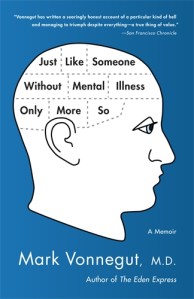
27. Just Like Someone Without Mental Illness Only More So by Mark Vonnegut

Published in 2010 by Delacorte Press.

“I’m getting better again, taking medication, doing my very best to be a good patient, but then out of the blue, the chain-link fence that surrounds the hospital pulls me toward it, wraps around me, and is going to crush me. […] At some point in there I try to tell my father that I’m feeling better, and he says that he wouldn’t nominate me as Mr. Mental Health quite yet. I want to ask him if he is in the running or just one of the judges.”

I’m fully prepared to be wrong here, but I suspect that high on the lists of why people gravitate towards reading memoir is because they anticipate a certain unflinchingness in articulation. They expect, oft-erroneously, that if a person’s got the testicular/cervical fortitude to put themselves out in the limelight, then, by gad, they’re going to write with moxy, with aplomb, with some brass! I’m pleased to report that Mark Vonnegut’s got all three. Even though I’ve not yet read anything by his famous father, I was hesitant, approaching this title. You know full well how the children of illustrious creatives often balk from the wide circles of fame their parents cast. If they do venture into productive waters of their own, they typically embody one of the following traits:

1. They offer work that is painfully, ludicrously derivative—but this is forgiveable, and less egregious than—
2. the fact that they just as easily feign ignorance of their parents’ existence, shunning the specific styles of their mothers and fathers.

Shunning is all well and good, but shunning for reasons that are petulantly emotive rather than deliberately stylistic—well, that smacks of danger, to me… the danger of potentially good art being obscured by the long, long arm of familial resentment. It’s important to note that Vonnegut doesn’t write with cloying sycophancy or feigned apathy about Kurt, when he writes of him. In this way, I suppose people who turn to Just Like Someone Without Mental Illness Only More So to glean more of Vonnegut Senior’s inner workings would be most put out. I respectfully posit that they’re looking in entirely the wrong place. This is Mark’s story, after all. Readers like myself, who’ve not had the benefit of reading his previous book, The Eden Express, will likely be relieved to know that this second offering stands heartily on its own—though, doubtless, if you enjoyed this one, as I did, you’ll want to seek out the first.

A wideness and generosity of range drives the scope of the memoir; it feels like we’re touching base with Vonnegut at various points on his life, that he’s chosen this approach in attempt to round and flesh out the narrative: to show the polyvalency of the paths he’s trod. In addition to sharing the trajectory (if not the specifics, but more on that anon) of his four psychotic breakdowns, the writer presents his childhood days, his memories of Kurt the non-writer (his pre-fame father was, to quote Mark, “the world’s worst car salesman who couldn’t get a job teaching English at Cape Cod Community College.”) We’re also treated to reflections on Mark’s seemingly circuitous path to entering medical school at the age of twenty-eight, glimpses into his family’s mental health (or lack thereof) history, his decision to specialize in paediatrics, humorous anecdotes gleaned from his stint of relief work in Honduras. The overall impression created is less linear than good-humouredly scattered, with the chapters anchored by the author’s own paintings.

What’s particularly illuminating about Vonnegut’s situation is that, as both mental patient and physician, he’s able to speak candidly and forthrightly about either side of the institutional coin. His perspectives on the profession, patient-doctor relationships and medical insurance are wise, modulated by experience rather than any desire of his to sell you something. The insights he proffers on what one might term “behind the scenes” goings-on in the world of health care might not be novel, but it’s refreshing to have them uttered by someone in his specific white coat. Here, he speaks about the nature and classification history of his ailment:

“I was diagnosed as suffering from schizophrenia. […] What I had and have is more consistent with what is now called bipolar disorder, which used to be called manic depression. The name change was an effort to get away from the stigma around the diagnosis of manic depression. Good luck. Until we come up with an unequivocal blood test or the equivalent, we’re all blowing smoke and don’t know if what we call schizophrenia and bipolar disorder are one disorder or a dozen.”

It’s especially gratifying to read Vonnegut’s less than flattering opinion of the corporate concerns that undercut the quality and consistency of aid given. In remarking on the shifting behaviours that govern patient-doctor discussion, he reminisces with gratitude on the open, wide-ranged talks he was able to have with his own psychiatrist when his Thorazine dosage was being reduced. In speculating on what that procedure would entail in a present-day setting, his tone is resolutely bald.

“Today, if I was lucky, I’d see a case supervisor monthly and maybe a psychopharmacology nurse every three months. Clinical guidelines would mandate that I be on antipsychotics for at least five years. The medication I was on would be determined by who paid for lunch and what deal was cut between my health insurer and the pharmaceutical industry.”

I didn’t get the impression that the author was trying to earn a battery of enemies in the medical insurance field. He’s not calling out the insurers, the pharmaceutical manufacturers, the impersonal practitioners, because he’s trying to curry favour with readers for his audacity. One senses that Mark Vonnegut’s just speaking his mind, that having lived through his psychotic episodes (which he refers to as “breaks”) made him less susceptible to tolerating perceived injustices: in short, that those very breaks helped build him into a more genuine, candour-driven self.

An anticlimactic area centres on the issue that there is little visceral untangling of the four psychotic breaks themselves. The writer doesn’t shy away from bringing them up, but we’re never allowed a full and inexorable assessment of those specifics. The autobiography opens with the general delineation of Mark’s symptoms: his inability to eat or sleep; the voices that plagued him; his tendency toward self-harm; his heavy sedation. I kept waiting, with bated breath, to be led further down the rabbit hole of an insider’s vivid description of bipolar disorder… but it felt like Mark kept me solidly, perhaps even safely, at the fringes. Maybe this is as much enlightenment as can be reasonably expected, and maybe this is just the way Mark experienced those breaks, too. Still, it’s difficult not to feel stranded on the shore of apprehension, hoping an illuminating wave of prose will sweep us into the churning emotional seas of a world populated by voices in your head. It never happens. Perhaps I ought to be grateful for that, rather than critical.

What will win readers to this artful autobiographical meandering is, ultimately, its ease of voice. The narrative is laden with quotable illuminations on the role of art in assuaging despair, on the combined weight-inspiration of laying claim to a famous father, on the ways in which interludes of madness can wreak havoc on your life and simultaneously transform it to your best advantage. All of these are shared in the writer’s personable, gently self-deprecating style. Just Like Someone Without Mental Illness Only More is a interior journey you can take with the signposts of a life that’s been, by turns, extraordinary and reassuringly simple. If you think of your autobiographical narrator as a companion and cohort in the reading experience, you’d be hard-pressed to find one more earnest and admirably principled than Mark Vonnegut.

A free electronic copy of this novel was provided by the Random House Publishing Group (Delacorte Press imprint) for review, through NetGalley. The opinions expressed in this review are entirely my own, and are not influenced by their generous gift of gratuitous literature.

26. Swamplandia! by Karen Russell

Published in 2011 by Vintage Books.

Longlisted for the Orange Prize for Fiction, 2011.

Ava Bigtree can’t help but feel like she’s floundering, rather than flourishing, in her deceased mother Hilola’s footsteps. Hilola was the feature attraction show-stopper at the Bigtree’s family-owned and operated alligator wrestling theme park, “Swamplandia!”, nestled on an island little more than an adventurer’s spit of a hundred acres, off the Floridian mainland. “Mainland” is a geographical state that the Bigtree children—Ava; her awkwardly academic brother Kiwi; her eerily disengaged sister Osceola—have come to both desire and decry. The swamp, the theatre of routine and spectacle, of sold-out crowds clamouring in the stands, the moods and movements of their alligator brood (each animal named Seth, to avoid ambiguity): this is the life to which they’ve been born. However, when Hilola Bigtree succumbs, mundanely and sadly, to cancer, “Swamplandia!” falls on hard times. First Kiwi, then the Chief (the children’s gruffly well-intentioned father) head to the mainland for reasons both disparate and bonded, leaving the girls, the alligators, and the island to each other.

Much has been made of Swamplandia! since it was published, and it’s easy to see why—the novel is a quirk-factory. The ingredients for a tall-taled yarn are stacked sky-high, lined up for our perusal without even a shred of self-effacement in the prose. Nothing seems tongue in cheek or inversely satirical about the host of Seths, the fantastic Bigtree establishment ensconced within the swamp, the undead visitations of Osceola’s supernatural gentleman callers. To swallow this narrative arc, you won’t need suspension of disbelief so much as an utter willingness to park your reliance of concrete allegories outside. This novel isn’t for the reader who dismisses weirdness; quite the contrary… if you’re not inclined to wade through the inlets that lead to the sound of surreality, then this isn’t the best way to kick off your year in reading. Adherents to the sweet, cerebral cult of oddities, however, will find the book gratifying, akin to a curious girl’s fictional compendium of island-within-island navigation, of gritty, unsentimental survivalism.

I have read few books within recent memory wherein the author so skilfully constructed her setting as integral to the work’s beating heart. In Swamplandia!, the swamp is far more than a mere cardboard backdrop against which a plastic alligator or two is positioned. The landscape is capable of eliciting fear, awe or grudging respect (or all three), depending on which season you confront it. Early on in the story, Ava’s description of persistent bad weather coincides with the theme park’s declining fortunes.

“Our swamp got blown to green bits and reassembled, daily, hourly. The wet season was a series of land-versus-water skirmishes: marl turned to chowder and shunted the baby-green cocoplums into the sea; tides maniacally revised the coastlines. Whole islands caught fire from lightning strikes, and you could sometimes watch deer and marsh rabbits leaping into the sea of saw grass on gasps of smoke.”

When the plot becomes dense with dreadful adventure, much later on, as Ava, in the company of the enigmatic, leather-jacketed Bird Man, embarks on a quest to rescue her sister from the dark maw of the underworld, the descriptions of the islands teeming around our tenacious narrator threaten to steal the show. The nearer Ava draws towards the Stygian wilderness in which she believes Osceola to be trapped with her paranormal beau, Louis Thanksgiving, the more dreadfully fascinating her surroundings become.

“I was seeing new geometries of petals and trees, white saplings that pushed through the peat like fantailing spires of coral, big oaky trunks that went wide-arming into the woods … A large egretlike bird with true fuschia eyes and cirrusy plumage went screeching through the canopy.”

If landscape in Swamplandia! can be considered a pliable, inventive entity, then the tridented, oft-unspoken concord among the Bigtree progeny often feels and reads like a ghost character who haunts the pages, howling with love and angst. Ava’s frankly inquisitive absorption of the secrets and foibles in both her brother and sister’s nature make her a talented voyeuse. The perils into which she dashes, seemingly uncaring of her personal welfare, are prompted by the fiercest of sibling devotions, and yet, very little that is voluminous or fulsome distinguishes the talks that Ava trades with Osceola and Kiwi. Their adoration is made to stretch thinly over mysterious swamp islands, into the cheerless concrete of mainland life. In depicting it, Russell reminds the reader of the craggy heartlands of human communication, of how, even (or especially) among those who love each other best, familial adoration is unerringly represented by a snarling, non-communicative beast, one who skulks in a cave, one whose feelings run too deep to fathom.

It is, however, in the narrative split between Ava and Kiwi that the structure of the novel falters, diminishing a sustained sense of reading pleasure by forcing unsolicited somersaults from one compelling character, to one decidedly less so. This shift is taken up when Kiwi heads to the mainland, his act of teenagerly defiance to his father’s pipe dreamed notions of salvaging the future of “Swamplandia!”. For what he’s worth, Kiwi is not an unsatisfying character. His self-imposed blend of awkwardness and haughtiness, his massive disconnect from mainland life meeting his puppyish desire to ingratiate himself into the best ideas of his full potential: these make for good reading, and hold the bulwark of levity for much of the novel’s narration. Anyone’s who’s felt the weight of being a smart outsider hang heavy on their shoulders will relate to what Kiwi goes through as he endures the undignified employ at the subterranean-themed rival amusement centre, The World of Darkness. Witness, for instance, as poor Kiwi’s inner sufferer-scholar flares up, following the unwarranted opprobrium of a superior.

“Kiwi could feel his intelligence leap like an anchored flame inside him. His whole body ached at the terrible gulf between what he knew himself to be capable of (neuroscience, complicated opthalmological surgeries, air-traffic control) and what he was actually doing.”

Indeed, reading the ‘World’ segments are grimly, wit-stingingly winning: the setting is described as so mock-garish, so ostentatiously macabre, so unaware of its own enormous kitsch, that it prompts comparisons with similar, comically absurd urban designs. A short story featuring Kiwi’s exploits and misadventures at the ‘World’ would go over spectacularly, but even for all his tragicomic fumblings towards manhood, Kiwi’s narration is eclipsed utterly by Ava’s.

Perhaps what I like best about Swamplandia! is its audacious ambition. There is always some distance, in varying increments, of how outstanding a thing wants to be, of how ardent its desire to overwhelm you, compared to the impact, the force of actual resonance it generates. Respectfully, there is more distance between ambition and impact in this kaleidoscopic swamp-romp than, say, the illumination of other, greater first novels. That said, (bearing in mind that even a poor work of art, which this is not, usually requires patience, effort and devotion), Russell’s work here is both charming and challenging, beautiful in a graphic, grounded light. It introduces us to a pragmatic heroine fighting for a happy story, or at least, a safe one, while a wilderness of reconditely-curved fates clutch at her ankles like vine creepers. If there were no other fine hallmark of writing prowess in Swamplandia!, Ava Bigtree on her own would be worth the price of the paperback/hardcover/Kindle copy. She’s the sort of little girl whom grown women ought aspire to de-age themselves towards.

25. American Psycho by Bret Easton Ellis

This review is affectionately and irreverently dedicated to Joshua X. Thank you for introducing me to Patrick Bateman, and thank you even more for not doing so in person.

Published in 1991 by Vintage Books, New York.

You’ve met Patrick Bateman. He’s the guy you had Waldorf salad/ apéritifs/ a candid sauna conversation/ a three course dinner/ a tray of Bellinis with, last Friday/ weekend/ fortnight/ financial quarter, at Indochine/ Dorsia/ 21/ Tunnel/ Pastels/ the Hamptons, with… oh who remembers, really? He’s a member of your yacht club/ exclusive gym/ Harvard graduating class, and you get your ties/ pocket squares/ tans/ dry cleaning from the same places. If you’re an attractive, elegantly dressed woman of a certain social set, you’ve probably shared his bed. If you’re an unsure yet comely prostitute, or an ecstasy-addled socialite, you’ll probably die in it.

But do you know Patrick Bateman?

He is handsome; there can be no denying this. He is superbly educated, outstandingly networked, exquisitely attired. His apartment, housed in the same building in which Tom Cruise owns the penthouse suite, is an interior designer’s wet dream. He has friends. He has money. He is… he is… a damned unreliable narrator, and why? Patrick Bateman is insane. You have, in all likelihood, never encountered a principal narrator whose word you could trust less, and this is, at once, outstandingly written and utterly bemusing—a twinned pleasure/migraine to parse. The novel’s plot, which in terms of thickness could be described as bareboned at best, is delivered to us entirely through Bateman, a Manhattanite yuppie businessman, as he navigates the breakneck-paced, agenda-laden, hyperactive worlds of commerce and pleasure that dictate the speed and settings at which he consumes, makes love, arbitrates, teases vagrants, and contemplates murder. As the novel progresses, Bateman’s brutal inner monologues morph into equally misanthropic slayings, several of which are highlighted and lovingly recounted to the reader in high-definition detail. Ultimately, our urbane protagonist becomes less and less capable of neatly compartmentalizing his serial killer and business savant personas, and as the body count grimly rises, so too does his paranoia, despair, desolation and impeccable cruelty.

One of the most striking facets of Bateman’s world is that it is inundated with a never-ceasing stream of conversation, a steady, witty, charming flow of dazzling one-liners and emphatic recommendations. It is a world in which no one listens to anyone else. Indeed, Bateman might be one of the few people who does any real listening. He might be the only person he knows who listens. It isn’t that he never shares the worrying compulsions within him, either. He quite frequently bares his… er, soul… on the subject of his insatiable blood-lust, but on the incredibly rare occasions that his words penetrate his audience’s mire of self-indulgence, his confessions are met with distracted humour and prompt dismissal. In one interchange, when his romantic partner for much of the novel, Evelyn, gushes enthusiastically about her visions of wedding splendour for them, Patrick effusively responds with a description of the ideal firearms he’d bring to their nuptials, with which to slaughter Evelyn’s immediate family. He receives no response to this other than his girlfriend’s continued pre-bridal salivations. In another, particularly mirthful scenario, when asked by a vapid model he is vaguely interested in bedding about his occupation, he shares that he is “into, oh, murders and executions, mostly”, after which, predictably, his companion asks him if he enjoys the work. The establishment of this savage, smirking landscape, in which no one practices human interaction without artifice, provides the perfect canvas against which Bateman lets the blood of so many flow. Perhaps our protagonist might be less deranged than he is, if he existed in a convivial, earnest setting, perhaps not… but there is no denying that it is infinitely easier to committ atrocities against someone if they have never, despite their honeyed insistence, truly given a damn about who you are.

Easton Ellis is arguably at his finest when he allows us to peer into the ragged veil of Bateman’s flinching, badly bruised humanity. Any passable horror story will be strewn with as many depictions of smouldering carnage as can be forced between its dripping pages; few are capable of drawing out our sympathy and begrudging acceptance of the similarities between ourselves and the monster that crawls across the chapters with smoking entrails for his necklace. Bateman works as well as he does because he is crafted with multilayered complexity, with unerring attention to detail, with as much brittle amusement as raw terror. In one of his final executions of the novel, in the midst of a failing attempt to wrangle a culinary delight from a section of corpse, our murderer slips into plummeting despair.

“And later my macabre joy sours and I’m weeping for myself, unable to find solace in any of this, crying out, sobbing “I just want to be loved,” cursing the earth and everything I have been taught: principles, distinctions, choices, morals, compromises, knowledge, unity, prayer — all of it was wrong, without any final purpose. All of it came down to was: die or adapt. I imagine my own vacant face, the disembodied voice coming from its mouth: These are terrible times.

This is a remarkable work of fiction. It might be most remarkable for how much your conflicted, uneasily mottled reactions to the depiction of its protagonist will render your introspective ruminations, your late-night diary scribblings, your smoothly hip but really self-conscious Facebook posts, not just of the book, not just of this genre of literature, but of and on yourself. Patrick might well become your antihero nonpareil, your reverse answer to the question, “What Would Jesus Do?”. You will not only be disgusted and sickened by him, startlingly enough. You will be touched by his overtures of gentility, by his saccharine daydreamings of ambling through the park with his secretary Jean, buying and releasing balloons into the air. You will laugh uproariously at his expense. (I challenge you to go into a Chinese drycleaners’ and not dissolve into hysterics after softly whispering “Bleach-ee”, with just a hint of threat in your voice). You’ll laugh at Bateman because of every one of his thousand nervous tics, his ridiculously overblown reactions to perfectly common occurences, his manic stops and starts, his revolting yet astoundingly funny pranks (coating a much-pissed-upon urinal cake in cheap chocolate, then proffering it to Evelyn over dinner). Then, when it dawns on you that you’re laughing at a man whose mind is the wasteland of serious dementia, a man desperately in need of a cornucopia of corrective drugs, you’ll ask yourself about your own sickness.

While reading American Psycho, it was easy enough for me to commiserate, in the abstract, with popular opinion surrounding its release at the end of the 1980s. Reviled, condemned, near-categorically panned, it was described as being too vulgar, too misogynistically self-serving to be worthy of the worst pornography. It would be unfair to wipe some of the mud from these allegations by theorizing that the novel was written before its time. When, one wonders, would be ‘the right time’ for a work of fiction concerned with the graphic satirical exploration of a young  lunatic, simultaneously trapped and liberated by the consumerist, capitalistic framework of fiscal success and personal nihilism that is his life? Perhaps there is no time in which such a book could have been written which would have ensured it a stellar reception—perhaps, when you’ve read the book, you will think this is more of a coup de grâce than a criticism. You might not be happy living in a society where the only thing a publication such as this merits is rousing applause. It would mean, one supposes, that either no one got the point, or, worse, everyone did, and endorsed it unflaggingly for the wrong reasons.

Almost every awful thing you have heard about American Psycho is true. It is nauseatingly graphic about murder, rape, torture, cannibalism, necrophilia, animal assault, and the perverse, detached delight that the perpetrator of these crimes takes in committing them. It will not comfort you. It is not a comforting book, but, as Patrick himself is always reminding us, these are not times for the innocent—and if they weren’t, on the cusp of the 1990s, they are indubitably not so, now.

I maintain, however, that Patrick Bateman should not terrify you.

Somewhere, even as you read this, even as you gingerly contemplate adding this book to your “must-read” (or “never-read”) list, there is an improbably beautiful man in an Ermenegildo Zegna suit, wearing A. Testoni loafers, crossing the street to go to work, where he will be greeted by a receptionist he believes, despite an overwhelming lack of evidence, to be madly in love with him. His body is a wonderland. He grows weak in the knees at the sight of expensively manufactured business cards, and the thought of not being able to secure a dinner reservation at the town’s most exclusive restaurant could, quite likely, bring tears to his eyes. He is frequently, ruthlessly cruel to homeless people, and demands abortions of the girls he’s gotten pregnant without so much as batting a well-rested eyelid. Last Hallowe’en, he wore one of his suits, covered in a plastic overcoat, and carried a chainsaw, to go to an upscale party as Patrick Bateman, because Patrick Bateman is his non-ironic hero. He has no natural sympathy, proclivity for kindness, no moral compass, no scruples, and no criminal record.

That should terrify you.

24. Anatomy of a Disappearance by Hisham Matar

Published in 2011 by The Dial Press.

Nuri’s childhood is well-heeled, sensitively moulded; he does not lack for parental affection, though it is frequently distilled with eccentricity. The recipient of uncommon, and uncommonly shown, affection from his parents, he finds himself, at a tender age, thrown into a bemusedly altered state when his mother succumbs to a mysterious illness. In an attempt to restitch the tenuous fabric of their familial comfort, Nuri and his father, former political dissident of international reknown, Pasha, vacation at the Magda Marina Hotel, a sweltering beachside resort dotting Alexandria’s coastline. It is there that father and son encounter the entrancingly beautiful, yellow bikini-clad Mona. Their interactions with her form the basis of a complicated, acutely felt triangular relationship that spans erotic awakenings, unspoken betrayals, and the passage of many years, indelibly altering each participant in its perfumed wake. When Nuri and Mona are left reeling in the aftermath of Pasha’s abduction, the mire of bureaucratic red tape and festering resentments through which they must navigate leave them sceptical as to just how precise their lifelong impressions have been, of the man they love most.
Something about reading Matar’s prose puts one in mind of wandering through the dense foliage of a half-sentient dream, wherein the author delineates, blurs and casts colours of sound and light over our keenest emotive reactions, wearing the robes of a master chiaroscurist. Seemingly ordinary expositions are transmogrified so that we drink his imagery beneath a sea that is mapped somewhere between our own imagination meeting his. Rarely do we doubt this authenticity of voice, which renders the work as easy to absorb (for the reader who appreciates fineness of form) as the purest air. Lexically, stylistically, Matar barely makes a misstep, and in this regard, each page is a pleasure.

Threads of the disturbingly and entrancingly erotic hem each page of Anatomy of a Disappearance, and they don’t strictly apply to the characters one might pair by default, either, which is what makes the implementation of this ragged desire all the better. Insofar as the tri-pointed bond among stoic Pasha, mercurial Mona and frequently discomfited Nuri himself can be said to be its own personage, that unnamed fourth character that embodies their inharmonic disunion feels eros across the board. Some of the best passages of the novel thickly hint at never-to-be-resolved shards of sexual tension between father and son; the foundations of this are even more intriguing to parse than every sweaty boudoired flirtation that Nuri and Mona trade, predictably. Those open to the multivalence of burgeoning sexuality will find this aspect of the reading richly, thoughtfully cast.

Emotional complexity could be said to be the feeling cornerstone of the novel; this marries seamlessly with the thematic exploration of the survivor’s impasse: of what remains to be done once a loved one’s enforced absence drags itself past the point of rational hope. The novel is also constructed as much on the skeletal considerations of a bildungsroman, making the aching peregrinations of Nuri all the more valid. We both feel for him, and feel that his suffering, his sense of displacement at his typecastedly stolid British boarding school, his fumblings through the onsault of sexual prerogative, are necessary and credible. If Matar has Nuri flounder and regret for the sake of sustaining depth, then it is skilfully done, not without compassion, not without (more importantly), reminding us of how easily replaceable his childhood and teenage difficulties are, with any of our own, barring (or including) the shadow of a father one fears may never return, or be returned.

At times, Nuri grapples for an identity outside of the distant cloak of his father’s presence, and the complexity of his reaction to feeling this is vividly imparted—his reluctance, guilt, shame, bravado, swirl all together, blotting onto the page our impressions of him as a meticulously drawn protagonist, worthy of our attention, sympathy and solicitude. In one of the most perspicaciously hopeful scenes of the novel, an adult Nuri pauses in the midst of a solitary walk, to consider the apartment block before him.

“The stone buildings stood dimly in the night, and, looking at them, I felt a deep longing to inhabit their rooms. To make love and eat and bathe and sleep in there, to quarrel and make promises, to sit with friends and talk into the night, to listen to music, read a book, write a letter, consider the position of a new object, watch flowers in a low vase, watch them at different times of the day, clip their stems and replace their water daily, move them away from a harsh light, a drafty passage, draw out their time.”

Occasionally, the contemplation over whether Pasha will ever reenter Nuri’s life becomes subtly secondary to the question of whether or not Nuri will ever successfully navigate a personhood with which the latter can be content, away from Pasha’s all-encompassing orbit. Truly, Nuri works against the threat of his own inevitable disappearance, specifically in how he can make his life count, before the decline, in how he can etch himself visibly into a world where he, not Pasha, can own the starring role.

Some books seem so quietly, inexorably suffused with the idea of the best they could be that they never quite, to phrase it with seeming, but unintentioned unkindness, get over themselves. Anatomy of a Disappearance is one of the most thoughtful, thinking person’s reads I’ve had the pleasure to know this year, but perhaps much of its internal grey space is never externally worked out across the page. The result is a study of the intricately plotted map of minefielded human interaction, which may yield more casualties of clarity than clearly charted coordinates… which, when you’re reminded of Tolstoy’s oft-quoted opening liner on family, seems to be less disingenuous than damned honest.

A free electronic copy of this novel was provided by the Random House Publishing Group (The Dial Press imprint) for review, through NetGalley. The opinions expressed in this review are entirely my own, and are not influenced by their generous gift of gratuitous literature.

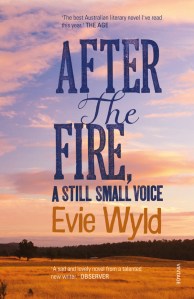
23. After the Fire, A Still Small Voice by Evie Wyld

Published in 2009. This Edition: Random House Australia, 2010.

Winner of the John Llewellyn Rhys Prize, 2009.

Shortlisted for the International IMPAC Dublin Literary Award, 2011.

“He was still whole, there were still things that one man alone was worth.” 

Frank Collard turns to the wild, and his grandparents’ rustic outpost in the swamplands, when an abusively disastrous relationship shatters his heart. Lonely, he gradually inches away from being corralled by the teeming landscape that surrounds his shack, to becoming a part of it, blending gracelessly and gruffly into the local milieu. Though he adapts the semblance of a normal life, rooted in work and earnest, albeit thorny, social interaction, he shares little of the past he’s fled. His reluctance to unburden himself of old hurts mirrors the journey of his father Leon, an extraordinary maker of cakes who found himself hard-pressed into military service, feeling it change him perhaps irreparably, as it did his own father, who volunteered eagerly, yet found vital parts of himself effaced by the reality of war.

There is the distinct impression one sometimes receives, when reading of something grand, or sweeping, or otherwise elaborately contrived, that a character has just done in the book one’s reading. The feeling is akin to furrowing the brow and exclaiming, “Well, that’s just not how real people behave, is it?” It is worth noting right here that Evie Wyld’s book is built on the structure of something unflinchingly honest—even the way it flinches is honest. While reading, one gains the impression of absorbing something stripped to barebones and left in the sun to roast, of prose subjected to a rigorous, flinty syntax, studded through with alarming pinpricks of raw beauty.

Wyld is at her best, here, when discussing grief, and the book could be considered a generationally unfolding sorrow-documentary, of a kind that dampens our eyes and makes us suck in our breath, with the laughter we laugh when things are good and proper miserable, so that to laugh about it is the only sane recourse. What is particularly laudable is the manner in which Wyld inserts gut-spasming woe into the most domestic and non-extraordinary of settings. Witness, for instance, Frank’s messy navigation of girlfriend-withdrawal, in the aftermath of a nasty confrontation that effectively seals their rupture:

“The toast pinged up, and, crying, he buttered it and daubed it with jam, inhaling deeply and letting out long shaky breaths. He ate it breathlessly between hiccups. His mouth, which at that moment had nothing to do with him, would not stop making the sound ‘Aaaaaaaa’ like a stiff door opening. He lay on the floor, a smear of jam on his cheek, and mashed the last of the bread into a wet pap with an open bawling mouth. The crusts sat on the floor. He swallowed and breathed in sharply, then cooled his crying to a whimper, then to sniffling and then just to staring. The sun moved across the kitchen floor, regardless.”

The author writes this so convincingly that we accept a grief so cavernous as to unman Frank, a relentless sadness that chokes, rendering useless the elegant protestations of studied melancholy. There are no fainting couches here, no dainty snifflings into handkerchiefs. I especially love the way in which Frank’s mouth “…at that moment had nothing to with him…”, reminding us that when we are this transported outside ourselves with a surfeit of intense emotion, even our anatomy feels remote, conducted by another, out of our sight, outside the realm of interest.

Though Frank and his father lead separate, near-diametrically opposed lives on the page, the ways in which Wyld unites their divergent stories with lashings of past trepidation, of an unquantifiable sense of void, are skilful and subtle. Both men feel themselves hunted and haunted by the nigh-unassailable sensation of being pursued into unknowns. Nothing in their resentment-riddled, mysteriously ill-articulated communion, or lack thereof, allows for the sharing of this unified phobia; neither of them knows the other suffers in a language so well suited to his unique understanding. The reader wonders, for the duration of the reading, whether or not it would make a difference to their relationship if, for instance, Frank were ever told of the dreadful doubts Leon nursed while at war:

“Tears on his face, he felt the teeth of a terrible thing on the back of his neck, breathing through its nose on him, in, out, hot, pant.”

Some may find it unrewarding that the exact cause of the father-son malaise remains largely unearthed. It can be galling to consider that Frank and Leon might have fallen out over some poorly edited snafu, a minor discrepancy that wounded both their masculine prides; perhaps Frank’s girlfriend wonders at this, as she tries to sift through the rubble that nourishes a long-term vow of silence. Personally, the ambiguity marshalling the quietness between these men works admirably; it leaves it to the reader to devise reasons, grand or minute, and it prompts speculation over how much of the events of the last chapter of the novel coloured Frank’s perception of Leon, and Leon’s musings over Frank. This is good writing, the skilfully underscored balance of omitting just enough, of never bludgeoning the reader over the head with detail; those of a discerning, thoughtful bent will notice appreciatively (while those inclined to fast-food in their literature will probably have put the book down by now).

Grief and terror couple and uncouple against a background of settings one would initially think too bland (save for the backdrop of Leon’s outpost and battlefield, which Wyld blesses with no war paint, just irksome bush scratching the legs and loosing the bowels of boys pretending at soldiers) to support their movement through the chapters. Yet none of the settings read as anything less than exquisitely suited to the unfolding of each private, stunted drama. The dirt and insect-framed jungle wilderness that surrounds Frank’s shack, the family bakery in Parramatta to which Frank returns, despite himself, in search of his father (the same bakery in which his father once turned out elaborate baked goods in a thorough, calm manner; the very bakery in which he courted Frank’s future mother), the home of Frank’s sole friendly family unit, in the unkempt northlands: all these locations in the novel are implacable, inviting themselves near-perfectly for Frank’s fumbling self-discovery. The author infuses as much detail (without rendering her landscapes in a saturated style) to these places, making them represent geographic markers as well as placeholders for the full range of human emotional discord and desire, as if to suggest that cartography remains immune, for the most part, to the petty dramas with which we map our time on earth. This makes Frank’s sadness and stubbly conflicts simultaneously relevant to him, and gloriously, disturbingly irrelevant, given the sweeping dismissal of Enough Time: a fact of which Frank himself seems all too cognizant for much of the novel.

Yet the mission statement of Wyld’s book, if there can be said to be but one, is not as reductive as “Life causes despair to run roughshod all over you; therefore, despair.” The gnarled, honest interactions he shares with Sal, the precocious child of the aforementioned family unit, are some of the best passages of the book, and attest to the contrary of prevailing desolation. Their unlikely bond speaks instead to the surprising friendships that can be worked at when embarrassment and artifice are cast aside. Beset at every dirty, suspicious corner with the long arm of the past, Wyld’s grittily redemptive novel seems to whisper, “This is the way you come back to yourself; this is how to banish spells of unremitting dark: gracelessly, naturally, with pain—the only way possible.”

This is the third book I’ve read and reviewed on my personal reading list (which you can see here) for The Bookette’s British Book Challenge 2011.

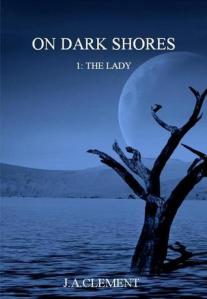
22. On Dark Shores 1: The Lady by J.A. Clement

Published in 2011 by Weasel Green Press.

“For a time, a countless time, there had been nothing more than ceaseless water, stinging bone-sand, and the wind, keening; but suddenly the wind died and the grinding waves smoothed down to uneasy swells. Sounds whispered over the unquiet waters like a chanting of spells; at first they held no more meaning than the mourning wind or the hissing sea-spume, but then came a sound that caught and held, like the anchor of a ship.”

Nereia is a resourceful thief, quite likely the best pickpocket that the small, salt-sprayed fishing town of Scarlock has seen. Though bitterly weary of her trade, she perseveres for the welfare of her sweetly trusting younger sister, Mary. Orphaned since Mary’s infancy, both girls live uneasily in thrall to Copeland, a small-time shady businessman with big-time aspirations, in the acquisition of which he intends to involve Nereia, whether she willingly consents or no. Bolstered by his stoic bodyguard heavy, Blakey, Copeland proves himself distressingly capable of meting out punishment to those who would liberate themselves from his iron grip of control. Despite her prior knowledge of this, Nereia cannot help but make a desperate bid for freedom. In so doing, she pits her gritty resilience against Copeland’s well-crafted cruelty. The quietly slumbering village that witnesses their struggle, and the startling events wrought of its consequences, may well hold more time-brined secrets than its shuttered windows and sea-slick walkways suggest.

Reading the expository opening paragraphs of On Dark Shores 1: The Lady prompted my best hopes for a gracefully constructed and fertilely imagined creative landscape. In these lines, we are introduced to the cast’s main players not by name, but through their dreams, all of which are uneasy, tempest-tossed. Tidings are being washed ashore which will bode ill, we are given to understand, and this hinting at future upheaval is admirably conveyed through Clement’s subtle associations of geographical tumult with individual distress. It is evident that we are reading the work of someone who enjoys implementing literary ornamentation, someone who is mindful of the importance of strongly crafted situations, and equally worthy characters to populate them.

That being established, however, the novel lacks a certain evenness of successful storytelling. There are beautiful, glowing passages, to be sure, but there are also areas which appear to have missed a similar application of consistent, dedicated layering. Much of the novel’s narration is dependent on third-person accounts of events, which provides the writer with a broad canvas for perspectives. Given the number of personages to whose inner thoughts we are privy, the potential richness available from multiple non-omniscient narrative seems only hinted at in promising glimpses, without ever truly being deeply sustained.

Reading Clement’s depictions of the natural terrain of her novel offers the surest marker of appreciation for her descriptive prowess. The polish and gleam in her lines often shines most brightly when she writes about the sea (which, given the title of the series, might be intentionally done, or not.) For instance, it would be difficult to savour the following:

“The drizzle had stopped, but the light was failing across the restless sea; the smoothed steel swells were growing wind-tipped and wild with hissing spray.”

and then declaim Clement as talentless; quite the contrary. If she were a consistently uninspiring, yawn-soliciting producer of paltry prose, that would render this review short and dismissive. The difficulty lies in aligning her bountiful caverns of gorgeous writing with her other fictive terrain that is decidedly less lush. Much of the dramatically-infused dialogue featured in character altercations is less riveting than it could be; this is not to suggest that the author ought to puppeteer her players into uttering phrases only as she would say them. The beauty of dialogue (and third-person limited narration alike) lies in allowing an imperfect, biased, disjointed accounting of things; yet without authorial polish and poise, neither scenario nor character appears in their intentional (and thus convincing) lack of lustre. Instead, the writing suffers; the writing appears unmade, neglected, merely patched up with good intentions and talented flourishes, not soundly caulked through in an expert’s hand.

I do not suggest that there aren’t gems to be unearthed in this first installment of the On Dark Shores series; there are. Previously mentioned is Clement’s proficient sculpting of the geographical vistas of her story; the land and sea speak to us as convincingly as Scarlock’s residents and visitors, at times, perhaps more so. Among the highlights of narrative lie expository snippets from townsfolk who aren’t crucial to the machinations of the main plotline (or are they?) such as Niccolo, the fisherman who, early on, provides a piece of fateful information, and spends the rest of the story accounting to himself for its unintended results. Another minor character who prompts intrigued speculation is the proprietress of the local brothel, referred to enigmatically as Madam. Her past is storied, checkered with less than savoury happenings, and if she becomes a central figure in the events of the series’ next installment, I sense that it will be all for the good. Do not be surprised if you find yourself yearning for more revelations concerning the mystical mother of the Shantari and her monumental upcoming journey. Hungering for elucidation on the second novel’s skeletal premises, beckoning beyond our reach, is an excellent effect engendered by a first-part installment, but not if it comes at the risk of souring or, worse, sapping our interest in the events of the book currently in our hands.

Clement does a formidable job of constructing a world outside of the primary events of the novel; this holds its own drawbacks as well as delights. Often, the concerns and preoccupations of the fringe characters are more compelling than the principal ones. Nereia herself is the most glaring disappointment. She possesses all the requisite building blocks for Clement to create a rollickingly outstanding heroine. Instead, she wanders through the plot’s progression (which is less haphazard and more sketchily dubious, reading as though telling segments of it had been left on the cutting floor) with spirited gumption, certainly, but without the visible progress necessary to substantiate her full self. By this I mean that she owns enough moxy and fortitude to establish her as a warrioress worth our time, without sufficient context-crafting, without the heady, darkly glowing internal monologues and stream of consciousness narration that would have furnaced her fighter’s tale so convincingly.

On Dark Shores 1: The Lady tips itself out of favour by anchoring its plotline with a forcibly forward slant towards the remaining two books in the series, not allowing for the bountiful breathing space to truly come into its own. Its gracious writing style, dedication to fleshing out particular characters and literarily-cast foundation recommend it; its incoherency, implausibility of certain situations and disjointedness make one hope for a far more spectacular sequel. I do hope for it. There is brilliance in this authoress’ dusky world of wailing wind and water…muted, perhaps, but visibly gleaming all the same.

J.A. Clement’s engaging website, Wandering on Dark Shores, features comprehensive updates on her writing process and plans for the full series, as well as a host of purchase links for the first novel. You can also follow her on Twitter, here.

A free electronic copy of this novel was provided by J.A. Clement for review. The opinions expressed in this review are entirely my own, and are not influenced by her generous gift of gratuitous literature.

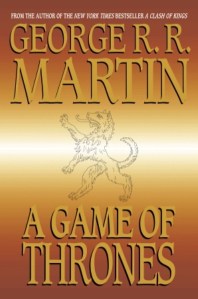
21. A Game of Thrones by George R.R. Martin

Published in 1996. This Edition: Bantam Dell Random House, 2011.

Winner of the Locus Award for Best Fantasy Novel, 1997.

Shortlisted for the Nebula Award for Best Novel, 1997.

Shortlisted for the World Fantasy Award for Best Novel, 1997.

“Wind and words. We are only human, and the gods have fashioned us for love. That is our great glory, and our great tragedy.”

We’re not in Middle Earth any more, baby.

Don’t get me wrong — you’d be hard-pressed to find a more earnest Tolkenian stalwart than your humble reviewer. I begin with Tolkien, not to disparage or dignify Martin by comparison, but to posit that both men have crafted worlds beyond measurable value in the genre of adult fantasy.  A Game of Thrones, first in the A Song of Ice and Fire saga (and here is a series that deserves such a title, not other current pretenders that feature incandescent undead and perpetually blue-jeaned werelings), is worthy of a place on the loftiest pedestal you polish for your high fantasy, for reasons both dirty and divine.

Winter is coming. These are the the watchwords of House Stark, proud and patrician defenders of the North of Westeros and rulers of Winterfell, its ancient castle fortress. Presided over by principled Eddard Stark, his loyal wife Catelyn and their five children, Winterfell enjoys a lull of peace before the arrival of Eddard’s best friend, the King of Westeros’s Seven Kingdoms, Robert, who presses the former into becoming his ‘hand’, his second in command and principal advisor, to rule at his side in King’s Landing, many leagues south of Winterfell. Eddard’s beloved bastard son, Jon Snow, seeks his own livelihood elsewhere, denied the companionship and security of a permanent place in the Stark familiarity he’s known his entire fifteen years. He rides even further north, to fringes of civilization and the Wall, a massive ice bulwark spanning 300 feet long and towering 700 feet tall, hewn by Brandon the Builder to defend Westeros against the threat of wild creatures both known and beyond human imagination. Jon “takes the black”, swearing his fealty to the Night’s Watch, a band of ebony-clad soldiers charged with the protection of the Wall against every possible threat. Meanwhile, across the narrow sea from Westeros, wily, dispossesed Viserys Targaryen, last male survivor of the royal line King Robert slew, dreams of nothing but regaining the crown he deems his birthright. He sells his young sister Daenerys in marriage to fierce Dothraki warlord, Khal Drogo, in hopes of attaining a vast legion of horsemen to recapture the kingship at his command. These concerns involve the three-pronged storyline of A Game of Thrones, but they are a mere glimmer behind the bedezined curtain of plots, subplots, and tributaries of storylines stemming from even these.

Two major criticisms I’ve read of A Game of Thrones is that it’s appallingly overconcerned with the sociopolitical intrigues of the monied elite, as well as guilty of favouring a decidedly misogynistic slant. Given that the titular game refers to an ongoing series of intellectual manipulations and sleight of hand coercions for ruling power, I cannot see how the selfsame intrigues would not come to the fore. It is worth noting that it is not always the monied elite players of the game who yearn for power, however. All have aspirations, and the aspirations of all are keenly documented, not merely those of royal bloodlines. The concerns of the peasantry, the commonfolk, the ‘little people’, are admittedly less prevalent, but they do occur. They oil the machinery of the grand conquests; they litter the battlefields of bad decisions. The fact that they do not speak as much surely says a great deal about them, the position they hold in society, and the stratification of society itself. When they do speak, which is not, it ought be noted, a rare occurrence, merely a less frequent one, it is always believably, and in service of plot strengthening, theme reinforcement and general expository goodness.

As for the lack of strong female characters in the novel, yes, there are several less of them than their male counterparts. George R. R. Martin’s prerogative in writing of more men in positions of power than women can hardly be called a misogynist’s work, if this is the sort of creative world he wishes to establish. Refusal to read the book on these grounds seems like lazy feminist pointscoring that owns no basis in logical assertion: would a novel densely populated with women warriors and leaders offend the rights of men? I’m all for reading about the ascent of gorgeously-sculpted women in literature and life, and the stories of Daenerys Targaryen and Arya Stark are well worth the stories of ten less lovingly-limned leading ladies.

A densely worded world needs vibrant, achingly alive characters to populate it, else all its lavish description has been for naught. Martin moulds such figures in abundance, and charges them with the telling of the thousand and one tales within these pages. The narration of the novel is entrusted to eight principal players (excluding the hair-raising prologue, delivered to us by minor figure, Will). They are:

  • Eddard Stark, Lord of Winterfell, Hand of the King of the Seven Kingdoms, a man burdened beneath the bastion of being almost entirely too good;
  • Catelyn Stark, Eddard’s loving wife, supportive of his every decision, save his emotional proximity to his bastard son;
  • Jon Snow, newly-appointed man of the Night’s Watch, who chose to serve for honour but finds the reality decidedly more grim;
  • Sansa Stark, Eddard and Catelyn’s eldest daughter, exceedingly fair of face and soft of courage, the polar opposite of her sister;
  • Arya Stark, as steel-tempered as any aspiring knight, and more than many, no less resolute than her brother;
  • Bran Stark, whose dreams hold far more than the fodder of mere daylight imaginings;
  • Cersei Lannister, radiant wife of King Robert, who is more than passing attached to her equally lovely twin brother, Jaime;
  • Tyrion Lannister, also called The Imp, younger brother of Cersei and Jaime, and, as he himself would be quick to point out to you, a dwarf.

The utter lack of authorial omniscience in the narration makes each account from each character sing all the livelier. One becomes so engrossed in the tale told, for instance, in Tyrion’s chapters, which are brimful of well-executed wit, wordplay and self-deprecating humour, that to see them come to a close often elicits a frown of annoyance. Switching from Tyrion’s narration to Arya’s, especially after being left on the crest of a dramatic, jaw-dropping development, or a particularly arch comment from The Imp, seems frustrating for the first page, until Arya’s pugilistic perseverance entirely wins us over. We part ways with her at the end of each of her chapters, musing ‘ah, if I only had a daughter/sister like that… why can’t I be more like Arya, anyway?’

It is in this respect that Martin’s cast reminds me of Tolkien’s: for the archetypal luminescence by which readers best enjoy identifying themselves. There is no underdog who can read Tyrion’s half-bitter, half-humoured introspectives without at least a tinge of knowingness, just as no mother, made frantic with desperate love for her children, can deny that they, like Catelyn Stark, would not cut their hands to the quick, to save a slumbering son. The personages within A Game of Thrones could be used to construct a tarot deck of emblematic figures, each character occupying a central or minor slot. What tempers this universal accessibility, however, is that none are drawn with too thick a brush in one overarching quality. Tyrion, for instance, may distinguish himself from the ruthless egoism of House Lannister and his siblings, but his penchant for exquisite enactments of cruelty makes for spectacular reading. Viserys Targaryen rules over his half-crazed compulsions and his little sister with a mercilessly iron fist, but Daenerys remembers him for his passing peaceful jaunts as well, for his quietly hungry boyhood dreams of a better life for them both, in a kingdom across perilous waters. The impression is sustained in nearly everyone we meet in these pages, of a life preceding their appearance in the narration, a life with all its innumerable associations, foibles and moral complexities. Reading characters who are less richly envisioned, less convincingly wrought, will be all the more telling for having read Martin’s, here.

Neither is the folkloric beating heart of the world of Westeros, and all that lies beyond it, treated with any less attention to detail. A Game of Thrones is prefaced by an exquisitely rendered map, pure cartographic delight in the tradition of Tolkien’s own storytelling legacy. There is history in every fireside account, in every mug of ale passed between hands in each tavern of ill repute. There are gods, both old and new, the ancient weirwood deities of the Godswood, beneath whose heart tree Eddard muses for guidance and polishes his greatsword of executioner’s blood; the pristine new gods of the septons and septas, the star spirits that the Dothraki believe to be the fallen dead. The novel is tapestry, a liberal and forceful commingling of belief systems as rich and dense as freshly shed blood, as deep as the darkest magic.

One could do much worse than to wander from Middle Earth into Westeros.