
Novel Niche is thrilled to unveil this exclusive interview with Anu Lakhan, Trinidadian poet, fiction writer, editor and debut chapbookist. First published by Argotiers Press in 2018, Letters to K is hilarious and heartbreaking, audacious and abashed, like no other letter-set to a dead writer you’ve ever read before.
Here, I sit with Lakhan over metaphysical tea, and let her tell me all about the elusive J_L_, our protagonist writing missives to Kafka. I might know less for certain at the end of this interview than at its beginning: rarely is a fate so entrancing as when Lakhan’s pen is in the inkwell.
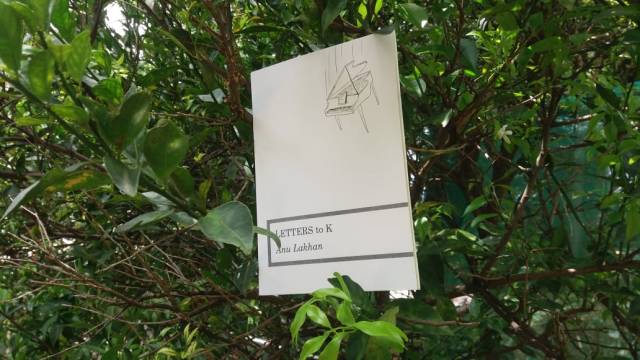
Novel Niche: Letters to K lets us in on a writer’s deep love for Franz Kafka. Tell us how you feel about Kafka, yourself.
Anu Lakhan: Does she love him? I think there’s a way to go before she feels love—real love—such as one might feel for a mother or a pet. Right now she’s really just looking for someone to talk to.
I, on the other hand, definitely have something rather like love for him. It is very easy to love and admire a dead man. I already know he will not contradict me or shame me in any way. I miss him as if there’d been a time when we were together. Not only his fiction, but his letters and journals are so extensive it’s hard to understand how more people do not find themselves feeling this loss.
He was really quite a noodle. Funny. A funny, silly man in many ways. And yet the work is sharp, dangerous, immaculate. Impossible not to love him.
NN: The chapbook is a perfect vehicle for a series of (one-sided) letters. Is this your first standalone epistolary project? How did it come into being?
AL: This is the longest one so far. I’ve done one-off missives to Kafka before (in which an adolescent girl emails him to ask for help with her homework); to Dorothy Parker (in which a wife writes an agony aunt letter to Ms Parker about uncomfortable, bargain-priced beds); and most recently to the bracing poet Eric Roach as part of a Caribbean Literary Heritage project (in which I break off our engagement because of prevailing weather conditions and extinct animals).
Still want to know how we got to the letters from J_ L_?
J is a character who has long been looking for someone she feels comfortable with. She’s tried—over various stories—to be fine with her own company, with family and friends, and friends of the family (outcomes unsatisfactory). She has enjoyed and found solace in cats, dogs and horses. Occasionally it occurs to her that she should make some greater effort with other humans. So what kind of person would suit? She does not think like Kafka, but she likes how he thinks. She does not believe living as he did would work for her but she admires that he tried. That doesn’t seem like a bad place to start imagining a good companion.
NN: Fundamental loneliness, the narrator J_ L_ tells Kafka, is one of the truths she best shares with the deceased author. Do you think that the lonely turn frequently to the dead, in letters or outside of them?
AL: Not enough. Sure, lots of people talk to deceased loved ones. They may even keep journals that look like they’re addressing specific people.
Dear Mother,
I really needed your help with the garden today.
Dear X,
I miss you and would prefer to be dead at the bottom of a well rather than go another day without you.
That sort of thing. I hear it’s quite soothing. And of course, as Caribbean people, the spirit world is never far from us. But I don’t know if we’ve worked out healthy, non-desperate ways to engage with those not living. This answer holds for both the lonely and the not-so-lonely.
NN: Would the register and intimacy of these letters change if they were purely digital? Would VoiceNotes to K, or WhatsApps to K, be a different sort of endeavour?
AL: They would not be sent by J, so from the beginning the undertaking would be very other. If she seems confuffled in writing, only imagine how she’d trip over herself with VoiceNotes. How many times have you started sending one simple message and ended up saying everything wrong and had to send three or three dozen more to clarify your original thought? Or worse: she might start and after two words be reduced to whimpering. The shame. WhatsApps—equally a no-go. She’d go mad waiting to see the little blue ticks and then she’d fret about his lack of response.
These other options are not open to her because they have a force of immediacy. She’d fall prey to expectations. That wouldn’t do.
NN: Would J_ L_ Skype with Kafka, in another place, another time?
AL: Again, immediate and intimate. It’s too intimate. Kafka could barely bring himself to endure face-to-face meetings with his myriad fiancees. Whenever personal contact was threatened, he wilted. Unless they both kept the video off, Skype would have been a disaster.
The letters were the only things that made sense because they made sense for him as well as J. The same beloved women he couldn’t face, he harassed them into writing him. He demanded letters. Three a day if possible. Gods! They had jobs. They were busy. He was busy. Prague and environs must have had the best postal service ever. If in this time, present time, we had anything like such a good service, email might never have been dreamed up.
NN: Letters to K made me reach for my old, secret correspondences, patterned boxes of love-and-eventual-hate-mail. Which published or private letters do you reach for, in your own life?
AL: I don’t. They usually hurt. I write new ones.

NN: I read this book aloud for pure pleasure: it would make an excellent audiobook. Who would your dream narrator be? Would you give them any directorial notes?
AL: If J is a young Trinidadian woman, it would be my niece Jaya with her gorgeous sandy voice. Imagine Stevie Nicks young. And Caribbean. And less nasal. That’s my niece.
If J can be from anywhere, I have in mind Saoirse Ronan (as is), Dolores O’Riordan (alive) or Sinéad Cusack (younger). Apparently any woman with a tricky Irish name will do.
I didn’t have much of a J voice in my head (really had to think about it). I heard Kafka reading the letters to himself. Sometimes quietly, sometimes riotously. Kafka would be Adrien Brody with a German accent. Obviously he’d have to spend months in front of open windows, naked, in the Prague winter, preparing for this. Because, of course, K was all about that kind of thing.
Apart from the Brody-naked-window thing, no directions. That’s because I think I’d be a maniac as a director. Better to leave those things to professional maniacs.
NN: An illustration of a piano, done by Kevin Bhall, falls as if in slow-motion throughout the chapbook. What music is on the sheets we see, fluttering to the floor?
AL: A few songs, actually. The pianist who was unfortunate enough to lose his instrument in this—tragically—the most common type of piano fatality, was playing around with:
Scenes from an Italian Restaurant – Billy Joel
Coronita de Flores – Juan Luis Guerra
Sweet Child of Mine – Guns N’ Roses
It Don’t Mean a Thing (If It Ain’t Got That Swing) – Duke Ellington
See, it doesn’t matter what’s playing when a piano is ready to fall on your head. I’ve found the happier the music being played, the more likely it is the piano is on its way down.
NN: “I am not trying to elevate myself in the literary world,” J_ L_ explains in one of her early letters to Kafka. A writer as a hermit, scornful of and stressed by the literary social scene, is a popular trope… but do you think it makes for better writing?
AL: Oh, hell no. It’s horrible. I know some of the finest writers have lived like this but I think their work is brilliant in spite of such a disposition, not because of it. That is a bitter, bitter world. Somebody is paying in blood and insomnia for it.
By the by, J is not trying to elevate herself in the literary world not because she disdains it but because she’s not in the literary world. She’s not a writer.
NN: In the last of her letters, J_ L_ tells Franz that she’s always felt like an outsider. Are the best stories told from the fringes, and not the centre?
AL: I’m afraid this question is beyond me. I don’t think I’m always sure of the difference between fringe and centre. And as told by whom? The narrator or the writer? Do we always know we’re in the middle? Isn’t it beyond dreadful when we discover we’re on the outside when we’d been thinking we were in?

Buy Letters to K here.
Read Paper Based Bookshop’s spotlight of Letters to K here.
Letters to K is Anu Lakhan’s first chapbook. She is a poet, writer, editor, friend to cats and Kafka. Born and living in Trinidad and Tobago, she has never knowingly sent a letter to anyone in Czechia, living or dead.
All images © Anu Lakhan.


 The Brief Wondrous Life of Oscar Wao (Junot Díaz) chronicles the lives of the titular character, Oscar Wao; his sister, Lola; his mother and grandfather. Oscar must deal with being overweight, a virgin and a Dominican still haunted by the ghost of the dictator, Rafael Trujillo. What lands this book here might be a strange one. It’s mainly because of the numerous accolades Díaz has received for it. Normally, I didn’t think people cared for the type of brash and vulgar storytelling employed in Oscar Wao. And honestly, it was right down my alley (writing-wise). When I saw that Díaz’s work could be accepted by the Pulitzer committee, I thought, “Why not mine?” As I said, strange reason. But it’s a damn unique and interesting book, nevertheless.
 The Diving Bell and the Butterfly (Jean-Dominique Bauby) is a memoir ‘written’ by a man who has locked-in syndrome. See, Mr. Bauby had been debilitated by a stroke, which rendered all but his left eye motionless. He blinked to the rhythm of a cautiously rearranged alphabet, and with a very, very patient nurse, this book exists. Just being able to read the book is a miracle, if you ask me. Within it contains the musings and memories of a man that thought he would be stuck in the deep, blue sea for the rest of his life. But now, from behind the steel cage of his diving bell, we can hear his voice. If this doesn’t readily reassure your belief in the power of the written word, I don’t know what will.
 Boy (Roald Dahl) is the first part of the autobiographical work by Dahl (the second part being Going Solo). It almost reads as an epistolary novel, as Dahl pastes clippings of letters, photographs and other family documents to relate his past in a whimsical manner. The chapters in Boy relate to a prank gone wrong at a candy shop, a grisly car accident and warming the toilet seats for the older boys at a school in Derbyshire. Despite its bursts of humour, it is the most serious book I’ve read from the author. Boy does not overshadow his fictional works, but it made me think: Life is remembered by how you tell it. If that makes sense.
 Miguel Street (V.S. Naipaul) is my second favourite Caribbean book (the first being Oscar Wao). My first encounter with the book, if I remember correctly, was a chapter featured in a primary school “Reading Book”. The chapter was about B. Wordsworth, a mysterious man who “felt like a poet but could never be one”. The story was strange and heartbreaking in its feeling of incompleteness. But there was nothing more to be said of B. Wordsworth, and the story was over. I think this was the first time I had read a truly sad ending to a story. The collection of stories in Miguel Street is well worth it, but I won’t forget that experience with B. Wordsworth.
 The Sound and the Fury (William Faulkner) is the hardest book I’ve ever read, that I’ve ever finished (the hardest book I’ve never finished is The Scarlet Letter… trust me, fucking ridiculous!) Fury was my introduction to the much-beleaguered writing style known as stream-of-consciousness. In prose, anyway. Does Beat generation poetry count? It centers around the Compson family, sections devoted to various family members. The two that stood out the most to me were Benjy and Quentin. The non-linear narratives that rely on Benjy’s diminished mental capacity and Quentin’s disjointed and emotionally affected recollection of his family and his sister, Caddy, require multiple re-readings. I remember being on campus, busily dissecting the book during Biology lectures. It was my first experience with frustration that somehow felt rewarding simultaneously. Once you are willing to decipher it, it’s worth it.
 Disgrace (J.M. Coetzee) was a novel I received for free at a writing workshop when I was twenty. We were given a week to read the book for an upcoming book-club type discussion of character and theme. The story itself concerns David Lurie, a college professor fired for misconduct, who loses most of his reputation and integrity in the process. Yes, it is as depressing as it sounds. But there was one thing that stood out for me as I read this book: the present tense. I had never given it much thought before that. The present tense is quite effective once used properly. Not necessarily to build suspense or (no pun intended) tension or anything, but just to hold the reader in that moment of disarray and imminent disarray. I’ve been trying to re-create that ever since.
 Middlesex (Jeffrey Eugenides), to me, is the paragon of a bildungsroman (a coming-of-age tale), especially one that involves identity (most of them do, though, don’t they?) It’s a thick book, but that’s because it goes into so much detail with our protagonist, Cal, and his family’s migration from Asia Minor. The hook? Call is intersexed, afflicted with a genetic condition known as 5-ARD. The males are often mistaken for females all the way up to puberty, and are raised as such. The question isn’t about how this can be fixed, but: should it be fixed? Now, Eugenides’ style is verbose, be warned. But from the two books I’ve by him, it’s fitting and beautiful. When it comes to the dense, thorny theme of identity, I don’t think there could be enough words.
 The Virgin Suicides (Jeffrey Eugenides) is a shorter book than Eugenides’ Middlesex, but it’s no less loaded with purple prose. The story is told by a group of men as they recall and muse upon the sudden suicides of the reclusive Lisbon girls in their neighbourhood. Their actual interaction with them was minimal, so they resort to filling in the blanks with theories of domestic horror. However, The Virgin Suicides never wanders into any gruesome vision. It is probably the least angsty book about suicide I’ve read. Instead, the story focuses on teenage whimsy and puppy love in light of what has happened, as if the girls themselves were pixies perched on mushrooms, or some other magical beings. The book feels like magical realism, though entirely grounded in drama and disillusioned romance. Why this book is here is because it holds that intangible quality that separates melancholy from melodrama. It remains my key to written emotion.
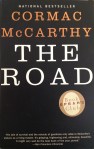 The Road (Cormac McCarthy) concerns a father and son’s journey across a wasteland, the near-shell of a once-verdant world. The technique employed by McCarthy to show the stark emptiness of this situation? The abandonment of punctuation. While I had experienced the fiddlings of grammatical structure before, like with ee cummings, I never reckoned any operative utilisation of it with a novel. Like The Call of the Wild, The Road is written with a complex simplicity (you’ve probably figured out that I’ve an inclination for this odd oxymoron). It describes desolation in brief whispers. Hopelessness in dying breaths. No need for abundance of any sort here.
 The Curious Incident of the Dog in the Night-Time (Mark Haddon) concerns Christopher Boone as he plays detective to discover who stabbed his neighbour’s dog, and ultimately uncovers the dark secrets kept by his family. Christopher, however, lives with an autistic spectrum condition and experiences great difficulty accepting the hard realities of his findings. The book is told from first person and is much easier to read than Benjy’s portion in The Sound and the Fury and is more on par with the emotional journey in Flowers for Algernon, though it does require patience when Christopher’s OCD steps in and prevents the plot from advancing. This is all done for effect, however, and works most of the time. This book lands a place on this list for its ability to integrate Christopher’s medical condition into the narrative, not as a gimmick or technique, but to show how different people process different situations. How I may have reacted to Christopher’s findings might have been much different, but this is his story. And everyone should have a story, shouldn’t they?


 The Pleasures of the Damned (Charles Bukowski) is a collection of poems by, well, Charles Bukowski. In my review for this book, I said that Bukowski is overbearingly honest in most of his poetry. He creates dystopia without apocalypse. The ordinary degenerate. There’s nothing else to it, since basically he was a degenerate. The collection, however, made me view poetry in a different light when I first discovered Bukowski at fifteen. Poetry didn’t have to be embellished or written with finely curled letters. It could be simple and ugly. Not even well-articulated hatred, like Sylvia Plath. Just raw, pithy imagery about toughness, like a one-eyed cat, a tough motherfucker, chasing blind mice.
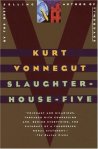 Slaughterhouse-Five (Kurt Vonnegut) concerns Billy Pilgrim, who becomes “unstuck in time”. After being abducted by a strange group of aliens, Billy finds that he can see his entire life (and even past his death, until the end of the universe itself). I read this in university and it changed my perspective on how science fiction could be written. Vonnegut, to me, seems to write with an extraterrestrial readership in mind. There is a certain humour in the simplicity we take for granted. Vonnegut captured that here. It is something I hope to also.
 The Absolutely True Diary of a Part-Time Indian (Sherman Alexie) concerns Arnold Spirit, as he grows up in the ‘rez’ (Indian reservation), surrounded by disillusioned, drunk and temperamental Native Americans. This is the quintessential young-adult book, yes, complete with bullying, falling in love and illustrations. And it is quite remarkable. Young-adult authors engineer their books to extract an emotional catharsis, I believe. Finding humour in degradation. And the great fear that settles when one is told of their own home, “This place will kill you.” Living in a crime-ridden country, I can relate. Also, who knew comic strip cartoons could go so well with prose?
 The Catcher in the Rye (J.D. Salinger) is a book we all know, or should know. It is a polarizing book, not for its content so much, but because it has been read by some of the most irritating people. Holden Caulfield has been kicked out of Pencey Prep and wanders around New York City for a few days before returning home. He also wears a red hunting cap. That’s it. That’s the book. And I’ve read it, no exaggeration, about ten times. I read this when I was fourteen after I borrowed it from my school library. Didn’t know anything about it when I did, but damn, it was hard to do my homework the night I started it. I don’t love Holden. I don’t even like him. But I realise: I don’t have to. It helps, yes, to feel something for a narrator. But I realised that they don’t always have to be affable. Just intriguing, as character is the greatest tool we have to elevating plot.
 Johnny Got His Gun (Dalton Trumbo) is similar to another book I have on this list, The Diving Bell and the Butterfly, though they are both here for different reasons. Joe Bonham awakens in a hospital and eventually deduces that he is basically a living torso. Yes, his face is gone and his appendages have all been blown off by an artillery shell. He’s a prisoner in his own body. It is a poignant and extremely depressing novel. It is here because of its attention to sensory detail and use of flashback during the recall of Joe’s life and family. It also shows the influence the written word can have against a behemoth such as World War I.
 The Gunslinger (Stephen King) is the first book of the Dark Tower series, the magnum opus of King’s career, and I’ve put it here to represent both itself and the series. Though I’ve only read up to its fourth installment, the series is a detailed and expansive work that treads through the wasteland of a world that can only be described as where “the rest of the world has moved on”. Characters from previous novels make appearances, affecting the plot and reinforcing the idea that all King’s work is set in one universe. A haunting western setting along with deliberate anachronisms showed me that there really is no boundary to the worlds you can conjure up. Everything is acceptable, once done calculatingly and professionally.
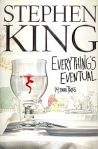 Everything’s Eventual (Stephen King) is a short story collection, of which I wish to discuss only the titular story. “Everything’s Eventual” concerns Dinky Earnshaw, who has the ability to construct symbols that elicit strong suicidal feelings for those who view them. Dinky doesn’t understand his ability, and doesn’t use it until he is convinced to do it to rid evildoers in his city. I was thirteen when I read this, and I had never even imagined that such a Jedi-like mind trick could be taken seriously out of a Star Wars setting. King made it work, however. From an early age, because of this story, I realised how limitless writing really was. Sorcery could exist in suburbia, and that was fine.
 Flowers for Algernon (Daniel Keyes) is an epistolary novel (and I actually didn’t know what that meant until I read it) about Charlie Gordon, a mentally challenged janitor whose rapidly increasing intellect affects his life and those around him. As it is an epistolary novel, the story takes place in entries from Charlie’s journal. The result is quite effective, as it shows both Charlie’s own changes in his thought processes, and clarity of events in hindsight. I came across this in a second hand book kiosk while I was in high school, and I actually had no idea at the time that books could be structured that way successfully.
 The Chrysalids (John Wyndham) is a book that most high school students around my time might have done for their O’ Level Literature class. Though I didn’t study Literature, I read the book anyway. I was probably thirteen at the time. The story concerns David, one of a group of telepathic children whom live in Labrador. The people of Labrador believe that any deviation of the human anatomy (or ability) must be banished to the “Fringes”. It’s one of those classical allegory stories that youngsters are told to read, like Animal Farm. And while Animal Farm carried a strong message, it didn’t affect me as much as Chrysalids’. It carries one that is central to literature itself: never stop analysing everything.
 The Call of the Wild (Jack London) concerns Buck, a domesticated dog that has been sold to become an Alaskan sled dog. The language is straightforward yet descriptive and the primal themes retain power in their simplicity, so when I read this at a very young age, it hit hard. It’s probably one of the most effective books I’ve read. It doesn’t miss a beat and the theme of “returning to nature” will always be relevant to literature, to society, to any persona one may hold. We all must be animals when the time comes.






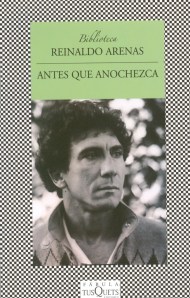 Antes Que Anochezca, the Spanish language Before Night Falls by Reinaldo Arenas (incidentally, I bought my best friend the English translation last Christmas, and wrote about it briefly in
  Any novel titled And Let the Earth Tremble at Its Centers becomes an “I must have you in lieu of bread” acquisition. This is the first novel of Gonzalo Celorio’s to have been translated into English, an undertaking of the Texas Pan American Literature in Translation series. (Marginalia: in its original 1999 Spanish publication, it was released by the same Tusquets Editores who released Antes Que Anochezca on their Fábula line.) It’s translated by Dick Gerdes, and foreworded by Ruben Gallo, author of
  Since it was published in 2010, I’ve thought about Basharat Peer’s Curfewed Night more than occasionally. Peer, a Kashmiri journalist and political commentator, writes about the
  A literary treatment I’ve admired on my colleague’s blogs for some time is a multi-tiered reading project: handling an impressive beast of a tome in segments, and offering a reader’s diary alongside the gradual covering of sections. Currently, Iris on Books is doing it with the daunting War and Peace (
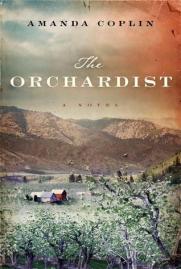 The Orchardist by Amanda Coplin (2012, Harper) is, at first glance, an almost outrageously handsome book. It seems to tell you, by the very look of it, that it will be both durable to hold and magnificent to read. Coplin’s story is described by Holloway McCandless (what a gorgeous name, right) of Shelf Awareness as “an extraordinarily ambitious and authoritative debut”, which, when one thinks of debuts, is what one wants to hear. Set in the rural reaches of the Pacific Northwest at the end of the twentieth century, The Orchardist has one of those plots that gives you faint goosebumps under your arms and across your nape, just considering it. It involves a kind, reclusive man interfacing with two young pregnant girls who trespass on the fringes of his land and the cockles of his heart. There’s trauma, and acts of redemption, and the bedrock of an America that scarcely resembles the one of 2013. My mother has already read it, and loved it. She deemed it “serious, important writing”, a moving, beautiful story, movingly and beautifully told.
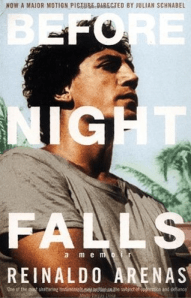 I gave more than one Christmas book last year, however. To my best friend, I gifted Before Night Falls by Reinaldo Arenas (1994 reprint, Penguin). It is her favourite memoir in film, and we both predict/hopefully anticipate that it will be her favourite memoir in print, too. (An outrageously goodlooking image of Javier Bardem from the 2000 movie is plastered across its front cover, which, one imagines, would spike impulse sales considerably.) The New York Times Review of Books describes Arenas’ prose reminiscences as “a book above all about being free”, charting in often painfully honest chapters the episodes of sexual persecution that have defined his queer autonomy, and political suppression that has stifled his creative work. Nor, one notes grimly, are the two methods of censorship mutually exclusive. This is the world on which so much of the Cuban writer’s fiction is founded, and Before Night Falls grants the reader the freedom of access to anti-regime, anti-persecutory reading: freedoms that Arenas himself often worked and lived without.
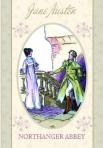 My brothers gave me three books, two of which suit each others’ company as impeccably as cucumber sandwiches and Darjeeling tea: North Parade Publishing collector’s edition copies of Jane Austen’s Sense & Sensibility and Northanger Abbey. Perhaps alarmingly, or predictably, I’ve read no Austen in her totality other than that which I studied, because, well… I don’t know.
  One needs to be in the precisely perfect alignment of mind and disposition to delve into Austen for pleasure. These volumes might well lend themselves to that faster than the others in my possession. Incredibly portable, endearingly tiny, and interspersed with charming black and white illustrations, these are true keepsakes. I will endeavour to fill out my collection with the remaining titles, and actually strive to read them all.
 The third of the books from my brothers is the hauntingly-covered Her Fearful Symmetry by Audrey Niffenegger (2009, Alfred A. Knopf), whose super popular The Time Traveller’s Wife endeared me in no way towards it. (Please remember that I am a book snob, and that book seemed to have “Oprah’s Book Club” smeared all over it. For all I know, it could be a good read.) Her Fearful Symmetry seems more promising, telling the tale of two intensely bonded sisters, Julia and Valentina, and their acquisition of a London apartment that looks over the impressive Highgate Cemetery, home to the bodies of several departed luminaries. As ghost stories go, it seems a juicy, engrossing tale, with, I hope, a shiver or two tucked inside.

 Ivan Turgenev’s First Love (2005 reprint, Barnes & Noble Books) is widely celebrated as one of that prolific Russian author’s most favoured pieces of short fiction. “Anyone who has ever been in love,” the blurb of this edition proclaims, “will be touched by this tale of passion and disillusionment.” Given that my previous year was characterized by mostly contemporary reads in both fiction and non-, First Love feels both mirthful and apropos: a reminder that a look, a glance, a well-considered waltz backwards into the archives of classical literature can elicit rejuvenating effects. Coming in at just under seventy pages, I don’t think I’d be remiss in casting this slim volume as a potential
  Run by Ann Patchett (2008 reprint, Harper) is touted by Jonathan Yardley of Washington Post Book World as “a thoroughly intelligent book, an intimate domestic drama,” one that deals, above all else, with concerns of family. Patchett’s fourth novel, Bel Canto, thrust her into the spotlight: the three books that preceded it received acclaim, certainly, but not quite in the way that the PEN/Faulkner award-winning Bel Canto did. Run‘s biggest worry, out the gate, must have been on how it would stack up –even if Patchett didn’t trouble herself on this issue, the critics would. The author is talked up by The New York Times Book Review as being “more hammer and nails than glue and lace”, which is enough to make me wheel back and take serious note, on its own. I haven’t even read Bel Canto, though, so here’s what I’ll do: read Ann Patchett backwards, like my fingers are tamped down on a VCR’s rewind button. We’ll see what insights and revelations emerge.
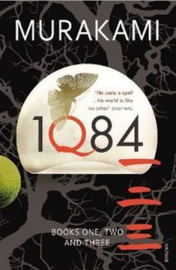 Arguably the sexiest thing beneath the Christmas tree addressed to me, Haruki Murakami’s 1Q84 (2012 reprint, Vintage) is going to be the first book I read by this legend of an author. I am excited. I am so excited. This book seems strange and compelling and entirely unpredictable, and I want to know it, the way you would want to know the dark, Aragorn-esque stranger in the corner of the tavern. The Times calls it “a work of maddening brilliance”, and so wide is the net of global recognition flavoured with quirky, creatively fecund singularity that Murakami’s cast around him, one is inclined to agree vigorously even before reading the first page. Set in Tokyo’s 1984, the novel follows the intertwined stories of Tengo and Aomame as they venture deeper and further down rabbit holes of parallel worlds and suspicious ghostwriting assignments. I would like to repeat, just for the record, that I am so excited.
 Mario Vargas Llosa’s The Dream of the Celt (2012 reprint, Farrar, Straus and Giroux) is described in the last lines of its blurb as a novel that dares to push the envelope where historical fiction is concerned. It illuminates the life of Roger Casement, the Irish nationalist whose humanitarian work deeply discomfited those accused of its crimes, notably the British in Northern Ireland. Convicted and executed by the British, stripped of his rank and title, Casement’s pioneering work was so sullied by his disgraceful end that real interest in his legacy only peaked again in the 1960s. This novel feels formidable, masterful and deeply rewarding. I shall have to acquire a copy in its original Spanish, and read the two side by side.
 Edited by R. V. Branham, Curse + Berate in 69+ Languages (2008, Soft Skull Press) is a reminder that my mum is possibly more of a badass than I will ever be. There is very little I can say explicitly about this irreverent, whimsical, yet clearly superbly researched book that won’t get Novel Niche slapped with an NC-17 rating, which really is the core of the compendium’s, er, charms. Disclaimer: Wanting to use several of these gorgeous, filthy expressions doesn’t make you a bad person, but inventing and engineering social encounters so that they escalate into verbal bloodbaths, just so you can shout out “trust fund hippie” in French, or “five-faced hypocrite” in Tagalog: well, that’ll probably get your Miss Manners card revoked.
 I’m not joking. My Fantasies: An Erotica Journal by David Russell and Gary Silver (2006, Clarkson/Potter Publishers, Random House) is precisely the sort of book my mother would give me, with or without any expectations that I’d fill in the lined pages, which feature helpful prompts such as “Here are my instructions for the perfect massage…” This gift, I think, is most telling: of how few boundaries there are in the discussion of what governs good and bad in printed matter, in the creator & progeny relationship of which I am one half. What is even more endearing, and comforting, is that this is the way it has always been — not that my mum was giving me erotica to read when I was in pinafores, no, but that the conversation on reading has never felt stilted, blinkered or reined in by dictates of “You shouldn’t”, or “Good/chaste/charming girls don’t read those awful things.” Panelled with quotes by the usual suspects (Pablo Neruda; Gustave Flaubert; The Kama Sutra; Rumi), and tastefully (yet pulse-tinglingly?) peppered with illustrations in unobtrusive sepia, this pocket journal is precious, darling: a fitting accoutrement to the love you’re making or dreaming up.
 From she who knows the mettle and measure of my reading life with as much intimacy as my mother, I received The Children’s Book, by A. S. Byatt (2009, Alfred A. Knopf). For a long time in my teenaged years, I would tell anyone who asked that my favourite book was Byatt’s Possession. It was. Never had I read something so perfectly, ornately itself, if that’s at all coherent — this unabashed love letter to epistolary ardour, to the secret lives of writers and the conventions of two ages colliding into each other. Everything Byatt writes feels forged in a master (a mistress!) class of writing well, and I cannot fathom that The Children’s Book, loosely based on the life of English children’s book author E. Nesbit, will feel any differently. I don’t have the full measure of The Children’s Book (and when does one have the full measure of a book, ever, really?) but I can tell that it will lend itself to cloistered, intense readings. I will read it so fixedly that the rest of the world will fall away, and people and places will seem strange, when I return to them again.
 I read Palimpsest by Catherynne M. Valente in the last month of last year. Whenever I thought of reviewing it for Novel Niche, I felt that it wasn’t time. I felt, specifically, that there would be no way I could speak critically of a novel that had made me feel so much in love: in love with words and storytelling; in love with sexually-shared cityscapes, and in love with one of the four main characters of the story: November Aguilar, the beekeeper with a face that shows the places she has been in stark, difficult detail.
 When I read A Home at the End of the World by Michael Cunningham, a few years ago, I remember being stunned, and discomfited, by his chronicle of the curious, unsanitary ways in which people come together, and then cast themselves asunder. Cunningham seemed to be holding up not just the relationship triangle in the novel, but every unconventional friend-and-romanceship algorithm, asking us to question the meaning we put into structures of marriage and long-term commitment. I just tugged my paperback copy from the bookshelf at my side, brushed off the thin grey film of dust on its spine, and cracked open the book to a familiar page, to the opening paragraph of a chapter that describes the way a mother loves her infant.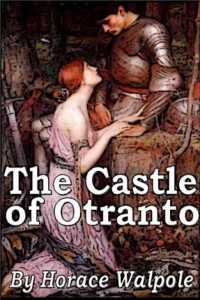

 Morgan Kelly reads and writes in every conceivable genre. A Brontëite, a Whovian, a Xenaphile, and a Buffyonian, she loves storylines with kick-ass heroines, brooding heroes with fine style, and meaningful, witty dialogue. Her first spooky Gothic historical romance novel came out this year with Avon/HarperCollins. She likes to think Midnight In Your Arms is the bastard love child of Daphne Du Maurier and Ernest Hemingway with Emily Brontë as a Godmother. Her ideal tea party would include Sylvia Plath, Lou Reed, Her Majesty the Queen of England, and you. You can be her fan on
  Novel Niche