13. His Dark Materials I:The Golden Compass by Philip Pullman

Published in 1995. This Edition: Alfred A. Knopf, 1998.

Winner of the Carnegie Medal, 1995.

Winner of the 70th Anniversary Carnegie of Carnegies (the UK’s favourite Carnegie Medal winning book of all time)

The Golden Compass is bone-chillingly good ( a statement that surely holds some water, when you consider that I read it in decidedly non-frosty tropical temperatures.) Still, I felt the cold—the unmistakable ice-kiss of fear and awe that assails you when, and where, you least expect it.

Lyra  Belacqua has been perfectly content to play at full tilt on and around the premises of Jordan College at Oxford, for the entirety of her eleven year-old existence. Brought up in a well-intentioned yet scatterbrained way by the college academics, Lyra has been accustomed to being orphaned, with no blood relations save her oft-absent uncle, Lord Asriel. Though she lacks parental guidance, Lyra is never alone. She basks in the constant company of her dæmon familiar, Pantalaimon. Both her helpmeet and her best friend, Pantalaimon is of Lyra herself: neither she nor he can fathom a reality in which they exist separately. This bond between human and dæmon exists between all humans—to not be thusly companioned would be beyond the realm of belief, and of decency.

Lyra has long dreamed of accompanying Lord Asriel on his mysterious expeditions to the North, but she cannot predict that she will journey there under the oft-terrifying, fantastical circumstances that do take her. The Golden Compass charts her journey to the bitter-cold roof of the world, where Lyra and Pan must confront an evil beyond imagining, from even the most unexpected of sources.

If you are wary of the magical, mythical, extra-terrestrial or para-normal, The Golden Compass (originally entitled Northern Lights, which I prefer) is not the book for you. If you cannot abide an iota of speculation or criticism concerning organized religion, or discomfiting questions about why we believe what we do, then I strongly urge you to read elsewhere. Still, if you’re even the slightest bit curious, and are not averse to the very real possibility of a paradigm shift, then yes… reading this book could well change your life.

Each of the characters of Pullman’s novel is exceptionally well-crafted, whether they be major or minor. We meet and are awed, cowed, wooed and enraged by a host of extraordinary creatures, including my personal favourite, a fallen bear-sovereign, deprived of his ennobling armour, who dulls his bitterness with drink and hard labour. We also encounter a kindly gypsy seer, and the proud, sorrowful witch with whom he shares a storied past. We scoff at the wizened academics of Jordan College; we weep at the tragedy of a young boy’s loss of innocence, and we marvel, open-mawed, at the depiction of one of literature’s best-drawn, ruthlessly ambitious power couples.

Yet for all their fantastical elements, there is no awkwardness about this cast, no barrier separating them from us. They, too, obsess and are filled with equal parts regret for that which they have done and that which they failed to do. They, too, fall prey to vanity. They, too, are hurt for love, and not one of their stories compels you to narrow your eyes in derision, declaring, “Hmph. Only in a fantasy book.”

Set in an age of invention, discovery and conquest, The Golden Compass is littered with marvellous machinery, with vivid descriptions of barges, airships, of hot-air balloons, of instruments hewn with wicked and wistful intent. The most remarkable of all the creations we discover in this novel, however, is the titular object itself, otherwise called the alethiometer. Entrusted to Lyra to give to her uncle, she is told only that it tells the truth, and that she must learn herself how to decipher it—and learn, she does. The descriptions of the alethiometer attest to its beauty, and Lyra’s interactions with it show us, and her, that parsing the truth is an intricate, highly subjective process.

The novel is written in prose that seems, at times, plucked from the pages of a bygone era’s texts, such are its curious lilts and cadences, the peculiar goodness with which something is said, that enriches the very description of it, elevating it from the commonplace. Pullman truly is a turner of phrases. He subjects language to his particular purpose: to charm and captivate us. By my reckoning, he succeeds at that.

I think there has been some sad compromise over the literature to which we expose children, and I wonder at that. Who says that books for young people must be patterned with every prettiness, every convenient lie, every smiling face and sunny sky we can conjure? Detractors will, of course, posit that there is nothing natural about The Golden Compass, but the heart of the novel is filled with every natural feeling in the world, from grim despair to raging passion to lonely, determined resilience. Lyra becomes a benchmark for ourselves, as we wonder, at all that we would or would not do, with our destinies plotted out against the unforgiving, glorious Northern Lights.

‘You speak of destiny,’ he said, ‘as if it was fixed. And I ain’t sure I like that any more than a war I’m enlisted in without knowing about it. Where’s my free will, if you please? And the child seems to me to have more free will than anyone I ever met. Are you telling me that she’s just some kind of clockwork toy wound up and set going on a course she can’t change?’

‘We are all subject to the fates. But we must all act as if we are not,’ said the witch, ‘or die of despair.’

Enjoy another consideration of The Golden Compass by my dear book reviewing colleague, Jennifer of Books, Personally, which examines some issues and concerns that this review doesn’t directly address, here.

This is the first book I’ve read and reviewed on my personal reading list (which you can see here) for The Bookette’s British Book Challenge 2011.

12. Fruit of the Lemon by Andrea Levy

Published in 1999. This Edition: Headline Review, 2000.

“I became nervous waiting for the poet to start. I was thinking, ‘Please be good, please.’ The poet became my dad, my brother, he was the unknown black faces in our photo album, he was the old man on the bus who called me sister, the man in the bank with the strong Trinidadian accent who could not make himself understood. He was every black man – ever.”

Faith Jackson has always been, for the most part, a good girl. She’s a dutiful, well-attired twenty-two year old university graduate, raised by black expatriate Jamaican parents who, according to the common account, came over to England on a banana boat. White boys heckled Faith about this during her childhood, but to her parents, nothing about that journey even remotely elicits shame. Here, early-established, resides Faith’s quandary: her existence straddles bi-polar states of embarrassment and defiance, of red-faced chagrin at her skin, and awful anger at the reactions it provokes in London, where her ‘kind’ are called ‘wogs, ‘nig-nigs’ and ‘coons’ by the various Caucasian whites with whom she interacts. After witnessing a brutal act of vandalism perpetrated by white thugs against the black proprietress of an independent bookstore, something in Faith gives in to despair.

Alarmed by their daughter’s detachment from her (ostensibly glamorous but unfulfilling) job, even by her withdrawal from the raucous bonhomie of her flatmates’ ambience, Faith’s parents devise a plan. They pay her airfare for a fortnight’s getaway in Jamaica, the home to which they’ve been contemplating returning. As Faith’s mother gently reminds her, “Child, everyone should know where they come from.”

While reading Fruit of the Lemon, it became quickly apparent to me that I was in the hands of a startlingly evocative writer. Levy rarely ‘lays it on thick’: there is none of that overindulgence, poorly executed, in exposition, description or plot progression. The ingrained racism Faith endures uneasily in England, her incremental malaise and mistrust of her own complexion, are subtly enforced at every turn, ‘til we feel like buckling beneath the pressure, ourselves.

Caribbean readers will not, I think, be disappointed by Levy’s depiction of Jamaica. Not being of Jamaican ancestry personally, I cannot claim a countrywoman’s expertise, but the testament of the life and people of the island never, not once, caused me to furrow my brow and say, ‘Eh?’ Odds are, whether you are from Jamrock, or Trinidad, or Barbados, or anywhere beneath our persistent and particular sun, you will recognize trademarks of your own growing-up stories. You will steups (loud and irritated sucking of one’s own teeth, referenced several times by Levy) at the description of a relative just like the one who drives you mad. You will sigh when Faith learns the saddest stories of her origins from her Jamaican family, because that sadness, that mad, mad history lies dormant in your family too, just waiting to be prodded uneasily to life again.

Fruit of the Lemon made me laugh uproariously, no small feat, considering that it takes comedic heft on the page to really send me reeling with mirth. Levy excels at marrying elements of the absurd with the lamentable. This is particularly well-transmitted in the presentation of Faith’s ridiculous yet endearing elder brother Carl, who proclaims his superiority over his sister, treating her with a mixture of gruff disdain and barely-veiled irritation, but sheepishly hides the face that he is only just doing his first A-level exam. Most, if not all, of Levy’s characters are drawn in this enviably well-rounded way, so that they things they do and say elicit both hilarity and mortification.

Perhaps most striking of the praises offered to Fruit of the Lemon is the Sunday Telegraph’s assessment that “…[readers] will recognize the truthfulness of the world which Andrea Levy describes”—and these truths, to my mind, have less to do with being Caribbean, and more to do with being an observant person, regardless of skin hue or geographical marker.

With a narrative that spans the reach of the Atlantic, Levy writes convincingly of home and abroad, of isolation amidst throngs and of togetherness where only a few are gathered. Fruit of the Lemon begins with a humbly tiny family tree of Faith and her nuclear family. It ends with the deeply-rooted history of multiple branches, each tier a story and a legacy all its own.

This review was initially featured on Baffled Books.

This book, and 11 more, are part of my official reading list (which can be found in my sign-up post here) for the 2011 Caribbean Writers Challenge.

11. The Fourth Treasure by Todd Shimoda

Published in 2002. This Edition: Random House, 2003.

“In the sensei’s diluted mind there was a flash flood of knowing, a firestorm of awareness, a billion synapses exploding into a nova of cognizance. So much to resolve, nearly no time left.”

First year neuroscience graduate student Tina Suzuki learns of an intriguing, potentially lucrative test study for her doctoral thesis at the University of California, Berkeley – a sensei of shodô (Japanese calligraphy) has suffered a debilitating stroke. The attack has left him severely weakened, devoid of speech, robbed of his formerly impeccable skill with the vital implements of calligraphy, known as the four treasures: fude (brush); sumi (ink); kami (paper); suzuri (inkstone). Despite the effects of the aneurysm, Kiichi Shimano, better known to his students (one of whom is Tina’s Japanophile boyfriend, Robert) as Zenzen sensei, continues to create beautiful yet incomprehensible tracings. The markings, called ‘art’ by Tina and ‘scribbles’ by the doctors tending to the sensei, hold reserves of emotional appeal for one unlikely source—Tina’s self-effacing mother, Hanako, whose connection to shodô and Shimano run deeper than anyone (save one wily private eye from Kyoto) can suspect.

In her praise of The Fourth Treasure, author Liza Dalby remarks that the novel “…has the depth and nuance of a skilfully calligraphed scroll.” As hyperbolic as such a statement sounds, her assessment is as precise as Shimoda’s writing and the rendering of a tale ornately-wrought, presented with deceptive simplicity.

If I were to name a point at which this book excels without exception, it is in its form, which is briskly engaging without being irritatingly self-involved (in my experience, most literary works of the latter ilk are both annoying and difficult to stomach.) The margins of the novel serve as room for annotations. From Tina’s neuroscience notebook, we learn of the complex framework of the human mind, as she neatly defines biochemical behaviours (while finding that equating them with individual consciousness remains a mystery). From the Instructor’s Journal from Zenzen’s School of Japanese calligraphy, we receive lessons in shodô, complete with exquisitely-rendered kanji and exacting guidelines for their creation. The text is also interspersed with the mysterious inkwork of Zenzen sensei, flanked by tiny segments of poetry, no doubt indicative of the disjointed thoughts of the shodô master. These brief lines are heart-rending. They combine Shimano’s yearning with cryptic phrasing and brevity of form to achieve a muted, haiku-worthy stream of thought. The effect is mesmerizing—I could read an entire novel composed of just these.

There are multiple narratives at work in The Fourth Treasure, too. The story of Tina’s personal development may seem to initially dominate the progression of the novel, but soon, we realize we are reading a delicately balanced commingling of chronicles, including a series of sepia-tinted flashbacks that reveal the dynamic connection between the sensei and Tina’s mother. Among the other tales told are a bird’s eye view of Kando, the detective who finds himself entangled in the stories of Shimano and Hanako. Most enthralling, however, is the ancient History of the Daizen inkstone, used by Shimano and coveted by many, who believe he possesses it unlawfully. These fragments of the lives of the 17th-century calligraphers who first drew inspiration and art from the Daizen inkstone are expertly handled, in fine, evocative and precise prose. We may only see these characters in interludes, but the impressions they make are deeply felt – a sign of unforgettable storytelling if ever I read one. Adding to the near-flawless counterpoise that Shimoda exacts is the advantage of successful use of multiple perspective: we are granted access, not just into the mind of Tina, but the wonderings and speculations of several others: most notably, Zenzen sensei, whose thoughts open the book and preface his stroke, and Hanako, whose quiet revelations bring the novel to a close in a coda of liberation and sweet, shodô-tinted release.

If The Fourth Treasure falters anywhere, it is in matching the vividness and vitality of its crafting to the consistent success of its characterization. Tina, for example, seems uncertain for so much of the novel, not just in her aspect, but in her formation, like a series of wobbly figures plotted on a blurry Cartesian plane. It is the world of shodô that breathes purpose into her (and makes her infinitely more readable than she is when we meet her.) Even if the individual characters do not incite a riot of passion in the heart (and indeed, this may well not be their purpose), their circumstances cannot but move you. They grapple with love that has never died, even though it was starved, and with love that was never truly in bloom to begin with; with loss of one’s access routes to exhilaration in art and life, and with how to forge new pathways through pain and the bewilderment of loss.

My January 2011 has been a month of good reads, and The Fourth Treasure has been the best of them.

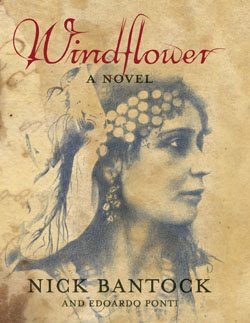
10. Windflower by Nick Bantock

Published in 2006 by Chronicle Books.

I was seduced, once. Part of that seduction was the gift of the incomparable Griffin and Sabine books, a multilayered, visually arresting collection of the correspondence shared by two extraordinary, magically-linked soulmates. Is it any wonder, then, that my heart skipped a beat when I spied the lushly-presented (Chronicle Books, hardcover) Windflower, nestled between two monotonous bestsellers at my local library? Since catapulting myself headfirst in love with Griffin and Sabine, I’d added everything Nick Bantock has ever written to my must-explore list. This was a book about which I’d been breathlessly excited, so I found a quiet nook of the library, and, Laura Marling crooning whisper-low through my headphones, I lost myself in another of Nick Bantock’s compelling—albeit decidedly less so—creative offerings.

Windflower is Ana’s story. She is a young woman, skilled in the cante jondo, who seeks to restore the life-preserving, nomadic spirit to her people, the Capolan, who have become distressingly landlocked, through choice, over the years. With none of her tribespeople, except her sage grandfather, able to discern that her impending marriage would be disastrous to her future dreams of rejuvenating the Capolan through dance, Ana flees her village. She runs to the seaport town of Serona, in search of Felix Bulerias, the man she’s been told can guide her in her quest to channel the inner fires of her dance. Instead, she encounters four very different men, each intoxicating and mysterious in his own manner. By turns enchanted, perplexed and emboldened by Serona’s exotic wares and compelling figures, and haunted by the dual burden-privilege of her responsibility to her people, can Ana discover herself in her greatest passion of all: her connection to the Eternal Dance?

I could not help but think of the plot progression of a Disney princess title, both as I read Windflower and as I revisit it now. This is not necessarily, perilously a bad thing, but the overall effect is far out of the orbit of my expectations. It isn’t that the novel isn’t good. Indeed, the work feels lovingly hewn in both design and thematic. Bantock has created all of the paintings and drawings that appear, as one continuous footnote-mosaic, in the novel from beginning to end. In the details of these elaborately compiled page-tiles, it is easy enough to discern traces of the artist’s eerily mesmerizing style. Alas, though strange and lovely to behold, nothing of this border-art compelled me beyond a calm appreciation, when what I’d hoped to do was clamour for more. In this case, more of the same would just have produced further demonstrations of cool regard.

To speak further on thematic and content, Bantock has crafted a story that must surely appeal to most, hence the Disney-esque charm, perhaps. There is pleasure in reading of the four men who entrance Ana:

♣ Boreos, a handsome, commanding businessman who incites a fever pitch of lust in Ana, while simultaneously leaving her in doubt of her autonomy in his presence

♣ the chivalrous, middle-aged man of means, Mr. Hamattan, who platonically woos Ana into teaching him the flute, and gets her closest to Felix Bulerias (but at what cost?)

♣ Zephyr, Ana’s animated fellow tenant and fledgling pilot, who lends wings to her spirit, but is unable to reign in his jealous suspicions of her other admirers

♣ Sirocco, the lean, mysterious foreigner who channels passion and purpose into Ana’s cante jondo, but wants her to dance to his beat above all others

Amidst the chasms and crests of her adventures with these four, Ana often turns to the lovely and worldly Halle, who becomes her co-worker, landlady, confidante and adviser. Though she struggles with finding her own voice, which often gets tangled up in the mire of others’ best intentions for her, nothing about our protagonist’s journey struck me as particularly tortuous. At most turns, Ana is surrounded by encouraging friends, a raucous yet pleasant workplace, and a quartet of attractive men vying for her attention.

Bantock does set obstacles in Ana’s path to self-actualization, yes. He does pepper the landscape of her many happy Serona days with doubt and trepidation, but I couldn’t help but think that Ana’s path was much more smoothly-paved than that of the average teenage runaway bride who flees to a city completely unknown to her, in which she knows no one, in which her people are routinely marginalized, in which she is a petite, unaccompanied young woman with a pocketful of dowry coin, ripe for the picking.

It is my expectation of ‘more’ that hinders a glowing review of this fine novel. The story is fine and well-rendered, in language that is fine, and on occasion, ascends to a sublimeness of expression. The resolution of Ana’s fate (and that of her people’s) was fine, in a satisfyingly foreseeable way. This is a fine book, truly, to add to any collection of Nick Bantock’s oeuvre, but I daresay it is not his best.

“No longer governed by her mind, her feet steered her body. The tune was not mournful, though it was melancholy. Never speeding, it gyrated within its solitude. She traced it around and around the rooftop until eventually the rain began to fall more violently and she could no longer hear any music, just water drops striking the tiles. Their staccato beat broke her hypnotic swirl, and she began to dance to the drum of the rain. Faster and faster she whirled until she lifted her face to the clouds and laughed out of sheer pleasure.”

9. She’s Gone by Kwame Dawes

Published in 2007 by Akashic Books.

I’ve seen several volumes of Dawes’ poetry collections lining local bookstore shelves, but reading She’s Gone, a Caribbean mystic-meets-American urbane love story, is the first true interaction I’ve had with his work.

One sizzling Southern Carolina night, the paths of Kofi, a Jamaican roots reggae man, and Keisha, an American sex and gender researcher, intersect. This book is about how they come to each other, come for each other, how they live together, as well as how they manage (or fail to do so) apart.

I confess, the novel irritated me profoundly at intervals, particularly in both the portrayal of Keisha’s character, as well as the stiflingly familiar revisited relationship rubrics for two passionate souls. All the elements of a rollicking Tyler Perry screenplay/film seem firmly established:

♣ the enigmatic, sexily-accented black man who is  both difficult to love and impossible to quit;

♣ this man’s smouldering, vicious ex-woman, who represents almost everything that is both dangerous and compelling about his past, his backstory before he meets…

♣ the intelligent and beautiful black woman who struggles with loving love a little too much (and has the tempestuous, abusive ex-boyfriend, pacing and promising in the background, to prove it);

♣ this woman’s smarter, more successful, infinitely lonelier, less loved cousin, who cannot help but fall for the enigmatic and sexily-accented man, knowing full well that there will be no storybook ending for her;

♣ the rest of our female protagonist’s extended family, (including a pistol-waving, housedress-wearing matriarch) who are full of opinions, comments and semi-relevant anecdotes – and a feast of the best Southern home cooking;

♣ this woman’s sassy, fierce, feisty best friend/boss combo, who’s there for her when she needs her the most, but is not there at least once when it counts the most – you know, so our female protagonist can dig deep and find her own hidden fortitude;

♣ the creation of a baby, who helps make things almost magically good, life-affirming, and tender –  the way that babies do.

I will own to the fact that it is not necessarily the existence of these tropes within this work that bothers me, so much as the persistence of many of these constructs in the world, in each of our separate, interwoven societies. At one point, while reading, I felt like murmuring to myself, “Mm. Yes. We get the point. Women love men who use them bad and use them up.” Still, if some of the character assessments that abound in the novel seem and feel tired, well… perhaps that’s not lazy, at all. Perhaps that’s just people as they are. I cannot declare Dawes’ story to be lazy, even if it is one I would avoid, strenuously, if it came at me in the form of a film adaptation. It simply means that Dawes is good—maybe even brilliant—at capturing that which exists around him, in people, in the ways they/we hurt and honour each other.

For all the groanworthy excerpts that centre on Keisha and Kofi’s amorous travails, the novel contains some heft, and more weight than is initially apparent. Dawes is at his best when he inhabits the thought-space of Kofi: an artist in exile, even in his lush island mountains, a man driven to dreams and despair, and achingly good music. His words, the way he articulates everyday frustrations, observations, fears—they resound from the page, skipping, trilling off the tongue in that sweet and unmistakable Jamaican dialect. (Dawes is a master of capturing the voices of his characters; no utterances seem contrived or out of place.)

Of all the lovers and losers we encounter in She’s Gone, Kofi feels the best-drawn, the most convincingly rendered. Is this because he is closest to home? Whatever the reason, he is a pleasure to read. His letters and e-mails to Keisha, both when he is courting her and when he is estranged from her, are organic, vital scripture: better and more beautiful, indeed, than the man himself. Isn’t that we want from our correspondence, anyway? Isn’t that at the heart of any extraordinary missive passed between two people? The desire to render yourself a little larger than the life you inhabit, for the one whom you which to ensorcell… this is what Kofi’s letters do.This is what most of us wish we could do when we write, no?

She’s Gone is not, in the final estimation, a masterpiece. I was as underwhelmed as much as I was moved, and the overall effect is not a consistent one of either delight or dismay. What Dawes crafts right, he crafts right, though: there is beauty in his depiction of landscape; there is palpable lyricism in the tones and timbres of every voice he makes speak. There is reverence, accuracy and respect in his treatment of island and Southern-U.S. state living. Is there fault to be ascribed, then, if the novel simply does not resonate with me as it might do with another? No, I daresay, there is none.

Is it an audacious thought, to have had the first taste of a writer, and then have thought—there is more to him, than this? There are better, bolder, richer lines, sweeter worlds waiting to be discovered. After I finished reading She’s Gone, I unearthed some of Dawes’ poems, and I knew, as I had felt instinctively, that I was right.

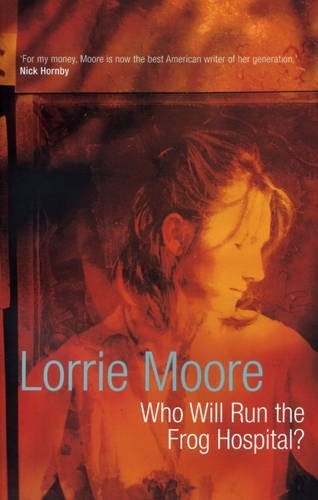
8. Who Will Run the Frog Hospital? by Lorrie Moore

Published in 1994 by Vintage/Anchor Books.

Admit it—you know you’ve got one.

Along with a paraphernalia-packed drawer of your idealistic, angry years betwixt eleven and nineteen, and every holdover memento that’s defied the lure of the garbage or local Goodwill/Salvation Army, (you feign laziness, unwillingness to ‘spring clean’, but you damned well know it’s nostalgia)—along with these, you keep the memory of a best friend. You braided her hair in thousands (you know, like, thirty?) of plastic-clipped plaits. You both got high off of office-supply glue, stolen cigarettes, illicit pay-per-view softcore pornography. You kissed him once, hard, in your father’s garage, and neither of you spoke of it, not ever. You thought of her on the day you got married, and for a guilty second, your maid of honour didn’t seem like such a perfect choice. Together, you played with fire. Together, you were sure you could both change or rule the world.

The enchantingly titled Who Will Run the Frog Hospital? was, for me, worth fishing out of a bargain bin at a charity sale, based on the quirky promise of its name alone. If I could compare the experience of reading it to consuming fruit, it would be like nothing so much as a crisp, tart apple—something in the vein of a not so wicked stepmother’s gift, bearing far less malice than the origin tale, with more wise humour that’s never too far from a sigh.

The novel’s progression seems bivalent at first. Protagonist Berie Carr remembers her adolescent ramblings and misadventures with her best friend, Silsby Chaussée, while the former navigates the murky waters of adulthood and a marriage that is failing in tragically slow increments—this, while she sojourns in a city famed for its passionate interludes. Approaching the story’s end, however, the narrative appears seamless. Whether Berie was assiduously pilfering money as an amusement park cashier in her childhood town of Horsehearts, evading drunken rape and other life threatening risks with Silsby at her side, or wandering alone in the present day through narrow Parisian streets, her hip aching for a secret reason, (one that, when revealed, smarts at the side of the reader herself, for all its quiet cruelty) the story feels linear. It follows the line of the life of Berie, with and without the person who has known her best. What could be simpler, or more haunting?

If it is difficult to quote Lorrie Moore’s prose, it is not because it is unlovely, quite the opposite. It presents a challenge because so much of it is lovely, and not with the hollow lustre of pretty words fashioning no purpose, either. There is a lilting cadence of sadness to Moore’s description that will catch your breath when you least expect to be swayed.

You might say that the novel goes nowhere, in terms of discernible plot progression, and you might not be entirely wrong. Life’s like that, though, isn’t it? We wander countless times over into the murky mire of our favourite mistakes, swearing anew each time, wondering why we are here again, with all the televised and replicated rebellion of teenagedom, all the mortifying ostentation that paves our tumble into adulthood.

When Berie visits with Sils again, on the occasion of their ten-year high school reunion, she knows that Silsby is simultaneously just as she ever was, and lost to her, always. She takes a long, languorous shower in Sils’ bathroom, thinking, wanting.

“I felt close to her, in a larcenous way, as if here in the shower, using her things, all the new toiletries she now owned, I could know better the person she’d become. All evening, I’d been full of reminiscences, but she had seldom joined in. Instead she was full of kindnesses — draping her own sweater around my shoulders; bringing me tea. How could I know or hope that she contained within her all our shared life, that she had not set it aside to make room for other days and affections and things that now had all made their residence and marks within her?”

This illuminating, thorny offering from a severely underrated writer is even more captivating than its title. Perhaps, when you have turned its last page, as I did, you will think of someone with whom you once made a blood oath, with whom you shared scabbed knees and shy showers. Perhaps you will pick up the phone to call them, and feel what I felt, to learn that the number had long been discontinued.

Perhaps you will be luckier (or infinitely less lucky?) and they will answer.

7. The Tattooed Map by Barbara Hodgson


Published in 1995 by Chronicle Books.

“My arm no longer belongs to me. It’s become another thing — to be admired and studied but not a functional object. It no longer carries my watch; it feels too precious to be made to hold things and I can’t bear to touch myself in case it spreads even further. As I become detached from it, I can admire and appreciate its physical beauty as though it were a map drawn out over months of exploration and study, but the moment I remember it’s mine, a part of me, I reel with nausea.”

Lydia and Christopher are the oldest and best of travelling companions. Former lovers and perennially out-of-sorts friends, they are perfectly attuned to the other’s idiosyncracies, without suffering them gladly. The two embark upon a meticulously planned journey to Morocco, intending to stay in North Africa for six months. Chris, a shrewd antiques dealer, scours the cities they visit for prized furnishings requested by his well-to-do clients, consulting his arsenal of haughtily precise buying lists.

Lydia, on the other hand (hands being a point of importance in The Tattooed Map, but more on that anon), is, by her own blithe confession, “just happy to wander. If I had my way, I would wander forever and ever.” After an uncomfortable layover in a disreputable motel, Lydia awakens with what she initially believes to be a cluster of flea bites on her left hand. During her days of heady exploration and documentation of Morocco’s multifaceted faces, Lydia observes, bemused, as the red puckers on her skin morph into an increasingly detailed map. The more Lydia attempts to unearth the secrecy surrounding her skin-inheritance, the more fevered she grows with semi-lucid dreaming. Her wanderings towards the truth of the tattoo take her beyond the grasp of the reader, and halfway through the journal, the confused, distressed Christopher turns to the same form of archiving he initially scorned—he keeps Lydia’s journal, both proprietorially and actively. His entries follow her own, each one an echo of her voice, each one hoping against hope that he will see her again.

Lovers of ephemera, of detailed dealings in flotsam and jetsam: The Tattooed Map will be a gold-starred destination on your literary sojourns. The novel is an archivist’s dream, bordered and fringed with annotations of addresses, grammatical conjugations in foreign tongues, pencilled-in calendars, rows of photograph details, sketches and schedules, of tattered post-its and sepia postcards. Nor does what would ‘normally’ be themed marginalia live merely in the margins of Barbara Hodgson’s freshman offering—maps, leaflets, full-page illustrations unfurl and explode across the shared journal. That which is pictorally visual carries as much importance as what is scripted. Hodgson has achieved an enviable balance of drawing us in through text and art. (I urge the furrow-browed cynic not to think of the concept that fuels The Tattooed Map as a carefully contrived, convenient marriage between scrapbooking and Photoshop, but rather like the brainchild-project of an author and an artist on vacation. Then, marvel at the fact that Hodgson is both author and artist on this lavish endeavour.)

I read the book in one fevered setting—to fully embrace this confessional rant/purloined pocketbook of a pair of lost and longing travellers, a first, urgent reading feels like the most authentic approach. The mysteries of Lydia’s  branding with a growingly elaborate cartographic plan, and her subsequent disappearance, held me in their thrall. I was unprepared, however,  for the emotionally satisfying journey of Christopher’s stilted, half-crazed forays into unearthing odd truths, in his quest to reclaim his missing friend.Somewhere along this sepia-studded, map-fragmented journey, my mind declared itself a willing and active participant in the baffling mystery at the core of The Tattooed Map. I hungered for an answer that would stymie and spellbind me, a plot machination of hefty and impressive weight.

I was dismayed not to find an answer, therefore. The last few pages of the novel seemed to sweep up in a rush to meet my impatient hands. I turned a page, hoping to have my fears for Lydia either quelled, or released in a grateful sigh—to meet blankness. The end of the book resembles nothing so much (initially) as a well-timed slap in the face, not one that is unkind, but rather, matter of fact. It is a proclamation that, perhaps archly, declares, “Well, what did you expect? This isn’t The Da Vinci Code, after all. You should have known better than to search for some fantastic, absolute overarching set of theorems and loopholes that fall neatly into place.”

In any fictional tale that shies away from clear cut propositions in plot resolution, if there is no happy, formulaic ending, then it follows naturally that there is no ending suffused with sadness, either. In fact, I will leave it up to you, dear reader, to discover how much of an ending there is. Will you be ultimately frustrated or fascinated by the peregrination of this novel, which resembles a thousand spiral staircases curling upwards towards some infinite, unknowable end? You may not love this ending, but it would be a challenge not to love the journey. To pass on The Tattooed Map would be to deny your wanderer’s spirit a whirling-dervish adventure, despite the possibly disquieting dust cloud it leaves in its wake.

“Only your skin and your tears will allow you this journey.”

4. The Road by Cormac McCarthy

Published in 2006. This Edition: Picador, 2007.

Winner of the 2006 James Tait Black Memorial Prize for Fiction.

The Times’ Book of the Decade.

Winner of the 2007 Pulitzer Prize for Fiction.

Shortlisted for the National Book Critics Circle Award, 2006.

“I will do what I promised, he whispered. No matter what. I will not send you into the darkness alone.”

A man and his son travel through a burnt and ravaged America, moving slowly towards the coast. On their journey, they are beset by threatening, sickening remnants of their dying landscape. They forage for food and supplies with varying degrees of failure and success. Their main objects of quotidian significance are a squeaky-wheeled shopping cart and a gun running low on bullets.

The unnamed father-son pair inch laboriously towards the warmer sea climate, since they both know that another frigid winter in their current environment will be the death of them. The father intermittently hacks up blood in heaving spasms, signs of an illness that he attempts to hide from his child. His wife has deserted them through suicide, her self-perceived last humane act in a world that was crumbling into fire and ruin, even before her son was born into it.

The man and his son have no dearth of reasons to be feckless, foul, feral. Instead, perhaps slightly implausibly (but only to the jaded), they are good. They affirm to each other that they ‘carry the fire’, that they are lightbringers, of a kind, in a time when thick clouds of falling ash darken the skies and men dine on each other – literally – to fend off starvation.

What makes The Road remarkable? Why does it stand out from the groan-worthy stack of literary post-apocalyptica that fawningly reuses the same three and a half tired tropes with fervent aplomb, gore and sexy zombie mayhem? This book isn’t like that. There’s no tastefully deformed protagonist, boot planted atop a still-spasming cryptwalker, musket smoke melding into a chemical induced fog. There are no blade-brandishing, half cyborg, half humanoid babes with rapier wits and… well, rapiers?

The Road can seem pretty damned irritating at first, with its truncated sentences, abrupt pauses, stops and starts, its jerky narrative openings, which also feature a distinct disregard for contraction-specific apostrophes. Once you accustom yourself to the manner in which McCarthy tells the story, however, it is unlikely that you’d want it told any other way. The prose is not just sheer minimalistic brilliance—that on its own would be accomplishment enough. The narration is shot through with spare, elegantly-wrought images, recollections and half-starved thoughts from the father which stun doubly: for their enchanting and harrowing symbolism, and for their startling beauty. The father’s ruminations are borne of starvation, hypothermia, desperation, and threaded together with an undeniable nostalgia for times without atrocities, in a way that provokes tears… tears and thoughts of what our own wonderings might be.

Who will benefit the most, from a reading of this novel?

A mother. An environmentalist. A thinker of quiet and often desperate thoughts. A person who thinks environmentalism is a waste of time. An over eater. A carrier of light. A thief. A person who has been close to death. A person who barely considers death. A person who cannot conceive of a time where money and books will be useless. An anti conspiracy-theorist.

Anyone who thinks that humanity is reckless. Anyone who thinks that humanity is visionary.

A father and a son.

I cannot remember encountering a book that has so strongly deserved to be read, for all its tender warning, its horrific spectacle, its imaginings of things that are awfully credible, for a very long time. This is a book that deserves your attention. My only regret? That I didn’t read it sooner.

“No lists of things to be done. The day providential to itself. The hour. There is no later. This is later. All things of grace and beauty such that one holds them to one’s heart have a common provenance in pain. Their birth in grief and ashes. So, he whispered to the sleeping boy. I have you.”

3. Wicked: The Life and Times of the Wicked Witch of the West by Gregory Maguire

Published in 1995 by HarperCollins.

“To the grim poor there need be no pour quoi tale about where evil arises; it just arises; it always is. One never learns how the witch became wicked, or whether that was the right choice for her – is it ever the right choice? Does the Devil ever struggle to be good again, or if so is he not a devil? It is at the very least a question of definitions.”
I like stories that unravel myths, fairy tales, and moral fables. I applaud the successful taking of an origin story, turning on its head and shaking it, emptying its pockets of archetypal copper pieces, of stereotypical silver doubloons. We have all been fed a steady diet of literary truths, whether or not we’ve ever picked up a book of our own volition. They surround us, circling in the air. They are the nursery rhymes our mothers and fathers murmured as they tucked us into bed. They are the talismans, artifacts and artifices we wear around our necks: our religious symbolism, our ethnic pride, our clannish representations of belonging. Old truths, especially those about good and evil, either comfort or dismay us accordingly. Most people are not concerned with questioning or interrogating the truths we’ve been told about the nature of sin versus virtue. Most people would be profoundly uncomfortable with even the suggestion that good and evil can be mutual partners in a never-ending symbiotic tango.

Such people will probably reject the premise of Wicked out of hand… and will not get past the first few chapters. Those who do not—those who are willing to have their preconceptions challenged—will fare far better. For readers predisposed to an appreciation of magic with a distinct adult rating: this is your stop.

Wicked is scripted, at a cursory glance, on the barebones of the world contained in L. Frank Baum’s The Wonderful Wizard of Oz. The Land of Oz that we encounter in Maguire’s novel is of his own geographical hand, drawn with detailed cartographic attention to specifics, peculiarities, the crafting of a believable and compelling otherworld. Oz is a land of wildly disparate regions and territories: the vast, windswept deserts of the Vinkus, the industrially prosperous Gillikinese state, the marshlands and stilt-legged dwellings of Quadling County, the prairie stead of Munchkinland. All paths and roads, including those made of yellow brick, lead to the glinting urban landscape of the Emerald City, where very little is ever as it seems.

The novel’s main narrative hinges on Elphaba, a green-skinned, clever, antisocial girl born to the Munchkinlander couple of itinerant preacher Frexspar and his beautiful, restless wife, Melena Thropp. Elphaba’s story—her strange, largely friendless childhood in Munchkinland, her rebellious, iconoclastic years at Shiz University, her encounters with condemnation, curiosity, concern and confusion all – these inform the heart of the book, but are not on their own, as it were, their vital organ. The voice of the novel is contained in other major characters (and periodic narrators) as well: in the tragicomedic maturing of beautiful Galinda, in the wise, brash motives of Fiyero, in the restless longings of Melena, the surprising intelligence of Sarima, the love-struck earnestness of Boq. Wicked‘s five sections—Munchkinlanders; Gillikin; City of Emeralds; Into the Vinkus; The Murder and its Afterlife—span several generations. Lives are lost, friendships are won, friendships and kinships made, shattered, found in unlikely places. Wars are waged, both political and personal; victims and villains work together in close quarters. Maguire is no respecter of tidy, seamless resolutions, or neatly pigeonholed plots. Characters’ lives run messily into each others’. This is no singular tale of a warty witch wreaking vengeance on a Kansas ingénue, though if you look for that single-mindedly, you will doubtless find it. The novel leaves itself dangerously, (or wonderfully) ambiguous on many points about which most readers will likely yearn for specificity. You would be hard-pressed to not find a concern that didn’t prick directly and perhaps uncomfortably at your personal conscience in these pages.

What makes us human, and how do we advocate our superiority over animals? What about that pesky infidelity business, when confronted with the possibility of true connection—or just a really good meeting of bodies, if not minds? When does sex stop being sexy and start being just damned strange? Do we prefer our prettiest society girls with or without a sobering grip on reality? What are the ethical implications of endowing mechanical creations with limited sentience, and forcing them to do our bidding? What makes one girl beautiful, and another… reprehensible?

Perhaps the most intriguing question of all lies in just how much we’re willing to do for a pair of gorgeous, self-validating shoes.

“She dropped her shyness like a nightgown, and in the liquid glare of sunlight on old boards she held up her hands – as if, in the terror of the upcoming skirmish, she had at last understood that she was beautiful. In her own way.”

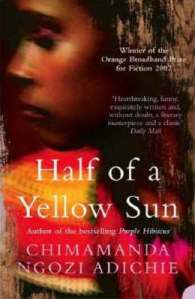
2. Half of a Yellow Sun by Chimamanda Ngozi Adichie

Published in 2006. This Edition: Harper Perennial, 2007.

Winner of the Orange Prize for Fiction, 2007.

“ ‘Why don’t you want the money?’ Kainene asked him.

‘What will I buy with the money?’ he asked.

‘You must be a foolish man,’ Kainene said. ‘There is much you can buy with money.’

‘Not in this Biafra.’ ”

Half of a Yellow Sun is a meeting place for stories, told by three vastly different, irrevocably connected characters. Ugwu, a precocious boy from an impoverished village, is sent to tend house for the eccentric, eloquent Odenigbo, a lecturer at Nigeria’s Nsukka University. Overcome by the incredible improvement in his living situation, Ugwu becomes quickly devoted to pleasing his ‘Master’, as he insists on referring to the enigmatic lecturer and fervent anti-establishment nationalist. It is not long before the distractingly beautiful Olanna, the daughter of a wealthy, influential Lagos statesman, eschews her pampered circumstances to move in with her lover Odenigbo. Olanna’s gentle compassion towards Ugwu endears him to her, as simultaneously, her potent sensuality leaves the boy achingly aware of her allure. Neither is Olanna’s sensuality lost on Richard, a sensitive, thoughtful British national, who falls quickly under the spell of Olanna’s acerbically witty, less comely twin sister, Kainene.

The novel is about the marriage of circumstance and coincidence that envelops these five, set against the backdrop of the 1967-1970 Nigerian-Biafran War.

Wait. Do you think, as you open the first pages of this, Chimamanda Ngozi Adichie’s sophomore novel, that you’re in for a torrid, sexy drama-romance lightly pedestalled atop an intriguing war-torn background? The novel’s background is its foreground. This novel’s setting is immediate… it is pertinent, at all times, to the concerns of the book, to its intertwining themes of love, loss, betrayal and survival. If you began with this book knowing little, as did I, of the Nigerian-Biafran conflict, you will not end it in the same manner. More than that, it is likely that you will be prompted to discover more, to unearth historical documents, to explore archived discussions, news posts and articles on the Internet. It is what I did, and why? I believe that, once you have read this novel, o discerning blog-reader, you may well understand that I was simply compelled to do so. It has been a long time since I’ve stumbled across a read this immersive.

I am no stranger to the powerful world of African (and African-Diaspora) literature. I have trembled and sighed at the bone-chilling moral fable of Achebe’s Things Fall Apart. I have laughed, belly-deep, and wondered just as deeply, over the Brother Jero plays of Wole Soyinka. I confess that I have wept at the most excruciating passages of Ngũgĩ wa Thiong’o’s A Grain of Wheat. Maya Angelou’s works—autobiographic and poetic—pull directly and insistently at my heartstrings and my conscience. I could go on, but I shall not, apart from adding that Adichie deserves a seat at any table where great, moving, soul-stirring African works of literature are being discussed. Indeed, Achebe himself invites Adichie to sit at that table, with the assertion that she is “a new writer endowed with the gift of ancient storytellers.”

In Half of a Yellow Sun, it becomes evident, after only a few chapters have elapsed, that one is reckoning with a master storyteller, and no mistake. The novel’s timeline spans a near-decade, but the passage of time under Adichie’s plot-weaving is anything but linear. We may be unsure, as we read, of who says what, and perhaps even of who is speaking for whom. The writer reels us in with the expectancy of revelation, offering snatches of insight at telling intervals—and the skill resides, in retrospect, on not being exactly sure when we were reeled in. All is revealed, save one thing, by the novel’s end. That one thing lifts the story Adichie tells to the highest point of its possibility, transforming a potentially fitting ending to one that turns itself over in our minds for months, for as long as we keep even a sliver of this story on our mental bookshelves.

The characters of Half of a Yellow Sun are drawn with an expert hand, both in their evolution over the time of the novel (how they are altered by the horrors of surviving in civil unrest, how they remain the same), and in the scope of their relationships with each other. The discerning reader will sigh, and marvel, at Ugwu’s growth, at Olanna’s secret thoughts, at Kainene’s deceptive coldness. There will be amused concern at Richard’s alienated foibles, and grateful acceptance of his growing familiarity with an intoxicating landscape, as well as the woman who intoxicates him. One will wonder at how Olanna can possibly love Odenigbo, in his most abysmal moments, and exclaim, a chapter later, that she could love no other man so wisely, or so truly.

Then, there is the war itself… surely a volatile, capricious character in its own right. To become acquainted with the face of war can be a disconcerting thing, even with the comforting veil of distance, of sitting in one’s plump, overstuffed armchair, sipping tea while murmuring disconsolately over bombings in locales with exotic names. This novel works towards stripping away that veil of comfort. Whether it can be said to be entirely successful is up for debate, but surely it edges us closer to the seat of conflict, to the heart of the criminality and humanity of war. To care about a war when it has not happened to us—when it has not touched our lives personally—this can be a difficult thing to prompt in even a sensitive, educated reader. Adichie does this. She has us smell the smell of burning flesh, taste the sourness of dirty water. She has us dig in the rubble for those we love, and in so doing we learn, perhaps (even if we do not admit it readily to ourselves) how we would fight, flee, suffer or survive, in the context of our own wars.